Categories
Fairy Tales

What’s in Those Mountains? : An Exploration of the Peculiarity and Universality of Appalachian Fairy Tales

By: Caroline Baxter

William Faulkner, when describing his experience as a southern writer from the foothills of Appalachia in Mississippi, wrote “We need to talk, to tell, since oratory is our heritage”. My family is from differing parts of Appalachia, and that place, its accent, and its community comforts me in a complex but instinctual way. It’s a rich and unique culture that deeply values community and prioritizes storytelling despite its simplification or belittlement. The people of Appalachia emphasize and elevate the act of oral storytelling, the simple process of sitting with someone and telling them a story. Living in Los Angeles, we see oral storytelling as an old form, a precursor to our storytelling now—theater, film, novels, ect. But oral storytelling is still active and important to many cultures across the globe, especially one right here in the US. Appalachian Oral Storytelling is a modern example of the origin of fairy tales, because it permeates the everyday experience and represents a core identity within Appalachian culture. Their fairy tales and folk tales offer a unique style of mysticism within their storytelling due the landscapes isolation, the ancient quality of the mountains, and the greater reliance on the natural world. We can learn from this tradition to emphasize the importance of oral storytelling to deepen community bonds and celebrate cultural complexities.
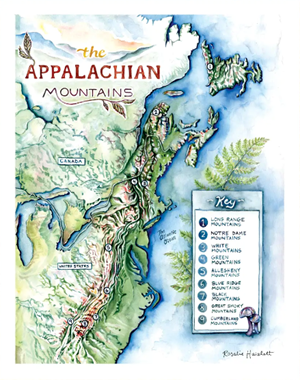
The Appalachian Mountains have a unique history and demography which informs the stories, identities, and culture of the area. It is not just (to put it plainly) a place that’s only “poor, backward, and white” (Baird). The mountains span from Canada to Alabama, but the region specified as Appalachia is the southern US section of the mountains south of  New York. Its history and storytelling influences are tied to three major groups, the Cherokee tribe, “Scots-Irish, English, German, and Italian immigrants,” and African Americans as descendants from enslaved people (Sivinski 5). As Elizabeth Engelhardt states:

 The Appalachian mountain range is one of the oldest on planet earth, has borne witness to more history, and has endured through more seasons of change than most any other place. The heights and depths, temperature range, and reach of the mountains across the continent mean diversity on a scale beyond the keyboard of human writers.

(Engelhardt 6)

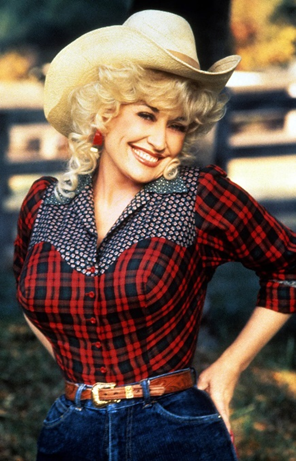
Too often as an American, I see our history and identity as new, at least in comparison to the histories of Europe or Asia, but this is due to the erasure of Native American history. To label this area and community as only one thing erases history, culture, and lived experience of a vast and complex place. If we want to find a true example of American fairy tales, in our “melting pot” sense of identity, Appalachia is the place to find it.  Its isolation produced a unique and rich culture that had a huge impact on the greater American identity and culture. Think of the instrument of the banjo, or American folk, or Dolly Parton, the Patron Saint and Queen of Appalachia.
Appalachian culture has oral storytelling as a major part of their identity and everyday life, it is not just contained within the entertainment they watch or read. It is also supported systemically through organization and higher education. Stacy Sivinski describes her experience tied to Appalachian storytelling in her novel Fairy Tales of Appalachia, she states:

My family and community treated storytelling like a living, breathing thing. Tales weren’t just encountered between the covers of a book, but grew out of late-evening dinners, conversations with friends, and the long car rides we often took while traveling to visit my grandparents in West Virginia.

(Sivinski 3)

Sivinksi represents how much oral storytelling is used as a community building exercise that appears in all parts of her culture. She also represents how this skill was a “living, breathing thing” highlighting the development and uniqueness of every time each tale is told. It grows. As Sivinski describes her process of transcribing the regions fairy tales for her novel, she states:

Most of the recordings that I encountered in the archives featured a diverse set of individuals who were taking several hours.. from the normal rhythm of their lives to share a few stories with a visiting folklorist. In the background of these recordings, the sounds of daily happenings… can often be heard, situating these tales more firmly in their original context.

(Sivinski 11)

This description highlights the encompassing aspects of oral storytelling, it’s not just a formal story in the evening, but continuous and vibrant, even taking up hours of time. Rather than an event, it’s a daily occurrence.  It connects directly to the tradition of fairy tales. In The Classic Fairy Tales by Maria Tartar describes the origins of fairy tales: “Once told around the fireside or at the hearth, with adults and children sharing the storytelling space, they captured the play that yoked luminous beauty with the dark side” (Tartar xii). So, it seems this Appalachian style pushes beyond this traditional image of the “hearth” but still honors the community and kinship in its process.

This process of storytelling is also embedded within the education and academic culture found within Appalachia. It promotes the tradition to be modern, to be a practice that is celebrated today. The Young Appalachian Story Summit occurred in 2021 in the International Storytelling Center in Jonesborough, TN. There are also storytelling undergraduate and graduate programs at East Tennessee State University. The National Storytelling Network originated in a small town in Tennessee in 1975. The promotion of the process of oral storytelling is not just contained within the Appalachian region, but rather it’s a passion that is cultivated in the region and spread across the country and the world.

Appalachia, like many other cultures, contains pervasive stereotypes and preconceived notions, both within social structures and within their classic stories, which mostly tie with Jack tales and horror tales. Yet, the pervasiveness of these tales within the oral tradition reflects the scribes with these individuals deciding what is popular and staples of the genre. The Jack tales—or tales with the same trickster character as Jack and the Beanstalk—entered the Appalachian mainstream with the migration of Scot-Irish settlers, and have been identified as staples of the genres. Theres also a large fascination with horror tales in Appalachian folklore, both within the community and outside it. When you search for stories of Appalachia, you’ll mostly find article titles like “5 Spooky Mountain Stories to Keep You Up at Night” or “The Urban Tales of Appalachian Ghosts”. Theres a fascination and mysticism within these mountains, whether it may be its age, the isolation, or there really is something magical and ancient about that place. As Engelhardt stated previously, these mountains are some of the oldest in the world, adding to the depth and richness of this place. Their isolation and smaller population lead to a greater connection and reliance on the natural world, leading to stories that explore its beauty, magic, and horror.
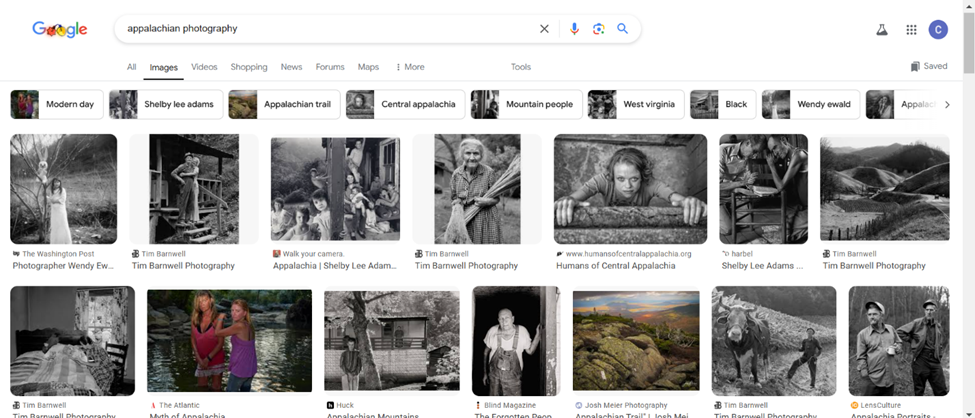
Within these mainstream depictions, Appalachia is seen as a place of the past, or as Engelhardt states, “Again and again Appalachia is relegated to the past tense: ‘out of time’ and out of step with any contemporary present, much less a progressive future” (Engelhardt 5). When you search “Appalachian Photography”, about 90% of the photos are in black and white, again reflecting this place as a relic of the past. (If you’d like a more balanced depiction of the region, look here– https://appvoices.org/2015/12/09/wide-angle-contemporary-photography/#comments) This is a deep erasure of the complexities, diversity, and engaging aspects of Appalachian culture , and its missing many female focused stories. As Sivinski puts it:

‘Who has historically collected folktales and decided what is worthy of preservation?’ As Donald Hasse points out, one of the main reasons well-know fairy tales often perpetuate certain narratives about women is that they were canonized primarily by men.

(Sivinski 16)

We’ve seen the same story play out in Europe, with the Grimms and Charles Perrault, yet only one group gets labeled as backward, and out of touch when analyzing an incomplete cannon.
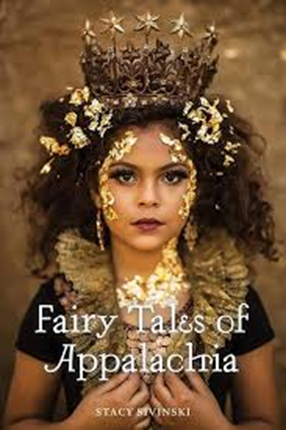
Appalachian culture is more than just their stereotypes, and so are their stories. They contain many complex and driven female characters. That is part of the mission of Stacy Sivinski’s work Fairy Tales of Appalachia, to highlight the diversity and representation that is already contained within these tales.  She says, “because Appalachian women have historically assumed extraordinarily active roles in their communities, it is especially important that folktales with strong heroines become more readily available” (Sivinski 17). These stories have been classics in Appalachian fairy tales, they just haven’t been transcribed or highlighted. Within the novel, there’s retellings of Jack Tales with a female lead, Appalachian retellings of classic stories like Cinderella and Bluebeard, or stories which reflect the blending of Scot-Irish, African American, and Cherokee influence. One specific tale that represents a blending and originality is The “Little Princess of the Forest.” There are familiar fairy tale tropes and images, like a little girl wandering through the woods, a death like sleep and an awakening by a prince, a murderous mother-in-law, and a search for the princes’ missing bride. Yet, the tale has its own unique connection to the natural world, with our main character being taken from her parents by a bald eagle, and her later being turned into a water lily and a magnolia fruit. As Savinski states “”The Little Princess of the Forest’ thus pulls together a range of fairy tale tropes while also offering a plot that is distinct and does not traced back to a single story” (Sivinski 66). The tale deals with themes that permeate the human experience: poverty, grief, jealousy, and identity, another staple of the fairy tale genre. The most compelling characters in these stories are women, we focus first on the mother of the little princess, then the little princess herself, an old witch, and finally the evil queen. Its not surprising at all to see these tales hold modern sensibilities, because a huge aspect of this tradition is its growth as they are pass down and retold. The main characteristics of the men in this tale is how they relate to the women, with the old witches son, and the prince and king with their obsession with the Little Princess of the Forest. While the tale relies on and explores patriarchal conventions, it does so through the eyes and experiences of woman and paints them as a variety of characters. Appalachian women are just as complex, interesting, inspiring, and dangerous individuals as anyone, so they deserve to have their stories told, because they’ve always been there. Theres at least enough to write a book with 29 examples.

Maria Tartar states “Storytelling is a culture-building activity… one that makes the human world, but, as the tales included here are forever reminding us, they also make the world human” (Tartar xxv). Oral storytelling is an important way to build and strengthen our communities, and it is too often dismissed based off pre-conceived notions. The way we connect with others around us is by telling them stories. The first thing I always do when I come back from a trip or catch up with someone is tell them my favorite stories, and I love to listen to their favorite stories. These stories facilitate a bond and a deeper level of understanding. Appalachia, Oral storytelling, and Fairy Tales have been dismissed as traditions and places of the past, but we can learn community building and cultural identity through these seemingly “ancient” things.

Works Cited

“About – National Storytelling Network.” National Storytelling Network – National Storytelling Network, 17 Apr. 2024, storynet.org/about-nsn/.

Baird, Sarah. “Stereotypes of Appalachia Obscure a Diverse Picture.” NPR, NPR, 6 Apr. 2014, www.npr.org/sections/codeswitch/2014/04/03/298892382/stereotypes-of-appalachia-obscure-a-diverse-picture.

Engelhardt, Elizabeth S. D. “Trying to Get Appalachia Less Wrong: A Modest Approach.” Southern Cultures, vol. 23, no. 1, 2017, pp. 4–9. JSTOR, https://www.jstor.org/stable/26391674. Accessed 22 Nov. 2024.

FAULKNER, WILLIAM. “An Introduction to ‘The Sound And The Fury.’” The Mississippi Quarterly, vol. 26, no. 3, 1973, pp. 410–15. JSTOR, http://www.jstor.org/stable/26474057. Accessed 2 Dec. 2024.

Sivinski, Stacy, and Jamie Sivinski. Fairy Tales of Appalachia. The University of Tennessee Press, 2023.

Tatar, Maria. The Classic Fairy Tales. 2nd ed., New York, W.W. Norton & Company, 2017 (xi-xxvi).

Photo Sources

https://hollerhousebristol.com/products/print-appalachian-mountains-map

https://www.cntraveler.com/story/appalachian-mountains-may-have-once-been-as-tall-as-the-himalayas

https://www.vogue.com/article/dolly-parton-tennessee-nashville-travel https://www.nationalgeographic.com/premium/article/appalachian-mountains-ancient-geology-modern-horror-stories

Categories
Fairy Tales

The Mystery of the Miners

By Ellie (Katherine) Lynch

Dwarves in fairy tales are not merely supporting characters but reflections of a unique community, a fascinating entity whose existence raises complex questions about their origins, roles, and interactions with others. My intention with this essay was to set out on a journey to explore dwarves through an anthropological lens. What I found in my research was that the dwarves in fairy tales represent an isolated yet deeply communal society. Their mysterious origins, rituals, and labor become amplified compared to the society in which they mirrored and the work they performed because their distinct characterization allows them to function as versatile narrative tools. By acting as both helpers and moral foils, their portrayal reveals tensions between dependence and autonomy, otherness and belonging, and labor and reward within the narrative structure. Despite their age and wisdom, even their small stature acknowledges the dwarves’ balance between childhood and adulthood. The ever-present dichotomy they address reflects the conflicting themes of the fairy tales they belong to. Just like the roots of a tree, it is their grounded connection to the earth that allows them to occupy a role in fairy tales, which can contain a multitude of responsibilities. 

The dwarves’ ambiguous origins and isolated existence amplify their role as ‘othered’ beings, distinct from humans and the supernatural.  The idea of dwarfs came from mostly German, Norse, and Icelandic culture and folklore. Miners during both the 18th and 19th centuries were seen as having their own laws, customs, and language that were unknown to outsiders. Though their community was relatively mundane, its mystery made it ideal for storytelling because it was easy to make up stories about a group of people who kept to themselves, and not much about them was known. As Maria Tartar said, ‘The dwarf figure often signifies a liminal space between humanity and the supernatural’ (Tatar, The Annotated Brothers Grimm). The miners that inspired this fantasy creature were by nature small, and their stature reflected the conditions in which they worked. Their small size was a practical adaptation to the cramped and often dangerous conditions of mining, as explained by Pierre H. Berube  in his book ‘The Origins of Dwarves.’ Thus, the concept of ‘Dwarves’ was born. The mystery around their grounded presence tied to labor that works with the earth is what allows them to be a catalyst for magical and otherworldly stories. Mining, the dwarves’ primary occupation, symbolizes more than physical labor. It reflects the act of digging for hidden truths about purpose, reward, and societal expectations. 

Despite their isolation, which underscores their otherness, the dwarves exhibit a strong sense of community and camaraderie. This raises questions about how belonging and identity are intertwined with the human need for connection. So often, we as humans align ourselves with others because of similarities in an attempt to not be so alone in the world. The same can be seen with these mythical creatures. The dwarves almost always live and work as a cohesive group, and their shared purpose magnifies their loyalty to one another. It is not known whether they are related by blood or simply a chosen community separate from humans. However, if we look at the humans who inspired their tales, we can assume they are related by blood, as their stature was a genetic trait passed down for work in the mines. Not only are they physically separated from humans due to their place in the forest, but their stature and customs also separate them. However, we see them bridge this gap in stories by helping humans like Snow White.  “If you will keep house for us, cook, make the beds, wash, sew, knit, and keep everything neat and tidy, you can stay with us, and you shall have everything you need.” (Brothers Grimm 95). When examining this quote, it seems like the dwarves are offering her a place to stay simply in exchange for labor, but I believe the more profound meaning lies in the dwarves’ dedication to their work. It is not that they needed Snow White to do these things for them, but instead, they gave her a job so that she could fit into their community. I had many questions regarding the labor of the dwarves. Is their mining for survival, profit, or ritualistic purposes? Are they free workers or bound to a higher power? However, upon further thought, I believe the dwarves’ association with labor underscores themes of industriousness and the value of mutual aid. Their identity is directly tied to their craft; without it, they are simply small creatures living in the woods. In labor, they find community and belonging; without it, they have no purpose and, thus, no meaningful reason to stay together. 

In many fairy tales, dwarves embody the archetype of the helper, providing assistance that enables the hero or heroine to succeed. It is the dwarves who keep Snow white hidden and safe from her evil stepmother. Their role as helpers is not to be underestimated, as it is powerful to have others rally behind you for a fight they have no dog in, and that support is precisely what the dwarves do for snow white. Unlike Fairy Godmothers, they do not grant her every wish or trickers who give her loopholes and riddles, ultimately working for their greed. The dwarves have a very simple “we help you, and you help us” mentality. The way they allow others to lean on them for help and wisdom makes them an incredibly constructive tool in furthering the protagonist’s journey. It is also interesting to note that many communities usually depict isolated groups negatively, seeing them as “outsiders”; however, dwarves almost always have a neutral or positive reputation. I firmly believe it is because of this helping laborer mentality. They are not harmful nor unproductive to society and thus are given a pass from the negative connotations of what being an outsider can mean. 

The portrayal of dwarves in fairy tales reflects their complex roles as helpers, moral guides, laborers, and outsiders, reflecting societal values and anxieties. Dwarves’ unique qualities of labor, isolation, and moral authority make them essential to fairy tales. They are versatile narrative tools as they bridge the gap between human struggles and supernatural elements. Their role as moral guides is particularly significant, as it addresses universal themes of belonging, purpose, and moral complexity when compared to other supernatural creatures like fairy godmothers or trickers in folklore and fairytales alike. There is much we can learn from them when it comes to those themes. They are an invaluable narrative tool that has often gone unappreciated, yet they are imperative to many story structures. 

Works Cited

Grimm, Jacob, et al. The Annotated Brothers Grimm. W.W. Norton & Co, 2012. 

Berube, Pierre H. “The Origins of Dwarves.” Mythlore, vol. 29, no. 12, fall-winter 2010, pp. 163+. Gale Literature Resource Center, link.gale.com/apps/doc/A242509666/LitRC?u=loym48904&sid=summon&xid=77207c6d

Tatar, Maria. The Classic Fairy Tales: Texts, Criticism. W.W. Norton & Company, 2017. 

Categories
Fairy Tales

“Sure, I’m Decent”- Talking Body Politics, “Bluebeard,” and Gilda

By Megan Brown

Pin page

I have seen Gilda at least 20 times, but I’ve seen this particular scene- the part in which the titular Gilda is introduced to us- at least 25. Here, Johnny Farrell (played by Glen Ford) eases open the bedroom door where he’s told “the canary” is waiting. Indeed she is. The room is black, at first. And then the lights go up. Indeed, she is waiting: Rita Hayworth, brandishing her curls, her steely eyes, in what film critic Mary Ann Doane calls “an almost violent gesture” (Doane 99). Slipping up her taffeta dress to cover a scandalously bare shoulder, dominator of her small, cinematic kingdom like Julius Caesar or Citizen Kane. We know she is waiting before we see her, one because of the darkness, and one because the movie is hers. The text is an organism which is entirely dependent on her entrance. Gilda, those technicolor letters squashed above Rita Hayworth’s leonine body, her eyes daring the camera, daring us. Witness me, take me, I am not the offering but the offerer.

Shot for shot (or rather plot point by plot point) the above scene in Gilda is an exact copy of Charles Perrault’s “Bluebeard.” We have the heroine/hero (Johnny Farrell) opening the taboo room where a woman’s body is revealed to be. The room is licentious, dangerous. In “Bluebeard,” it is attended by edicts and threats veiled in language. In Gilda, it is the bedroom- the (quite literal) site of promiscuous activity. In “Bluebeard,” the revelation is the dead feminine body wounded by penetration. In Gilda, the revelation is the female body alive and poised and threatening, Rita Hayworth offering herself to our eyes like a poisoned apple. These two texts which are in active conversation with each other- “Bluebeard” and Gilda- will be the focus of my paper. Whereas “Bluebeard” assuages male anxieties, Gilda creates them. Our titular woman is possessed of that forbidden carnal knowledge and it does not maim her but instead makes her dangerous, unsavory, hungry. She is masculine in her appetite and is the consumer and not the consumed. And a woman possessed as she is of herself and her sexuality is a terrifying thing. 

I want to take a step back here and discuss the genre of film noir as a whole, because this topic gives us further proof of ancestry between the movies of the 1940’s and “Bluebeard.” As Sylvia Harvey writes, “The encounter with a depressed peacetime economy…began a process of general disillusionment for many of those returning home after the war, in search of the values which they had fought to defend” (Harvey 39). In the golden age of film noir- about from the 1940’s to the mid-1950’s- American patriarchal values underwent extreme displacement. As Harvey puts it, there was a double transformation at play: the man-turned-soldier returns to a home that is just as ravaged as him, this time by economic breakdown and uncertainty. To greatly simplify Freud’s theory of the uncanny, these men returned to the site of comfort to find the familiar- the wind-up toy wife, the neat little house house, the Cadillac, the office job- very, very, strange. There was another transformation at work too. As film historian Stella Bruzzi writes in the first chapter of her book “Bringing Up Daddy: Fatherhood and Masculinity in Post-War Hollywood,” “multitudes of American women…found fulfillment in employment during the war” (Bruzzi 2). So that little toy wife, so amicable pre-conflict, transforms now into a highly dubious figure. One that is capable of building the sides of ships, meeting other women, and encountering other (strange) men. What was she up to while her beloved was away? Who entered the home, whose home did she enter, whose cologne is on the bathroom counter? There are locked, forbidden rooms in every home now: the study, the bedroom, the top drawer.

This notion of “returning home” to make a bed with a stranger pervades “Bluebeard.” Before we know of the cutlass and the locked chamber with its miniscule wives, Bluebeard is an aristocrat. He is charming in that Jane Austen man-of-the-gentry way, unremarkable except for the eponymous hue of his facial hair. Perrault tells us of Bluebeard’s courting history, “the younger of the two sisters began to think that the beard of the master of the house was not so blue after all and that he was in fact a fine fellow” (Perrault 189). But Bluebeard as he appears known – a fine fellow, a master of the house- evaporates the minute he and his new bride return home. He, like many post-honeymoon lovers, becomes controlling, moody, prone to other interests, other distractions. Remember the promised rage: “if you so much as open [this door] a crack, there will be no limit to my anger” (Perrault 189). Though once charming, he remains impersonal now more than ever. He cannot be possessed as a person by knowing. He has his secrets, his locked doors, his impossible revelations in the shadows of rooms with familiar names (like Kitchen, like Bedroom). We can imagine, too, a similar dynamic at the end of WW2: happy, canvas-clad husbands kissing their sweethearts goodbye before boarding the boat, and then coming home ravaged. Wives venturing outside the kitchen or the market to dirty their hands with oil and grease, picking up a lover, spoiling the sheets. In both “Bluebeard” and the post-war era, the home becomes fraught, the office, the bedroom, the lips of a spouse all forbidden, all locked doors with potential mounds of the dead. Gender, as an offshoot of identity, becomes slippery: he, with his head full of trauma, might be called hysterical. He cannot, with the economy and all, find a job. She has had a job. She has brought home money to pay the bills, has built ships and bombs and ammunition like a soldier herself, she has (literally) worn the pants. Husband and wife are strangers as people, husband and wife are strangers as category

I want to transition to talking about the femme fatale as a denizen of the film noir and as a manifestation of post-war gender anxieties. To even those unfamiliar with French, the term femme fatale is self-explanatory. She is a woman, la femme. And she is fatal, deadly, poisonous. Gila is an example of a femme fatale. So is Mildred Pierce in Mildred Pierce, Phyllis Dietrichson in Double Indemnity, and Norma Desmond in Sunset Boulevard. As Mary Ann Doane writes in the introduction to her book Femmes Fatales, “The femme fatale is the figure of a certain discursive unease…her most striking characteristic, perhaps, is the fact that she never really is what she seems to be” (Doane 1). She never really is what she seems to be. She is evasive and slippery, a cipher in a black slip and gloves. And this is what I mean when I say that Gilda (and, for that matter, the film noir genre) is in constant conversation with “Bluebeard.” If the femme fatale presents an impenetrable appearance masking a shifting interior reality, then we can read her as the Forbidden Room personified. In Perrault’s text, the forbidden room is “small…at the end of the long passage on the lower floor” (Perrault 189). In other words, it is unassuming, hidden, inaccessible. Before the chamber is open, it becomes a cabinet of possibilities; any number of unnamable and incomprehensible wonders (or perversities) could lie within. So too the femme fatale, so too Gilda. She is an animated veil, a walking shadow. She is, per Doane, the “figure of a certain discursive unease.” 

Take Gilda, for instance. In their first dinner down at the casino, the three main characters of the film-Johnny, Gilda, and Ballin- share a toast “to the three of us.” In a previous scene, a drinking to the” three of us” comprised a company of Johnny, Ballin, and Ballin’s cane, which harbors a hidden bayonet point. Hence Johnny’s comment back at the casino table: “I get confused,” says Johnny. “Well, just a few weeks ago we drank a toast to the three of us” (26:31). Here, we see an obvious connection to both Doane’s theory and Perrault. Superimposing Gilda and the cane, we see that they are one: shiny object (a door, a room) that holds within it a myriad of possibilities, all dangerous. 

There’s another implication here as well. And I don’t want to get stuck in the weeds with Freud, but there is something to be said about knife-as-phallus. This symbolic interplay is heightened when we consider Bluebeard’s chosen instrument (entendre intended) of destruction: a “cutlass” (Perrault 192), which the storybook villain uses to chop off the heroine’s head. Or literally: getting rid of the maidenhead. The association between Gilda and object is obvious, perhaps. The camera laps up Rita Hayworth’s every move like a dog: Gilda rolling up a silk stocking before carnival (occuring at 1:03:10), Gilda outfitted in a low-slung sequin dress, raising a toast to her other. The Carnival shot is especially voyeuristic. Here, the camera trains itself on Hayworth’s foot, following the motion of the stocking as she rolls the fabric up her leg. The camera and the intended viewership belies itself in its gaze. This is the gaze of appraisal, of perverse, window-peeking delight. But there’s a marked difference between Gilda-as-object (silk stockings, sequins) and Gilda as dangerous object. Gilda as phallus, not necessarily in a solely sexual way, but in a lethal way. In the way that many film critics attest that the knife that Norman Bates wields in Psycho is also a phallic object. In comparing woman to cane, to knife, the movie indeed affirms that Gilda is something to be possessed while also affirming the inherent power in her person. She is the cutlass in Bluebeard’s hand, the sexual dominator, the man.   

I want to talk more about the female bogeyman created as a result of all these gender anxieties. Using the lens of post-war familial breakdown, we can view Gilda as this: the ultimate manufactured monster of male anxieties, a vampiress of the missing maternal instinct. She is the cane-and-knife, the hidden object, the unknown in the home and in the bed. She is sexed and sexual and yet unattainable. Like Bluebeard, her mystery makes her unpossessable. As Sylvia Harvey writes of the femme fatale, “The ideological safety valve device that operates in the offering of women as sexual commodities breaks down in possibly most of these films, because the women are not, finally, possessed” (Harvey 40). As we’ve already discussed in our historical context, there was this prevailing fear during the postwar era that femininity had fundamentally changed. What I mean is that women had left the home and had thus brought into question their cleanliness, their purity. Sex within the home, in the binds of a union made official in some grand church, was one thing. Going back to Harvey’s quote, marriage legalized and moralized the possession of a woman, funneled her desire towards conception and motherhood. But in the film noir, as Harvey tells us, the “women are, not, finally, possessed”- they, like the wayward factory women of the 1940’s, stride without domestic tethering from place to place, from bed to bed. Make no mistake, the film noir still regards women as objects capable of being held, of being possessed (remember Gilda and the cane). But there’s danger here too in the ultimate failure of that possession, of the unattainable, invincible object taking to the casino, to the dancefloor. 

I want to transition now to talking about the different role of sexual knowledge in “Bluebeard” and in Gilda. “Bluebeard” presents a portrait of female sexuality in which the body is invariably fatal to the beholder. That is, as soon as the heroine is introduced to her own “femaleness” – the bleeding brought on by puberty, sex, or childbirth- she is met with the threat of death. In one of the tale’s moments of bawdy (and delightful) double-entendre, our heroine is “so tormented by her curiosity” (Perrault 190) over Bluebeard’s chamber that she “raced down the little staircase so fast that more than once she thought she was going to break her neck” (Perrault 190). A la Cecile in Dangerous Liaisons, Perrault fashions the sexual “torments” of a new and virginal bride- her curiosity (an Alice-in-Wonderland, childish word) to see what goes on behind locked doors. There is strong desire and potential delight in curiosity. There is something to be uncovered, which may yield wondrous results. Unfortunately for our heroine, that budding want of sexual knowledge is attended by doom and danger and threats of death. It’s important to note that our heroine is not the dangerous one herself. She, unlike Gilda, harbors no bayonet point. Our heroine’s desire is  n innocuous if a bit reckless, hence the racing down the stairs like a child at Christmas. Yet it’s the mere presence of her want, of her chance of encountering what she might want, that frames the danger at the heart of “Bluebeard.” Hence through the idea of “breaking her neck”: curiosity, desire, women and brides wanting to know the Thing that men already expect, are all attended by the threat of death. 

And, more than any other work perhaps, death pervades female sexuality in “Bluebeard.” After all, the corpse is the extreme ideal of the body-made-object, the paramount expression of that marital “possession” laid out by Sylvia Harvey. In the ultimate, climactic scene of “Bluebeard,” our heroine eases open the forbidden door to find, of course, the unrecognizable bodies of newly fledged brides. “After a few moments, she began to realize that the floor was covered with clotted blood, and that the blood reflected the bodies of several dead women…(these were the women Bluebeard had married and then murdered one after another)” (Perrault 190). After being “tormented” and “trembling” (Perrault 190) at the thought of opening the door, the final act is consummated. And blood is the sum of this discovery: blood on the floor, on the bodies, from the bodies that once were brides and unfortunately will always be women. This gruesome scene, Perrault tells us, is the nuptial expectation: a woman’s body cannot survive desire nor can it survive marriage. Womanhood is blood, and the state of womanhood is fatal- the taking of a maidenhead is the taking of a maiden’s head. Both are invariably fatal acts. 

There’s also an undertone of transgressive sexuality that runs through this (literally and figuratively) climactic scene. For one, the heroine’s “discovery” takes place when her husband leaves the home. “Bluebeard told his wife that he had to travel to take care of some urgent business…and that he would be away for at least six weeks” (Perrault 189). And two, there is the matter of the interdiction: “I absolutely forbid you to enter that little room.” As Sylvia Harvey writes in  “Woman’s Place, “the family is sanctified as the acceptable location of a sexuality defined in extremely limited terms” (Harvey 37). The heroine, however, is not experiencing this “sanctified” version of her sexuality. She makes the “discovery” of female bodies, her body, while her husband is away on business. Like a wartime wife, our heroine is a figure who indulges male anxieties- she plays while her husband is away. And if she is gratifying herself- trembling, racing down the stairs, drowning herself in torment- then she is not doing so with an eye towards an heir or the cradle. It’s this breed of female sexuality, unsanctified, unalloyed by the aim of conception, that men are so afraid of. And in “Bluebeard,” our heroine (and our other brides) does not get away with having her cake and eating it too. For her desire, for her curiosity, she and they and every other bride are punished. They are the bodies on the floor of Bluebeards’ chamber, bodies that may be possessed and hung and disposed of. Male control is reasserted. All is right in the world. 

In Gilda, the body, Gilda’s body, is still a possession. There are numerous mentions throughout the film of what Gilds invokes in men, of what men might do to her. “Gilda’s much too beautiful” says Ballin to Johnny as he leads him over to the table, “to be left alone” (25:38). There’s that ‘locked door’ again that prevents explicit mention of just what people do in the dark, but the implication is there. What might someone do to Gilda, what will happen if she’s alone? In “Bluebeard,” the eponymous husbands possesses his woman’s, the women’s, bodies, and thus what happens in the dark is always fatal. But Gilda’s body is Gilda’s. And thus what happens in the dark is whatever she wants to happen. After being pulled out of a lover’s arms by Johnny Farrell, Gilda turns to her paramour and tells him “‘if I would have been a ranch, they would have named me the ‘bar nothing’” (41:25). Now, Gilda (the movie) paints this scene and this line of dialogue as sinister, as perverse. In the beat before, Gilda sways with her man in the smoky casino, his hand traversing her lower back. And, after: Johnny wretches Gilda away by the arm. She is Ballin’s wife and thus from Johnny’s handling of her we can tell that her purity is more important than her well-being. However, there’s the catch: she is Ballin’s wife, but Ballin, unlike Bluebeard, does not own his wife’s body. It is Gilda that sways on the dancefloor, it is Gilda that allows and enjoys the traversing of the hand, it is Gilda that is the “bar nothing.” At this line, the male anxiety squirms: Gilda is “much too pretty” to stoop so low. She has a husband, a powerful one: why doesn’t he satisfy her? What do women want? But for all the sinisterness the male gaze festoons her lines with, Gilda’s desire is relatively uncomplicated. She is a beautiful woman. She knows she’s a beautiful women. She will use this fact to destroy, she will use this fact to have fun.

Any analysis of Gilda would be remiss without mentioning the scene. I am referring, of course, to the infamous striptease Rita Hayworth performs to “Put The Blame on Mame.” If I’ve seen Gilda 20 times, I have also seen this scene 25 times. I could write a novel on this scene alone: Rita Hayworth possessing the body and character of Gilda, taking the stage of the casino in a bias cut, satin dress. Her tossing a sable wrap aside as the intro starts, peeling off a satin opera glove as she croons about how we should all put the blame on Mame: a woman whose sexuality is linked with natural disasters. “One night she started to shim and shake / that brought on the Frisco quake” (1:39:11). Her raising her arms high above her head to hold out the last note, her tossing a diamond necklace into the crowd like it’s worthless to her. And then, among the jeers and whistles, her calling out “I’m not very good at zippers. But maybe if I had some help!” (1:40:51). The line of men she draws, stumbling and sweating and pushing for a first glimpse at flesh. Her laughing, teeth barred, as they attempt to tear her apart. 

As Mary Ann Doane writes of this particular scene, “striptease provides the perfect iconography for film noir, economically embodying the complex dialectic of concealing and revealing” (Doane 105). What Doane is essentially saying here connects to a point I made earlier: that Hayworth’s body becomes the bloody chamber, the site of mystery and revelation. She assumes the role of both Bluebeard and the heroine in this scene: she is the revealer, the opener of doors, but she does so already knowing the secret. Sexuality, and the particular power of her sexuality, is nothing new to Gilda. She already knows what lies behind the locked door. What’s impressive about this scene, then, is the way it turns the gendered assumptions of “Bluebeard” on their head. It’s the men that are curious, it’s the men that are foolish, rushing like the heroine so that they themselves might “break [their] neck” (Perrault 190). Gilda is a sexual object, sure, but it is Gilda that is presenting herself as object. It is Gilda that knows that the secret of her uncovered would make a man tremble, like our heroine on the threshold of the forbidden room. It is Gilda, mouth open, laughing as they rush to rip her to shreds.

If we’re talking body politics, then both Gilda and “Bluebeard” acknowledge that power lies in the possession of the body, her body. In “Bluebeard,” that power lies with the husband. Marriage, and particularly the vexed element of sexuality involved in marriage, renders the wife to the ultimate possessable state. Remember the shaking, the trembling, the revelation of female bodies in a darkened room. Female sexuality, Perrault tells us, is at all times attended by danger, by death. And it is the dead women that is the ultimate object, the ultimate male fantasy of complete corporeal ownership. Enter Gilda, enter Gilda. Unlike Bluebeard’s wives, her body is not broken by sex. She has made the discovery of the bloody chamber. She dances close to her man in the dark in a satin, backless dress. She is the Bar Nothing. And her body is indeed an object (recall the knife-in-cane). But Gilda’s body, as Sylvia Harvey reminds us, cannot be possessed. The revelation of her own sexuality, the dark chamber of her own body, does not bring Gilda to vacate herself. Rather, she possesses herself. Her body in her hands brings men to their knees, reduces them to denizens of their foolish curiosity to know her body, to be the naive girl at the threshold of the bloody chamber. She herself is both commodity and commodifier, seller and profiteer; she is never without power.  

Works Cited

Bruzzi, Stella. Bringing up Daddy : Fatherhood and Masculinity in Post-War Hollywood. BFI 

Pub., 2005.

Doane, Mary Ann. “Gilda: Epistemology as Striptease.” Femmes Fatales : Feminism, Film 

Theory, Psychoanalysis. Routledge, 1991.

Doane, Mary Ann. “Introduction: Deadly Women, Epistemology, and Film Theory.” Femmes 

Fatales : Feminism, Film Theory, Psychoanalysis. Routledge, 1991.

Gilda. Directed by Charles Vidor, 1946.

Harvey, Sylvia.“Woman’s Place: The Absent Family of Film Noir.” Women in Film Noir. Rev. 

and Expanded ed. Ann E. Kaplan, 1998.

Perrault, Charles. “Bluebeard,” in The Classic Fairy Tales, ed. Maria Tatar, W.W. Norton, 2017. 

Categories
Fairy Tales

Hungry Like The Wolf: Ethical Ingestion and Disordered Devoring In Fairytales

By: Avery Eagleton

In the tales of “Snow White,” “Hansel and Gretel,” and “Little Red Cap,” the theme of consumption plays a crucial role in the narrative. For instance, Snow White takes a bite of a poisoned apple, Hansel and Gretel nibble on a house made of bread and sugar, and Little Red Cap ultimately meets her fate by being consumed. Food imagery is abundant in these stories, reflecting the characters’ complex relationships with nourishment. In these narratives, food can offer comfort, provide sustenance and allure, or pose a threat. Furthermore, it often symbolizes the connection to maternal figures; wholesome eating is associated with nurturing maternal instincts, while improper consumption is linked to the malevolent mother archetype.

The Grimms’ portrayals of food reflect the societal anxieties surrounding consumption that permeated all strata of society, transcending age and class, and these concerns remain relevant today. As Carolyn Daniel underscores in her work Voracious Children: Who Eats Whom in Children’s Literature, “food events are always significant, both in reality and in fiction. They reveal the fundamental preoccupations, ideas, and beliefs of society [. . .] and evoke visceral pleasure” (1-2). In this essay, I will demonstrate that positive representations of eating signify order, while negative depictions convey disorder. I will then examine the connection between food and parenting and discuss the prominent theme of the cannibalistic mother in Grimms’ fairy tales. I intend to illustrate that the Grimms emphasized food and eating in their narratives because they aim to reinforce appropriate consumption behaviors for children and adults.

In fairy tales, food often holds significant symbolism; when depicted positively, it represents stability and order, whereas negative portrayals indicate chaos and disorder. Zipes references Marina Warner, who observes that “food – procuring it, preparing it, eating it – dominates [fairy tales] because the overriding image of survival; consuming it offers contradictory metaphors of life and civilization as well as barbarity and extinction” (Zipes 224). Within the tales of the Brothers Grimm, food acts as a safety marker and a tool for deception and entrapment. For example, when Snow White arrives at the dwarves’ cabin, she is welcomed by a table set with a white tablecloth, and she helps herself to “a bit of bread and vegetables from each plate and [drinks] a sip of wine from each cup” (Tartar 97). This sense of security leads her to find the most comfortable bed and allow herself to rest.

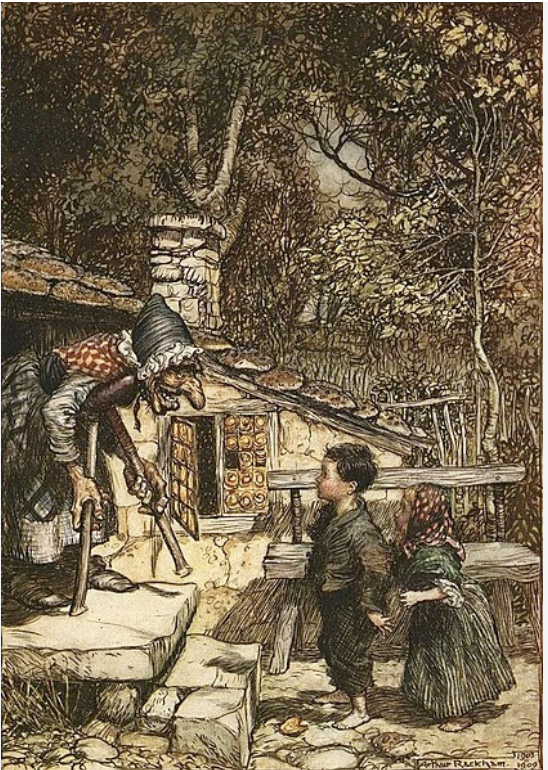
Both protagonists and villains utilize food because it is a means to outsmart their opponents. A prime example is Snow White, who is deceived by her malevolent stepmother with a poisoned apple. Similarly, in the story of Hansel and Gretel, the children are enticed by a house “made of bread, with a roof of cake and windows of sparkling sugar” (Tartar 239). The very foods that these characters come to trust ultimately pose a threat to their safety. These narratives suggest that we should sometimes be wary of others, as well as the food that typically brings us comfort. Thus, the depictions of food serve because they are cautionary lessons regarding control and identity.

Self-control and caution are central themes in these stories. In these narratives, food does not always represent order and stability. They illustrate the importance of being wary when encountering strangers. Little Red Cap learns a vital lesson about trusting others when the wolf swallows her whole. However, she manages to escape and retaliates against the wolf by appealing to his appetite. She cleverly deceives him twice: first, by filling his belly with rocks to make him feel full and allow her to escape, and second, by enticing him off her grandmother’s roof with leftover water from cooking sausages.”The smell of the sausages rose to the wolf’s nostrils. . . he stuck his neck out so far that he couldn’t keep his footing. . . and he slid off the roof and slid straight into the big trough and was drowned”( Tartar 21).

The prevalence of the cannibalistic maternal role in fairy tales highlights the notion of a woman’s malevolence, which threatens children by transforming them into a source of nourishment. This idea epitomizes the extreme limits of maternal possessiveness. It often evokes fears surrounding swallowing and being swallowed, ultimately leading to losing personal identity. The purpose of such characters in fairy tales is to symbolize the danger encountered by children who stumble upon them. By sharing stories like “Hansel and Gretel,” we instill this fear in our children, which serves various functions beyond mere caution.

The Grimms condemned the greedy distortion of nature as a further attempt at real-life didacticism, encouraging parents to prioritize nurturing and sharing with their children, even in times of famine. Jacqueline Labbe suggests that the cannibalistic maternal figure trope encompasses more than just a lesson for parents.: “When food transmutes from nourishment for the child’s body to a metonym for the child’s body, eating is less about satisfying corporeal needs than about symbolizing moral needs” (Labbe 101). Being eaten as a punishment combines “bodily sensations like satiety and self-flagellation” (Labbe 101), and Labbe notes that it is only ever the bad children who end up “culinary delights” (Labbe 100). For example, Little Red Cap disobeys her mother by leaving the path, and she ends up eaten as a result (Tartar 20). In this context, the moral lesson emphasizes the importance of obedience for young audiences.

Gretel cleverly exploits the witch’s voracious appetite to her advantage. In this context, food—and its promise—serves as a means of deception and harm. These instances illustrate how food is intertwined with disorder, highlighting that what is intended to be nourishing can sometimes be distorted to deceive and ensnare. The positive connections between safety, comfort, and nourishment are rooted in a child’s fundamental relationship with their mother. The archetype of the nurturing mother, often found in fairy tales, is frequently associated with the notion of wholesome food. In “Little Red Cap,” the mother sends her daughter to visit her grandmother with a freshly baked cake. The girl explains to the wolf, “We baked yesterday, and we want my grandmother, who’s sick and weak, to have something nice that will make her feel better” (Tartar 18).

Connections arise between Little Red’s caring mother, the warmth of a secure home, the comforting aroma of baked goods, and overarching themes of nurturing and care. Daniel notes

“protagonists receive ’emotional nourishment’ (in varying degrees) and gastronomic pleasure from the food provided by maternal figures. The food symbolizes love, comfort, and safety.”

In the story of Hansel and Gretel, the children, facing starvation, are drawn to the witch’s house adorned with confections. Having experienced abandonment by their mother twice, the sweet treats they consume represent a deep yearning to reclaim the maternal comfort that has eluded them. The witch ultimately takes them in, who poses as a nurturing motherly figure, offering them “a fine meal of milk and pancakes, sugar, apples, and nuts” (Tartar 239). Despite her later revelation as a malevolent being, the children do not question her and mistake her for a caregiver, influenced by their association of rich, sweet foods with nurturing motherhood. In essence, fairy tales depict a mother who nurtures and adequately feeds her child because of the embodiment of love and order, establishing the standard against which all other maternal figures are measured.

Unfortunately for the protagonists, negative maternal figures are more prevalent in the Grimms’ tales than positive ones. These women are intricately connected to food and consumption, much like their benevolent counterparts; however, their nourishment is as unfulfilling and perilous because of the wholesome and safe sustenance a caring mother provides. In the story of Hansel and Gretel, the mother abandons her children to starve in the woods, offering them nothing but crumbling pieces of bread. This abandonment stems from her desire to enhance her own chances of survival during a famine. Because such a callous act may seem unimaginable to modern readers, the Grimms addressed a significant issue of their time. They likely employed this cautionary tale to “warn against child neglect in times of suffering.”

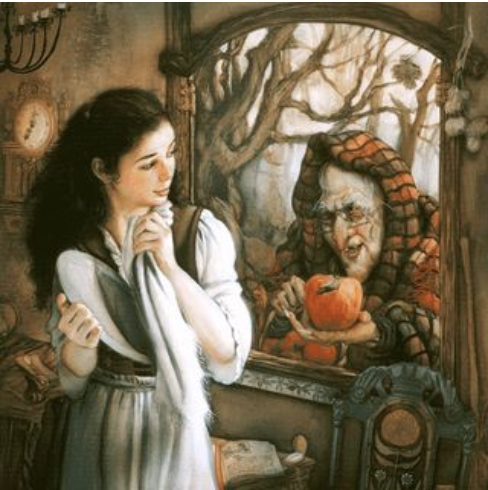
Starvation is not the only motivation for the neglect or harm inflicted by a cruel mother figure. As exemplified by the wicked stepmother in “Snow White,” jealousy can also play a crucial role. When the Queen realizes she is no longer the fairest in the land, “envy and pride [grow] like weeds in her heart… she [sends] for a huntsman and [commands]: ‘Get that child out of my sight. Take her into the forest'” (Tartar 96). Upon discovering that the girl has survived, the Queen devises a sinister plan to ensure her demise by intentionally crafting a poisonous apple.

She presents it to Snow White, saying, “Look, I’m cutting it in half. You eat the red cheek, and I’ll take the white cheek.” However, the apple was so cleverly crafted that only the red side was poisoned. The Queen’s maternal instinct is lacking; not only is she depriving Snow White of safety and security by sending her into the woods, but she also intends to harm the girl by offering her a seemingly wholesome apple that she has deliberately tampered with. The mother figures in “Hansel and Gretel” and “Snow White” serve as the Brothers Grimm’s exploration of neglectful or misguided parenting. These portrayals of poor maternal care are often tied to associations with food, which starkly contrasts with the depictions of virtuous mothers in other fairy tales. The Grimms aim to educate children and adults about proper childcare and appropriate parental behavior through these narratives.

Mothers who take pleasure in feasting on their children can be even more terrifying than those who neglect, starve, or poison their children. Cannibalism represents the ultimate malevolence associated with negative mother archetypes. In both “Hansel and Gretel” and “Snow White,” the child who seeks love and safety through food ultimately becomes the object of the mother’s appetite. The witch in these tales is a disturbing parallel to Hansel’s troubled mother. The notion that a mother might even desire to consume her child thrusts readers and protagonists into a distorted world; traditionally, a mother’s role should be to fulfill her child’s needs, not her own appetite of her child.

In contrast to the nurturing mother, whose intentions are transparent, the woman’s reasons for eating the children are numerous yet vaguely defined. Much like the witch in “Hansel and Gretel,” this cannibalistic woman embodies the antithesis of the loving mother while outwardly resembling her. Children often struggle to discern whether this woman harbors intentions to consume them, which makes her appetite particularly menacing, positioning her frequently as the quintessential fairytale villain. Depictions of mother figure with a desire to feast on children exemplify the pinnacle of chaos and terror.

These tales resonate today because they address pertinent issues that remain relevant two centuries later. Starvation, poverty, obesity, and concerns over the origins and contents of our food are still contentious topics: food remains intricately linked to feelings of order and disorder as it was in the nineteenth century. For young readers, eating is inherently associated with survival, comfort, love, and stability, stemming from the primal bond between mother and child. By reinforcing the image of the nurturing mother through food symbolism because simultaneously instilling suspicion and fear through examples of sinister and cannibalistic mothers, the Grimms’ fairy tales reveal how food can also signify disorder. Whether depicted as rich or bland, sparkling or crumbling, saccharine or poisonous, the food motifs in these tales serve as compelling vehicles for reinforcing cultural norms surrounding appropriate and inappropriate eating, feeding, sharing, and parenting practices.

Works Cited

Daniel, Carolyn. Voracious Children: Who Eats Whom in Children’s Literature. New York: Routledge, 2005. Print.

Grimm, Wilhelm & Jacob. “Hansel and Gretel.” Folk and Fairy Tales. Ed. Martin Hallett and Barbara Karasek. Concise ed. Toronto: Broadview, 2011. 111-16. Print.

—. “Little Red Cap.” Folk and Fairy Tales. Ed. Martin Hallett and Barbara Karasek. Concise ed. Toronto: Broadview, 2011. 29-31. Print.

—. “Snow White.” Folk and Fairy Tales. Ed. Martin Hallett and Barbara Karasek. Concise ed. Toronto: Broadview, 2011. 116-22. Print.

Labbe, Jacqueline M. “To Eat and Be Eaten in Nineteenth- Century Children’s Literature.” Critical Approaches to Food in Children’s Literature. New York: Routledge, 2009. 93-103. Print.

Tatar, Maria. Hard Facts of the Grimms’ Fairy Tales. 2nd ed. Princeton and Oxford: Princeton UP, 2003. Print.

Zipes, Jack. Why Fairy Tales Stick: The Evolution and Relevance of a Genre. New York: Routledge, 2006. 195-243. Print.

Categories
Fairy Tales

Its Not Fair: An Exploration into the Role Beauty Standards Play in Modern Adolescent Girls’ and The Evil Queens’ Self-Esteem

By RYN

The story of Snow White by the Brothers Grimm is an Aarne, Thompson, Uther type 709 story. 709 stories are categorized by the presence of a jealous stepmother or queen. One could argue that the beauty of Snow White drew the jealous stepmother to resent Snow White and attempt to dispose of her, however, I would say that the Evil Queen’s low self-worth and desire for social recognition was the driving factor for her resentment of Snow White. This low self-esteem and need for social recognition is not confined to fairy tales, it is the mindset that has become increasingly common for adolescent girls in the 21st century. According to Piper Sandler, an investment bank, teens’ skincare spending increased by 19% between 2022 and 2023, as adolescents worry about preventing all signs of aging before it begins to show. How are adolescents experiencing the same fear and envy as the Evil Queen did centuries ago? The answer is low self-worth reinforced by beauty standards. Beauty standards are a set of traits and values that define what is beautiful. In Snow White, the Evil Queen is not malicious towards Snow White until the mirror informs her that Snow White is the most beautiful in the land, and by extension meets the beauty standard. Similarly to how the rise of teenage beauty consumption and adolescent self-esteem issues are on the rise post the introduction of social media, which exposes who meets the beauty standard and by extension what adolescents are lacking. From analyzing the actions of the Evil Queen and the consumption habits of adolescent girls we can deduce that the Evil Queen and modern adolescents’ obsession with beauty is because of the access to an unobtainable beauty standard that reinforces low self-worth. 

In today’s society, social media networks such as Instagram and TikTok replicate the role that the magic mirror played within the Snow White tale by overly informing adolescent girls of the unattainable beauty standard, according to a 2022 survey of teenage girls 97% of them report using social media daily. Further, the majority of the 97% of the interviewed population reported that “Skinfluencers have the most power over their purchases” (Mccoy et al). The population using the word “most” versus another word like “some” to describe the influence that social media has on introducing skincare and beauty to them suggests that they trust social media above other sources such as licensed medical practitioners and parental guidance. Further, The Journal of Clinical and Aesthetic Dermatology suggests that social media “Introduce[s] impressional viewers to appearance-altering fads” (Mccoy et al). When convincing adolescent girls to purchase these beauty products these “Skinfluencers” must first convince the adolescents that there is a problem with their appearance, to begin with. Skinfluencers misuse legitimate medical terminology such as ‘hyperpigmentation’ and ‘discoloration’ to suggest that normal and benign biological variance has a negative impact on social perception. This is similar to the role the mirror played in snow white. The Evil Queen was not angry or even aware of her deficits before she was informed by the mirror that she was not the fairest, and by extension did not meet the beauty standard. If the Evil Queen had in fact been “the fairest” (Tatar 110) she would have needed to be “as white as snow, as red as blood, and as black as the wood of the window frame” (Tatar 109). However, the central issue is that she trusted the mirror, a lifeless form, to determine what made someone “the fairest”. The Evil Queen, a woman, had a lot more agency than the average woman in Grimm’s stories. She was married to a king and was wealthy enough to have henchmen and servants to wait on her and do her bidding. There is a distinct lack of outward social pressure to change outside of the mirror, and the story in particular highlights that “She [The Evil Queen] was a beautiful lady” (Tatar 108). If she had no outward knowledge of her supposed inadequacy, she had no character telling her that she needed to be more beautiful, and she had more agency before knowing her flaws, then the mirror is both the igniting action into her downfall and the culprit of perpetuating rigid and harmful beauty standards. The impact of removing the mirror, social media, is apparent in our world too. Research done by the Children’s Hospital of Eastern Ontario completed a study that yielded that teens and young adults who reduced their social media use by 50% for a few weeks saw “significant improvement in how they felt about…their overall appearance” (Goldfield). Consumptive behavioral studies suggest that “social media…made adolescent girls consume skincare products excessively in pursuit of being beautiful” (Putri) and the consumptive patterns of all women directly correlate to each generation’s reliance on social media. A 2020 study conducted on women from three age generations yielded that “Gen Z used almost all of their spending money on beauty treatments. Meanwhile Gen Y only used 30% of their income, and Gen X used less than 5%” (Putri). There was a time before social media when there was limited access to global beauty standards and the increased availability of social media has caused irreparable damage to the self-esteem of adolescent girls, and by extension increases the demand for skincare and beauty products hoping to address issues that before marketing and social media influencers consumers were hardly aware they had. This raises the question of what were the Evil Queen and adolescent girls like before the mirrors introduced beauty standards to them.

Before the Evil Queen was told she was not the fairest, she held no animosity towards herself nor Snow White, similarly before social media rates of beauty consumption were lower indicating that there was an increased desire to conform to a beauty standard post the introduction of socials. In the beginning of Snow White the Evil Queen asks who was the fairest of them all, and the mirror answers that she was, and “then she was satisfied” (Tatar 109). The use of the word satisfied suggests that she has no need to take offensive action against Snow White or herself. So before the mirror’s disrespect the Evil Queen was satisfied and non murderous. Snow White was the embodiment of the beauty standard if she was “the fairest ever seen” (Tatar 112), so if the Evil Queen was satisfied with herself and the situation and simultaneously did not know of the beauty standard, her actions post-learning she was not the fairest can be explicitly caused by awareness of the beauty standard. After the mirror states the Evil Queen is not the prettiest, the queen changes in an instant “From that moment on she hated Snow White” (Tatar 109). Explicitly defining that it was after learning about Snow White’s adherence to the beauty standard that the Evil Queen hated her defines the point in which the oppressive and competitive nature of beauty standards began within the story. In the Putri article the researchers conducted a study where they asked adolescent girls their motivations for purchasing beauty and skincare products, and one interviewee stated “I usually wonder how a person’s skin looks so good? Obviously, I also want to look that good and appealing” (Putri). This suggests that before being exposed to people “better looking” and who use beauty products she would have not consumed any beauty products herself. This exposes that there is distinctly a pattern of behavior before and after being exposed to beauty standards and that the previous pattern is distinctly more accepting of one’s natural self. However, I would argue that the Evil Queen nor modern adolescent girls are changing their behavioral patterns solely to avoid personal feelings of inadequacy. Being pretty and meeting beauty standards does have an impact on the perceived social class of women as well as access to a variety of life opportunities. Beauty is a form of combat and agency, and it is one of the only ways that historically women have been allowed to express agency and access things in the patriarchal world. 

Pretty privilege is a term for the additional access and agency that women typically receive when they are perceived as beautiful within a patriarchal society. Snow White who is doted on and revered for her beauty is a prime example of experiencing pretty privilege. When the huntsman was ordered to take Snow White into the woods and kill her, he spared her life, which is the ultimate form of privilege. The story writes “Snow White was so beautiful that the huntsman took pity on her” (Tatar 109). Outside of Snow White’s beauty, she had no power or agency. Her father controlled the money and status and the Evil Queen controlled people like the huntsman. The huntsman was willing to risk his own life and his job to save Snow White while doing nothing but admiring her beauty and asking nothing from her in exchange. Using the particular word ‘that’ implies an explanation or reasoning in the subsequent clause of the quote is caused by the first clause. The huntsman would not have spared Snow White’s life otherwise which speaks to the social and agency value that beauty has, it can spare lives. Further, when Snow White escaped into the 7 dwarfs’ home and ransacked their cottage, they did not get angry at her because of her beauty. When the dwarves first arrived at their home they were upset because of the state of disarray that it was in, but when the dwarves discovered the beautiful Snow White they allowed themselves to be soothed by her perceived beauty and innocence. The dwarves stated, “What a beautiful child” (Tatar 111) when before they saw her beauty they were upset and disgruntled. The dwarves then allowed Snow White to stay in exchange for domestic labor, instead of being hostile towards her. However, I think it’s important to note that the “agency” and “privileges” that Snow White’s beauty had were in exchange for options that still benefited and relied on the patriarchy. Snow White was not killed because of her beauty- beauty as a method of protection from violence but instead was confined and domesticized for her beauty. Snow White is believed by the dwarves to be a princess, a title of nobility and status, yet she is immediately confined to the home and domestic life, two places that are traditionally feminine. This raises that beauty standards offer an illusion of choice, with one option being falsely paraded as better. To be pretty like Snow White and be protected by male characters and heroes such as the huntsman, but always be reliant on males for your own safety and be confined to domesticity. Or not meet the beauty standards like the Evil Queen and be “doomed to the inward search” (Tatar 377) for inadequacies while not being granted protection nor any social benefits. In modern society, girls are offered the same semblance of choice by beauty standards. Girls can either meet the beauty standard and be offered pretty privileges or not meet the beauty standard and be denied social acceptance. Pretty privilege is portrayed as solely positive and helpful, which is why adolescent girls flock to beauty treatments such as makeup and skincare; social acceptance is closely connected with life opportunities. This is further exacerbated when adolescent girls see on social media Skinfluencers skin glow-ups, pretty women being treated better, and the money that can be made from being pretty on the internet;  “All of these perceptions directly affect self-esteem and life opportunities” (Putri). The false illusion of an easier life via pretty privilege is still a heavily internalized narrative, and after learning of the beauty standard, the behavioral patterns of women are heavily influenced, switching from a passive behavioral pattern to an aggressive offensive behavioral pattern. 

The Evil Queen and modern adolescents both have rapid and intense responses to their perceived social inadequacy after being made aware of it. After the Evil Queen is told she is not the beauty standard she sets out to murder Snow White out of fear of losing power and protection in favor of Snow White’s beauty. The Evil Queen is cited as having “never had a moment’s peace” (Tatar 110) after being made of her inadequacies which is a far cry from “She was satisfied” (Tatar 109) such a short time ago. There is an inherent panic and fear that arises in response to the mirror’s revelations because it reveals an opportunity for women’s power and leverage to be lost. According to the Putri article “Skincare and makeup products are still the fastest growing categories in buying and selling” (Putri) within consumption patterns and “Skin care is one of twenty categories being bought rapidly” (Putri). The use of the word rapidly suggests panicked and uneducated decision-making, as opposed to a holistic and calculated general purchasing attitude. The Evil Queen rapidly attempted to dispose of Snow White via a number of unapproved and inefficient methods such as suffocations by lace and poisoning. One cannot make logical and educated decisions in a state of panic. The article further states that “adolescents are impatient in waiting for the results of skincare and frequently switch to other products they believe are better” (Putri). These products absolutely can work and actually move adolescents closer to a beauty standard-approved look, but out of fear of immediate social consequences for not currently meeting the beauty standard, adolescent girls are switching products rapidly and panicking hoping for an instantaneous magic solution. I would argue that the attempted murder of Snow White and beauty overconsumption are symbolism for the same modality of internalized fear and inadequacy. Beauty standards make it harder not only for the individual, such as the Evil Queen, but also the people around them that have to suffer from their behavioral patterns such as parents having to fund their daughters’ overconsumptive beauty regimen. 

From the introduction of the mirror to the Evil Queen and modern adolescent girls their behavioral patterns shift. The mirror, an unverified source of truth for women, is used to comment on whether and how the beauty standard can be met in the narrative and society. The pre-mirror behavioral patterns of less rigid conformity to beauty standards and generally better self-perception are replaced with deeply panicked insecurity which causes the two focus groups to lash out in an attempt to regain power that they feel is already lost or about to be lost. Further, the illusion of benefit from conforming to the beauty standard puts pressure on women to quickly conform so they can avoid further social disenfranchisement and can more quickly access social privilege. It was interesting to see social sciences such as behavioral psychology inform the perspectives of consumption analysts and the interconnectedness of the experiences of the Evil Queen and teenage girls. Both groups were made aware of their beauty shortcomings, suggested negative social impact as a response, induced into shifting their behavioral patterns out of panic, and began aggressive countermeasures in response, which ultimately led to no additional feelings of power or social acceptance.


Works Cited

Ellen, Barbara. “Why Are Our Children Obsessed with Anti-Ageing Treatments? Take a Look in the Mirror | Barbara Ellen.” The Guardian, Guardian News and Media, 27 Jan. 2024, www.theguardian.com/commentisfree/2024/jan/27/joyless-children-fixated-on-anti-ageing-skincare. 

Goldstein, Gary. “Kids These Days: Social Media’s Impact on Adolescent Behaviors.” Journal of Clinical and Aesthetic Dermatology, May 2024, web-p-ebscohost-com.lmu.idm.oclc.org/ehost/pdfviewer/pdfviewer?vid=0&sid=7513c3f2-05c5-4c44-b93a-7f2f569a935d%40redis. 

Putri, Sunita, and Namila Putri. “Consumptive Behavior of Urban Adolescent Girls in Using Skincare Products.” Gale Academic, Journal of International Women’s Studies, July 2024, go-gale-com.lmu.idm.oclc.org/ps/i.do?p=AONE&u=loym48904&id=GALE%7CA803788454&v=2.1&it=r&aty=ip. 

“Reducing Social Media Use Significantly Improves Body Image in Teens, Young Adults.” American Psychological Association, American Psychological Association, www.apa.org/news/press/releases/2023/02/social-media-body-image. Accessed 5 Dec. 2024. Tatar, Maria. The Classic Fairy Tales: Texts, Criticism. W.W. Norton & Company, 2017.

Categories
Fairy Tales

The Politics of the Female Monster: An Unruly Dissection  

By: Maricia Marquez

A monster is defined according to Merriam-Webster as “a person of unnatural or extreme ugliness, deformity, wickedness, or cruelty,” but what has become of this monster? Since the prolusion of this term in critical conversations of humanity as well as in its simpler uses in stories of heroes and villains, the “monster” is often seen as a reflection of humanity itself. Monsters reflect the flaws of man, his connection to the wild beast humming under misunderstood loneliness. This reflective “flaw” of man is something I argue adheres to men and men only. What then becomes the role of the female monster? Where is her place in the discourse and what does she represent? The monstrous woman is not a symbolic vessel for flaws but instead exhibits the potency of feminine strength. Because women have come to embrace themselves as monsters, they use their discerned otherness to subvert the status quo to challenge the patriarchy and redefine monstrous femininity. Female monsters were created by male standards to create an antithetical being to the perfect woman, however, when a woman embraces the title, she regains the power and humanity the term has tried to strip her of. Women in positions of power are the “evil queens” of society, demonized and held to standards far beyond those that adhere to their male counterparts. When a man exhibits flaws, he is a king, when a woman does the same, she is a monster. This contradiction, though great in its ability to obscure generation after generation of boys and girls is simple to answer, women in power are called monsters because men fear strong women. This fear created the evil queen and so many other renditions of the otherness of femininity. In exploring the embracement of this otherness in early versions of the female monster in literature rewrites the story of the female monster and returns to her the agency she has lost to a pontifical society.  

To define the “otherness” of the female monster, we must discern the model whom she deviated from. The “perfect woman” exists to offset the power of the monstrous woman. But how did she come to harbor this description? The truth is that she has been born from the confines of the male mind. Because she is from the male mind, a natural thing, she is considered part of the natural world, however, her existence is anything except natural. It is her perfection that makes her obsolete to the laws of nature, “for it is as much from literature as from “life” that literate women learn they are “to be dull/ Expected and dessigned” (Gilbert 11). The perfect woman has no flaws, she is as beautiful as she is kind, a dull shell to harbor what was once a being with dreams and aspirations. This perfect woman is the “normal” woman. In early forms of literature, man created her to be pure, and holy, a virgin who loses her purity only for the purpose of reproduction. A perfect example is from the early version of the fairy tale known as Snow White of the Brothers Grimm. In this tale, Snow White is nothing more than an uneducated homemaker becomes an appendage to the male existence, only real when she is approved by a man. This perfection becomes grotesque, entering into the uncanny valley of the blurred lines of what it means to design and to be designed. Snow White was indeed written by men, a tasteless character who exists to be perfect in form. She is youthful, with cherry-red lips and “white as snow,” all the qualifications needed to be a good little wife in the 19th century (Grimm).  

Adverse to this perfection is the “abnormal woman.” She is created not by man but is of her own establishment. Because she holds this agency over her own person, she is not allowed to exist in the same space as the “normal” woman do to her perceived monstrosities. She is considered unnatural due to impurities as “the devil mocks nature, mocks sense” and she thus becomes a devil in her own right (Warner 247). This woman in early literature derives from the “evil queen” trope of stories like Snow White. The abnormal woman embraces sexuality, living not to simple be an instrument of reproduction, but to cultivate knowledge and a fulfilling life not only for others, but for herself. The evil queen is written to not be obligated to care for the child of another woman, demonizing women who choose to not have children of their own. The queen is old, she is broken from a society that had been run by men. She is physically incapable of being the lovely little Snow White, but she comes off as so much more relatable due to exhibiting very human emotions of anger and jealousy towards Snow White. This monstrous existence is in actuality the most natural existence of them all. There is beauty in what is broken, the most natural state is that of being not completely put together. It is true that “the grotesque and the monstrous are closely associated… [but] one belongs to the order of representation, the other to the order of nature” (Warner 251). I argue that the grotesque woman is perfect, on who is represented as being perfect, but whose veil is stripped when she is realized to be the product of men and the male gaze. The monstrous woman on the other hand is imperfect, however, she accepts herself as such a thing, knowing it is within her human nature to be wonderfully incomplete.  

This human nature exists in comparison of the divine nature of impossible expectations of women in literature. Since the early days of literature and oral storytelling, female angels and monsters have erroneously acted as placeholders for the status quo. I bring up angels because of their prevalence and permeation across female narratives and of continuous terminology. Their often inherently feminine characteristics reproduce womanhood as something that should reach the status of divinity. Who are these angels? None other than the perfect princesses in the stories told across history- the snow whites of their respective stories. These angel-women are described as beings with unreal beauty, flowing robes and hair, those who are used as comparisons for someone who is loved above all else. This is achieved only while remaining wholly pure and untouched by inadequacies while remaining alive. We take the character of Snow White from the a tale of a saint of a girl who is supposedly the marker of what a good woman should be. The problem with becoming a saint is that saints are only saints when they die. In the Catholic Church for example, one can only be canonized a saint after their death. Saints and angels are whole and perfect, and in this state of purity, they are no longer alive “but if the angel-woman in some curious way simultaneously inhabits both this world and the next, then there is a sense in which, besides ministering to the dying, she is herself already dead” (Gilbert et. al 24). Snow White herself dies! She is put in a box and only returns to the land of the living when a man decided she needed to be taken out for marriage and to make a family. She gives her mind, body, and soul to a man she just met. Women nurture, we give birth and raise, but when giving ourselves for others becomes our only purpose in living, we are as good as dead. Angels are only beautiful when we accept, they do not exist in our physical reality. There is no story to a woman who is seen as only a vessel for others, “for to be selfless is not only to be noble, it is to be dead. A life that has no story, like the life of Goethe’s Makarie, is really a life of death, a death-in-life. The ideal of “contemplative purity” evokes, finally, both heaven and the grave” (Gilbert 25). The closest a woman can get to perfection is to die by existing without her own ambition.  

The female monster is then inverse to this angel, she instead placates the human condition at the expense of the divine. This is because the female monster has the desire to live with her sins instead of dying as a saint. When male storytellers create the perfect woman, they invariably destroy the multi-faceted woman, “thus, while male writers traditionally praise the simplicity of the dove, they invariably castigate the cunning of the serpent at least when that cunning is exercised in her own behalf” (Gilbert et. al 28). To choose to adore the dove is to choose the dead. This obsession with pure and innocent women such as the Snow White character undoubtedly attempts to overshadow the intelligence of her monstrous counterpart, that being the evil queen. The queen is thus demonized physically, with her maturation reeling against the youth of her stepdaughter. There is a fear men have of grown women, this is why they pursue young girls even in literary discourse, “At each stage of a woman’s sexual maturation, from the innocence of childhood to her (hetero)sexual initiation and culminating in motherhood (for some), there is a restrictive hegemonic discourse that defines “normal” and “abnormal” female behavior.” (Santos 152). These narratives are frightened of grown women who are only to be desired when one retains her youth; beyond her youth she becomes a monster. This monster may not be an angel, but blood runs through her veins where an angel has none.  

Why then, does this monstrous distinction matter? My answer is that if the tales as old as time denote the value of a woman as being based on purity culture and half-dead angels, these tales still exist in the modern era. With the embracement of the monster, women can rewrite the entire social narrative that femininity is inherently weak. This fear of monstrous women offers a degree of power over themselves that were supposedly written out of stories by the prevalence of perfect female characters, “that is, woman becomes dangerous, monstrous, when the patriarchal desire to harness her sexuality and reproductive powers is denied… threatening to the status quo” (Santos 114). The small feminine victories of retaining women’s reproductive freedoms, choosing to be the head of household, or even existing in a workplace are all instruments of monstrous liberation. Where the angel is doomed to die, the monster is reprieved to live. 

Works Cited 

Gilbert Sandra M., et al. “The Queen’s Looking Glass: Female Creativity, Male Images of Women, and the Metaphor of Literary Paternity.” The Madwoman in the Attic: The Woman Writer and the Nineteenth-Century Literary Imagination, Yale University Press, 2020, pp. 3–44. JSTOR, https://doi.org/10.2307/j.ctvxkn74x.5. Accessed 15 Nov. 2024. 

Jacob and Wilhelm Grimm, SneewittchenKinder- und Hausmärchen, (Children’s and Household Tales — Grimms’ Fairy Tales), final edition (Berlin, 1857), no. 53. 

Levy, Michael. “Warner, Marina. Monsters of Our Own Making: The Peculiar Pleasures of Fear.” Journal of the Fantastic in the Arts, vol. 18, no. 2, spring 2007, pp. 251+. Gale Academic OneFile, link.gale.com/apps/doc/A218817886/AONE?u=loym48904&sid=bookmark- AONE&xid=5a8aff0d. Accessed 14 Nov. 2024. 

Santos, Cristina. Unbecoming Female Monsters : Witches, Vampires, and Virgins, Lexington Books/Fortress Academic, 2016. ProQuest Ebook Central

Categories
Fairy Tales

My House, My Rules, My Coffee: How Marta Cabrera Embodies a Modern Feminist Cinderella Story in Rian Johnson’s Knives Out

By Avery Valerio

Fairytales have long held the power to shape and mold public perspectives on gender roles, feminism, and patriarchal values. One of the most notable stories, Cinderella authored by Charles Perrault, has historically reinforced anti-feminist ideals, portraying women as passive figures meant to shrink into the background and take up as little space as possible. This version along with many early renditions of Cinderella often uses language that reinforces these gender roles, contrasting powerful, strong male characters with meek, quiet, and gentle female figures. Though Cinderella is meant to be the lead, she is often cast to the side because the plot magnifies unimportant characters to further drown her voice. In contrast, feminist retellings of Cinderella allow the protagonist to take control of her narrative, giving her agency and a voice that shapes her actions and perspective. In the Rain Johnson film Knives Out, Marta Cabrera embodies a modern, feminist evolution of Cinderella. As a heroic female lead, Marta prevails without the forced introduction of a traditional prince charming, overcoming discrimination to serve justice and expose the truth within a wealthy, entitled family. Through Marta’s story, we see a reimagined, female-forward version of the classic fairytale, where the heroine is empowered to shape her destiny. Marta Cabrera, the astutely brilliant nurse in the film Knives Out, portrays a Cinderella-modeled character because she defies the original tale’s narrative that prompts women to take on a submissive role. Her story uplifts feminist retellings, changing the perception of female characteristics in fairy tales.

Cinderella stories have been adapted over time to fit certain narratives. The original tale allowed for gendered language to prevail and set a stage for misogynistic viewpoints to continue in adaptations of this tale through numerous types of media. Fairytales are a means for children to learn lessons about the world they will be growing up in. They can aid in warning of the dangers but provide an accessible and enjoyable mode of instruction. On the other hand, the embedded anti-female rhetoric cast out by Perrault can instill biases in children, allowing them to uphold patriarchal values, outcasting women in the world just as Cinderella is. As is demonstrated, Cinderella adheres to male standards as she dissolves into the background, never speaking against the wrongdoings committed against her. The entire tale revolves around the sole mission to attach herself to the prince and become his wife. When these values are being taught to children, they are led to believe that this is the correct way to act toward the opposite gender. Introducing Cinderella to children without allowing them to unpack the partisan ideas allows gender-based discrimination to thrive. “The embeddedness of appropriate gendered behaviors masks the fact that fairy tales are created and reproduced through the dominant discourse. Girls come to know that their value lies in men’s desire for them, and the characteristics and qualities that will assure their desirability revealed in cultural storylines” (Parsons 136). Many tales like Cinderella are incredibly popular and have impacted dominant cultural discourse. Most who read or have read this tale are unknowingly influenced by its structure regarding the view of masculinity and femininity, and what characteristics are required to embody one’s gender. Fairy tales are not unbiased ground., They are the product of common thought in a society shaped by the values that we deem important and worthy of upholding. When misused, they can be weapons that perpetuate gender stereotypes, especially in women, ensuring that these societal standards continue to influence children. Young, impressionable minds learn from Perrault that the depiction of girls as passive, accommodating, and unable to function without male influence is the truth that they should carry with them. Silencing Cinderella sends a message that a woman’s value is linked to her attractiveness and desirability as defined by men, reducing their abilities and condensing their achievements. Desirability being the only thing Cinderella is made for is made obvious through “the fact that a messenger of the prince discovers Cinderella and she is transformed once again by magic and beautiful clothes before meeting the prince indicates that in her humble state, she would not be worthy of the match. She must be beautiful to be worthy” (Parsons 144). Tying a woman’s worth to her appearance is deemed good enough to fit a male gaze tells young women that they have no value in this world if not yearned for by a man.

Young, impressionable minds learn from Perrault that the depiction of girls as passive, accommodating, and unable to function without male influence is the truth that they should carry with them.

Gendered language overpowers Perrault’s Cinderella, encapsulating the standard that women must present as the beings behind the curtain, not to be seen or make themselves known, especially when being mistreated. In a study of the tale, it is obvious that the utilization of certain phrases or words is meant to make Cinderella seem smaller and the prince, a powerful, pivotal role. The choice of language to describe Cinderella serves to minimize her importance, emphasizing her meekness and helplessness. Descriptions such as “gentle” or “beautiful,” aim to reduce her presence, portraying her as someone who should remain unseen and unheard, taking up no space, and allowing the male to serve as a protector. “As one of the most pervasive stereotypes, gender stereotypes reflect the general expectations about the social roles of males and females. For example, females are communal, kind, family-oriented, warm, and sociable, whereas men should be agentic, skilled, work-oriented, competent, and assertive” (Xu et al. 2). These adjectives return to the emphasized expectations for women to maintain poise and composure in all portions of their life, only marking value in the ability to be quiet and allow a masculine presence to work. In contrast to the ways in which Cinderella is described, the prince is upheld as a coveted being worthy of praise when little contribution is made from his character to the story. He is described as “able,” reinforcing how Cinderella should not be the one taking action against her circumstance, she should wait for a savior such as a man to change her situation (Xu et al. 8).  “Those who consider women less competent would tend to believe that they are fragile and sensitive and need to be protected by men”, which is exactly what Perrault means to uphold in his character descriptions (Xu et al. 2).

Though the detrimental impact of Perrault’s Cinderella is still pervasive in renditions of the tale today, it has also created a rise in feminist recharacterizations to take control and power back, permitting agency and independence to rule. My favorite reshaping of the Cinderella story is seen in Rian Johnson’s brilliant 2019 film, Knives Out. As a self-proclaimed expert on this movie, I have uncovered that its roots in feminist ideals are introduced throughout as Marta finds her voice and overcomes the controlling influences pining selfishly to gain what she is rightfully given. Marta is a nurse and caretaker for a wealthy author Harlan Thrombey, who has leeches for family members, attaching themselves to his name and image to achieve popularity. Harlan is murdered in a twisted feat where blame ends up lying on Marta. Though Marta takes on the characteristics of what Cinderella traditionally is in certain aspects: kind-hearted, loyal, and compassionate, she gains what Perrault’s version does not. Marta’s initial reservation and meekness are reminiscent of Cinderella’s veil, not allowing readers to gain insight into her nature as she is forced to take a backseat even whilst in the face of her stepmother and stepsisters’ cruelty. We begin to see the transformation and development in Marta as the plot thickens and she becomes the prime suspect.  She must navigate convincing deception, manipulation, and lies being thrust at her by Thrombey family members. Instead of shrinking into submission as the original Cinderella tale would like her to do, she finds her footing and finds faith in her honest nature. Though she is initially framed as the suspect, her journey to find her strength provides the dark answer to the whodunnit, finding the faux Prince Charming Ransom Drysdale, Harlan’s grandson, ultimately guilty. Similar to Cinderella, Marta is mistreated and taken advantage of. Differing from the traditional fairytale, her journey isn’t about lying in wait for a prince to come to her rescue and defeat the “bad guys”; it’s about her determination and confidence in herself as she knows her value lies beyond attachment to a male presence. She refuses to lower to the shallow levels of torment and hatred that the Thrombey family maintains, each of whom is more than ok with putting her in harm’s way to protect their interests. “The film ends with a powerful image: Marta, standing on the balcony of the Thrombey estate, looking over the rest of the Thrombeys as they gaze at her from the ground, speechless. She holds Harlan’s mug, which reads ‘My house, my rules, my coffee.’ As she sips that coffee, she humbly surveys all of the prosperity she is clearly shocked to have inherited, but that she even more deserves” (Manning). Marta emerges not just as a champion of the case but as a woman who has regained her power to speak up against injustice and mistreatment.


A feature of Knives Out that mirrors fairy tale standards is its character layout, with many roles reflecting key dramatis personae essential to fairy tales like Cinderella. Marta takes on the pivotal role in Cinderella, the princess, serving as the main character and the center of the film. Unlike the original, she possesses feminist-interpreted characteristics, bringing a modern spin to the standard. Harlan, Marta’s client, fulfills the trope of the magical figure. Amidst the disguised hatred and greed of the Thrombey family, Harlan stands out as a pivotal presence in Marta’s life, constantly showing her kindness and generosity when the rest of his family is cruel towards her. In a sense, the family’s German shepherds act as magical agents, similar to Cinderella’s birds. Their barking at Ransom—but not Marta—sparks Detective Blanc’s curiosity about Ransom’s whereabouts on the night of Harlan’s death, leading to the discovery of evidence against his self-proclaimed innocence. Benoit Blanc, the boisterous detective with a thick Southern accent, hints at the helper archetype but operates much differently than in Cinderella. While Blanc and Marta work well together, his main goal is not to prove her innocence but to uncover who is guilty. Marta must navigate her struggles—against herself, the Thrombey family, and her circumstances largely alone. Ransom Drysdale, Harlan’s overconfident and arrogant grandson, embodies both the false hero and the villain. Meanwhile, the entire Thrombey family exhibits moments reminiscent of the evil stepsisters, with even minor characters contributing notes of selfishness and malice that hinder Marta’s path forward.


Propp’s functions serve an essential role in laying the groundwork for fairy tales, and many can be identified as the plot unravels in Knives Out. The story begins with the abstention, or death of Harlan Thrombey, the king of the family, whose wealth draws in his greedy relatives. While Harlan wanted his family to succeed independently and bring kindness into their lives, they act in complete opposition to his wishes, mistreating his caretaker Marta and each other, embodying the greed and cruelty of the stepsisters and stepmother in Perrault’s Cinderella. A false hero is presented when Harlan tells Marta he knows of her mistake and pretends to be the hero, offering her a deal: if she renounces her inheritance, he will share half of it with her. The hero is recognized as Benoit Blanc, the famous detective, sees through Ransom’s falsehoods, proclaiming, “A donut hole in a donut’s hole. But we must look a little closer. And when we do, we see that the donut hole has a hole at its center. It is not a donut hole, but a smaller donut with its hole” (Johnson). Blanc recognizes Marta’s truthfulness, supported by her strange inability to lie without vomiting. Finally, in a significant deviation from the Perrault tale, there is no marriage at the end. Ransom unsuccessfully tries to manipulate Marta and assume a “Prince Charming” role, but her confidence and strength prevent this. Instead, Marta ascends the throne in the film’s perfect closing scene, stepping onto the Thrombey mansion deck with Harlan’s coffee mug, her perseverance and honesty having guided her through discrimination and into empowerment.

Marta Cabrera defies the traditional limitations placed onto Cinderella and rewrites the narrative that women must be docile, representing characters in storylines. Her  journey of self discovery and strength in her femininity in Knives Out challenges the patriarchal structure of traditional fairy tales, especially the passive roles women are often confined to in stories such as Perrault’s Cinderella.  Through her tribulations, Marta discovers that her strength lies not in waiting for rescue by male overpowering, but in asserting her voice and trusting her intuition. In order to save herself, she must be a loud presence, speaking up against injustice and having faith in her intuition. The triumph over the Thrombey family’s manipulation and greed symbolizes the reclamation of power and agency that traditional tales often deny female characters. Throughout the film Marta redefines what it means to be a Cinderella, proving that femininity is not a weakness but a profound source of strength, as she rises above adversity with resilience, integrity, and power.

Works Cited

Crowley, et al. “Feminist Frauds on the Fairies? Didacticism and Liberation in Recent Retellings of ‘Cinderella.’” Marvels & Tales, vol. 24, no. 2, 2010, pp. 297–313. JSTOR, http://www.jstor.org/stable/41388957. 

Feeney, Megan. Cinéaste, vol. 45, no. 3, 2020, pp. 60–62. JSTOR, https://www.jstor.org/stable/26976403. 

Johnson, Rian. Knives Out. Lionsgate, 2019.

Manning, Caroline. “Knives Out Analysis: An Allegory for America.” The Communicator, 20 Apr. 2020, chscommunicator.com/74714/a-and-e/2020/04/knives-out-analysis-an-allegory-for-america/.

Parsons, L.T. Ella Evolving: Cinderella Stories and the Construction of Gender-Appropriate Behavior. Children’s Literature in Education 35, 135–154 (2004). https://doi.org/10.1023/B:CLID.0000030223.88357.e8.

Xu, Huimin, et al. “The Cinderella Complex: Word Embeddings Reveal Gender Stereotypes in Movies and Books.” PLOS ONE, vol. 14, no. 11, 22 Nov. 2019, doi:10.1371/journal.pone.0225385.

Categories
Fairy Tales

An Era of Enchantment

Pierre Shamee

The Arthurian Revival as a means of cultural influence in Victorian England

FYS: Fairy Tales

Kelly Younger

4/29/2024

An Era of Enchantment

The Arthurian Revival as a means of cultural influence in Victorian England

  1. Introduction

The Victorian era catalyzed societal transformations in Great Britain under Queen Victoria’s monarchical power. This period experienced rapid industrial growth, strict social structures and poised cultural demeanors all while experiencing abrupt political changes. As the crown sought to cultivate popular faith in the power of monarchical rule, the revival of the legends of King Arthur, adapted as children’s fairy tales, served as a means of garnering the public’s pride and belief in the monarchy. This essay will examine one of the most widely disseminated retellings in children’s literature, Strachey’s 1897 adaptation of Mallory’s Le Morte D’Arthur (1485), in order to provide examples of the texts glorification of monarchical elements, particularly via his duality of his perfect warfare capabilities and his empathy as well as the idealization of becoming a knight. 

  1. Historical Context

Fairy tales seem deceptively simple, but carry significant influence as a storytelling medium. Subtle messages are scripted into the personae, allowing them to be utilized as both methods of moral education, instruments of propaganda, and harsh societal criticisms. During the Victorian Era, fairy tales critiqued and subverted certain political movements while glorifying others, extending the boundaries of fantasy into dynamic societal tools (Smith, 8). In 1789, a pivotal moment occurred when the French people conducted a violent revolution overthrowing Louis XVI and Marie Antoinette’s abusive monarchy and advocating for the strength of the people (Smith, 5). This brutal societal reform caused the elite and noble classes in Great Britain to worry in regards to the safety of their positions. Fearing that a similar hierarchical coup d’etat would occur in Great Britain, they inspired the Arthurian Revival, which strongly advocated for a monarchical system, as the monarch’s duty was to “protect the possessions of opulence, the fruits of industry, and the personal safety of all” (Smith, 6). King Arthur was seen as a statute of opulence and exquisiteness that aligned with the Victorian ideals, serving as a form of nationalism and establishing him as an emblematic English hero, epitomizing ideals that resonated with the public, titled the “fabulous king of Britain” (Bryden, 1). 

Fairy tales were powerful opuses that educate and diffuse concepts of morality and Victorian expectations to children, in order to serve as a source of patriotic pride during the Victorian Era. The wild stories offered entertainment as well as valuable lessons about virtues and vices. Using vivid narratives and engaging characters, these stories illustrated the consequences of choices, distinguishing between right and wrong in simple ways that anybody can understand and internalize. They are rich in symbolism and feature archetypal characters and scenarios that are instantly recognizable, addressing universal themes of love, betrayal and justice. By presenting moral dilemmas and resolutions, fairy tales instill core values most notably in children, guiding their development into morally conscious individuals (Tatar, xviii). The most monumental aspect of the Victorian Era were the virtues of society that rose in the midst of the cultural clutter. Dominated by a sense of duty, propriety, and a strong moral compass, Victorian virtues were seen as necessary for maintaining the social order. Key virtues included modesty, self-restraint, honor, bravery, diligence, and a commitment to family. The values rooted in morality were “constituted by features such as personal and social standards of conduct, ethics, honesty and justice” (Turchenko, 355). These virtues, all promoted by Queen Victoria herself, were deemed essential for the stability and prosperity of the nation and upholding of Great Britain’s classes (Said socio-economic sectors were divided into royalty, upper class, middle class and the lower class). The ethical framework of the Victorian times deeply set standards for behavior that defined the era’s social fabric. As expressed in a notable reflection on the period “The Victorian Age formed the basis of ethics, which became the code of conduct of the ‘true’ Englishman, a true gentleman” (Turchenko, 355). In order to imprint these values into society and create a feeling of national pride, the artworks revived the series of Arthurian legends. King Arthur himself pervasively appeared in many forms of art such paintings, novels, furniture, poetry and fairy tales. He was seen as a figurative symbol of reformation in order to untwine Great Britain from “the perils of social, political, cultural and economic strains” (Smith, 8).

  1. The Arthurian Revival

The Victorian Era revived the Arthurian legends in order to garner appreciation and support for a monarchical system. King Arthur the brave christian represented moral order. In 1485, Sir Thomas Malory would write Le Morte d’Arthur, a work that portrayed King Arthur as a just and majestic leader surrounded by his loyal and chivalrous knights. It catalyzed Arthur’s nineteenth century revival by layering him with an unprecedented coherence and majesty (Bryden, 13). This opus greatly contributed to the revival of King Arthur in literature, indicating that he would return to Great Britain when he is most in need, in this case during a time of delirium and political uprising. Sir Thomas Malory characterized the knights to serve as pillars of masculinity full of strength and purity. This influential piece of writing was first printed by William Caxton at Westminster. Only two copies exist and are folio, black lettered, and carry wide margins. This work of art was fully written in medieval english. Edward Strachey would then republish Sir Thomas Malory’s Le Morte d’Arthur in modern English during the year 1897. Strachey interpretation recounted all events of King Arthur’s journeys, as well as Sir Thomas Malory’s style and characteristic writing choices (Parins, Chapter 28). 

In Chapter 3, Book 3 of Edward Strachey’s translation of Sir Thomas Malory’s original text, a poor man comes into King Arthur’s court along with a young man to where he salutes the king and states “O king Arthur, the flower of all knights and kings, I beseech Jesu save thee” (Strachey, 65). King Arthur is represented as an absolute power of everything around him with capabilities of strength and compassion for others. He is illustrated as “the flower of all knights and kings,” a rich metaphor that glorifies monarchy by elevating Arthur above other monarchs and knights, both in virtue and in authority. The use of “flower” depicts a sense of perfection and beauty, portraying Arthur as the epitome of kingly ideals. Flowers are often associated with the idea of blooming, implying that Arthur’s abilities to rise above challenges. The poor man, named Aries the cowherd, then begs King Arthur to make his son Tor a knight, and that it would be his most significant inquiry. Arthur decides to knight Tor and solemnly holds him to code. This scene demonstrates how the honorous act of becoming a knight is a favorable action to make. Arthur supplies protection and care for his new knight, a servant of the single ruled kingdom. This act of knighting is an extension of his right to rule as it reinforces the social hierarchy placed under monarchy. Said ritual is also a cultural moment that reaffirms the values and ideals of the society during the Victorian Era regarding courage and justice. Arthur not only elevates an individual’s status within the society but also underscores the hierarchical structure that is central to maintaining order and governance in a feudal system. The king is the pinnacle of this hierarchy, and his ability to adorn titles is a key aspect of monarchical power. 

This glorification of monarchy continues in Le Morte D’Arthur by accentuating King Arthur’s ability to handle war and devise military strategies. In Chapter VIII of Book V, King Arthur and his noble knights had won the field and brought their prisoners to Paris. Arthur speaks to his enemy, Lucius, stating “I advise thee to withdraw thee: what doest thou here? Thou shall win nothing in these marches but great strokes” (Strachey, 105). Arthur demonstrates a wise attitude, reflecting a deeper understanding of the costs of war. His ability to foresee the futile losses that would result from further conflict demonstrates a leadership style that values human life and seeks to avoid unnecessary bloodshed. This trait is celebrated in a monarch, indicating a ruler who governs with foresight and compassion. Giving an opponent the advice to flee rather than risk defeat is an example of the kindness and generosity that characterize a monarchy that has been exalted. Such deeds promote the idea of the monarch as a merciful hierarchical figure, portraying him as more than just a fighter but as a protector of his people and even his enemies. King Arthur is a symbol used to glorify monarchy during the Victorian Era in order to embody the idea of leadership and liberty as well as symbolize foundation (Smith, 12).

Having explored the nuanced portrayals of King Arthur’s wise and benevolent rulership in Le Morte d’Arthur, the themes of glorified monarchy are sharply encapsulated in the painting The Last Sleep of Arthur, further enriching Arthurian symbolism and its impact on the perception of kingship during the Victorian Era. The painting is an oil on canvas from Edward Burne-Jones painted between the years of 1881 to 1898, and is notable for its grand scale (approximately 2.79 by 6.6 meters), which allowed Edward Burne-Jones to employ a detailed and expressive use of color and composition. The central figure of Arthur is depicted with a serene expression, lying down with his head resting on the lap of his sister, Queen Morgan le Fay, symbolizing his purity. The use of soft, ethereal light imbues the scene with a sense of peace and serenity, while the surrounding characters, dressed in richly detailed garments, enhance the calming nature of the scene. The soft pastels and detailed garden reflect the Victorian love for medieval aesthetics.  Arthur is in the absolute center of the piece, accentuating his importance and the alignment of Victorian ideals due to his hierarchy and order. The Last Sleep of Arthur glorifies monarchy through the portrayal of Arthur’s eternal kingship. Arthur is shown not as dead but sleeping, implying that his rule is not truly ended. This represents the monarchy with a sense of timelessness and resilience, implying that the king, and by extension his sovereignty, is immortal and enduring. The idea of the king awaiting a time of need to return and restore order elevates the concept of monarchy beyond mere mortal leadership to one that lives after death. The painting thus becomes a powerful allegory for the timeless and cyclical nature of just leadership, which reassures the audience of a perpetual guardian watching over the realm.

The Last Sleep of Arthur, Edward Burne-Jones (1898), oil on canvas.

  1. Conclusion

The Victorian Era, marked by profound cultural, social and political shifts, used fairy tales as a strategic tool to reinforce public support for the British monarchy. This period utilized the revival of legendary figures such as King Arthur, embedding them in the cultural consciousness as emblematic heroes that mirrored the virtues of the monarchy, presenting it as a pillar of societal prosperity. These narratives, while seemingly harmless, are powerful vehicles for social control. They encapsulate complex ideologies in simple stories that are easily absorbed by children, who are the most impressionable members of society. Furthermore, these tales depicted distinctions between order and chaos, which could only be kept apart with the help of a monarch, a notion represented as the force of stability versus unnecessary evil within Strachey’s Le Morte Darthur (1897). The Arthurian legends served as moral allegories for the Victorians and threaded the glorification of monarchy into the fabric of Great Britain, imprinting its values onto society in the midst of a rapidly changing world. 

Works Cited

Bryden, I. (2005). “The Arthurian Legends in Victorian Culture,” Reinventing King Arthur

Routledge. https://doi.org/10.4324/9781315244846 

Parins, M. (1996). Sir Thomas Mallory: the Critical Heritage, Routledge. 

Smith, C. (2016). “King Arthur and the historical myth of England: a child’s guide to

nationalism and identity in the Victorian era.nationalism and identity in the Victorian era,” College of Arts & Sciences Senior Honors Theses, paper 124. http://doi.org/10.18297/honors/124

Strachey, E. (1897). Le Morte D’Arthur: Sir Thomas Mallory’s Book of King Arthur and of his 

Noble Knights of the Round Table, Macmillan and Co. 

https://archive.org/details/lemortedarthursi00malouoft/page/138/mode/2up

Tatar, M. (1999; 2017). The Classic Fairy Tales, W.W Norton.

Turchenko, V. (2018). “Victorian System of Values,” University of Delaware, pp. 354-356. 

Categories
Fairy Tales

Majnun and Layla: Fairy Tale Motifs, Devices, and their Function in Forbidden Love Stories

By Karma Chamseddine

Introduction 

Love in Fairy Tales has had a never ending impact on how love stories are presented now. While not classified as a Fairy Tale, a tragic, romantic legend that shares tropes and themes with them, Majnun and Layla, has also been retold over and over again. Fairy Tales initially were only told orally, beginning thousands of years ago in primarily Western civilization. Charles Perrault, the Brother’s Grimm, and Hans Christian Andersen helped turn this solely oral tradition into stories that could be read as well. However, the story of Majnun and Layla dates back to the 7th century in Arabia and Persia.  Often called the Romeo and Juliet of the Middle East (though it originally dates back much earlier) It is about real life figures, Qays Ibn Al-Mulawwah and Layla Bint Mahdi, and their tragic romance. Both were in love, but unable to be together due to tribal and parental restrictions. Layla’s father forced her to marry someone else. Majnun spent the rest of his life mourning and writing poems for her, and both eventually died – depending on the version, of a broken heart or other natural cause. Over time, the story was continuously retold by authors, musicians, and poets such as Nizami Ganjavi and Qassim Haddad. Potentially, by following common fairy tale tropes and devices, this story and many more current ones has withstood the test of time.

The Miracle Baby

Majnun is a miracle baby, born despite his father’s infertility. This trope is present in several fairy tales, such as Snow White, Rapunzel, The Frog Prince, and Sleeping Beauty. In Majnun and Layla, Majnun, or technically Qays, is described as having “the smile of a pomegranate, like a rose whose petals have opened overnight, like a diamond which transforms the darkness of the world into sheer light” (page 1). While not an actual miracle baby, Layla, when first introduced, is described as a “miracle of creation”, similarly equating her beauty to divineness. 

Likewise, the descriptions equate Majnun to worldly pleasures, nature, and miracles. Comparing him to ripe fruit, flowers, and light, he is suggested to be pure and good. Similarly, in the Brothers Grimm version of Snow White, the queen who desires a child describes her dream child “as white as snow, as red as blood, and as black as the wood of the window frame” (Tatar, page 95). By describing the child in colors that contradict and oppose each other, there is a sense of impossibility, or to-good-to-be-trueness, too pure, like Majnun, for the world she will be born into. As Majnun said in Ganjavi’s poems:

“What can I do? My fate is dark as pitch. 

I have not reached this place through my own wish. 

I am constrained, shackled by iron chains. 

What use to struggle now? This is my fate.

I can’t myself unloose these bonds of mine, 

Nor free my body of their heavy weight.” (Ganjavi, page 122)

Thus, Majnun, like Snow White, is doomed to a certain dreadful fate from the start. Comparing it to a dark pitch, it suggests a dreadful place with no way out. By describing himself in chains, it suggests the restriction between him and Layla is painful and tortuous for him. By claiming there is no point in struggling, he tragically gives up. While, in some versions, a happy afterlife in Paradise between the two is insinuated, this life is definitely ill fated for them.

Like many Fairy Tales, particularly Brothers Grimm versions or Hans Christian Andersen folk tales, there is a connotation of God’s blessing here. It was described that God granted Qays/Majnun’s father his wish. In this case, it is Allah, in the Qur’an, rather than the Bible. Such supernatural connotations are extremely prevalent in fairy tales, and relate to the otherworldly intangibility of true, passionate love.

Names and The Moon

Similarly to Fairy Tales, Majnun and Layla’s names, especially Majnun’s, carry significant meaning. In Cinderella, the name represents her constant entrapment in her house and by the fire place, where she became covered with cinders. Likewise, Snow White, Rumpelstiltkin, and Red Riding Hood are all names that are symbolic of such characters and their journeys. This makes them much more memorable.

Majnun’s actual, birth-given name is Qays. In Arabic, the name Qays means “steadfast” or “lover”. This foreshadows the main characterization of him during the story, which is a stubborn lover for Layla. He begins being called “Majnun”, meaning “madman” and “possessed” by a jinn/demon in Arabic, after everybody notices his infatuation with Layla, symbolizing his descent into the madness of falling in love (Clinton, page 21). The story is called Majnun and Layla, not Qays and Layla, as the name Majnun ends up embodying his character’s tragic future completely. It dooms the story from the beginning.

The name Layla means night in Arabic, and her hair is described as being as dark as the night. Aside from that, in literature, there are connotations between the night/the moon and divine femininity. The moon is often also used in love stories as a symbol of connection, fate, time, and separation. As seen in the art of Majnun and Layla above, the moon symbolizes their connectivity in spite of distance.

In many versions of Cinderella, her transformation/the spell breaks when the clock strikes midnight, emphasizing time and circumstances as obstacles to love. Also, in Beauty and the Beast and The Frog Prince, the prince transforms back into a human under a (sometimes full) moon, contrastingly portraying time as a privilege, as a good thing came to one who waited. In Romeo and Juliet, there is the iconic balcony love confession scene. Juliet says “O, swear not by the moon, th’ inconstant moon, / That monthly changes in her circled orb, / Lest that thy love prove likewise variable.” (Shakespeare, Act 2, Scene 2, page 77)

This symbolic use of the moon in fairy tales is also quite common in more current love stories, such as The Notebook, The Summer I Turned Pretty, Twilight.

In book and TV series The Summer I Turned Pretty, the story of Belly and Conrad is similarly largely about timing, yearning, and separation (before they eventually come back together in this case). Like Majnun and Layla, their story is about first loves. When describing their relationship, Belly says that Conrad gave her the moon and the stars, equating their bond to something infinite and unchanging. 

In The Notebook (both the novel and film), the moon plays a role in several romantic moments that display the everlasting nature of Noah and Allie’s love. Such as the dancing moment above, and their love confession by the lake.

Interdiction and Violation

What this project has explored is, what about forbidden romance, has been and is still so appealing to us to the point of the story lasting for centuries? Are these stories realistic? Are there things to learn from them even if they’re not? How do current love stories follow and diverge from them? Amongstthe most important reasons these stories withstood the test of time is that they follow the fairy tale functions of interdiction and violation. Forbidden love is a common trope in Fairy Tales such as The Little Mermaid, Cinderella, Rapunzel, Sleeping Beauty, and Beauty and the Beast. The reason for this forbiddenness, depending on the tale, is social class/status, the body, curses, and family rivalries/parents. Potentially, it is common because it serves as an effective interdiction, one of Vladimir Propp’s functions, meaning something that is forbidden. Majnun and Layla’s relationship “is transiently chaotic which contains parts with sudden explosion which can be interpreted as a kind of madness ”(Jafari, page 620). This madness makes the violence of the interdiction painfully understandable for the audience. Likewise, in The Little Mermaid, her relationship with the prince is forbidden by the sea king and nature itself, and also by the fact that she is a mermaid and he is a human. While she perseveres despite this difficulty, the love is unrequited, and ends tragically. 

The other Fairy Tales, however, have happy endings despite this forbiddenness. On the one hand, this may make them more enjoyable and rewarding. On the other hand, a tragic ending can be both more memorable and more realistic, as seen in how long tragic stories of love, such as The Little Mermaid, Majnun and Layla, Romeo and Juliet, and Orpheus and Eurydice have lasted. It also makes a stronger case against societal prejudices, teaching the audience a lesson, a cautionary tale of some sort. In Majnun and Layla, this lesson is not to let societal barriers stop two people from loving each other. Due to the effectiveness of the interdiction in the forbidden love trope, the violation (of the interdiction), another Propp function, is both rewarding and tense as well. If the tale ends tragically, then the violation is often even more consequential and effective, as the threat of it and stakes behind it feel real to the audience. These fairy tale tropes are what makes stories with tragic endings so much more impactful and memorable.

Works Cited:

Clinton, Jerome W. “A Comparison of Nizami’s Layli and Majnun and Shakespeare’s Romeo and Juliet.” The Poetry of Nizami Ganjavi: Knowledge, Love, and Rhetoric. New York: Palgrave Macmillan US. 15–27. Web.

Ḥaddād, Qāsim. Chronicles of Majnun Layla and Selected Poems. Trans. Ferial Jabouri Ghazoul and John Verlenden. First edition. Syracuse: Syracuse University Press, 2014. Print.

Jafari, Sajad, Julien C. Sprott, and Hashemi Golpayegani S Mohammad Reza. “Layla and Majnun: A Complex Love Story.” Nonlinear Dynamics 83.1-2 (2016): 615-22. ProQuest. Web. 30 Apr. 2024.

“Layla and Majnun by Nizami Ganjavi: Complete Story in English.” Heliotricity, 16 Nov. 2021, www.heliotricity.com/layla-and-majnun/. 

Shakespeare, William, 1564-1616. Romeo and Juliet, 1597. Oxford :published for the Malone Society by Oxford University Press, 2000.

Tatar, Maria. The Classic Fairy Tales (Second Edition) (Norton Critical Editions). W. W. Norton & Company, 2017.Tavares, Elizabeth E. “Romeo & Juliet / Layla & Majnun.” Shakespeare Bulletin 2018: 340–345. Web.

Categories
Fairy Tales

Analyzing Adventure Time: What makes a perfect subversive fairy tale

By Jake Dixon

What makes a good modern or subversive fairy tale? Is it a story that changes an aspect of a fairy tale? Is it a fairy tale for adults? Is it a story that uses fairy tale elements that’s edgy? Adventure Time is a story that not many people would associate with fairy tales. Adventure Time is a cartoon that was made in 2010 by Pendleton Ward. It became a worldwide phenomenon, and went on for 10 seasons, with the last season ending in 2018. On a surface glance, the show seems childish, with the cartoon aesthetic as well as the goofy characters and absurd humor. Adventure Time in its earliest seasons uses the fairy tale formula in its storytelling, and later it slowly subverts and breaks down these formulas to deepen the characters, enhance its worldbuilding, and demonstrate its philosophy on growing up, happiness, and love.

Is Adventure Time even a fairy tale? To answer this question, a description of the show is needed. The simple premise of Adventure Time revolves around Finn the Human and Jake the Dog, and it follows them on adventures that they go on in the Land of Ooo. They often have to save Princess Bubblegum, as well as a myriad of other princesses from the grips of the ice king. He kidnaps princesses with the sole desire of forcing them to marry him. And at the end of every episode, Finn and Jake stop Ice King’s plots to marry the princess, and the status quo is returned. Finn is a courageous and charismatic young boy who would do anything to protect princesses and fight evil. Jake is a wise and carefree shapeshifting dog who often gives advice to Finn, and carries him where he needs to go. More often than not fairy tales have very shallow and simple characters, as well as an unspecified setting. Adventure Time ticks both of these boxes, which makes it bear a striking resemblance to a classic fairy tale. A noble prince, a princess in constant danger, and an evil king/wizard who takes princesses hostage. 

Adventure Time characters have very little depth at the start. Most characters have a set personality and don’t develop from episode to episode. However, unlike Shrek, where it outright tells the audience that the movie is a subversion of the fairy tale world, Adventure Time slowly peels back the layers of the characters and the world and slowly breaks down the fairy tale formula one episode after another. Side characters begin to reappear from episodes prior and it expands on their personality traits, episodes begin to blend together with overarching stories. And the main cast begins to exhibit some form of depth. For instance, Finn has always had feelings for Princess Bubblegum, but she never reciprocates those feelings back, so Finn begins to break down and shut himself out from everyone around him. Finn isn’t a noble prince who saves the princess and lives happily ever after as portrayed at the start of the series. He is an emotionally unstable kid who doesn’t understand love. Princess Bubblegum isn’t exactly a helpless princess either. As the series progresses, Princess Bubblegum is shown to be very intrusive on her people. She has cameras everywhere in the candy kingdom and watches over everything and everyone. Princess Bubblegum is a dictator, who cares about her people deeply. She even committed genocide on a group of sentient guard robots she created, because they were fulfilling their programming of violence and held underground fights. 

The breakdown of these archetypal characters extends to all the rest of the main cast, Jake the Dog, who is known for being wise and noble, was once a petty criminal who sometimes still slips into his old ways. Marceline the vampire, who is the least similar to a fairy tale archetype, but her character is still subversive. Vampires are viewed as cold blooded killers who have no regard for human life, which is what Marceline tries to project herself as at the start of the series. Yet as the series goes on, it is shown that she is shown to be incredibly emotional and caring, and the façade that she puts up is due to her past trauma of abandonment. 

Out of all the characters that have more to them than meets the eye. The ice king is by far the one with the most depth. In the episodes titled “I Remember You”, and “Simon and Marcy”, the ice king’s backstory is revealed. Ice king was a normal man living in a world very similar to normal society, when the apocalypse happened. His real name was Simon, and he was Marceline’s adoptive father during the apocalypse. He had a crown that would give him ice powers, but in return every time he used it to protect Marceline, he would lose parts of himself to the crown. Eventually, he realized that he was becoming too dangerous, so he had to leave her alone in order to protect her from himself. We later learn that the reason he wants to be loved by princesses is because he lost his fiancé Betty because of the crown, and subconsciously the ice king wants to be loved again. This was the moment when the ice king turned from a villain to a victim of circumstance. It is a very clear allegory for mental illness, or more specifically dementia. Simon’s slow descent into madness and eventually him not being able to remember himself is very emblematic of Alzheimer’s disease. The National Institute of Aging states that symptoms of Alzheimer’s disease include memory loss, poor judgment, losing track of dates and times, mood and personality changes, and increased anxiety and aggression (NHIS 2022). Because of this revelation, many people around the ice king no longer treat him like a villain, and begin to exhibit more patience with him. Finn even begins to call him Simon.

(Simon and Marceline)

The final part of the fairy tale is the land of Ooo itself. Many fairy tales take place in unidentified locations at unidentified times. This makes the characters like Little Red Riding Hood or Rapunzel feel like they are omnipresent and beyond this world. This is what Ooo is like at the start of Adventure Time. Although the land of Ooo is named, the origins and where the land of Ooo exists is still a mystery. This makes it feel like it takes place out of our own universe of understanding. It builds up this narrative that it has no connection to the real world, and that no place could ever exist. But as the series goes on, and the fairy tale nature of the undisclosed setting falls, the true origins of Ooo is revealed. Around 1000 years before Adventure Time takes place, the world was very similar to our own, with coffee shops, businesses and regular humans. Until a tragic nuclear holocaust broke out that brought humanity as well as the rest of the world to the brink of extinction. This war was orchestrated by the Lich, the embodiment of death, whose only motivation is to watch all life die. As 1000 years passed, due to the war as well as its fallout, strange creatures and magic began to appear, creating what is now the land of Ooo. Grounding the setting in a reality similar to our own makes the story have way more stakes and the consequences of the war feel much more dire. As this could happen to us on any given day. 

Next I want to analyze two episodes that perfectly encapsulate the messages and philosophies that Adventure Time is trying to teach. Puhoy is an episode that takes place inside a pillow fort, and is one of the most compelling episodes I have ever seen. It begins with Finn being distraught over him and Flame Princesses (one of Finn’s many love interests), and the fact that she didn’t laugh at his joke. He sees her not laughing as the end of their relationship, where Jake and BMO see it as a misunderstanding. Jake. trying to make Finn see how much he is overthinking uses a cup as a metaphor. “You see this cup, this is literally my favorite cup.” He then throws the cup out of the window, and says “Now it’s gone forever, so it’s not real, and I don’t care about it anymore!”. What Jake is saying is a clear example of living in the moment. He sees the cup as something that brought him joy, but as soon as it’s gone, there is no reason to dwell on it because it already happened, and there is nothing he can do to change it. Ignoring Jake’s advice, Finn crawls into the pillow fort they made to fester about his relationship with Flame Princess. 

When Finn crawls in, he is met with a world that is fully made of pillows. When he stumbles in, the door disappears behind him. He then fights a pillow dragon and becomes the savior of the pillow town. He meets a girl named Roselinen, and ends up marrying and having two kids with her. As the episode goes on, he continues to fester about the door, and how he can find his way back to the real world. Even though Finn has built up a family and is happy in the pillow world, he can’t stop himself from overthinking about the world that he left behind. More years pass and Finn can’t even remember what his life was like before he entered the pillow fort. He misremembers what Jake looks like, and what he told him before he entered. He realizes that staying with the family he has is much more important, and festering about what he can’t change is only going to make him more unhappy. It’s implied that he spends the remaining days happy, where the last shot is him on his deathbed, surrounded by people he loves. He dies, and wakes up as a kid again in the pillow fort where he gets an unexpected call from Flame Princess, saying that she gets his joke and thinks it’s very funny. Jake asks him to recount his experience, where Finn says he can’t recall anything he just went through, and the episode ends. 

(Finn on his deathbed in “Puhoy”)

The message of Puhoy may seem difficult to grasp, however I interpret this episode as the idea of a “silver lining” taken to the extreme, as well as a fight between living in the moment vs. living in the past. The first is the idea of a silver lining, which is defined by the Cambridge Dictionary as “an advantage that comes from a difficult or unpleasant situation” (Cambridge Dictionary). When Finn is transported to the pillow world, his only desire is to leave, and try to find a way out. His entire motivation, even when he has a wife and kids, is to escape and go back to the real world. When he realizes what he has built in this world, and what he would be leaving behind if he did find the door, he decides to make the best of a bad situation and stay with what he built. He is also living in the past, rather than seeing what is in front of him. The message that Jake gave to him at the start of the episode might have gone over his head, but he figured it out on his own. I believe that living in the moment and planning for the future is one of the major keys to happiness. “The past is now gone and nothing can be done about it. So fixating on it can prevent us from performing an action in the present – Living in the moment is very important for being happy. Happiness is nothing about which you have to think. You can only experience joy and happiness by feeling it in the present moment.” (Sonal Kalra 2021).

The next episode is The Hall of Egress, which I believe is the best episode of the entire show. It is about Finn being trapped in a dungeon, where the only way he can escape is by closing his eyes and navigating it blind. Finn enters a magical dungeon and is trapped inside, while Jake is left outside. Finn is met with 3 doorways, and pulls out a string from his shirt, where he states “better leave a trail in case I get lost, breadcrumbs style. Plus for if Jake gets in and tries to track me down”. He then falls down a sharp drop in one of the doorways, trapping him, and making the string idea useless. He meets a giant door that is called the “Hall of Egress”, in which the only way to walk through the Hall of Egress is if you close your eyes. And if you open them, you will be sent back to the dungeon. Finn tries to use a map but the layout changes every time, so he decides to run through as fast as he can until he finally reaches the surface. But when he opens his eyes, he is still sent back to the dungeon. 

He makes it back up again, but Jake forces his eyes open. This happens over and over until Finn realizes he has to go off on his own and run through the wilderness blind, until something different happens. As he is running his shirt is caught on a log, and starts unraveling. He notices and says, “How long has this been going on? Someone’s apt to track me down, breadcrumbs style, e.g. Jake. I can’t let him catch me. No more threads to follow, no more Egress.” Finn runs for what seems like months  throughout the wilderness until he eventually comes across a dungeon similar to the one he found himself trapped in. He runs into the door, this time solid when his eyes are closed. Shocked, he slowly takes off his three blindfolds. Once his eyes are opened, the dungeon is now clear. Finn runs through, seeing Jake through the walls, while Princess Bubblegum whispers “Hurry Finn, at the seashell’s center lies the cornucopia’s smallest door.” The episode ends with Finn, eyes wide open springing through the ground and hugging Jake.

(Finn taking off his blindfolds in “The Hall of Egress”)

This episode is about navigating through a difficult time in life. It is also about growing out of childhood and into adulthood. First, I want to break down what Princess Bubblegum meant by saying  “at the seashell’s center lies the cornucopia’s smallest door.” According to Harper Crown, the symbolic meaning for a seashell is growth, transformation, and the journey of life (Harper Crown 2024). A cornucopia is the representation of abundance and prosperity, while the smallest door is imagined to be the hardest to fit through. So to put this all together, what Bubblegum was saying is that prosperity is awarded to those who struggle through life. In other words, those who go through the toughest times and push themselves to be better are able to see the beauty of life and the fruits of their labor. I also saw a striking resemblance with Hansel and Gretel, literally calling the thread “breadcrumb style”, when Finn uses the thread on his shirt to keep track of where he is. This is later contrasted with the second time the string of his shirt is leading him back, where he gets rid of it, and decides to trudge through the forest blind, whilst not looking back. This draws great parallels with Hansel and Gretel as they used Breadcrumbs to find their way back to their parents house. And when the breadcrumbs were eaten, they had to make their own path and navigate the forest by themselves. It could also be interpreted as a transition from childhood to adulthood. During this point in the story, Finn is 16, and about to reach the adult years of his life. The Hall of Egress, or exit, is a metaphor for leaving the childhood years behind, and the only way to find your way to happiness and to adulthood is if you run though it blind, and don’t look back.

Fairy tales in this day and age are seen as childish, and seen as a fantasy for parents to push morals onto kids. When most people think of fairy tales, they think of Disney movies and nursery rhymes. Adventure Time takes advantage of this viewpoint, the viewers comfortable with the one-dimensional characters of the early seasons. And when the characters are broken down into the complex characters that they eventually become, it makes it all the more shocking when the depth these characters have is given light. Adventure Time at its core is about childhood, and growing into people we were always destined to be. As Jake said, “It’s our natural state as people, to grow”. So why do I consider adventure time to be a subversive? I would define subversive as taking an idea or thing and fundamentally changing it to fit the mold of a new message or purpose. And that is exactly what Adventure Time does. It takes the fairy tale genre, and slowly breaks it down to show the soft inside of all the characters, as well as the world itself. While classic fairy tales messages may be “stranger danger” or “It’s what’s on the inside that counts”, Adventure Time subverts these types of messages and turns them into something bigger than itself. It breaks down aspects of life and shines light on taboo topics, which is only scratching the surface. It is truly one of the best and most innovative shows to ever come out.

References:

Silver lining definition | cambridge english dictionary. (n.d.-a).https://dictionary.cambridge.org/us/dictionary/english/silver-lining

What are the signs of alzheimer’s disease? | National Institute on Aging. (n.d.-b). https://www.nia.nih.gov/health/alzheimers-symptoms-and-diagnosis/what-are-signs-alzheimers-disease

Crown, H. (2024, January 18). Seashell symbolism and meaning. HarperCrown. https://www.harpercrown.com/blogs/topics/seashell-symbolism-and-meanings#:~:text=Seashell%20a%20Symbol%20of%20Transformation,power%20to%20cleanse%20and%20rejuvenate.

css.php