According to the Cambridge Dictionary, worldbuilding is “the act of creating an imaginary world in a book, movie, computer game, etc., so that it appears to be real” (Cambridge University Press & Assessment n.pag). For something to “appear to be real,” the creator of said book, movie, or videogame must be extremely intentional when crafting their fictional world. Some of the greatest examples of worldbuilding that immediately come to mind are the worlds of Harry Potter, Avatar, and Star Wars, all in which incorporate elements of fantasy, adventure, and science fiction. “Snow White” by the Brothers Grimm is another great example of worldbuilding by its authors, one that embraces the traditional structure of classic fairy tales through magical settings and intense character dynamics. Worldbuilding can look different across all forms of media, but what happens when this storytelling method is applied to a real-life interactive space? In 1955, Walt Disney did just that with the opening of Disneyland Park in Anaheim, California. The original park opened with four themed lands: Adventureland, Fantasyland, Frontierland, and Tomorrowland – all in which you can still visit at the park today (Rhodes n.pag). Guests enter Disneyland through Main Street U.S.A. with a sign reading “Here you leave today and enter the world of yesterday, tomorrow, and fantasy,” signaling that you are about to embark on a journey that provides an escape from the real world. Although all areas of the park have their own special features and attractions, I believe that Fantasyland especially feeds into that magical escapism that Disneyland aspires to achieve in their park. The creation of Snow White’s Enchanted Wish in Fantasyland highlights how fairytales like the Grimms’ “Snow White” can be transformed into interactive experiences because they utilize strong methods of worldbuilding, such as environment and setting, character identities, and power dynamics. This transformation of “Snow White” into an animated motion picture and then finally into a real-life amusement park attraction reveals how fairytales offer timeless expressions of guidance and escapism that are comforting and relevant to both children and adults.
In the original tale of “Snow White,” the Brothers Grimm build their fictional fairy tale world by implementing physical descriptions of the environment and setting. This literary foundation therefore allows Disneyland Park Imagineers to create an experience that is both authentic and engaging for their audiences. Following the Grimms’ version of “Snow White” readers are taken through a world characterized by beauty, danger, and magic. Snow White escapes from the Queen and her Huntsman by frantically running through the dark forest, comes across the Dwarfs’ miniature home with peculiar furniture, then finally almost spends the rest of her life trapped in a glass coffin. But perhaps the most chilling environment that readers are faced with throughout the story is the Queen’s foreboding chamber, described as “remote” and “hidden…where no one ever set foot” (Grimms 100). The Grimms make it a point to mention that the Queen’s chamber is a place where no one other than herself can enter because here she uses her witchcraft with cruel intentions – to kill the fairest of them all. This sense of danger and secrecy materializes in Snow White’s Enchanted Wish when riders exit the Dwarfs’ mines and are met with two vultures keeping watch from a tree branch up above. The scene that plays out immediately after perfectly captures the essence of Propp function #6, Trickery, because we physically witness the Queen transform herself into a frail old peddler woman and the conjure the infamous poison apple. With the use of dark ambiance, accompanying sound effects of birds cawing and potions hissing, and neon-like lighting during this sequence, Imagineers are able to achieve the terrifying yet mystical environment that is presented in the Grimms’ original tale. These methods of the ‘dark ride’ that allows Imagineers to bring the “Snow White” tale to life is what Gary Dehrer argues is an essential part of achieving the virtual reality of Disneyland in his article titled “Imagineers in Search of the Future:” “Dark rides formed the backbone of Fantasyland’s entertainment experience, as special effects could be used to further create illusion and magic…The power of dark rides pulled guests deeper into the Park experience, whether it was riding with Mr. Toad or flying with Peter Pan” (Dehrer n.pag). In this sense, riders get to experience Snow White’s story from a first-person point of view. Specifically in this chamber sequence, the audience knows of Snow White’s misfortune before she does herself, simply because of how Imagineers decided to tell her story. Throughout the entirety of Snow White’s Enchanted Wish, Imagineers engage in physical storytelling and carefully build the world of Snow White just as the Grimms do literarily in their original tale.
In addition to using intentional descriptions of environment and setting, the Grimms utilize specific character identities to build the fictional world of “Snow White,” which is then physically transformed into the ride as well. In the original tale, the Seven Dwarfs play a large role in Snow White’s story and happy ending. They are characterized as being hospitable, helpful, and wise, and are often seen as playing the role of the Helper, one of seven Propp’s dramatis personae. In the story, the Dwarfs are the ones who invite Snow White to be a guest in their home, warn her of the dangers of the Queen, and even provide her with a glass coffin as her final resting place: “They said: ‘We can’t possibly lower her into the dark ground.’ And so they had a transparent glass coffin made that allowed Snow White to be seen from all sides…They brought the coffin up to the top of a mountain, and one of them was always there to keep vigil” (Grimms 101). This scene perfectly captures the sincere nature of the Dwarfs because it reveals their kindness towards her even in death. Previously, their relationship to Snow White felt slightly transactional because they allowed her to stay in their cottage in exchange for her keeping house. However, now that she is dead, there is nothing that the Dwarfs receive by taking care of her – they simply are doing so to honor her and her beauty.
I think the ride at Disneyland does an excellent job of bringing their characters life by opening the ride with their miniature cottage and playful dance sequence. The physical embodiment of the Dwarfs in Snow White’s Enchanted Wish gives riders hope when things go array with the Evil Queen at the climax of the attraction. Because they are introduced as friendly and helpful companions to Snow White from the get-go, it makes sense for the ride to end with the Dwarfs killing the Evil Queen themselves. This sense of security that the Dwarfs provide throughout the ride is what H. P. Steeves argues is an important part of constructing the chasm between perception and reality in his article titled “Becoming Disney: Perception and being at the happiest place on Earth:” “We must believe we are relatively safe, yet perceive that we are in danger. Both are necessary for the experience of thrill. If we do not believe we are safe then we do not get on the ride. If we do not perceive any danger then the ride is not exhilarating” (Steeves n.pag). In this excerpt, Steeves is talking about the rollercoaster rides in Disneyland, but I think the same principle can applied to the dark rides featured in Fantasyland, especially in Snow White’s Enchanted Wish. Before the ride was known under this name, it was titled “Snow White’s Scary Adventures,” implying that the ride featured some aspects of danger and unsettlement. However, even with the name change and ride updates made within the past few years, I still think the ride can be considered scary, especially for younger audiences. With the reoccurring danger of the Evil Queen, the Dwarfs provide a sense of safety, innocence, and lightheartedness that remind riders of the happy ending that is to come. Even when riders are seated into their buggy at the beginning of the ride, the backdrop features the Dwarfs’ miniature cottage, with their silhouettes dancing with Snow White in the window. Overall, the Dwarfs embodiment in Snow White’s Enchanted Wish directly reflects their character identities from the original tale because of how they are introduced from the very beginning and their reoccurring presence throughout the remainder of the ride.
Finally, the Grimms introduce a strong power dynamic between the Queen and Snow White in their original tale that is translated both through the interior and exterior of the ride in Fantasyland. In the story, the Queen holds power over her stepdaughter in multiple ways. For one, she, herself, is the Queen, which already gives her hierarchical status over Snow White. Two, the Queen is now playing the role of a mother, a parental figure who usually acts a source of knowledge and wisdom for their children. But perhaps most importantly, the Queens holds power over Snow White in her hatred and jealousy towards her, especially after hearing she is not the fairest of the land: “When the Queen heard these words, she trembled and turned green with envy. From that moment on, she hated Snow White, and whenever she set eyes on her, her heart turned as cold as stone. Envy and pride grew like weeds in her heart” (Grimms 96). I would argue that these feelings of hatred and jealousy from the Queen hold the most power over Snow White because they are the driving forces of action in this story. It is not only what prompts Snow White to run away in the first place, but it is also what prompts the Queen’s motives for deceit and trickery. Without this power dynamic present throughout the tale, there would be no sense of danger for Snow White, and no need for the Huntsman or Dwarfs’ help in the first place.
My best friend, Carlos, being commanded to bow down to her Royal Highness in Fantasyland this past summer.
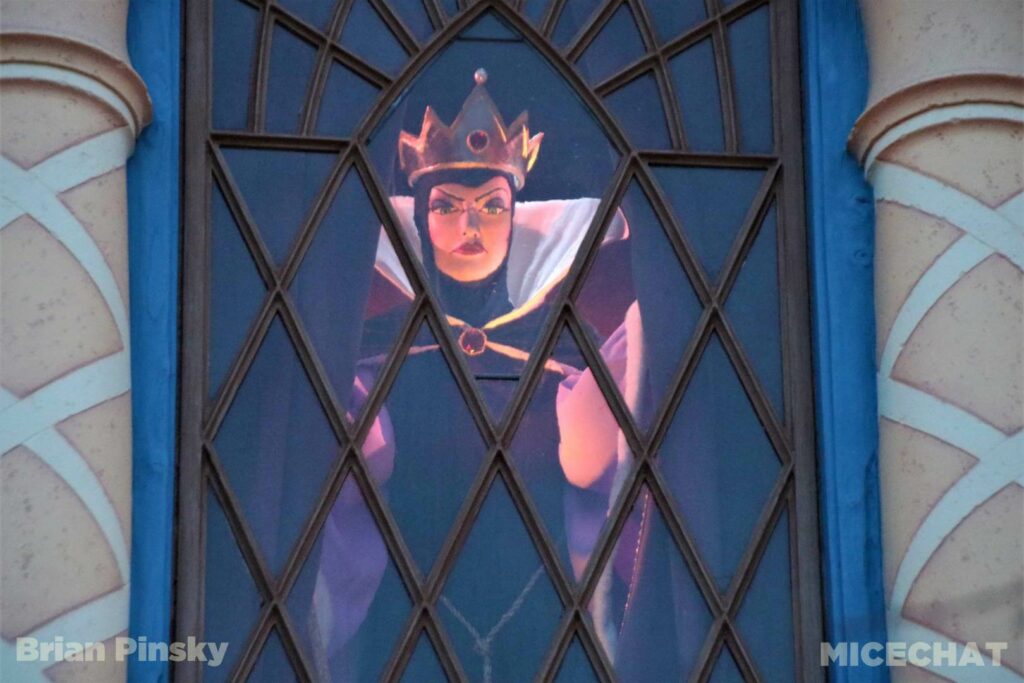
As Sandra M. Gilbert and Susan Gubar write in their essay titled “[Snow White and Her Wicked Stepmother],” the Queen “is a plotter, plot-maker, a schemer, a witch, an artist, an impersonator, a woman of almost infinite creative energy, witty, wily, and self-absorbed as all artists traditionally are” (Gilbert and Gubar 389). The Queen carries all of these personas throughout the entire story, which is what makes her character so great. She imposes power over her stepdaughter through her own means, and it is merely up to the Dwarfs and the Prince to save Snow White in the end. The Queen is the embodiment of a strong, independent woman – qualities that Snow White unfortunately lacks in both the original story and ride adaptation. In Snow White’s Enchanted Wish, the Queen can be seen in both the interior and exterior of the ride, always watching over and plotting her next move. She can be spotted occasionally opening the curtain and peering through the castle window on the ride’s exterior tower, signaling the danger she imposes even before the ride begins. Simply her placement above park-goers in the castle tower physically symbolizes the power she not only holds over Snow White, but over us as well. When riders are finally seated, the Queen is a reoccurring character throughout and is always casted in a sinister light – her loud cackles can be heard echoing through the ride’s tunnels and her presence irks younger (and truthfully older) audiences as she horrifically turns to reveal her transformation into an old hag. Even in her death, she can be seen towering over the Dwarfs and the riders at the top of a rocky cliff. The Queen’s character dominates the ride entirely, and it is the danger that she imposes that makes us feel accomplished when we finally reach the end.
The creation of Snow White’s Enchanted Wish in Disneyland Park is the embodiment of the Grimms’ worldbuilding in the original tale of “Snow White.” Their fictional world comes to life through implementing methods of environment and setting, character identities, and power dynamics, all in which can be seen throughout the ride adaptation in Fantasyland. The ability to bring a fairy tale to life with an interactive amusement park experience reveals how storytelling can transform across all mediums and become a physical space for people of all ages to enjoy. This transformation from written to interactive storytelling is important because it highlights how fairy tales remain prevalent throughout centuries of literature and timeless across generations of people. Thousands of adults and children alike visit Disneyland yearly to escape from the pressures of everyday life. Rides like Snow White’s Enchanted Wish offer its guests a glimpse into another life, one that isn’t their own but can still be experienced firsthand.
Works Cited
Cambridge University Press & Assessment. “World-building.” Cambridge Dictionary,
“How could we forget those ancient myths that stand at the beginning of all races, the myths about dragons that at the last moment are transformed into princesses? Perhaps all the dragons in our lives are princesses who are only waiting to see us act, just once, with beauty and courage. Perhaps everything that frightens us is, in its deepest essence, something helpless that wants our love.”
––Rainer Maria Rilke
Hansel and Gretel
Daddy went out to chop some wood
Mommy–new mommy– was up to no good.
She didn’t love us
She didn’t care
She’d still kill us if the cupboards weren’t bare
We made it back once
cause Hansel was clever
But the woods were dark,
Real dark this time around.
We were lost,
But we were lost
together.
Deep into the woods we went,
Our feet tired, hope nearly spent.
I hoped we might just go to bed
When we caught the scent of baking bread.
I thought my eyes were playin’ tricks
When I saw a house standin’ on peppermint sticks
There was a little old lady,
Little old and ugly.
But That sweet old lady wasn’t really so sweet
Just cause we’re little doesn’t
Mean we’re treats.
We showed that old witch
A thing or two about tricks,
Popped her in the oven
And we banana split!
I know it’s true–
Daddy was willing to leave us to die…
…But at least he wasn’t gonna put
Us in a potpie!
Rapunzel
That came baby through
Swaddled and coddled already
Wrapped in a keratin blanket.
–The witch-doctor said it was a bad omen–
But she knew.
How could she not?
Hair is never the end.
It begins with hair, and the rest
Flows after.
It flows and flows
And flows and
the blood will rise and fall
With the tides and the moon.
Hide her deep in the earth;
she would still sprout,
Break out and blossom.
Somethings
You just can’t
Lock away.
A Wolf’s Guide to the wood
BEWARE LITTLE GIRLS OUT BY THEIR LONESOME
If they are wearing clothes of crimson, burgundy, or rose, Exercise CAUTION
if suspect is hooded, exercise EXTREME CAUTION
IF YOU HAPPEN TO CROSS PATHS WITH SMALL CHILDREN:
Play it cool. (smile)
Ask for directions (Then avoid the designated area)
Ask for advice (Heed none whatsoever)
ENCOUNTERING WOODSMEN, PIGS AND GRANDMOTHERS
Immediately scan surroundings for those tiny humans
Woodsmen, Pigs (usually) and Grandmothers are only dangerous in combinations with small children, and red clothing.
Woodsmen are dry and gamey, pigs often taste like construction,
Grandmothers are succulent (Do not swallow whole)
Beauty and the Beast
Every once in a while
Or upon a time
A beautiful soul
May gaze through
Into the looking glass
And find
A “who” they do not
Yet recognize.
Don’t be too froggy.
Don’t jump
too quick.
There is a beast staring
Back through your own eyes.
Or is it?
Indeed there is a beast
Deep in every mirror.
But sticks and stones are poor
tools to clean.
Curiosity it seems does a
Fine job at making things
Clearer.
Who then?
Why them?
If not what, then where?
Does it matter in the least?
Ask if there
was love.
Ask if love
is still there.
Would you not rather be the beast
Snow White
Poison in my throat–
Light begins to leave my eyes–
Still, I choose to trust.
Sleeping Beauty
Never take for
Granted the kind
Of kindness
A fairy may grant.
If you are to
Sleep, pray not
To sleep on
Knowing this
Pendulum swings heavy
And full to both sides.
The fairies, they do
Not care much for excuses.
Even the mites
That burrow deep in
Their brows have
Hibernated more winters
Than neolithic coal which
Have since turned to
Karats.
The blessings they bestow,
Like magic
Without the poofs and puffs
Of smoke,
Are but goodie bags.
The fountain
Of gold: A sweet
Wrapped in tinsel.
The curse reversed:
A plastic kazoo.
And the slap on
The wrist for
A poorly planned
Party, may quickly
Become a century-long
time-out.
Cinderella
To anyone and everyone
Who has spent their days knelt in the dust and ash,
Research has shown that fairytales are tools that can be utilized to aid in different aspects of child psychological development. There are many reasons why parents cross culturally have used storytelling with their children: In a 2011 study where 470 parents of children ages 3-5 were asked questions about fairytales. When asked about what purpose do fairytales serve for their children: 66.4% of parents said that they used fairytales to model good behavior, 50% of parents said they used fairytales to manage bed time anxiety. 15% of couples said that they would restrict story time as a punishment. All couples (100%) agreed that there is an instructive purpose to fairytales. (Tsitsani et al. Fairy tales: A compass for children’s healthy development – a qualitative study in a Greek island). This study shows that clearly parents recognize fairytales as a tool for their children’s development. This raises the question: How are fairytales exactly helping in children’s development? Bruno Bettelheim (1903-1990), a child psychologist, explores how fairytales help children better understand the world in his Book: “Uses of Enchantment”. He deconstructs fairy tale motifs and how they are applicable to common problems that children face and how they aid in helping a child develop a better understanding of their world. He takes inspiration from psychoanalysis to apply these motifs to children’s stages of development. In this paper, I have created three case studies based on Bettelheim’s research to show how his approach to fairytales could be used in psychoanalytic therapy. Fairytales are not only tools for children to understand their world better, in a clinical setting, fairytales can be utilized to help children struggling with complex interpersonal issues that they may not yet understand.
Bettelheim’s approach
Bettelheim as a child psychologist takes an interesting perspective on fairy tales. He applies psychoanalysis coined by Freud which primarily focuses on the development of a child’s personality to fairytales to highlight the importance of fairytales to children’s psychological development. Bettelheim’s approach is not merely a reiteration of Freud’s ideas, however. The application of concepts to fairytales and fairytale motifs is what made him a leader in the field of psychology. Bettelheim’s goal in the Uses of Enchantment is to help children and adults understand the meaning in their lives through fairytales (Bettelheim 4). He states that finding this meaning through fairytales has had profound clinical effects on the lives of his own patients “As an educator and therapist of severely disturbed children, my main task was to restore meaning to their lives. This work made it obvious to me that if children were reared so that life was meaningful to them, they would not need special help” (Bettelheim 4). He sees fairytales as the way that children can understand these deeper meanings in life that may be easy for adults to comprehend but due to the nature of development are confusing to children.
One of the ways in which children can find meaning in fairytales is through relatability. Since fairytales are told from a child’s perspective, addressing issues that are relatable to a child it is easy for the child to project themselves onto the story, “He can gain much better solace from a fairytale than he can from an effort to comfort him based on adult reasoning. A child trusts what the fairy story tells because its world views accord with his own” (Bettelheim 45). Fairy tales, unlike adults are easy for children to understand because they do not contain complex constructs that children do not yet understand. Bettelheim references Piaget, another leading psychologist in developmental psychology who states that children think animistically (Bettelheim 45). Animistic thinking is the application of human emotions and problems to inanimate objects “to the child, there is no clear line separating objects from living things; and whatever has life has life very much like our own,” (Bettelheim 46). Because children think this way, magic in fairy tales in the form of talking animals and magical objects makes perfect sense to them and is relatable in a way it would not be to an adult. This is a way in which the fairytale is catered towards the children’s point of view. Bettelheim’s idea that fairytale motifs can help children understand their complex struggles is a way that fairytales can be used to address major problems in children’s lives in clinical settings. Though Bettelheim has made an important contribution to both the studies of folkloricism and psychology, his work is not without controversy. One of his criticisms surrounds his knowledge or lack thereof of folkloricism. In “the Uses Of Enchantment”, Bettelheim’s inability to consult a large range of previous sources on the genre leads him to make broad and incorrect statements about folklore (Dundes, 76). However, Bettelheim is a psychologist, not a folkloricist, his prominent and relevant findings surround psychology, which he does have extensive knowledge on. I would argue that this would be a larger problem if Bettelheim claimed himself as a folkloricist but since he is not I feel that this criticism is fair but does not discredit his contribution. It is also argued that Bettelheim did not consult the previous work of Géza Róheim, another psychologist at the time who previously wrote about wish fulfillment in Hansel and Gretel, and Little Red Riding Hood. The two had extremely different interpretations of the tale (Dundes 76). However, I strongly disagree with this criticism. While it is important to consult the previous work of leading scholars in a field, as I am doing in this essay, it is also important for there to be different ideas in the same field of study. By reading another scholar’s interpretation, Bettelheim could have compromised his own interpretation and new ideas. I have always been taught to formulate my own interpretation of a story before consulting another’s analysis because once another scholar’s analysis is read it is much more difficult to differentiate their ideas from my own, which is why everything I have taken from Bettelheim centers around his interpretation of motifs and how they function rather than his thoughts on the tales as a whole.
Psychology is an incredibly broad field, it is influenced by findings in biology, chemistry, sociology, neuroscience, and more. Some psychologists take an approach influenced by chemistry, others develop their ideas through sociology, and many take a wide range of influence from all of these things, to argue that a psychologist must look at all previous relevant research is an impossible task because of the nature of the field. There are approaches to psychology that I hate, for example evolutionary psychology. I have read literature and even took a full course on the topic, however I do not include it in my approach to psychology and my analysis of individuals simply because I disagree with most of it and find it inherently outdated and problematic. Criticizing Bettelheim for not consulting another scholar’s work is harmful because it suggests that there is a “correct” approach to psychology which undermines the point of the entire field. It is possible for psychologists to have conflicting ideas and can be incredibly important in discovering new things. For example, our current understanding of color vision developed from two incredibly different theories. The acceptance that the two theories can both be true at the same time is what allowed psychologists to have a wholistic understanding of how we see color.
Bettelheim is also criticized for using the work of psychologist Julius E. Heuscher from his 1963 book without credit. Passages are copied almost word for word and Bettelheim uses several of Heuscher’s main ideas and claims that they are his own (Dundes 79). Unlike the other criticisms, I strongly agree with this one. It is undoubtedly wrong to use another’s work without credit and since the paragraphs are worded almost identically, lazy on Bettelheim’s behalf.
To truly replicate a “study” I must explain my participants, and methodology: I constructed stories of three children experiencing different complex issues, these make up the case studies in this paper and my participants. None of the information in any of these case studies represent real children as this would be unethical without providing informed consent and getting permission from the Institutional Review Board. I have applied Bettelheim’s concepts and motifs to each case study to evaluate the child and prescribe them a fairytale to help with the problem they are having.
CASE STUDY 1
Lia’s school reports that Lia is incredibly socially withdrawn. She was referred by her elementary school counselor as her teachers noticed she would frequently stay inside during recess to read her book. Lia is above average reading level for her age, and particularly has an interest in sci-fi fantasy books. Her school reports that she is very intelligent and always does well on her assignments, but rarely speaks, even in class. Lia’s parents report that getting to school is a challenge for Lia and that she hates trying new things. When asked more about what that meant, Lia’s parents said that every day Lia would scream and cry and beg not to go to school. They also state that Lia has little interest in sports or outside activities and at home spends a lot of time in her room, reading. Lia’s parents also state that when they leave as a family, Lia often clings to them and refuses to interact with anyone else, she struggles to order food when the family goes out to eat and makes her parents order for her. In session, Lia is silent and reads her book. The only time she speaks, without being asked to speak, is to ask: Can I go home now? She asks this at the end of every session at 1:30 on the dot. She seems to be eager to go home and she packs her book into her shoulder bag quickly and leaves. Lia appears to have a tremor in her right hand and rocks back and forth when she reads, presumably for comfort. When asked to describe what she is reading she will in detail and then promptly go back to reading, when she talks about her book she becomes animated and passionate, words come easy to her but she is unwilling to discuss anything other than the plots of the books that she reads.
FAIRY TALE ASSIGNED AND WHY (1)
Lia appears to struggle from severe anxiety to the point of agoraphobia. Agoraphobia is a condition that is characterized by the extreme anxiety around traveling to new places and leaving the home. Individuals with agoraphobia are trapped by their own anxieties, the disorder revolves around a fear of being potentially stuck in an overwhelming situation ( Agoraphobia, Mayo Clinic). Individuals with agoraphobia also may find that clinging to family members, especially in unfamiliar environments can temporarily help the individual feel more secure. However, this is not a treatment nor a cure for agoraphobia as we cannot always rely on others to be a safety blanket. “If we try to escape separation anxiety and death anxiety by desperately trying to keep grasp on our parents, we will only be cruelly forced out, like Hansel and Gretel.” (Bettelheim, 11). The only effective treatment to agoraphobia is facing ones own anxiety. Reading seems to be a way that Lia can cope with the overwhelming outside world when she does not have the security of her parents. Reading, specifically something so far from reality like fantasy is a form of escapism as it is a mentally stimulating activity that transports one to a different world. While stories are incredible for young minds as outlined through Bettelheim’s work, and Lia is obviously incredibly intelligent for her age, forming social bonds and relationships outside of parents is necessary for children as their parents won’t be there for them to rely on forever.
I would prescribe Lia Rapunzel by the Brothers Grimm because individuals with agoraphobia often feel trapped by their own anxieties, much like Rapunzel is trapped in her tower by the evil witch. The evil witch is a personification of Lia’s anxieties, she is unaware that she is trapping herself in her own metaphorical tower. She believes what her anxiety is telling her, that she is unequipped to handle overwhelming situations and relationships without the help of her parents much like the evil witch in Rapunzel believes that Rapunzel cannot handle the world away from her tower. The witch believes that she is protecting Rapunzel when in reality her lack of preparation for the world makes her vulnerable this is similar to the way that Lia’s anxiety tells her that new places and situations are dangerous when this is not the case. Rapunzel lets a random man climb her hair and be alone with her in her isolated tower, she has never met a man before (Tatar 491) and therefore she does not know that they can be dangerous, she is naive to the understanding that people don’t always have the best intentions and because of this puts herself in an incredibly vulnerable situation. Lia, is blind to her own naivety as is Rapunzel, seeing this nativity in a character that shares her experience of feeling trapped is an important lesson for Lia to learn. The prince is also helpful for Lia to see that relationships can be a beneficial thing. Though she naively lets him in the tower, she is hesitant to form a relationship with him at first “Rapunzel at first was terribly afraid, she had never laid eyes on a man before. However the prince began to talk to her in a friendly way and told her that her song had touched his heart so deeply that he had not been able to rest until he had seen her. Gradually Rapunzel overcame her fears,” (Tatar 491). The evil witch harming her beloved prince shows Lia that pushing those away because of her anxiety (literally in the case of the evil witch pushing the prince out of the tower) is leaving her alone with the thing that is trying to sabotage her masquerading as a “protector”, her anxiety. Even when blind, the prince does not give up searching for Rapunzel, which models a positive example of how good relationships can be and that her anxiety can be wrong.
Reading is a way that Lia copes with this anxiety through escapism and distraction, however this does not make the anxiety go away rather pushes it back to the unconscious. Bettelheim states: “When the unconscious is repressed and its content denied entrance into awareness, then eventually the person’s conscious mind will be partially overwhelmed by the derivatives of these unconscious elements, or he is forced to keep such rigid compulsive control over them that his personality may become severely crippled,” (Bettelheim, 7). Lia must learn how to face her anxiety rather than trying to escape it if she wants to live a life more fulfilling than being trapped in her tower. Rapunzel is a character relatable for Lia and the story can help her understand that her anxiety does not have her best interests at heart and is in fact stunting her development.
CASE STUDY 2
Allison is an 8 year old girl from Chicago Illinois, Mother reports frequent outbursts at home. School reports that Allison is withdrawn and often seems to be in her own world. Her love for drawing and art signals high creativity. Allison appears to be shy, slight hand tremor in both hands suggests anxiety and nervousness. She keeps to herself and only speaks when prompted, she is very polite. Allison reports that her parents are married happily. Allison reports that her mother works a lot. When asked if Allison and her mother fight a lot: Allison insists that they do not and that they have an excellent relationship despite her mother’s report. Allison is always on time, her mother brings her to each session despite her seemingly busy schedule. Allison and her family seem to be well off financially and it is evident a lot of emphasis is placed on Allison’s appearance and the way she presents herself. She maintains good posture, even when sitting on the couch and is always wearing formal clothes. Her hair is always in two identical tight braids. When asked about why she is in therapy Allison states that it is because she is a bad kid sometimes and has anger issues. Allison’s school reports no anger outbursts but that sometimes Allison appears sad.
FAIRY TALE ASSIGNED AND WHY (2)
Considering Allison’s prognosis, and the lack of issues at school, a defiant disorder is not evident. Rather, Allison seems to suffer from anxiety due to her mother’s inability to properly handle her stress. Judging from the level of politeness she demonstrates it is evident that this is something enforced strongly at home. Her mother cares about her, she makes time to bring her to therapy and Allison’s afternoon sports. However, the cause of Allison’s outbursts does not seem to be related to an underlying issue rather pressure from her mother to reach a standard of perfection that is impossible for a child. Considering that Allison insists there are no problems between her and her mother, it can be inferred that Allison is experiencing a phenomenon that Bettelheim calls “false parent syndrome”: “Far from being a device only used by fairy tales, such a splitting up of one person into two to keep the good image uncontaminated occurs to many children as a solution to a relationship too difficult manage or comprehend.” (Bettelheim, 67). Allison does not yet have the tools to understand that her mother’s anger is a manifestation of her own anxiety around her unachievable expectations of Allison, so instead of viewing her relationship with her mother as it is she internalizes her mother’s issues.
A fairytale motif used to help children better comprehend their own understanding of false parent syndrome is the Evil Stepmother. Children lack the ability to accept that sometimes parents aren’t “all good” or “all bad” and by creating an “all bad” stepmother it can help the child understand their anger and towards the evil stepmother while still acknowledging that the “good” or biological mother exists. Creating an evil separate parent allows children to understand that it is possible for a parent to be at fault and this could be extremely helpful with Allsion, “The fairytale suggests not only isolating and separating the disparate and confusing aspects of child’s experience into opposites, but projecting these onto different figures,” (Bettelheim, 75). Allison’s lack of willingness to discuss the issues in the relationship with her mother indicates that she feels ashamed for the inability to control her anger, an impossible expectation to have of the child. “It is as if the fairy tales, while admitting how human it is to get angry, expects only adults to have sufficient self-control not to let themselves get carried away,” (Bettelheim, 72)
To get Allison to realize that her anxiety and emotions are not the fault of her and that her mother’s expectations are harming her, I would prescribe her Cinderella by: the Brothers Grimm. Cinderella provides not only an evil step-mother, but also evil step-siblings. Applying Bettelheim’s concept of “false parent syndrome” to the step-sisters as well may help Allison understand that the parent and their expectations can influence the behavior of a child, therefore helping her understand that the fault of her outbursts are not entirely her own and that her mother’s expectations of perfection are influencing her behavior. The Brothers Grimm create a clear juxtaposition between the behavior of Cinderella’s original mother and her step-mother as well as between her and her step siblings. In the beginning of the story the step-sisters were described as having “features (that) were beautiful and white but whose hearts were foul and black,” (Tatar 148). The opposite of Cinderella, who is good and always says her prayers but is covered in ash because she sleeps next to it every night (Tatar 148). Representing Bettelheim’s idea of having all good and all bad characters split Allison can now clearly see how a parental figure can be responsible for negative traits in their child. This could possibly also help Allison prevent internalizing her mother’s obsession with her appearance. The protagonist in Cinderella is represented as wearing rags and being covered in ash but she is a good person, whereas her step-sisters obsessed with vanity and status do “everything imaginable to make Cinderella’s life miserable” (Tatar 148). Much like Allison’s mother, the evil step-mother in Cinderella is obsessed with status. She even goes as far to cut off parts of her own daughter’s feet so that they will marry royalty (Tatar 152). Both increasing her and her daughter’s status. The Step-mother’s expectation of status is literally physically harming and disabling her children. It is clear that Allison has been instructed not to talk about her fights with her mother because of her hesitancy discussing their relationship. Her mother has an expectation of the appearance of a perfect relationship with her daughter while this is not actually the case. Often parents are afraid that a child’s emotions as well as their own will reflect negatively on them and their parenting. Telling their children to not speak about family fighting, creates an environment of shame around anger. As seen through the evil step-mother cutting off the step sisters feet. Attempting to alter or change the truth to keep an appearance has devastating effects for the child. The step-sisters are expected to lie and pretend that they are Cinderella while bleeding and in pain. Forcing a child to deny their own pain from their parents anger to maintain an appearance is detrimental to the child’s understanding of their sense of self because the child will internalize all of that anger and believe that they are the problem. Cinderella can teach Allison about the harmful side of familial expectations through the motif of the evil stepmother.
For anyone struggling:
If you are struggling with fear of growing up read Sleeping Beauty: No one can stay a child forever and you may miss a lot trying to prevent the inevitable.
If you keep falling in love with people that destroy you read Beauty and the Beast: A beast is a beast for a reason, even if he is incredibly nice. This story can help you understand why you love those that hurt you.
If you are stuck in grief read Cinderella: Don’t allow your grief to make you miss out on the ball and finding your prince. Be your own fairy godmother and pull yourself out of wallowing.
If you struggle with confidence read Hansel and Gretel: You are more clever than you think and you can and will get out of bad situations.
If you struggle with self-sabotage read Snow White: Don’t let things meaningless things like vanity prevent you from true happiness.
If you feel like you are stuck in a box read Little Red Riding Hood: Wolves come out when you stay on the path.
Works cited:
Tsitsani, P., et al. “Fairy Tales: A Compass for Children’s Healthy Development—a Qualitative Study in a Greek Island.” Child: Care, Health and Development, vol. 38, no. 2, Mar. 2012, pp. 266–72. EBSCOhost, https://doi-org.lmu.idm.oclc.org/10.1111/j.1365-2214.2011.01216.x.
Bettelheim, Bruno. Uses of Enchantment. Random House Inc, 2023.
Dundes, Alan. “Bruno Bettelheim’s Uses of Enchantment and Abuses of Scholarship.” The Journal of American Folklore, vol. 104, no. 411, 1991, pp. 74–83. JSTOR, https://doi.org/10.2307/541135. Accessed 15 Nov. 2024
“Agoraphobia.” Mayo Clinic, Mayo Foundation for Medical Education and Research, 7 Jan. 2023, www.mayoclinic.org/diseases-conditions/agoraphobia/symptoms-causes/syc-20355987.
Tatar, Maria, editor. The Classic Fairy Tales: Texts, Criticism. Second ed., W.W. Norton & Company, 2017.
Russian formalist and folklorist, Vladimir Propp, argued that all fairy tales exist as slight variations of a single tale. Silva explains Propp’s Dragon Slayer model for this universal tale, “he took note in his later magnum opus[1] of the connections between fighting a dragon and being swallowed by one; between being in the beast’s entrails and entering the realm of the dead; and between this transition—which he considers the wondertale’s axis and its central point—and metamorphosis” (84). The hero’s descent into the stomach of the dragon symbolizes a multi-faceted transformation essential to this tale-type model. The act reflects the fairy tale trend where children defeat monstrous foes, each with massive appetites, through figurative devourment. However, tales where they must escape the literal inner space of their antagonists as described by Propp appear much less common. Tracking the occurrence of heroes who emerge from stomachs across global folklore and modern storytelling, the belly of whale appears overwhelmingly often. The belly of the whale succeeds as a cross-cultural archetype of reflection and transformation to overcome humanity’s deepest anxieties, because of its trifold nature as divine enigma, womb asylum, and resurrective tomb.
All three of these elements stem from the biblical story of the prophet Jonah who transforms from a coward overwhelmed by the heavy weight of his responsibilities to a grateful philosopher searching for justice after he is swallowed by a fish. When God calls him to save Israel’s enemies in Nineveh, Jonah attempts to abandon his prophet vocation by fleeing in the opposite direction by boat so that God will have no choice but to destroy the unrepenting city (New Revised Standard Version, Updated Edition, Jon. 1:1-3). Instead of punishing Nineveh, God punishes Jonah, sending a storm after his ship (Jon. 1:4). The entire gentile crew repents, but Jonah, still refusing to follow God’s plan, asks the crew to throw him into the sea as a sacrifice so that God will no longer be angry with them (Jon. 1:11-16). After they do this, God saves Jonah from drowning by sending “a large fish to swallow up Jonah, and Jonah was in the belly of the fish three days and three nights” (Jon. 1:17) where he eventually prays to God for forgiveness and is brought back to Nineveh to prophesize. Although he later expresses more dissatisfaction with God’s plan, his time inside the large fish, which encyclopedian John Wilson argued could only have been the mammalian sperm whale (Moe 9), restores his character from anxiety to passionate confrontation. The appearance of the fish acts as a peculiar deus ex machine thwarting Jonah’s suicide attempt in both punitive and salvatory ways, disarming him of all freedoms except prayer while also granting him mercy from the consequences of his choices.
This mysterious divine combination of punishment and mercy encapsulates the enticing enigmatic nature of the whale that functions to affirm the hero’s own humanity. It was not until 1984 that researchers took the first underwater film of sperm whales (Moe 2), meaning before then few people knew living whales beyond brief moments of partial visibility when they breach the surface. Whales then represent complete unknowns, not to mention the mostly unexplored ocean depths itself, whose reputation of size becomes exaggerated in people’s imagination. Their awe-inspiring size fits into the religious model, where humanity’s anxious need for domination gets humbly pacified by their stature, except for when pursued by the unchecked egos of whalers. This divine power might also act in separation from the human world, like angels justly ruling heavenly seas while humanity keeps its dominion over land. Psychoanalyst Bettelheim argues the importance of divinity in folklore and fairy tales, “Literary critics such as G.K. Chesterton and C.S. Lewis felt that fairy stories are ‘spiritual explorations’ and hence ‘the most life-like’ since they reveal ‘human life as seen, or felt, or divined from the inside’” (24). These critics clarify that experiencing a fairy tale requires an inherently spiritual turning inward that the divine symbol of the whale’s innards powerfully exhibits.
Their mysteriousness and unimaginable size relate these species to human knowledge and its limits, becoming a symbol of what humanity does not know in an anxious (swallowing) and protective (saving) way. Unaddressed in the old Jonah story, whales are also intelligent mammals which further emphasizes the puzzling bond between them and humans. Their mammalian nature becomes divine and comforting because of how it seemingly allows them to overcome sweeping natural rules. A person without hope that their efforts will make any difference may look to the whale for inspiration, because of how it overcomes its mammalian limits of breathing with lungs to traverse the sea. The fact that the whale does not digest Jonah at all in the story underscores these confounding symbolic elements of the whale image. The whale then does not serve as an organic antagonist but rather a divine miracle that complements human existence to remind Jonah of his own providential limits.
In possibly the other most famous[2] belly of the whale story, Carlo Collodi’s The Adventures of Pinocchio, a mile-long Shark[3] suddenly appears and swallows the wooden puppet, providing the final challenge for him to start becoming a real human boy. Collodi references the divinity of the Shark by describing it as “Attila of fish and fisherfolk” (141) which the footnote clarifies means “Scourge of God” (192). Just as in Jonah’s tale, divine punishment takes on the form of a whale-like creature, but Collodi expands the significance of this idea, “When Pinocchio recovered his wits, he couldn’t even figure out what world he was in. All around him was darkness. Everywhere” (142). The darkness itself of the whale’s belly epitomizes mystery, strangeness, and the limits of human sense and perspective. The darkness may act as a complete extension of Pinocchio’s child-like naivete which constantly leads him into trouble throughout the story, but it also performs as the extinguishment of his stubbornness. With his lack of knowledge externalized to make up a whole setting with no apparent next destination, Pinocchio may no longer flee from immoral short-sighted scheme to short-sighted scheme, as he did with the Cat and Fox, Lampwick, and other tricksters. Pinocchio then notices a light in the darkness and the Tuna tells him, “’It must be some companion in misfortune who—like us—is waiting to be digested!’” to which he replies “‘I want to go see him. Maybe it’s some old fish who can teach me how to escape?’” (143). Previously overlooking the advice of the older Geppetto and Talking Cricket in favor of the words of tricksters, the whale develops for the first time an intuition in Pinocchio to trust older people. Pinocchio’s father and creator, in apparent religious allegory, created the light and the two reunite thereafter. Pinocchio proceeds to recap the plot of his entire story so far to Geppetto (146), self-actualizing by telling his fairy tale story. This process benefits him the courage to lead a plan of escape that Geppetto questions, “’Do you really think it’s possible that a puppet like you, barely a meter tall, could have enough strength to swim with me on his shoulders?’ ‘Just try it and you’ll see! In any case, if it’s written in the heavens above that we must die, at least we’ll have the immense consolation of dying in each other’s arms…. Follow me, and don’t be afraid’” (148). Pinocchio confronts the deep ego fear of death from within the dark whale chamber and nearly sacrifices himself to save another person (his father), in complete contrast to the id selfishness with which he answered past challenges on land. With his father on his shoulder, and the Tuna following his example, Pinocchio transforms from the child trickster to a paternal hero, and not much later receives his human form from the fairy. The divine enigmatic nature of the Shark exposes Pinocchio’s mortal anxieties such that he acknowledges his past experiences, incorporates the paternal into his identity, and proceeds with selflessness, ultimately transforming him with true humanity.
Similar to the externalization of Pinocchio’s childishness, the belly of the whale functioning as a womb renders Jonah into a practically pre-natal form that inspires faith in him by revealing God’s maternal nature. Jonah behaves like an impatient child at the start of the story, following the pleasure principal as Spearing explains, “Jonah is trying to run away from his superego’s (conscience’s) demand that he fight against the wickedness of the people of Nineveh” (4). He adheres to id fear and shallow superego cultural biases which transmutes him into a fetal form so he may mature into the reality principal of long-term deep ego ideals of his own God’s selfless love and forgiveness. Bettelheim explains the relevance of this transformation in fairy tales through the Grimms’ “Little Red Cap” where the titular characters emerges from the belly of a wolf, “Little Red Cap, when she fell in with the wolf’s seduction to act on the basis of the pleasure principle instead of the reality principle, implicitly returned to a more primitive, earlier form of existence. In typical fairy-story fashion, her return to a more primitive level of life is impressively exaggerated as going all the way to the prebirth existence in the womb, as the child thinks in extremes” (180). As a figurative child, he acts in oedipal conflict with the paternal figure of God, because he cannot differentiate the functions of God’s inconsistent forceful punishments. Only focused on the traditionally masculine act of physical force and destruction, Jonah must also observe the functions of God’s maternalistic side to understand God’s justice. Anxiously distraught at God’s paternalistic power such that Jonah invites the crew to kill him, Jonah receives maternal care in the womb-like asylum of the belly that restores his safety so that he may reflect on the deeper needs of his subconscious. When the whale regurgitates him, his consumed form is replaced with a wiser superego structure through rebirth.
John B. Flanagan connects these psychological relationships to the archetypal maternal image in his sculpture Jonah and the Whale: Rebirth Motif (fig. 1). By vertically orienting the sperm whale’s shape, his design signifies a female body with Jonah contained tightly in her womb. An etched line at the bottom of the sculpture connected to Jonah represents the whale’s mouth, the vaginal canal, and his umbilical cord. Jonah becomes dependent on the whale’s appetite and its maternal chamber. Flanagan’s demonstration of the whale’s union of animalistic stomach and maternal womb parallels the union of the whale’s masculine and feminine form. Moe defends the gendered image in the original story, “The sperm whale can be figured as masculine: his massive and phallic forehead, his creamy spermaceti, his very name, his aggression toward whaling ships. This hyper-masculine whale is now to become intensely feminine via its womb, a site of nurture, gestation, growth, offspring, and delivery” (10). In the sculpture, the sperm whale’s phallic head appears to collide with the wooden base of the statue yet also provides the support to uplift the rest of its form, fetal Jonah included. Similarly, God’s masculine destruction draws Jonah to his beliefs, but becomes only the foundation by which he may understand the graver importance of feminine selflessness after being selflessly birthed again himself. Flanagan shapes the whale’s tail as a breastplate, connecting the animal’s journey to Nineveh to the strength nurtured in breastfeeding. The rugged, otherwise undetailed form of the statue demonstrates the archetypal-ness of the whale image, such that even without a head or identity for the human mother, its being functions irreproachably as such.
Other belly of the beast stories embody this maternalistic image to reconcile toxic dominating desires with nurturing relief, drawing overwhelmed heroes into moments of inspiring safe simplicity. In Finding Nemo, Marlin and Dory are briefly trapped inside the mouth of a blue whale during their search for Nemo. The choice of a blue whale over a sperm whale reflects the geographical setting of the film, an enigmatic interest in the largest animal species alive, and the smallness of the fish characters who can fit through the whale’s baleen plates where Jonah could not. The latter point emphasizes that the smooth wide inner space of the whale’s mouth relative to Marlin embodies less of Flanagan’s cramped womb imagery. Nevertheless, the feminine connection between the whale and Dory, who summons it and speaks for it by translating Whale, and the more peaceful nature of blue whales compared to sperm whales (along with Marlin’s peaceful takeaway) indicate the maternal effects of the scene. Dory serves both as maternal proxy for the whale but also in Marlin’s parenting relationship of Nemo after the barracuda ate his partner, Coral. Inside the whale’s mouth, Dory relieves Marlin’s parenting anxiety by starting a conversation between them, “’There, there. It’s all right. It’ll be OK.’ ‘No, it won’t.’ ‘Sure it will, you’ll see.’ ‘No. I promised him I’d never let anything happen to him.’ ‘Huh. That’s a funny thing to promise.’ ‘What?’ ‘Well, you can’t never let anything happen to him. Then nothing would ever happen to him. Not much fun for little Harpo’” (Finding Nemo 01:10:40). In typical fairy tale fashion, the story instructs parents to allow children to adventure despite its many dangers, because without them they will not grow. However, instead of expressing this through the story of a child protagonist, the unique setting of the grand maternal whale allows the film to directly comfort the adult characters and audience. The special hectic multi-layered symbolism of the whale extends Dory to proxy for Nemo as well when Marlin starts off, “’No more Whale! You can’t speak Whale!’ ‘Yes, I can!’ ‘No, you can’t! You think you could do these things but you can’t Nemo!’” (Finding Nemo 01:12:36). Dory’s consistent demonstration that she can in fact ‘speak Whale,’ whether it is intuitive or learned, contrasts with Martin’s blatant blindness to it and mistrust of her. Marlin asserts paternal control by imposing his own estimation of Nemo’s limits on him, but maternal Dory expands those limits against Marlin’s strict attachments that only stress him towards cruelty. Once Marlin follows Dory’s example in literal and figurative ‘letting go’ of these attachments, the whale ejects them at their desired destination, just like the whale in Jonah’s story. That Marlin and Dory find themselves inside several other male organisms throughout the film[4] (Dory even references Disney’s adaptation of Pinocchio before Marlin gets eaten by the anglerfish)[5] without discovering an inner lesson about themselves contends the significance of the maternal whale image in this scene.
In the animated series, The Marvelous Misadventures of Flapjack, Flapjack lives inside of the talking blue whale Bubbie who takes him wherever he desires and acts as his mother figure. In the episode, “Bubbie’s Tummy Ache,” Flapjacks adventures out of her mouth and deeper into her stomach. Far from the enigmatic darkness of other depictions, the show presents Bubbie’s insides in gross biological clarity, displaying her throat, vocal cords, and stomach with contracting flesh, gasses, and fluids. At each stage of Flapjack’s descent into Bubbie, a character flashbacks to a lost passion of their life. In the mouth, Bubbie tells Flapjack about her pie-eating competition days (Orman 00:53), from the throat, Captain K’nuckles tells Flapjack about his pocket-watch and previous protégé who he lost in a different whale’s throat (Orman 04:10), and in the stomach, trapped old Ruth reminisces about her many suitors she wanted to marry (Orman 07:03). The contemplative space of Bubbie’s physical form, which is entirely without perilous stakes during this episode, invites these characters to recollect important joys to them. As Flapjack ascends Bubbie, each of these passions return into their lives just as they were before. In this episode, Bubbie serves not only as a maternal shelter to protect innocent young Flapjack from physical dangers and the negative influences of K’nuckles, but also as a means of connecting the adult characters back to joys of their own youth through her maternal biological shelter.
Outside of the whale image, the maternal archetype appears in other belly of the beast stories but with more antagonistic attitudes. In Maori mythology, Hine-nui-te-po, the mother of all of humanity, becomes the goddess of death when she flees to the underworld after learning that her husband, the forest god Tane, is also her father. The arrogant male demigod Maui-tikitiki-a-taranga attempts to give humanity immortality by crawling through Hine-nui-te-po’s vagina and out of her mouth to reverse the cycle of life and overcome death. However, one of his tirairaka fantail friends accidentally foils his attempt by laughing and waking her up from sleep. She clenches her thighs which cuts off his head within her womb before he can enter farther, killing him. In this example, a whale does not consume and comfort a patriarchal hero in need with its maternal womb but rather the hero blames the maternal figure for its mortal anxiety and attempts to venture into that space on their own, leading to their punishing death.
Similarly, in Edmund McMillen’s indie roguelike The Binding of Isaac: Repentance, young boy Isaac, imagines killing his abusive mother (Mom) in fantasy play then crawls inside her to the Womb levels where he defeats Mom’s Heart. At this point, he unlocks the ability to use his experience defeating Mom’s Heart to become Eden and replay the game with any combination of stats and items. By expressing his desires to erase the current harmful presence in his life (Mom) and have instead a safe maternal presence in his life (the Womb with a pure Mom’s Heart), this setting empowers Isaac with confidence in his imagination and the possibilities of the future. However, as he repeats this fantasy more, he becomes guilty of his desires, opening Cathedral (heaven) or Sheol (hell) as the next levels in the game. In Cathedral, he optimistically aims to absolve himself through suicide, while in Sheol he attempts the same as self-punishment.[6] Eventually Isaac can confront his identity[7] and his constant fear of his mom,[8] to crawl inside a decayed version of her to face the monstrous corpse of Mother which represents a healthy yet fearsome externalization of Isaac’s trauma.[9] By defeating her, Isaac unlocks a route of the game where he does not have to enter his mother, but instead can actually ascend from the depths of the basement[10] to the reality of his home. By confronting the realities of death in the imagined corpse of his mother, Isaac lets go of imagining the satisfaction of his id anger and turns to resolving superego conflicts. In Home, he frees himself of guilt and fear respectively by defeating the true final bosses of the game, Dogma and The Beast. He then imagines himself ascending to heaven, a place he envisions as rewinding time to before he exists. Accepting the absence of maternal asylum in his life, which he previously artificially and violently created in play, the only relief that remains to the tragic figure is a pre-pre-natal non-existence. Nevertheless, the final cutscene reveals that Isaac has found shelter in his divorced father’s home, “Are you sure this is how you want this story to end Isaac? You’re the one writing it, it doesn’t have to end this way. Here, how about we tell it a different way. Maybe a happy ending?” By expressing his trauma, guilt, and fears through stories told bravely by his father, Isaac is able to overcome them. Bettelheim explains the importance of a parent vehicle of the fairy tale, “If we parents tell such fairy stories to our children, we can give them the most important reassurance of all: that we approve of their playing with the idea of getting the better of these giants” (28). The paternalistic narrator framework of the game establishes the limits of the maternal belly of the beast’s ability to provide certain heroes with sheltered self-actualizing transformation. However, with the parental reading of Isaac’s own creative work by the father, Isaac may come to terms with the maternal womb that enraptures him. After this cutscene, Isaac may play as the Tainted form of characters, each one overtly embodying elements of abuse so that Isaac may truly overcome them in a happy ending.
The video game itself acts as a self-reflexive belly of the beast, with the player replaying the same levels to defeat Mom at least 202 times[11] before achieving the true happy ending of the game. Once the player enters into Isaac’s world they become trapped within the layers of his reality until they bring about his real absolution of trauma. However, video game addiction aside, they are only trapped in so far as they need the comforts and transformative guidance the game might provide. By entering into the belly of the beast with an identity other than themselves (Isaac), the player prepares themselves with the transformative guidance the shelter offers before it becomes immediately apparent in their own lives.[12]
In the film adaptation of Coraline, Coraline travels through a tunnel resembling a vaginal canal to the threatening maternal space of the Other World (Coraline 00:16:00). At first, her Other Mother, a physical clone of her biological mother except for buttons in place of her eyes, behaves as Coraline desires and provides her with anything she wants, satisfying Coraline’s childish id. However, Coraline discovers that her Other Mother is a witch who eats the flesh of children and traps their soul in a mirror. The Other World itself becomes a proxy for the stomach of the witch. After making this discovery, the tunnel between the two worlds becomes dead and rotting, Coraline’s perceived ideal maternal space compromised by the mirrored appetites of herself and the witch (Coraline 01:00:59).[13] Nonetheless, by observing the demise of this artificial maternal belly of the beast stand-in, Coraline becomes grateful for the parental support she already has[14] and confidently confronts the strict reality principle of her family’s parenting style.
Finally, the image of the belly of the whale in Jonah’s story also functions as an underworld to address mortal anxieties. Jonah prays from within the belly of the fish, “I called to the Lord out of my distress, / and he answered me; / out of the belly of Sheol I cried, / and you heard my voice. / You cast me into the deep, / into the heart of the seas, / and the flood surrounded me” (Jon. 2:2-3). Jonah compares the belly of the whale to the belly of the underworld Sheol, revealing that his prayer comes from his fear of death and current descent towards it. The prayer continues, “I went down to the land / whose bars closed upon me forever; / yet you brought up my life from the Pit, / O Lord my God. / As my life was ebbing away, / I remembered the Lord, / and my prayer came to you, / into your holy temple. / Those who worship vain idols / forsake their true loyalty / But I with the voice of thanksgiving / will sacrifice to you” (Jon. 2:6-9). Here Jonah narrates his loss of life and ascent from the underworld as a reborn figure. This passage also defines the only accurate prophecy Jonah conveys in his book as he predicts Jesus’s descent and rise from hell later in The Bible.[15] The belly of the whale then contains an important duality of life and death that presents the hero with an ultimatum of damnation or redemption.
Due to the divine and maternal connections to the creation of life, previous examples also include references to this symbol and its themes. For example, Maui adventures into the consumptive depths of the underworld in order to achieve his ultimate goal of adventuring into the depths of his mother so as to relieve his fears about death. Isaac descends and rises from literal Sheol, as well as the figurative cycle of his constant death and rebirth through the game’s replayability. In Pinocchio, Collodi connects the Shark to death by humorously emphasizing its sickly old age, “Now you must bear in mind that since the Shark was very old and suffered from asthma and heart palpitations, he was forced to sleep with his mouth open” (148). Furthermore, when human Pinocchio asks what happened to his old self, Geppetto reacts, “he motioned toward a large puppet that was propped up in a chair, his head turned to one side, his arms dangling and his legs crossed and bent at the knees. It seemed miraculous that he could stay upright” (159). Pinocchio’s new comforted self leaves behind a deceased prior form. Bettelheim explains these different selves in context of “Little Red Cap,” “The child also understands that Little Red Cap really ‘died’ as the girl who permitted herself to be tempted by the wolf; and that when the story says ‘the little girl sprang out’ of the wolf’s belly, she came to life a different person” (179). Each of the examples throughout this paper illustrate the death and rebirth of a character’s identity due to their descent and reemergence from the belly of the whale which incarnates the underworld.
In the Urabon Sutra, one of the closest disciples of Buddha, Mokuren,[16] uses his psychic powers to observe his deceased mother, who he unexpectedly learns is trapped in the suffering Realm of Hungry Ghosts.[17] Although not overtly tied to an organic beast in this story, a maternal figure, an appetitive stomach, and mortality converge in a single image. After Mokuren offers many gifts to Buddhist monks, his mother ascends into a divine realm. By accessing the belly-like underworld through a vision, Mokuren understands and attempts to reciprocate his mother’s service to him so as to relief his generational guilt that he has not lived up to her sacrifices, and mortal legacy anxieties by setting the example for others to honor him after death.
As the vague nature of Urabon Sutra example indicates, true belly of the beast stories in East and South East Asian folklore are rare due to different longstanding cultural values regarding beasts. Buddhist cosmological expert Rawlinson describes folkloric water dragon creatures, “[naga] are represented as controlling water (or the waters), but not as mere water, but rather the essence of water: the sap in trees, the nectar of the gods, soma, the seed of living beings, milk, honey…. They are called water lizards; they are said to be water-dwellers and to play in water. More specifically, they live in the ocean, rivers and whirlpools; and they have power over rain” (7-8). Although naga possess the divine might of Jonah’s whale, their animistic nature as ‘the essence of water’ distances their symbolism from the anthropocentric comforts of the religious, gendered, appetitive, and mortal whale. Their naturalistic duality further bolsters this distance, “But the most important element in the naga make-up is fire. Nagas cause things to burn or actually burn themselves because they cannot control the element of fire” (Rawlinson 9). The aquatic enigma of the whale provides a simultaneously dangerous and comforting symbolic presence similar to the naga fiery chaos and aquatic order, yet the whale essentially differs in not having uncontrolled destruction as a key trait contradicting the whale’s controlled traits. The whale’s duplicity is grounded in the wholeness and stability of its physical traits, such that its male destructiveness may become the feminine support through a simple sculptural reorientation. To re-define the whale with the oppositional qualities of the naga would require altering its actual form, not just presentation. Rawlinson explains the symbolic significance of these naga traits.
“It is a misunderstanding of the magical worldview to object that nagas cannot be both ugly and beautiful; that they cannot be the embodiment of the water element and the fire element; or that they cannot simultaneously be snakes, people and devas. Magic embraces ambivalence and does not try to explain it away. Our argument has been that this ambivalence, combined with the notion of a hierarchy of levels of being or reality, is the essential feature of the magical cosmology that we find in the Buddhist texts.” (10)
The naga’s contradictory ambivalence serves to expand the levels of reality in stories rather than condense them as the whale’s converging natures do. This block quote also highlights that naga essentially differ from the beasts discussed so far because they have an explicit human nature to them as well. With their divine deva abilities, they may transform into humans and even reproduce with them, which while opening other possibilities, prevents them from functioning as a symbolic vehicle by which human anxieties are captured and overcome. Rawlinson cites traditional Buddhist stories involving Naga, such as one at the beginning of the Vinaya,[18] but the naga act as mindful, protective deities that pose expansive questions about reality rather than consume to provide challenging guidance as the entangled image of the whale often does.
Jonah’s story so effectively standardizes the belly of the beast image, not only due to these three key symbolic elements, but also because of its satirical pseudo-myth structure that empathetically addresses the anxieties of fairy tales while posturing as more important than that style of storytelling. Moe explains that cultural retelling of whale stories forms a clear genealogy leading back to Jonah, “As Jonah’s tale is retold, the story exhibits rhetorical velocity, a term which refers to the speed at which a text circulates as well as the ways in which that text is repurposed. The Jonah narrative circulates in multiple contexts, so much so that numerous writers can retell the same stories from different sources” (17). The story of Jonah’s contextual versatility likely stems from its comedic nature resulting from characters acting the opposite of how characters in those roles in other Biblical stories usually act. For example, Jonah does whatever he can to not prophesize as God commands and yet pagans, who typically rebuke Jewish prophets, end up accepting Jonah and God on the ship and in Nineveh. This satire veers the story’s style away from religious myth and closer towards a fairy tale. Bettelheim comprehensively defines myths.
In myths, much more than in fairy stories, the culture hero is presented to the listener as a figure he ought to emulate in his own life, as far as possible (26). The dominant feeling a myth conveys is: this is absolutely unique; it could not have happened to any other person, or in any other setting; such events are grandiose, awe-inspiring, and could not possibly happen to an ordinary mortal like you or me (37). Not only do mythical characters have names, but we are also told the names of their parents, and of the other major figures in a myth (40). The real heroes of history, however, having been people like the rest of us, impress the child with his own insignificance when compared with them. Trying to be guided and inspired by an ideal that no human can fully reach is at least not defeating—but striving to duplicate the deeds of actual great persons seems hopeless to the child and creates feelings of inferiority: first, because one knows one cannot do so, and second, because one fears others might (41). Myths project an ideal personality acting on the basis of superego demands. (41)
Because Jonah continuously renounces God and suffers from the unhappy self-loathing that results, Jonah cannot function as mythic hero meant for the audience to emulate. Although the story has mythical oneness due to Jonah being a prophet and God sending the whale specifically for him, the many examples of Jonah retellings throughout this paper culturally defend that people believe in fear and fascination that a whale could swallow any person near the ocean. Jonah does have a mythical name and family heritage that makes him an unrelatable historical figure, but does not act on the basis of superego demands. Bettelheim then contrasts this definition with fairy tales.
Far from making demands, the fairy tale reassures, gives hope for the future, and holds out the promise of a happy ending (26). To decide whether a story is a fairy tale or something entirely different, one might ask whether it could rightly be called a love-gift to a child (27). Although the events which occur in fairy tales are often unusual and most improbable, they are always presented as ordinary, something that could happen to you (37). Whatever strange events the fairy-tale hero experiences, they do not make him superhuman (40). The fairy tale, by contrast, makes clear that it tells about everyman people very much like us (40). Fairy tales depict an ego integration which allows for appropriate satisfaction of id desires. (41)
At the end of Jonah’s story, God promises a happy ending to the world and Jonah prevails as the only Hebrew prophet to survive giving their prophecy. Jonah’s story does not work as a love gift to a child, but I argue below that it works as a love gift to an adult. Collodi, who notoriously hated children, must have appreciated this gift and then adapted the story into a fairy tale love gift for a child in the ever-popular Pinocchio. God sending the fish and the fish vomiting him out are presented in single lines without any descriptive language or reaction by other characters such that they come off as ordinary. Despite Jonah’s name and vocation, he behaves for most of the story like a common person, especially in avoidance of his vocation. The strange whale setting depicts an ego integration for the satisfaction of Jonah’s id desires and the destruction of his superego biases. Therefore, the motif of Jonah’s whale likely owes its stark success to the story’s style more closely resembling a fairy tale for adults than a condescending model myth.
Although the biblical image of Jonah’s whale prevails in modern culture as a fascinating expression of the belly of the beast[19], many traditional fairy tales and modern stories embody it in completely distant manners. In the Grimm Brothers’ “Little Red Cap” and “The Wolf and the Seven Young Kids,” their titular characters get carved out of a wolf’s stomach after being eaten, and they replace the wolf’s belly with stones. In the Japanese fairy tale “Issun-Boshi,” a one-inch tall prince cuts his way out of an ogre’s stomach with his sword causing him to get recognized as a hero and transform into a full sized person. In Maurice Sendak’s fairy tale, Pierre, a Cautionary Tale in Five Chapters and a Prologue, apathetic rebel Pierre lets himself get eaten by a lion, only to realize how much he cares about life when he almost dies, and a doctor surgically removes him from the lion. In The Empire Strikes Back, the crew of the Millenium Falcon hide their ship in an asteroid near Hoth, accidentally landing inside the mouth of a massive space slug[20] that sustains its own thin internal atmosphere and microbiome. In the Adventure Time episode, “Belly of the Beast,” Finn and Jake must negotiate a diplomatic compromise between a Giant and an ensemble of Party Bears living inside of it, causing a stomachache. In the video game Subnautica: Below Zero, the player may enter into the microbiome of the jellyfish-like leviathan species Ventgarden. Each of these stories contain their own dynamics based on the nature of the beast, but have in common the Propp essence of transformation. Bettelheim clarifies one last time, “[the child] cannot yet comprehend inner transformations. So among the great merits of fairy tales is that through hearing them, the child comes to believe that such transformations are possible” (179). Bettelheim overlooks that because adults have fully grown physically and in brain development, belly of the beast myths and fairy tales prove crucial to reminding them that they may continue to change for their better peace of mind.
Certainly, other elements of the belly of the beast image contribute as well to humanity’s longstanding fascination with these transformative stories, but in stories that focus on whales as the beast subject, male adult and child heroes alike discern powerful guidance due to its symbolic nature as divine enigma, maternal womb, and resurrective tomb.
Works Cited
Bettelheim, Bruno. The Uses of Enchantment : The Meaning and Importance of Fairy Tales. Vintage Books ed, Vintage Books, 2010.
Collodi, Carlo, et al. The Adventures of Pinocchio : Story of a Puppet. Penguin Books, an imprint of Penguin Random House LLC, 2021.
Craig, Robert D. Handbook of Polynesian Mythology. ABC-CLIO, 2004.
Flannagan, John B. Jonah and the Whale: Rebirth Motif, 1937. Bluestone with wood base, 33 1/2 × 11 1/4 × 6 in., 61.5 lb. (85.1 × 28.6 × 15.2 cm, 27.9kg). Brooklyn Museum, Bequest of Edith and Milton Lowenthal, 1992.11.12a-b (Photo: Brooklyn Museum, 1992.11.12_front_PS11.jpg).
Grimm, Jacob, and Wilhem Grimm. “Little Red Cap.” The Classic Fairy Tales. Edited by Maria Tatar, W.W. Norton & Company, 2017, pp. 18-21.
Grimm, Jacob, and Wilhelm Grimm. “The Wolf and the Seven Kids.” The Original Folk and Fairy Tales of the Brothers Grimm, Princeton University Press, 2014, pp. 23-25.
Icinori, Raphaël. Issun Bôshi: The One-Inch Boy. Little Gestalten, 2014.
Moe, Peter Wayne. “Of Tombs and Wombs, or, the Whale, Part III.” Leviathan: A Journal of Melville Studies, vol. 17, no. 1, Mar. 2015, pp. 41–60. EBSCOhost, https://doi.org/10.1353/lvn.2015.0003.
Omori. Directed by Omocat, OMOCAT, LLC., 2020. Windows PC game.
Orman, Thurop V., et al. “Bubbie’s Tummy Ache.” The Marvelous Misadventures of Flapjack, created by Thurop Van Orman, season 2, episode 13, Cartoon Network, 22 Oct. 2009.
Sendak, Maurice. Pierre: A Cautionary Tale in Five Chapters and a Prologue. Harper Trophy, 1991.
Silva, Francisco Vaz da. Metamorphosis : The Dynamics of Symbolism in European Fairy Tales. P. Lang, 2002.
Spearing, A. C. “The Subtext of Patience: God as Mother and the Whale’s Belly.” The Journal of Medieval and Early Modern Studies, vol. 29, no. 2, 1999, pp. 293–323. EBSCOhost, search.ebscohost.com/login.aspx?direct=true&db=mzh&AN=1999068513&site=ehost-live&scope=site.
Subnautica: Below Zero. Directed by David Kalina, Unknown Worlds Entertainment, 2019. Windows PC game.
The Bible. New Revised Standard Version, Updated Edition, National Council of Churches of Christ in the United States of America, 2021.
The Binding of Isaac: Rebirth. Directed by Edmund McMillen, version 1.7.9b, Nicalis, 2014. Windows PC game.
Ward, Pendleton, et al. “Belly of the Beast.” Adventure Time, created by Pendleton Ward, season 2, episode 21, Cartoon Network, 4 Apr. 2011.
Yuasa, Masaaki, director. Mind Game. Studio 4°C, 2004.
[1] Propp, Vladimir. Istoricheskie Korni Volshebnoi Skazki. Азбука, 1983. I quote Da Silva about this text, because I could not find an English translation of this text available. Da Silva is referencing a French translation of the text.
[2] Many sources including Staniou’s “Pinocchio’s Road to Adulthood from Carlo Collodi to Christos Boulotis”
identify Pinocchio as in the top five mostly widely read, sold, and translated stories. The Bible always ranks above it
[3] Capitalized as such in the text. Also known as The Terrible Dogfish in Collodi’s text, or as Monstro in the Walt Disney adaptation.
[4] Incl. the barracuda, Bruce, the anglerfish, two pelicans
[6] He fantasizes suicide in both by locking himself inside of his play-chest where he suffocates. Obsessed with this image, his post-humous corpse, skeleton, and soul even become part of his fantasy play.
[7] Through the mirror segment in Downpour II. Isaac leaves his body, becoming only a soul, going into a mirror to an alternate world and then finds Knife Piece I.
[8] Mom’s Shadow in Mines II chase sequence without any items gained during the run, grants Knife Piece II. The completed Knife is used to open a fleshy door in Mausoleum II that leads to only a harder version of Mom’s Heart that after being defeated makes the entire floor decayed.
[9] As opposed to the previous final boss in the game’s development, Delirium, representing the conclusion of his unhealthy internalization.
[11] The mathematical minimum number of rounds played to earn the Dead God final achievement.
[12] By extension all stories consume us to provide a shelter for transformation like the belly of the beast, but I had a whole argument about why this videogame is a superseding exception but then I realized those qualities are found in all other forms of story too and I’m just trying to finish this paper. Bruh : (.
[14] Not just her parents, but also Mr. Bobinski as the complement to her father’s personality, and Miss Forcible and Miss Spink as the complements to her mother’s personality.
[15] Jesus references Jonah, “An evil and adulterous generation craves for a sign; and yet no sign will be given to it but the sign of Jonah the prophet; for just as Jonah was three days and three nights in the belly of the sea monster, so will the Son of Man be three days and three nights in the heart of the earth'” (Matt. 12.39-40). See also Matthew 161-4 and Luke 11:29-3.
[16] He is called Mokuren for short. His official name is Maha Maudgalyayana.
[17] This story led to the celebration of Obon Matsuri in Japan and ties into the Ghost Festival where people honor the spirits of the dead and make offerings to uplift their post-humous residence.
[18] “The Buddha, having just become fully enlightened, sits at the foot of the tree of enlightenment and comprehends the law of conditioned coproduction. He then sits successively beneath a number of different trees, including one called the Mucalinda. There is a storm for seven days and Mucalinda, the naga king, having emerged from his realm, encircles the Lord’s body seven times with his coils and spreads his great hood over the Lord’s head to protect him from cold, heat, flies, mosquitoes, wind, torment, and creeping things. Then Mucalinda, at the end of the seven days, knowing that the sky deva is without a cloud, unwinds his coils from the Lord’s body and, having given up his own form and magically created the form of a young man, stands in front of the Buddha, honoring him with joined palms” (Rawlinson 1).
[19] Cut from the divine enigma section of the paper due to time was a quick analysis of the God Humphrey in the game Omori, and the whale sent by God in the film Mind Game.
Up to a certain age, we should not tell kids about climate change,” says Mary DeMocker in The Parents’ Guide to Climate Revolution. “It isn’t their fault, and it’s too big for them to entirely comprehend. Instead, our job is to make our children fall in love with the natural world — and very few people fall in love with the terminally ill.”
Parents and fairy tales share a lot of the same responsibilities: put children to bed, remind children not to talk to strangers, teach children how to wield their imagination. They both scare children in an appropriate way and train them to distinguish between the good and the bad. Fairy tales, however, use lessons fashioned from furred monsters and tiny protagonists.
What is the point of positioning fairy tales in a post-climate-catastrophe setting, where the iconography of our most beloved stories have shapeshifted? What do we gain from the new conditions, fears and desires of this habitat? What new information does my version of LRRH have to tell? The reverse is what Ernest Block in “The Fairy Tale Moves on Its Own in Time” fought to answer: “How can [fairy tales mirror our wish-projections against a background that has long since disappeared?” (Tatar 349). I mirrored her question onto our future as it descends further into climate crsis, developing fairy tales positioned inside a post-climate-catastrophe (abbreviated as PCC).
In Classic Fairy Tales, Maria Tatar tells us, beside Claude Levitt-Straus’ analysis of fairy tales, “Minimalist and miniaturized, fairy tales require us to fill in gaps, to think more and think harder about what moves the figures in them” (Tatar xii). In the Little Red Riding Hood, we ask ourselves who the wolf is and what he represents; is it men prowling on young girls, who sometimes don’t look like wolves at all, but instead, charming princes, like Perrault insinuated? Is it womanhood–prowess, sexual awakenings, seduction as a tool–like its folkloric roots entertained? Upon my repositioning of the Grimm brothers’ stories, I began to think harder about how the creatures that tantalize come to be. How the squeaky heroin’s manage to fail or how they manage to survive. Upon my repositioning, I understand well what conditions plague the worst outcome of climate change.
What moves figures in the Grimm’s tales won’t be what moves the figures of my tales, because key elements’ recognizability will have changed–the villain’s form, the name that imbues the protagonist, the obstacles between equilibrium and destruction, all of it. The changing of lands means retaining essence but changing each standard of living. Will the children read Briar Rose, look out at the yellowed ground, and ask, “what’s a rose?” Will dystopian girls dream of being whisked away by alien princes who take her to lands that speak back–that provide food, entice one to roll around in itself, generate beauty?
Fairy tales, which not only have a grand impact on children and their development, but also serve as sociocultural context, shall be reworked for the future children inhabiting a post-climate-catastrophe world, specifically Briar Rose and Little Red Cap, because changed habitats would inform new cautionary and escapist rhetoric.
Note: what I rework is not the language. Within both of these tales lines from the tales verbatim – shared are the literary styles, dominant language, passage of social norms. Reworked are the concepts, emblems, motifs, obstacles, resolutions and impact.
We have briefly adopted our own fairy tales to accommodate changes in our Earth’s condition. Following capitalist responses to rapid industrialization and the environmental movement’s subsequently organized (NPR, 2017), Theodor Geisel (Dr. Suess) wrote The Lorax. The Lorax, now both a literary and cinematic feat, follows the thread of extreme environmental greed as it destroys a fictitious environment. It asks and fashions answers for the following fundamental questions:
What does a post-climate-catastrophe environment look like?
How does a society approach that point?
The story additionally poses smaller, more specific questions, which exacerbate it’s fairy tale likeness:
What does an early voice of reason sound like?
Is there a means of salvation once destruction occurs?
Though The Lorax is loosely deemed a fairy tale for the sake of the analysis and is, in reality, a cousin to the fairy tale at best, it emulates the cultural unique to fairy tales. Fairy tales aren’t born in response to a singular event nor movement, but rather are raw collections of scattered social understanding that seek unification.
“The parallels with this week’s U.N. climate report are stark. ‘The report paints a very sobering picture of the unforgiving, unimaginable world we have in store if our addiction to burning fossil fuels and destroying forests continues,’ says Mathai. She says Dr. Seuss’ eco-parable is a ‘powerful depiction’ of this point, despite being written so many years ago” (NPR, 2017).
Petite Cap
Once upon a time there was a village girl, the bravest you can imagine. The person who loved her most was her mother, and she wished for her child to be able to do everything she desired. The girl’s biggest desire was to visit the cliffs, a beautiful view she never got to see because of the acid rains plaguing it’s land. The mother, guardian of the region’s beloved okra bushes, once bartered many bunches of Okra for a little polytetrafluoroethylene (PFTE) cap. PTFE made it so that the acid rains plaguing the cliffs she so greatly desired to visit could not harm her! Oh, what a joy this was to the girl, who started wearing it all the time. Soon, everyone began to call her Petite Cap.
One day, her mother said to her: “Look, Petite Cap. You may go to the cliffs now that you have your cap. It will protect you, but you’d better leave now so that you get there before the rains become heavy. Leave as soon as you see more clouds begin to gather! Walk carefully and don’t take the cap off. Otherwise, you’ll be burned by the rain and you’ll have painful scars that will make you hideous forever. When you get to the cliffs, don’t forget to say good day and good bye to the land.”
“I’ll do just as you say,” Petite Cap promised her mother.
The cliffs were a far trek, a two hour walk from the village. She could tell she was getting close by the smell of the acid mixing with the land. No sooner had Petite Cap arrived at the cliffs than she met a dancing boy. Petite Cap couldn’t believe that she was seeing a boy dancing unharmed in the acid rain without protection–he had not one ugly boil on his arm! She wasn’t the least afraid of him, but envious.
“Good day, Petite Cap,” said the dancing boy.
“Good day,” she says to the cliffs. “Thank you kindly,” she says to the dancing boy, “and good day to you, too, boy who dances.”
The dancing boy laughs and dances even more gleefully.
“What brought you to the cliffs on this day, Petite Cap?”
“I have never visited them before.”
“What is that cap upon your head, Petite Cap?”
“Why you just said it, dancing boy. It is a cap that keeps me safe from the rain.”
He followed Petite Cap for a short while as she moseyed the cliffsides. Then he said: “Have you ever danced in the rain before? With that cap, you can’t move your head properly. Why don’t you take that cap off? The rain feels good and free on my skin. You are walking under this rain as if you are walking through your village, and yet it is so heavenly dancing under this rain on this cliffside.”
Petite Cap opened her eyes wide and saw how much fun the boy was having in the rain. The rain slid off of his plump cheeks and swaying arms like regular rain. He galloped through puddles and pranced through mud. He even opened his mouth and let the rain fall on his tongue! She thought to herself: “If I dance in the rain, I can bring the village to dance in the rain with me, and they will be overjoyed. I’m sure if this boy is just fine dancing in the rain, I, too, will be just fine.”
Overjoyed with excitement and freedom, she tossed the special cap off the cliffside. She was horribly surprised to find the rain began to burn. The rain caused boils to bubble on her arms and legs. She covered her face, and called out to the boy but there was no answer. He was no longer dancing.
“Oh, dancing boy, what burned ears I have!”
“The more music you’ll hear.”
“Oh, dancing boy, what burned eyes I have!”
“The less clouds you will watch for.”
“Oh, dancing boy, what burned hands I have!” “The more you’ll sway your arms.”
“Oh, dancing boy, I am melting!”
“That is the way to feel free.”
With haste and ubiquity, Little Red Riding Hood became a quintessential text to what Tatar calls “a rational moral economy” (Tatar 7). Before such shifts, however, Little Red Riding Hood was a risky and ribald piece of folklore between a curious girl and a prowling wolf. In consideration of the fact that fairy tales “have their roots in peasant culture relatively uninhibited in its expressive energy … [with] agricultural laborers and domestic workers [relying] on the telling of tales to shorten the hours devoted to repetitive tasks, ranging from hoeing and harvesting to spinning and sewing,” a PCC LRRH begs the question: what labor would exist? (Tatar 6). If agricultural, then what type of agriculture? One that is perhaps a regional, specified and careful provision due to incredibly sparse resources and abstruse points of harvest? If spinning and sewing, then spinning and sewing what? With a lack of animals and thus animal skin or fur, would the dominant form of weaving and twisting fabric utilize a synthetic, perhaps plastic, material?
The shifting of the laborious tasks themselves, in turn, shifts the tales that are brought to a life as a product of them. No longer would even their folkloric possibilities be “full of earthy humor and high melodrama,” if Earth’s personality itself has undergone fundamental changes. How could the word of ‘raw’, and the “traces” of such a concept’s “energy” as we know it–something that is rich or fresh–be expressed in a similar fashion within a world where ‘raw’ may come to mean dry or barren (Tatar 9).
There are a few emblems within the tale that dominate its sense of change, such as the fact that I do not rely on such a grandmother character to drive the story because a PCC would contain lower mortality rates, thus, the mother, who finds a lack of her own guidance early on, will naively sends LRRH off to the cliffsides. I also use acid rains, which has been found to be a consequence of climate crisis. “The causes of climate change and acid rain are anthropogenic and emissions based. When considering the cumulative gases and pollutants emitted from vehicles or coal power plants, we see the effects of acid rain and climate change are worsened” (Bowen, 2019).It is a motif that positions the environment as a dangerous threat, as an unpredictable force dressed in happiness—like a hungry wolf dressed in grandmother’s clothes.
Naturally, the existence of a strong moral that clearly drives our modern understanding of LRRH, would continue to drive the tale in the future. I predict a willingness to preserve cautionary tales such as LRRH because “they tap into discursive practices that rely on a pedagogy of fear to regulate behavior” (Tatar 10). In this dystopain society, the obstacles in the way of survival, such as acid rains, are exaggerated and highly consequential–incomparable to the obstacles we combat in the current age. Cautionary tales functions an widely used tool in a PCC scenario, using more fear and more terror, as they attempt to dissuade children from fatal consequences.
While we consider many historians’ and critics’ understanding of the tale, it is important to remember DeMocker’s insight, removed from the realm of fairy tales but intrinsic to children’s perception of the world: “…our job is to make our children fall in love with the natural world — and very few people fall in love with the terminally ill.” To balance inflated fear for the environment, the tale presents a similarly exaggerated appreciation for it through the boy’s voice. Like some writers’ unwillingeness to demonize the wolf, there is an allowed glimpse into the joy the child craves from the Earth: splashing in puddles and feeling fresh water coming from the sky on warm skin (Tatar 11).
One can imagine–upon seeing the social and political changes that subsequently alienated this thrifty, raunchy story for adults into a warning bell for children–the influences that PCC might impose on such a story. The new fears and hopes that might squash the story into a more disturbing moment in which not a wolf, but the environment itself, preys on children.
In the future, cautionary tales won’t be about the caution of climate change since it is the given circumstance. A cautionary tale instead will caution children from falling prey to the dangerous environment. This is what my version of Little Red Cap is.
If we want to dispose of the current functions of our planet, then we might as well start thinking about the new functions that future children will need to navigate and adhere to. The future kids in a post-disaster environment won’t read The Grimm Brothers or Charles Perrault because it won’t make sense to them. They won’t know what a wolf is which tempts the little girl. They won’t know what the woods are which a Prince hacks through to get to the Princess. Instead, children will read my stories because they will make sense.
BIBLIOGRAPHY
Tatar, Maria. The Classical Fairy Tales. 2nd ed., W. W. Norton & Company, 2017.
DeMocker, Mary. The Parents’ Guide to Climate Revolution: 100 Ways to Build a Fossil-Free Future, Raise Empowered Kids, and Still Get a Good Night’s Sleep. Foreword by Bill McKibben, New World Library, 2018.
Bowen, Jackie. “Acid Rain & Climate Change Are Connected, Here’s How.” Adirondack Council: Preserving Water, Air and Wildlands, Adirondack Council, 6 Dec. 2019.
Hall, Shannon. “Exxon Knew about Climate Change Almost 40 Years Ago.” Scientific American, Springer Nature, 26 Oct. 2015, www.scientificamerican.com/article/exxon-knew-about-climate-change-almost-40-years-ago/.
Blair, Elizabeth. “‘The Lorax’ Warned US 50 Years Ago, but We Didn’t Listen.” NPR, Morning Edition, 12 Aug. 2021, www.npr.org/2021/08/12/1026385429/the-lorax-dr-seuss.
This essay will explore how the fairy tales’ genre, which has always been a male-dominated genre, has been reimagined, adapted, and rewritten by women authors. The main focus will go on Angela Carter, because her transformative work in reshaping fairytales from a feminist point of view empowers women as active participants in storytelling rather than passive, submissed, or controlled subjects. Angela Carter’s work demonstrates how retelling fairy tales can challenge not just gender roles but also broader social structures and cultural norms. In addition, this paper will question the literary choices in fairytales and the consequent historical erasure of female voices in them by analyzing Carter’s “The Snow Child” and contrasting it with the classic “Snow White” fairy tale by the Grimm brothers.
Fairy tales have always been one more way to keep the male supremacy in society, not letting women express themselves and not giving them the necessaries tools to fight against a patriarchy. In the book Twice Upon a Time, Harries talks about the fact that tales are influential myths that reinforced gender stereotypes, limiting women’s potential and shaping cultural expectations: “as the second wave of feminist thinking got under way in the 1970s, many critics fixed on fairy tales as condensed expressions of social expectations for women and as dangerous myths that determined their lives and hopes.” (Harries, page 28) To reinforce her ideas, Harries also mentions that in fairy tales, “its predictable structure helps make its gender inequalities and family structures also seem inevitable.” (Harries, page 29) Which makes it evident how stories maintain the male gender’s superiority in all aspects. Elizabeth Harries clarifies this by stating that historically, women’s educational attainment affected their capacity for self-expression, as they were unable to acquire writing skills: “one of the crucial factors in study of literary history is what he calls access to literacy. And it is certainly true before the mid-seventeenth century, women in Europe produced far less writing than men did because literacy among women was at first for few aristocrats, and because later many women were taught how to read but not to write.” (p 21, Harries) In fact, initially only a few aristocratic women were literate, and later, while many women were taught to read, they were often not taught to write. Harries in her book analyzes that in order to understand literary history, we must examine how gender has shaped access to literacy and that women had been prived for a long time of the use of their voice in the writings, making it way harder these days to shape the male-directed tales into a more equal balance. “in order to understand literary history in general, however, we must continue to explore the ways gender has influenced not only access to to literacy and to the means of production but also to what we read” (p 21, Harries)
This essay will go further in the analysis of the objectification of the female gender with Angela Carter. In “Snow White,” the girl acts as a passive, idealized feminine figure, and the role of the savior is a male figure, the prince. In “Snow Child,” Carter does not simply rewrite the story of “Snow White” but instead brings out clearly the problems of sexism and depersonalization of women, even at a young age. In the Grimm’s version of “Snow White,” there are clear examples of the objectification of women: “Make me a present of it, for I can’t live without seeing Snow White […] She came to life. “Good heavens, where am I?” she cried out. The prince was overjoyed and said, “You are with me […] I love you more than anything else on earth. Come with me to my father’s castle. You shall be my bride.”” (p 101, Grimms) In this passage, it is clear how the prince is the one leading the scene, making Snow White only be a part of his story, where he is the one in power and who takes decisions. In Carter’s version “Snow Child,” the author makes of the dirty dream of a king come true, showing clearly how the mind of a man can be so sexist against the figure of a woman, of whatever age, just for his own pleasure: “As soon as he completed her description, there she stood, beside the road, white skin, red mouth, black hair, and stark naked; she was the child of his desire” (Snow Child, Carter). It’s crucial to pay attention to Carter’s language use in this last quotation since, instead of using the term “dream,” she used “desire” when writing “she was the child of his desire.” In contrast to a father’s wish for a child, this use of language conveys a sense of sexual and carnal desire. It is so important to note Carter’s attention in the language to transmit her version of the story as a critique against men, with every little detail possible. Towards the end of the tale, she writes, “Now the Countess had all her clothes on again.” (Snow Child, Carter) In this way, the author makes it hard to not imagine a sexual assault between the count and the countess, which in turn makes it impossible not to try to seek for a solution to stop the diffuse masculine aggression against women.
Angela Carter uses her stories to examine relationships of power mostly between genders but also in societal hierarchies. For instance, her focus on wealth, inheritance, and materialism critiques class structures, which are often implicit in original tales. She does this by using the familiar framework of fairy tales to explore themes like power dynamics, class, sexuality, and agency, opening pathways for other authors to deconstruct and reconstruct these stories in innovative ways. Carter’s work exemplifies how fairy tales can be used as vehicles to explore not just personal or gendered experiences but also collective societal issues. Her imaginative approach encourages new ways of seeing the stories we tell about ourselves and our cultures.
This new feminist vision of the tale, however, was not “necessary,” according to the article “From “The Snow Child” to “Snow White”: Angela Carter’s Inheritance from Classic Fairy Tales.” As the article states, the earlier versions of fairy tales such as those of the Grimms functioned similarly as a tool against patriarchy, simply in a more subtle and devious way, and are considered more effective in penetrating the minds of readers in a more unconscious manner than Carter’s more direct one. The author of the article states that “in the Grimms’ “Snow White,” a hidden clue exposes the operation of the patriarchal power mechanism over women, but in a more subtle way, revealing that patriarchal power disciplines women through brainwashing the mind and punishing the body.” Nonetheless, it is brightly clear how the Grimm’s version is a very misunderstandable version for those who read fairy tales, like most people, without much of a background analysis. Especially since fairy tales are nowadays used with children who clearly do not bother to analyze in depth every word in the fairy tale that is told to them and simply assimilate it as a moral lesson and life experience since they are still creating and learning their place in the world. Carter’s version, in fact, is a much clearer and more direct way to get across how things really are: in a male-dominated world where partiarchy has always reigned, women like Carter bring to light the problems of sexism and gender differences by shoving the facts in anyone’s face, so that it is impossible not to see them and not to reason about them and to want a change. This is the best way to talk about the problems that society presents from its birth; in fact, Emre Say in the article “A Structuralist Appreciation of Angela Carter’s “The Snow Child” Glimpsed through a Feminist Awareness” states: “As to the similarities between the Countess and the Snow Child, the chief common striking feature shared by them is their gender: Both are female. Relatedly, in congruity with accustomed gender role patterns imposed by patriarchal social codes, both the Countess and the Snow Child are delineated in a submissive position to the Count in their relationship with him, who represents oppressive patriarchal authority in the story.” (p 126, Say) As it is possible to note, in “Snow Child,” it is more simple to note the author’s attention to create a story that puts female characters in a submissive position to the main male character. Say also tells us to analyze the nudity in the story and how it evolves in the plot: “Another striking similarity that can be detected by an attentive eye and is indicative and further confirmative of patriarchal domination permeating the story consists in that they become naked and then get dressed up in the course of the plot—particularly should the Snow Child be taken into consideration as she comes into existence stark-naked, where, as the Countess’s clothes slip away from her body gradually—in a way as to serve to the pleasure of piercing-penetrating heterosexual male gaze.” (p 126, Say) The female characters in “The Snow Child” are unwittingly stripped of their clothes (and thus their dignity) to make room for the desires of the Count that do not take into account the feelings of the women in the story but only his carnal desires toward any female subject, regardless of age or family relationships with them. In this brutal but necessary way, Angela Carter is able to show us again how patriarchy, women’s submission and unbalanced social structures can be disruptive for those individuals that are the innocent victims and can’t defend themselves. Carter’s feminist retellings maintain the core characters and plots of the original tales while infusing them with progressive feminist values. Carter’s role is therefore to challenge the injustices present in our society, exposing their harsh realities exactly as they are.
In conclusion, this essay examined Angela Carter’s feminist reinterpretations of classic fairy tales, particularly “The Snow Child,” which represents a powerful critique of the patriarchal structures embedded in traditional narratives such as Grimm’s “Snow White.” Her work highlights the destructive impact of patriarchal and male perspectives in storytelling and offers a direct confrontation with the sexism often found in the original tales. By starkly presenting the harsh reality of patriarchal domination, Carter invites readers to reexamine social norms and confront feminist perspectives. Finally, her transformative approach not only deconstructs the oppressive structures of society but also aims to serve as inspiration for women’s empowerment and social equity.
The trickster personae dramatis finds its origins in folklore, fairytales, and mythology. From Native American creation mythology to the Ancient Greeks, to the films and television series of the twenty-first century, the trickster infests stories of every capacity. Throughout time and across the world, the trickster has taken up permanent residence. What about these slippery, abrasive personalities make the trickster an apparent necessity in storytelling? While many interpretations exist on what exactly the trickster represents in the reader’s psyche, the result is the same; the trickster is so prolific because we connect with what the trickster represents as a symbol of resistance, as a teacher of culture, and as a comedic relief. By dissecting famous tricksters throughout history, we find the characters acting per their responsibility of providing the reader with an entry point to understand the tales they inhabit. By dissecting their purpose, the importance of the trickster, a character often villainized, is revealed.
The trickster character, while having many narrative and social responsibilities, is multi-faceted purposefully for the benefit of the reader. Both a creator and a destroyer, a problem-solver and a game designer, the trickster is liminal. In Norse mythology, Loki the God of Trickery is also referred to as “The Liminal One” (Smith), meaning he exists in a constant in-between. Tricksters are often creatures of both things, neither completely one or the other. They are forces of good and evil who move between the world of gods and men. William J. Hynes in his essay “Metaplayers and Revealers” calls the trickster, “a psychic adventurer, the trickster continues to go where others wish to venture yet fear to tread.” (Mythical, 211) As a meta character, the trickster acts as an avatar that readers can easily move through the story as, meaning it exists both inside and outside of the story itself. For example, in the fairytale “Hansel and Gretel”, the reader places themselves in the role of the children destined to outsmart the evil witch. Folklorist James Deutsch explains why trickster characters like Hansel and Gretel are so universally beloved, “The success of the trickster demonstrates that you don’t need extraordinary physical prowess to win the day. Mere mortals may take much satisfaction in this turning of the tables.” (Smith) We enjoy watching the trickster outsmart their prey and as our entry point into the fairytale, we in turn outsmart ours.
Otto Kubel
The trickster, acting in its role as a representation of confronting authority, challenges the status quo in a way that satisfies the reader. While the common man follows societal customs mindlessly, the trickster is a disruptive force that proves the benefits of disobedience. Willian J. Hynes, trickster expert, says “Historically, the single most common significance overtly attached to the trickster and their antics…has been their ability to function as a vent through which pressures engendered by a system of beliefs and behaviors can be dissipated.” (Mythical, 206) In the case of Jack from Jacob Joseph’s retelling of the classic fairytale “Jack and the Giant Beanstalk”, the social frustration of poverty leads our trickster to theft. “So they lived off the bag of gold for some time, but at last they came to the end of it, and Jack made up his mind to try his luck once more at the top of the beanstalk.” (Tartar, 275) By undermining the authority of the giant, trickster Jack violates moral law successfully in a way that the reader sympathizes with and supports. Robin Hood is another socio-political trickster who rebels against subordination in legal and societal contexts, taking from the rich and giving to the poor. In her collection of fairytales, Maria Tartar writes that “They [fairytale characters] are the underdogs who turn the tables on their oppressors and establish, out of the least promising materials imaginable, a new social order characterized by measured abundance and amiable goodwill.” (Tartar, 229) The tricksters in these tales and histories are supported by the longings of the common people and the readers who cannot confront authority in their realities, and thus find solace in the accomplishments of the trickster. Apart from moral and social customs, tricksters also challenge political and racial status quos, giving readers a method of escape from the inequality suffered in daily life. Joaquin Murrietta, the Mexican cowboy, is preserved in folklore history as a violent martyr. In the film Legends and Folklore of the Old West, Murrietta’s legacy as a trickster is explained, “He took revenge against Anglo Americans for injustices committed against Mexicans during the California Gold Rush, essentially becoming a symbol of resistance against racial oppression and violence” (Legends, 2:30). Murrietta did his work at night, cutting cattle lines while riding horseback in acts of political disobedience that marked him as the infamous trickster that to this day inspires tales of the frontier. Hynes classifies folklore like Murrieta’s as being “both entertaining and educational”, speaking on the importance of giving the common people a literary anti-hero who understands the struggles of a human while acting against their frustrations in the methods of a god.
Because they often operate in systems where beliefs and entertainment remain intertwined, tricksters are used as a device to teach. Through their wits and scheming, trickster figures have brought to life the worlds they inhabit, making many of their tales creation stories. Susa-no-o is one such character from Japanese Mythology. In his article, A Japanese Mythic Trickster Figure: Susa-no-o, Robert S. Ellwood calls Susa-no-o “Undeniably a trickster figure in any sense of the word…” (Mythical, 52). The mythology is greatly contested and changes from retelling to retelling, but the chaotic disorder of the god is clear. After a marriage to his sister resulting in a bounty of divine children, Susa-no-o destroyed the sacred site of Niiname-sai and strewed his feces before the celebration of the Harvest Festival. After the death of Ogetsuhime the food goddess at the hands of Susa-no-o, rice, wheat, and soybeans was brought to the world. (Mythical, 145) There is a cyclical nature to the trickster as a creature that both brings into being and takes life from. In understanding this reality, the reader understands the cycle of life. This is made possible due to the inclusion of the trickster, who William J. Hynes calls “both the occasion for humor and the bearer of enlightenment.” (Mythical, 205) As readers, we listen to the knowledge of the trickster because of their erratic natures which tends to mirror our own. An important aspect of the trickster in the role of a creator is appetite. The craftiness and ingenuity of the trickster mean little if not paired with will, and because the archetype often acts in self-interest, appetite is a natural incentivizer. Again, as readers we relate to the drive of hunger, and thus understand the motivation of the trickster. This creates a bond of trust between the reader and narrator that immerses us in the story. From the Native mythology, “Raven Becomes Voracious” from the North Pacific Coast region, comes the creation of appetite. Appetite in itself mirrors the trickster, being both physical and effervescent, holding a peculiar place between worlds as the trickster does. As explained by Lewis Hyde, author of Trickster Makes This World, “Raven Becomes Voracious” is a story of descent “In heaven there are beings who do not eat; in this lower world of stomachs and fish there are mortals who eat constantly. Raven is a mixture…a being of considerable power who is unable to satiate his hunger.” (Trickster, 27) This transformative quality of the trickster, being both god and man, connects with the reader because as humans we have the tendency to imagine ourselves as higher beings concerning the rest of the animals we share the Earth with until we are forced to satisfy our base desires and descend back down to the lower world of stomachs and fish, led forcefully by appetite. Perhaps the most recognized trickster in Native American mythology and folklore, Coyote is known for his multitudes and transformative qualities. In his book The Oxford Companion to World Mythology, David Leeming describes Coyote as “At once clever and foolish, creative and destructive, otherworldly and worldly, a community figure and a loner. His appetites for sex and food are limitless, and he recognizes no taboos.” (Leeming, 83) In a Maidu myth, Coyote is said to have created the first lie, wept the first tears, and designed the first death. (Leeming, 84). Coyote shows us the destructive power of creation, educating us on our transgressions in assuming a place of power in the food chain and the innocuous contradictions that come with it. Creation stories that highlight tricksters are so popular because in material reality, we are the tricksters. We have created the world we live in through our wits and scheming, and thus the ironies of the creator trickster ring true.
Apart from educating the reader on the world and his place in it, the trickster also works to affirm societal beliefs. Hynes says “Trickster myths can be a powerful teaching device utilizing deeply humorous negative examples that reveal and reinforce the societal values that are being broken.” In fewer words; To show us the rules, trickster breaks them. In Greek mythology, Prometheus and Hermes carry the responsibilities of the trickster. William G. Doty in his article Hermes as Trickster, says “What seems more typically tricker-ish than his creations and inventions are Hermes’ corrections and restorations…in which he enables humans to reunite or to move to a higher level of awareness or insight.” (Mythical, 55) Hermes, by stealing fellow god Apollo’s sacred cattle, teaches us the dangers of thievery. The titan Prometheus steals fire from the Greek gods and gifts it to humans, resulting in the rise of human civilizations and forever altering the subservient status of humans to the gods (Liverpool). For punishment, Zeus chains the Titan to a rock to be brutalized by a bird for eternity. If the punishment was not clear enough, Hynes quoting Babcock-Abrahams, a trickster expert, says “That which is being broken, is always implicit…for the very act of deconstructing reconstructs.” (Mythical, 208) By raising humankind to the point of the creation of society, Prometheus subtly reminds us of the relationship between god and man and of the punishment for defying the natural order just as Hermes teaches us to be wary of sacrilege. This is a direct contradiction to the role the trickster plays as a creator, reminding us that while in some respects we act as gods, we are not the source of total power in the universe and must maintain a balance of social order.
By placing ourselves into stories via the trickster, we reveal hidden insights that deepen our understanding. By recognizing the outside influence of the trickster on the world around us, we can better appreciate our relationship to the trickster. Davy Crockett, while also a historical American hero, was inflated into a trickster god of mythological proportions. In a particular folklore, Crockett sells the same coonskin cap, now a permanent fixture of his character, back to a bartender ten times over (Jackson, 25). He now lives on in his god-like visage as a staple of the identity of the American frontier. A reinvention of Crockett was historically realized by conman James Fisk Jr., who worked in finance and was infamous for bribing lawmakers and members of the justice department in the 1800s. Author of American Tricksters; Thoughts on the Shadow Side of a Culture’s Psyche William L. Jackson says “He was called a con man by high society but was a hero loved by working class and poor people…Americans often seem to look up to the skillful players of improvised self-invention and confidence games, despite the sleaziness of their actual crimes and punishments.” (Jackson, 6) The image of a man rising to power inside a corrupt system through total disregard for legality is a romanticized bastardization of the American dream, one that has cemented itself into the identity of the country. The rebirth of James Fisk Jr. is realized in films like The Wolf of Wall Street, and in men like Bernard Lawrence Madoff, proving the trickster legacy to be a permanent and essential part of national identity. Not only is the trickster important narratively, but also in reality. By creating a cultural identity influenced by the trickster, we recognize our reliance on it.
Wikimedia
The final responsibility of the trickster is perhaps the most obvious – to provide entertainment. Katherine Luomala, a trickster expert says “Their basic human appeal, independence of cultural differences, is their initial attractive quality and their most enduring.” (Mythical, 203). The reason these stories are so pervasive, have stood against the test of time and come out victorious, is because we enjoy them. We listen to the wisdom they present because we like to laugh. Hyne says, “Both within specific cultures and worldwide, the humor and laughter evoked by trickster myths are never exhausted in a single telling. Obviously something is being communicated that bears repeating.” Without the trickster, we are left with little interest in the tales themselves. Even for those who find the humor unnecessary and deem the tales worthy of a listen regardless, readers are tasked with navigating the difficulty of the stories with no true entry point into the world of gods. Anne Doeuihi says in her essay “Inhabiting the Space Between Discourse and Story in Trickster Narratives”, “It is only to the closed, ordinary mind that trickster stories seem absurd or profane. It is in the language out of which they are constructed that trickster stories make accessible this deeper wisdom about the nature of reality.” (Mythical, 198) Humor is a point of connection and without it, the wisdom of the mythology, fairy tales, and folklore that are home to the trickster is lost.
Anne Dueihi says “The trickster shows us a way to see the world by opening our minds to the spontaneous transformations of a reality that is always open and creative.” Regardless of the role the trickster takes, regardless of the tale they inhabit, the reader is always drawn towards the complications of the archetype because The trickster reflects humanity. The trickster is liminal, unbelonging, transformative, a creator and a destroyer, a symbol of resistance and positive change, a teacher, a bringer of laughter, complicated and imperfect, and because of this, we love it.
Works Cited
Cushing, Frank Hamilton. Zuñi Coyote Tales. University of Arizona Press, 1998. JSTOR.
Leeming, David. The Oxford Companion to World Mythology. Oxford University Press, 2005.
Google Books
Legends and Folklore of the Old West. Films for the Humanities Sciences (Firm), 2011. A&E Television Networks, LLC. Master Academic.
Deutsch, James. “A Folklorist Explains Loki’s Place in Mythology’s Pantheon of Trickster Heroes.” Smithsonian Magazine, 9 June 2021,
Gilhus, Ingvild Saelid. Laughing Gods, Weeping Virgins: Laughter in the History of Religion. London, Routledge, 1997. EBSCO Books.
Hyde, Lewis. Trickster makes this world. Farrar, Straus and Giroux, 1998.
Hynes, William J., and William G. Doty, editors. Mythical Trickster Figures: Contours, Contexts, and Criticisms. University of Alabama Press, 1993.
Jackson, William J., and Peter Johannes Thuesen. American Tricksters: Thoughts on the Shadow Side of a Culture’s Psyche. Cascade Books, 2014.
“Prometheus: Stealing Fire from the Gods.” National Museums Liverpool, Accessed 1
Making mistakes is hard, but what’s even harder is owning up to them. In Oscar Wilde’s stories, “The Selfish Giant” and “The Happy Prince,” we see that redemption is possible when we confront our regrets and use them as catalysts for change. Both the Giant and the Prince face the consequences of their mistakes, and the regret they experience drives them toward transformation. Their journeys illustrate the profound human capacity for growth and redemption when we acknowledge our flaws, take responsibility for our actions, and act with compassion to repair what has been broken.
I. The Mistake
In the Selfish Giant, selfishness is depicted as a gateway to isolation. Upon realizing children have been playing in his garden while he was away, he states “‘My garden is my own garden,’ said the Giant; ‘any one can understand that, and I will allow nobody to play in it but myself’ So he built a high wall all round it, and put up a notice-board. TRESPASSERS WILL BE PROSECUTED” (331).This scarcity mindset—believing there isn’t enough joy or space for both himself and the children—leads him to erect a wall. Studies suggest that having a scarcity mindset “significantly dampens the ability to empathize with others’ pain during both the early and late stages of empathic processing.” The wall the Giant builds literally isolates him from the world, but it also isolates him figuratively from connection and joy with the children. For the Selfish Giant, his refusal to let the children play in his garden leads to an eternal winter; his world becomes lifeless: “Only in the garden of the Selfish Giant it was still Winter. The birds did not care to sing in it as there were no children, and the trees forgot to blossom. Once a beautiful flower put its head out from the grass, but when it saw the notice-board it was so sorry for the children that it slipped back into the ground again, and went off to sleep” (332). The absence of the children robs the garden of its vibrancy, and the perpetual winter is not just a season but a reflection of the Giant’s isolated heart.
Similarly, the Happy Prince was once isolated from the rest of the world, ignorant to experiences outside of his. He says, “‘When I was alive and had a human heart,’ answered the statue, ‘I did not know what tears were, for I lived in the Palace of Sans Souci where sorrow is not allowed to enter…Round the garden ran a very lofty wall, but I never cared to ask what lay beyond it, everything about me was so beautiful. My courtiers called me the Happy Prince, and happy indeed I was, if pleasure be happiness. So I lived, and so I died” (336). Again, walls are used as a symbol of the ignorance and self-centeredness of childhood. Yet walls are also a means of protection, and all children really want is to feel safe and loved. This extends beyond even childhood, and selfish actions by anyone can be understood better given this context.
II. Regret
Intense and heavy feelings of shame, guilt, and remorse can come after realizing a mistake was made. However, as Brené Brown explains in her book Atlas of the Heart, the difference between shame and guilt is crucial to differentiate. Shame is the internalized belief that “I am bad,”: “the focus is on self, not behavior. The result is feeling flawed and unworthy of love, belonging, and connection. Shame is not a driver of positive change. Guilt “is an emotion that we experience when we fall short of our own expectations or standards. However, with guilt, our focus is on having done something wrong and on doing something to set things right, like apologizing or changing a behavior” (134).
Daniel Pink explains in his book The Power of Regret: How Looking Backward Moves Us Forward that regret is tied to our sense of agency—the ability to take responsibility for our choices and to shape our futures. Looking back allows us to evaluate our limited time and resources, helping us align our actions with our deeper values and priorities. Regret allows us to live more intentionally when handled lightly and with the desire to make something of it.It becomes a springboard for change when we ask meaningful questions like: How can I make sure this doesn’t happen again? or What can I do differently next time?
This idea of regret as a tool for transformation is vividly portrayed through the Selfish Giant: “And the Giant’s heart melted as he looked out. ‘How selfish I have been!’ he said; ‘now I know why the Spring would not come here. I will put that poor little boy on the top of the tree, and then I will knock down the wall, and my garden shall be the children’s playground for ever and ever.’ He was really very sorry for what he had done” (333). In his moment of realization, the Giant expresses genuine regret that aligns with some of Harriet Lerner’s principles of a true apology:
Acknowledgment of harm: The Giant recognizes his selfishness and the harm it caused.
Focus on actions, not outcomes: He resolves to tear down the wall, not to seek forgiveness but to restore joy to the children.
Reparation: His gesture of placing the child in the tree and giving the garden to the children illustrates his willingness to prioritize and share in the happiness of others.
When the Happy Prince finally sees the reality of his city—its ugliness, suffering, and misery—he is able to recognize how detached and privileged his life in the Palace of Sans Souci truly was: “And now that I am dead they have set me up here so high that I can see all the ugliness and all the misery of my city, and though my heart is made of lead yet I cannot choose but weep” (336). He becomes regretful, but intends on helping as much as he can, giving so much that he destroys his statue body: “‘Alas! I have no ruby now,’ said the Prince; ‘my eyes are all that I have left. They are made of rare sapphires, which were brought out of India a thousand years ago. Pluck out one of them and take it to him. He will sell it to the jeweller, and buy food and firewood, and finish his play” (338). Despite it leaving him physically diminished, the Prince helps his city in any way he can.
III. Redemption
These stories are reminders that redemption and forgiveness is possible and accessible when mistakes and regret are used for positive change. Wilde’s allusions to Christ and heaven reveal a religious undertone throughout these stories that speaks to the possibility for forgiveness from God. When the Selfish Giant sees his favorite boy is hurt, he says, “‘Who hath dared to wound thee?’ cried the Giant; ‘tell me, that I may take my big sword and slay them.’ ‘Nay!’ answered the child; ‘but these are the wounds of Love.’ ‘Who art thou?’ said the Giant, and a strange awe fell on him, and knelt before the little child. And the child smiled on the Giant, and said to him, ‘You let me play once in your garden, today you shall come with me to my garden, which is Paradise’” (334). The Giant is redeemed for allowing the children to come back, and he is promised to live in Heaven for his transformation.
Similarly, the Happy Prince’s new perspective compels him to give away all that he has with the help of the Swallow. In the end, it is this generosity that welcomes him into the “garden of paradise”: “‘Bring me the two most precious things in the city,’ said God to one of His Angels; and the Angel brought Him the leaden heart and the dead bird. ‘You have rightly chosen,’ said God, ‘for in my garden of paradise this little bird shall sing for evermore, and in my city of gold the Happy Prince shall praise me” (341). Both the Selfish Giant and the Happy Prince use their regret as a means to take responsibility for those they once ignored. Through their acts of restitution, they illustrate how their humanity is rooted in their ability to actively make amends.
IV. Growing Up and Growing Outward
Through regret, both the Giant and the Prince demonstrate that compassion, generosity, and the willingness to change are ultimately at the heart of our humanity. Mistakes and regret can feel very heavy and paralyze us; however, fairy tales such as these are reminders that there is always hope for redemption, so long as we have the courage to recognize our shortcomings and do what we can to make up for them.
Who’s afraid of the Big Bad Wolf? Just like the Three Little Pigs who feared for their lives, or Little Red who had to be cut out of his belly, we are all afraid of the Big Bad Wolf. But when the Wolf takes shape of the mysterious biker boy who will definitely not drive you back before curfew, then we are not afraid. We are drawn to him, and captivated by his charm. Still, that does not mean he does not possess Wolf-like characteristics, as according to Charles Perrault, “tame wolves are the most dangerous of all”. The Big Bad Wolf is more than just a character present in a couple of old fairy tales. This single character led to the creation of a whole archetype composed of men who, just like the Wolf, hide their malicious intent behind a welcoming and lovable facade. The archetype is curiously alluring and intriguing, calling out the attention of women who are unable to see beyond the surface and escape the wolf’s sweet talk. With time, it would have been expected that women supposedly became more aware of nearby wolves, but even on current dating shows like Love Island, the Big Bad Wolf character comes out on top, leaving the women in a fragile state and upset, as if she had been taken advantage of. While the world has changed, the archetype of the Big Bad Wolf was able to evolve and learn how to survive in modern relationships.
The Big Bad Wolf originally appeared in the tale of The Three Little Pigs, whose first tale dates back to the 1840s. With Walt Disney’s 1933 short film “The Three Little Pigs”, the catchy and repetitive song “Who’s Afraid of the Big Bad Wolf?” popularized the character, who would go from simple representation of a hungry wolf to a portrayal of men’s most carnal desires. In the first version of Little Red Riding Hood (LRRH), “The Story of Grandmother”, the Wolf asks the girl to “take [her] clothes off” and “come into bed with [him]” (Tatar 15). Because Little Red is naive and lacked instructions from her mother, she is unaware of the Wolf’s sexual intentions. In The Three Little Pigs, the Wolf was an actual animal who was hungry and longed for pork chops. The tales of LRRH present us with a version of the Wolf who is not a literal animal, but an evil man. However, using a wolf to portray this is what makes the tale’s moral so successful and important, as young children would fail to fully absorb the story if the villain simply took the form of a human male. Other characters we are very familiar with share the same characteristics in the archetype: Gaston, Scar, the Beast before the transformation, Hades, and even Captain Hook. What is in them that draws girls in so much?
According to an article published by the Johns Hopkins University Press, the reason why the Big Bad Wolf seems so attractive and seductive to a big number of females is exclusively because of historical reasons, since “today’s gender role behavior is a relic from the days when men were hunters” (Schell 11). These so-called “alpha-males” became a somewhat ideal of what masculinity should look like, reinforcing a very common pattern we see today in society. The many Prince ‘Charmings’ that pair up with Cinderella, Snow White, or Briar Rose are just more of the same. They save the damsels in distress by being the heroes of the story, but as an audience, we know nothing about who they are. Going back to LRRH, the huntsman, who plays the part of a prince, coincidentally shows up at the best possible time to save the young girl and her grandma. That is all there is to learn about the huntsman, as there is no description of his personality that makes him a curious character. The Wolf, on the other hand, is the one we know a lot of. He is tricky, deceiving, manipulative, but enchanting and alluring. While the authors of the LRRH tales are aware of wolf’s devilish characteristics, French author Charles Perrault transfers the blame to Little Red, as “young girls, pretty, well-bred, and genteel, are wrong to listen to just anyone, and it’s not at all strange if a wolf ends up eating them” (Tatar 17). Unfortunately, it is vastly common for women to be judged for men’s behaviors.
But to analyze the Big Bad Wolf characters exclusively in tales, novels, and movies might be a little too disconnected from the real world. If one has basic knowledge of the characteristics of this archetype, it is a rather easy task to spot the wolves in a variety of literary works. I have found that the difficulty about this archetype is being able to identify the Big Bad Wolf’s characteristics in real life, where the people do not necessarily fit the dramatis personae of fairy tales and the “happily ever after” is not a guaranteed outcome. This way, the only possibility to look at everyday life interactions from an outside perspective ends up being through Reality TV, that even though has flaws and a somewhat present influence from producers, provides the audience with an ‘unscripted’ show in which we cheer for people just like us and spot from miles away the guys who resemble the Wolf a little too much. The first Reality TV show ever created was Candid Camera in 1948, where hidden cameras caught the reaction of random people to tricks and pranks. The first dating show; however, was in 1965, The Dating Show, which consisted of a bachelor asking three different women a variety of questions and ultimately choosing one with whom to go on a date.
In 2007, the Writers Guild of America (WGA) declared a 100-day long strike, in which they demanded higher residual rates and laws/measures to protect their work. Reality TV was then seen as a solution, as “most of the producers who craft reality TV story lines are not affiliated with a union” and therefore would not be affected by the strike (Black and Villarreal). Therefore, due to its cheaper cost in comparison to scripted TV, the Reality TV genre saw a rise in number of shows, “making it an ideal alternative during past work stoppages” (Black and Villarreal). In the book True Story: What Reality TV Says About Us, author Danielle J. Lindemann claims that “archetypes are the lifeblood of Reality TV”, showing that what made Reality TV so popular was how easily appealing it was for an audience who could put themselves “in the participants’ shoes” (Lindemann 11). Taking this into consideration, it is evident that the success of Reality Tv comes from a spot-on reading of the people in the world, and how the creation of archetypes can easily pre-categorize someone into a specific group. Every person watching a Reality TV show can find someone to relate to, and somehow pretend that that’s who they are.
Love Island USA Season 3 aired in 2021, during a time that people lacked human interaction: the COVID-19 pandemic. Season 3 was a widespread topic of conversation and argument in social media, bringing viewers from all around the world to share their opinions on the new bombshells that entered the villa each week. Will and Kyra were one of the main duos of the season, forming a couple on the very first week and only leaving the villa on the last day, with the second place award. However, although Will and Kyra believed they were one of the strongest couples, the other girls in the villa warned Kyra about Will’s attitudes a handful of times, and the audience of the show had plenty to talk about Kyra’s ‘blindness’ towards Will. At first, Will showed himself to be a charming and sweet guy who had no fragile masculinity, as he woke up early to meditate and did not mind if the girls painted his nails. While he claimed to have fallen for Kyra, he did not stop himself from flirting with the new girls that entered the villa, and lied to Kyra whenever she asked him what had really happened.
Kyra and Will, Love Island USA Season 3
Slowly and carefully, Kyra’s friends mentioned that a few of Will’s attitudes were somewhat sketchy, but whenever Kyra would bring that up with Will, he would tell her to not listen to her friends as their intention was to break them up. Even Kyra’s father, through a video call, wondered about Will’s true intentions. “What is Will at? 50-50?”, Kyra’s dad asked, insinuating that Will was sitting on the fence throughout the season (Love Island S3E26). Whenever Kyra’s head seemed to slightly turn and listen to her friend’s opinions, Will’s persuasiveness would immediately make Kyra forget why she was even angry in the first place. Sweet-talking and persuasiveness is one of the Wolf’s main characteristics, as in the many portrayals of the Wolf he is an intriguing character that makes Little Red Riding Hood eager to learn more. With all of this hate and contradiction surrounding Will, I dare say that Season 3 would have not been as successful would Will not be there. His casting is on-point, as he is, just like it has been made clear, just another representation of the Big Bad Wolf. His goal on the show was to be exactly that charming guy who slowly reveals its layers.
A shocking confession from a former producer of The Bachelor explained how all seasons of Reality TV were able to share similar drama and have different versions of the same ‘character.’
“You’d pre-categorize everyone and have some shorthand as to who they were. Mom. Southern Belle. The cheerleader. The bitch. The fat one. The crier.” (Lindemann 12).
This pre-categorization as she explained is what ensured the season’s smoothness. For what reason would they include two girls who are upfront and loud? They would not create any confusion or plot if there wasn’t a crier, someone to react to such confrontation. Kyra clearly plays the part of the damsel in distress, the one that believes she needs a man right next to her at all times, and prioritizes him over anyone else at all times and at all costs. However, even though the internet urged Kyra to confront Will or to leave him, their relationship is arguably what made the season triumphant. The audience liked seeing toxic masculinity on TV, and were all quick to judge Kyra while no one pointed their finger at Will who was succeeding at his manipulative goals. After the show was over, Kyra and Will created a Youtube channel to share their story but soon broke up, further showing that after re-watching the show, Kyra was able to properly see Will’s constant gaslighting and lies.
Heather Schell adds in the Johns Hopkins article that “the conflict in the plot derives from the clash between the heroine’s up-to-date values and the hero’s instinctive dominance behavior” (Schell 12). And while toxic masculinity and toxic relationships have become a topic widely talked about on social media, it poses an interesting question. If us, the audience, found ourselves in Kyra’s situation, would we have been able to so easily identify Will’s ‘wolfly’ attitudes? For the girls on the outside, it was crystal-clear, but Kyra easily fell onto his trap. The issue here is that the Big Bad Wolves are smart, and, as mentioned, they evolved with the world. They became smarter, and hid more easily. Going back to Season 3’s first episode, the girls believed they were right to label who was a nice guy or who was a ‘bad-boy.’ They then put two participants, Korey and Javonny, in the latter category, because they were covered in tattoos and somewhat fit the stereotype of what a ‘bad-boy’ looked like. It ended up that Korey and Javonny missed out on the opportunities to meet someone but were indeed good hearted, while Will, Josh, and Cinco had to juggle in-between girls. This shows that the Wolves are not identifiable because of how effortlessly they can blend and hide.
If Wolves are becoming smarter every day, then the likelihood each one of us will meet a wolf is pretty high. And while it has become evident that the Wolves are successful in Reality TV and can easily distort the audience’s minds, meeting the Wolf is not an exclusively bad thing. Just like Little Red, straying off the path and running into the Wolf was important for her to grow. In Perrault’s version, the choice of words he uses to describe the Wolf is very important, as he writes that “as [Little Red Riding Hood] was walking through the woods, she met old Neighbor Wolf” (Tatar 16). Immediately, the Wolf comes off as a friendly figure, as someone nice to talk to. Therefore, it is of wrong intent to argue that meeting the Big Bad Wolf is where the issue is, as the real issue lies in not identifying him. Avoiding the Big Bad Wolf is simply not the solution. Taking Love Island as an example, it is part of the game to meet every single participant of the show, even the ones that you show no attraction for at first. The Big Bad Wolf is rarely identifiable at first glance: as unlike Little Red Riding Hood, the wolf will not literally look like a wolf. The wolf is a man like every other, so the girls in Love Island can only really know the guys if they take the chance.
2009 video game The Path consists of six girls trying to make their way to Grandma’s house. Your task as a player is simple: get to your destination at all costs. However, just like game co-designer Michael Samyn explains, “whenever you go to grandmother’s house without meeting the wolf, the game will tell you that you failed” (Chaplin). Each player must step off the path, and that is when the game really begins. “You know, all the time, that the wolf is out there waiting. […] It feels ecstatic and horrifying at the same time”, Samyn continues (Chaplin). This way, the video game’s goal is for all players to step off the path, as there is no point in believing that they are not going to meet the wolf. The wolves are out there, and what is important is knowing how to act when you meet one – and according to the game-makers, you will. Girls of all ages should be made aware of the Big Bad Wolves, because hiding that information from girls is where the issue is. The danger is that, in most cases, young girls are not able to easily distinguish politeness from the wolves’ charm. In one part of the game, the player “stumbles into a deserted playground in the forest where a young man, sitting on a bench, offers her a cigarette” (Chaplin). Different types of wolves show the different types of danger that girls can encounter at different stages in their lives.
One of the possible “wolves” offering a cigarette to the girl.
In Love Island USA Season 3, it is possible to notice that the biggest danger is how female participants are blinded by the wolves’ charm, making them shut down any external advice coming from their friends or from media response. While all Love Island girls are aware of the many men in the world who are deceitful and past relationships are a common topic of conversation between the participants, Little Red Riding Hood was never warned about the dangers of the dark forest. In 1697 Perrault’s version, the mother offers no instruction to the girl. It is only more than a century later, in 1812, that the Grimm Brothers made the mother character more relevant to the plot. This way, Little Red’s ‘disobedience’ as some claim is not as valid and truthful to how the plot developed, but in Love Island, there is no apparent excuse as to the participant’s blindness. Still, the fault does not lie in the girl’s hands, but on the quick development that the archetype undergoes.
The 21st century has been the century that has slowly started to break gender norms and patriarchy. Feminism is getting more power each day, and protests that demand equal rights and equal pay have become widespread. However, when it comes to relationships, it is as if all those years of progress have returned to the starting point. Reality TV puts a few people under the spotlight, as a way to represent a bigger part of the population. It feels unnatural and rather uncanny to watch some interactions between the participants. It is as if us, as the audience, were not meant to know and see some flirtatious interaction or funny conversations. We have a lot to say about their lives, a lot to judge based on the tiniest percentage that makes the final cuts of the show. If our lives were under that same spotlight, what would we learn about ourselves that now seems completely invisible? It comes out to the simple idea that people like seeing others in vulnerable situations, and they particularly like when Big Bad Wolves come up, creating chaos in someone else’s lives. Unfortunately, the archetype of the Big Bad Wolf has been around for centuries and is part of almost every single fairy tale we know, and will continue existing for centuries to come, adapting more and more. This way, while this archetype develops and adapts, the archetype of the damsel in distress seems to be frozen in time, being applicable both to 15th century tales and to current dating shows. But even though we are all aware of the dangers of the Big Bad Wolves, we are sure to tune in to Love Island’s newest season and be entertained by the participants who are likely to commit the same mistakes as us. Should we then really be afraid of the Big Bad Wolf?
Works Cited:
Black, Meredith, and Yvonne Villarreal. “In Past Strikes, Networks Turned to Reality TV. Now It’s More Complicated.” Los Angeles Times, 10 Apr. 2023, www.latimes.com/entertainment-arts/business/story/2023-04-10/writers-strike-reality-tv-unions.
Chaplin, Heather. “On “the Path,” Everything a Big Bad Wolf Could Want.” NPR, 15 July 2009, www.npr.org/2009/07/15/106642281/on-the-path-everything-a-big-bad-wolf-could-want.
Lindemann, Danielle J. True Story : What Reality TV Says about Us. New York, Farrar, Straus and Giroux, 2022.
Schell, Heather. “The Big Bad Wolf: Masculinity and Genetics in Popular Culture.” Literature and Medicine, vol. 26, no. 1, 2007, pp. 109–125, https://doi.org/10.1353/lm.2008.0003.
Tatar, Maria. The Classic Fairy Tales (Second Edition) (Norton Critical Editions). W. W. Norton & Company, 1 Jan. 2017.
Most kids grow up watching Disney movies and hearing nursery rhyme fairy tales from their parents, with all of these stories ending in happily ever after. Many people assume that once kids grow up, no more adult fairy tales will be available to them. This is why I’ve always been drawn to the romantic comedy genre: to me, rom-coms have always been the grown-up version of fairy tales. The audience can always count on the main couple ending up together in these films. The central couple is always well-developed. Despite their flaws, these protagonists are easy to root for, and watching characters develop throughout the film’s runtime is always fantastic. When the world is bleakest, rom-coms are always there as a source of fun and hope. Though most rom-coms do a good job at hiding their fairy tale roots, many of these stories can be linked back to classic fairy tales. From Pretty Woman and “Cinderella” to When Harry Met Sally and “The Beauty and the Beast,” fairy tales and rom-coms are always intertwined. They also always serve the same purpose: to provide people with joy and entertainment during the hardest of times.
The romantic comedy My Best Friend’s Wedding was released during the summer of 1997, and it quickly became both a critical and commercial box office hit. Though the film appeared similar to other romantic films that had populated the 1990s box office, My Best Friend’s Wedding set itself apart due to a few crucial factors. Firstly, the film’s central romantic pairing, Julianne and Michael, does not end up together despite the audience’s expectations. Secondly, the main protagonist, Julianne, is more complicated than most romantic comedy protagonists, which makes it difficult for general audiences to root for her. Lastly, “My Best Friend’s Wedding…was memorable in large part because of Julia Roberts’s friendship with her gay editor, George (Rupert Everett), who helps her through the ordeal of her best (male) friend’s wedding” (Horton 68). The friendship between George and Julianne is given as much space to develop as the relationship between Julianne and Michael. These differences could have made My Best Friend’s Wedding the black sheep of the rom-com family, but instead helped the film become one of the most memorable films in the genre. At first glance, My Best Friend’s Wedding does not appear to have any connections to any fairy tale, especially given that this story does not end in the traditional happily ever after. Upon further examination, My Best Friend’s Wedding shares many similarities with the Brothers Grimm’s “Snow White.” The characters of the film’s leading trio of Julianne, Michael, and Kimmy can easily be paired with counterparts from “Snow White.” Many of the film’s events can be linked to events in “Snow White.” These similarities in character and plot showcase that the roots of My Best Friend’s Wedding come from “Snow White.” However, what’s beautiful about My Best Friend’s Wedding is that it is not a scene-for-scene remake of “Snow White.” Instead, it expands on the characters we’ve grown up with, allowing these characters to evolve in new ways. By the time the final credits roll, each of the characters in the core trio has grown beyond how the Brothers Grimm originally wrote these characters. Though My Best Friend’s Wedding attempts to set itself apart from other romantic comedies and fairy tales, the film is in many ways a modern re-telling of the Brothers Grimm’s “Snow White” because many of the film’s characters share similarities with the characters from the original story. These similarities help the film beautifully expand on the tale of “Snow White” and its characters for a more nuanced version that can teach people valuable lessons while maintaining the spirit of the romantic comedy genre.
Part I: Relevant Genre Conventions for the Screwball Comedy
Though My Best Friend’s Wedding has been labeled as a romantic comedy, the film might be more accurately described as a screwball comedy film. This is because “the romantic comedy is primarily about the construction of the ideal romantic couple, while the screwball comedy is primarily about liberation” (Wood 296). Screwball comedies often feature larger-than-life female characters frequently portrayed as eccentric and crazy. These films usually pair these women with traditional and patient men who tame them by entering into a romantic relationship with them, which leads them to become calmer and less crazy. These screwball comedies of early Hollywood used physical comedy and the eccentric behaviors of the female protagonist to create the stories that occurred on-screen. This misogynistic portrayal of women is less present in My Best Friend’s Wedding, as the film follows Julianne’s poor choices with physical comedy, such as her falling over or having to chase Michael and Kimmy down on foot, to convey that they are wrong. In addition, the difference in Kimmy’s socioeconomic status versus Julianne’s and Michael’s is a recurring theme throughout the film, because it helps Julianne formulate many of her attempts to break Michael and Kimmy up. This is yet another staple of the screwball comedy that is present:
“[S]crewball comedies often pair an upper-class lover with one from the middle or working class, and their drastically differing ideas often provide the narrative’s conflict…it is not the working-class character who leaves his or her profession but the upper-class lover who leaves his or her wealthy lifestyle to make the union work. Finally, the attention to leisure in these films pokes fun at the frivolities of high society” (Marshall 11).
One of Michael and Kimmy’s main conflicts that Julianne uses to her advantage is about Michael’s work. The resolution is similar to that of a screwball comedy because Michael keeps his job as a journalist, which Kimmy ultimately chooses to accept. The film’s unusual ending is also reminiscent of a screwball comedy in that Julianne is liberated from her feelings for Michael. Its abnormal ending makes the film feel “thrilling,” by rewarding the audience for knowing that “the central pair are clearly incompatible” (Stevens 30). My Best Friend’s Wedding is a better version of Classical Hollywood’s screwball comedies, because it finally gives the female characters the respect they deserve. Rather than making them the butt of the joke, Julianne and Kimmy are taken seriously, which allows the love triangle they find themselves in to be the source of the film’s comedy.
Part II: Character Counterparts to Snow White
Though it might be hard at first to connect My Best Friend’s Wedding and “Snow White,” it is essential first to establish that the film is telling the “Snow White” story with the Evil Queen as the focus, rather than Snow White. Julianne is the counterpart of the Evil Queen, because she shares the same jealousy, anger, and scheming that the Evil Queen does, which informs many of her actions. She surprisingly falls perfectly into the age range for the Evil Queen in the Brothers Grimm tale: “Unsurprisingly, most recent screwball comedies maintain this norm, as the average age of the lead actors in My Best Friend’s Wedding, Bridget Jones’ s Diary, Intolerable Cruelty (2003), and The Break- Up (2006) is thirty-five” (Marshall 14). In addition, Julianne’s goal of getting Michael for herself is unexpectedly similar to the Evil Queen’s goal of being the fairest in all the land. Julianne is somewhat driven by her insecurity about being unmarried at age 28 and dealing with the possibility of growing old alone, similar to the Evil Queen’s fears about aging. Julianne’s goal puts her into direct competition with Kimmy, the Snow White counterpart, which causes her to go to evil lengths to get what she wants. By placing the Evil Queen as the focus, the audience spends more time with Julianne and can understand her actions, even if unjustified. However, “Snow White” and My Best Friend’s Wedding deviate from their treatment of the Evil Queen at the end of the story. “Snow White” kills off the Evil Queen character, while Julianne is allowed to redeem herself for the damage she’s done. This choice for Julianne’s trajectory as a protagonist enables her to become more nuanced as a character.
Michael is the Prince Charming character in this story, as he is the man who ends up with the Snow White counterpart. Like Prince Charming, Michael often comes off as elusive and hard to read. Michael is one of the characters the audience knows very little about, but one thing that My Best Friend’s Wedding adds to the character is his indecisive nature. Throughout the film, Michael internally struggles to choose between Kimmy and Julianne, while he faces an external struggle over what to do about his job once he’s married. Michael’s character trajectory is to become more decisive, which helps him make the harder choices in his life. Michael ends up choosing the Snow White counterpart of the film, Kimmy, similar to Prince in the Brothers Grimm tale: “I cannot live without seeing Snow White. I will honor and cherish her as if she were my beloved” (Grimm 101). Because Michael is less of a focus in the film, he ends up being quite similar to the Prince. He still undergoes some change, but ends the film as the character most like their counterpart because he maintains that exact elusive nature. Regardless, he ends up in a better place; he is now more confident in his decisions.
Finally, Kimmy is the counterpart to Snow White because she carries the same naivety and doe-eyed innocence. Kimmy’s youth puts her at a disadvantage against Julianne from the beginning. Still, she shows glimpses of more agency than she initially lets on: “He’s got you on a pedestal and me in his arms” (Hogan 18:14-18:19). Kimmy attempts to be nice like her “Snow White” counterpart. Kimmy’s trajectory for the film is learning to stand up for herself and draw boundaries with people. The competition with Julianne brings this new side out of Kimmy because she is forced to reconcile with being taken advantage of by another person. Kimmy is unaware of the full extent of Julianne’s plotting against her, but her sense of Julianne’s true colors expands until she can no longer ignore her intuition. Kimmy entirely abandons her naivety after seeing Michael and Julianne kissing, giving her the push to stand up to Julianne and win back Michael. Kimmy ends the film a far cry from the typical Snow White, as she has developed personal agency that the character was never able to achieve in the Brothers Grimm tale.
Part III: Shared Events
The structure of My Best Friend’s Wedding is similar to that of“Snow White,” so many events in each of these stories can be linked together to follow the same story progression. Julianne and Kimmy’s first meeting is an excellent example of this. When Julianne arrives to meet Michael at the airport, she is horrified by his impending marriage but pretends not to be. His wedding comes on the heels of them both turning 28, the age that they swore they’d marry each other if both were still unmarried. Julianne’s 28th birthday is a reminder that she is getting older and becoming less desirable each year. At the beginning of “Snow White,” the Evil Queen similarly asks her mirror who the fairest in the land is, because she fears becoming less desirable as she ages: “‘But Snow White is a thousand times more fair than you!’ When the Queen heard these words, she trembled and turned green with envy” (Grimm 96). Asking for this reassurance is meant to protect the Queen’s pride, but it makes her more vain and obsessive over her looks. Being replaced by a younger woman propels the Evil Queen’s crusade to destroy Snow White, leading to the story’s events. The Evil Queen fails to recognize that destroying Snow White will not help her regain her status.
When Julianne meets Kimmy, she shares feelings similar to those of the Evil Queen. Though Kimmy is kind-hearted to Julianne and desperate to befriend her, her youthful beauty is thrown in Julianne’s face as a reminder of how old she is becoming and the dwindling romantic options around her. Worst of all, a much younger and prettier woman has come along to take the thing that she seems to think she’s always wanted: Michael. Michael’s impending marriage symbolizes to Julianne that she is no longer the fairest woman in his eyes. This loss drives her actions for the rest of the story, as “[t]he woman’s obsessiveness drives her into increasingly selfish and irresponsible behavior that takes no account of other people’s feelings and which she ultimately recognizes as a betrayal of her own finer ones” (Wood 299). The engagement sets Julianne off on her own quest, as she reclaims her status as the fairest woman in Michael’s eyes by breaking up Kimmy and Michael’s engagement. Julianne starts developing her Evil Queen persona in this moment, as she fails to consider how her actions will hurt Kimmy.
Though Julianne recognizes how horrible this goal is, she rationalizes this through her belief that her and Michael are meant to be together, which pushes her forward in continuing with her plans. In the Brothers Grimm’s “Snow White,” the Evil Queen attempts to harm Snow White two times before she uses the poison apple that puts Snow White into a death-like state. In My Best Friend’s Wedding, Julianne similarly uses two big schemes to attempt to break Michael and Kimmy before she finally confesses her feelings. The first scheme is milder than the other two: Julianne takes Michael and Kimmy to a karaoke bar. This is one of Michael’s favorite activities, but it terrifies Kimmy. Julianne aims to embarrass Kimmy by showing her poor singing skills. However, Julianne’s “plan backfires when Kimmy refuses to be shamed, gamely sticking it out and belting out the final verses to an appreciative crowd while Michael looks on adoringly” (Meslow 122). After the Evil Queen’s first scheme to kill Snow White fails to work, her failure pushes her towards a more intense method and fails to deter her from stopping what she’s doing. Julianne is in a different state after her karaoke plan fails. She feels more remorse, because seeing Kimmy’s bravery makes Julianne respect her more. What always brings back to her Evil Queen territory are her feelings for Michael. Every time she convinces herself that she needs to let him go, he always reels her back in. Seeing Michael as in love with Kimmy as he is in this scene should be enough for Julianne to walk away, but she persists.
The karaoke scene is big for Kimmy, as it reveals Kimmy’s hidden courage and self-confidence. While Snow White of the Brothers Grimm story would have likely run away from the Evil Queen’s challenge, Kimmy embraces it. Her intentions for accepting the challenge are also pure-hearted: she doesn’t do it to prove Julianne wrong but does it because of her love for Michael. She knows he enjoys doing karaoke, so she is willing to sacrifice her dignity and compromise for him. This scene is one of the first scenes where Snow White and Kimmy begin to differ. Snow White never builds courage or confidence in herself, but adding these qualities to Kimmy helps the character grow up and ready her for marriage. This scene beautifully foreshadows Michael’s final decision between the two women. Though Michael appreciates Julianne and everything that comes with their friendship, it’s clear once Kimmy starts singing that he is truly in love with her and she is the one he will ultimately choose. Until this scene, the film gives its audience few glimpses into Michael’s true thoughts. He is like the Prince in the Brothers Grimm story: an elusive presence we know very little about. This scene gives us a lot of insight into where Michael’s true feelings lie. Despite Julianne not being able to recognize Michael’s feelings here, the audience knows what his decision will be long before the choice is ultimately made. Though Michael experiences the least amount of change among the film’s core trio, his character changes begin here as the wheels start turning in his head about making the hard choices. He is not ready to make this choice, because his aloofness keeps him from recognizing Julianne’s feelings for him. This allows the tension between the main trio to continue building up.
The pre-existing expectation in watching My Best Friend’s Wedding is that Julianne and Michael will end up together. It is the idealistic, fairy tale promise of romantic comedies: no matter what awful things are done along the way, the main couple will end up together. Unlike other romantic comedies, “My Best Friend’s Wedding has Julianne do similarly awful things to blameless people, but without the comforting assurances that it’ll all be worth it when Michael realizes that they should have been together all along” (Meslow 123). This is where My Best Friend’s Wedding deviates from the genre’s expectations, which allows the film to showcase its strongest similarities to “Snow White.” “Snow White” and My Best Friend’s Wedding both utilize metaphorical deaths as the climax to their stories. For “Snow White,” it is the moment that Snow White bites into the poisoned apple from the Evil Queen and falls into a death-like sleep: “But no sooner had she taken a bit when she fell down on the ground dead” (Grimm 100). The Evil Queen “kills” Snow White, which helps her regain her status as the fairest in all the land. In My Best Friend’s Wedding, a metaphorical death similarly occurs when Julianne finally confesses her feelings to Michael and kisses him, which Kimmy witnesses. Julianne appears victorious, as she achieved her goal like the Evil Queen. Julianne’s betrayal of Kimmy leads Julianne into becoming her most Evil Queen like state, which shatters any remaining illusion the audience might have had about Julianne being a good person. However, this is the moment that My Best Friend’s Wedding fully deviates from “Snow White,” as Julianne immediately suffers the consequences for her actions by not getting what she wants.
After witnessing Julianne and Michael’s kiss, Kimmy runs off. The illusion of Julianne and Michael ending up together is taken off the table for good because Michael chases after Kimmy. The once indecisive Michael finally chooses between the two women. In shattering the film’s central love triangle, Julianne experiences a metaphorical death of sorts as she faces the proper consequences for her actions: “In the predominant 19th-century bourgeois genre, the novel of adultery, the “third” is usually a younger man and, given that it is a romantic genre, we side with his desire and tend not to see it as destructive, but it too must end. What puts a stop to adulterous couples? Death” (Segal 238). As Julianne chases down Michael, she calls her friend George, desperate for him to validate what she’s done. Instead, George gives Julianne a reality check about how wrong she’s been: “Jules, you are not the one…You have a small, but distinct window of opportunity to do the right thing” (Hogan 1:22:01-1:22:11). This phone call opens the flood gates for Julianne’s remorse. Her goal shifts, as she realizes she is in the wrong and works to bring back Kimmy for the wedding so that she can apologize properly.
Upon realizing that she’s wrong for what she’s done, Julianne begins to move away from the Evil Queen persona. This occurs because George helps Julianne recognize that Michael has made his choice, and she needs to accept that. This acceptance comes with conditions: now that she has screwed up Michael and Kimmy’s wedding, she must be the one to track down Kimmy and bring them back together. When Julianne and Kimmy confront each other at the baseball game, Julianne appeals to her in a new light. This time, she is apologetic and humble, as she admits to her wrongdoing and jealousy: “I lost. He doesn’t love me. He loves you” (Hogan 1:30:36-1:30:37). This confrontation is a big moment for both Julianne and Kimmy, because it leads to both characters becoming better versions of themselves. Julianne’s apology is a far cry from her Evil Queen persona, because she humbles herself to Kimmy, something she never would have done earlier in the film. Kimmy has also evolved past the doe-eyed, naive Snow White character she was initially. In this scene, Kimmy and Julianne’s previous dynamic has reversed, with Kimmy in control for once. She speaks more confidently than ever, as she clearly outlines Julianne’s wrongdoings: “You kissed him! At my parents’ house! On my wedding day!” (Hogan 1:30:01-1:30:07). While Julianne’s betrayal deeply hurts Kimmy, it helps her in the long run, because it pushes her to stand up for herself against Julianne. The betrayal makes Kimmy realize she’s stronger than she ever knew. Kimmy learns the lessons Snow White could never grasp, which helps her get what she wants and end the story in a more empowered place.
After accepting Julianne’s apology, Kimmy and Michael marry, mirroring the happy ending Snow White and the Prince experience at the end of “Snow White.” However, the endings of the two stories share more than just that in common. Both stories feature dancing, as the Evil Queen is forced to watch Snow White and the Prince bask in wedded bliss. In “Snow White,” the Evil Queen dances to her death: “Iron slippers had already been heated up over a fire of coals…She had to put on the red hot iron shoes and dance in them until she dropped to the ground dead” (Grimm 102). My Best Friend’s Wedding also ends with dancing, but Julianne’s ending is not as painful as the Evil Queen. In this finale, Julianne reunites with George and dances with him instead. This moment is less of a punishment and more of a redemptive moment for Julianne: “This is how My Best Friend’s Wedding ends… The erotic pair departs in the Rolls—to what one suspects might be a quite problematic future—and the friendship pair is reconstituted through the replacement of sex by dance and of the couple based on one kind of difference” (Segal 239). Rather than finding a romantic connection in the film’s final scene, George and Julianne’s friendship is strengthened, allowing one of the film’s friendships to remain intact. The dance continues the symbolic death of Julianne’s Evil Queen persona, representing her continuing to choose to be good again. Julianne’s lack of a romantic connection achieves the delicate balance of making sure Julianne is not rewarded for her evil actions while keeping her from ending the film completely alone: “‘The point of the movie is that the person you love the most doesn’t have to be the person you’re sleeping with…it might be your best social friend…And it’s not a crime to say that that love was the most important thing to her” (Meslow 126). This makes the film’s ending feel satisfying while ensuring that Julianne’s redemptive journey continues.
Once the credits roll, the leading trio finds themselves in entirely different places from their “Snow White” counterparts. Julianne is no longer the Evil Queen because the loss of Michael helped her regain her empathy. Julianne’s ending with George suggests that the Evil Queen is gone for good and that she will continue to be a better person. Michael experiences less change because his aloofness and evasiveness both remain present. Michael’s most significant difference is his decisiveness because he finally chooses between Kimmy and Julianne. The ending of Michael and Julianne’s romantic future ultimately leads both characters to better places because they have “become more caring and wiser individuals because of their encounter” (Horton 69). Michael’s marriage to Kimmy puts him on the same path to redemption as Julianne. Similar to Julianne, Kimmy ends the film departing a lot from her Snow White counterpart. Kimmy has built up her agency and taught her to stand up for herself. Kimmy no longer has Snow White’s naivety, but she retains her good heart and kindness because she finds it in herself to forgive Julianne.
On the outside looking in, My Best Friend’s Wedding appears to be a romantic comedy, the modern version of a fairy tale. However, it becomes clear this story is anything but. It was a story about “how all is not fair in love and war. It was a romantic comedy that wasn’t very romantic” (Meslow 116). Instead, My Best Friend’s Wedding is a story about the real world and the imperfect people who live in it. Because My Best Friend’s Wedding is told with Julianne as the focus, the audience is able to understand the motives behind her actions. This perspective, combined with Julia Roberts’s acting choices, helps the audience see that Julianne is not truly bad like the Evil Queen. She just fears losing something important as she is getting older and does not know how to cope with that. This is why My Best Friend’s Wedding differs from an ordinary fairy tale: it features a level of nuance and redemption rarely found in Brothers Grimm fairy tales. It does not tell a story that is morally black and white; instead, it features characters who make mistakes but are given the opportunity to grow from them. Though the film begins as a “Snow White” tale, My Best Friend’s Wedding sets itself apart because it expands past the fairy tale and romantic comedy genres to create a story rooted in redemption and growth.
Works Cited
Grimm, Jacob and Wilhelm Grimm. “Snow White.” The Classic Fairy Tales, edited by Maria Tatar, W.W. Norton & Company, 1999, 95-102.
Hogan, P. J.,, et al. My Best Friend’s Wedding. Special edition. Culver City, California, Columbia TriStar Home Entertainment, 2001.
Horton, Andrew. “Sound Comedy: American Screwball Romantic Comedy, Then and Now.” Laughing Out Loud: Writing the Comedy-Centered Screenplay, 1st ed., University of California Press, 2000, pp. 64–71. JSTOR, https://doi.org/10.2307/jj.2711623.9. Accessed 4 Dec. 2024.
Marshall, Kelli. “Something’s Gotta Give and The Classical Screwball Comedy.” Journal of Popular Film and Television, vol. 37, no. 1, 7 Apr. 2009, pp. 9–15, https://doi.org/10.3200/jpft.37.1.9-15.
Meslow, Scott. “My Best Friend’s Wedding (And the Deconstruction of America’s Greatest Rom-Com Heroine).” From Hollywood With Love: The Rise And Fall (And Rise Again) Of The Romantic Comedy, 2022, pp. 108–128.
Segal, Naomi. “Running in circles: My Best Friend’s Wedding after 19 years.” Studies in Gender and Sexuality 17.3 (2016): 237-240.
Stevens, Kyle. “Romantic comedy and the virtues of predictability.” New Review of Film and Television Studies, 14 Jan 2020, pp. 28-48, https://www.tandfonline.com/doi/full/10.1080/17400309.2019.1664059.
Wood, Robin. “On and Around My Best Friend’s Wedding.” Hollywood From Vietnam To Reagan…And Beyond, 2012, pp. 295–308.