By Avery Valerio

Fairytales have long held the power to shape and mold public perspectives on gender roles, feminism, and patriarchal values. One of the most notable stories, Cinderella authored by Charles Perrault, has historically reinforced anti-feminist ideals, portraying women as passive figures meant to shrink into the background and take up as little space as possible. This version along with many early renditions of Cinderella often uses language that reinforces these gender roles, contrasting powerful, strong male characters with meek, quiet, and gentle female figures. Though Cinderella is meant to be the lead, she is often cast to the side because the plot magnifies unimportant characters to further drown her voice. In contrast, feminist retellings of Cinderella allow the protagonist to take control of her narrative, giving her agency and a voice that shapes her actions and perspective. In the Rain Johnson film Knives Out, Marta Cabrera embodies a modern, feminist evolution of Cinderella. As a heroic female lead, Marta prevails without the forced introduction of a traditional prince charming, overcoming discrimination to serve justice and expose the truth within a wealthy, entitled family. Through Marta’s story, we see a reimagined, female-forward version of the classic fairytale, where the heroine is empowered to shape her destiny. Marta Cabrera, the astutely brilliant nurse in the film Knives Out, portrays a Cinderella-modeled character because she defies the original tale’s narrative that prompts women to take on a submissive role. Her story uplifts feminist retellings, changing the perception of female characteristics in fairy tales.
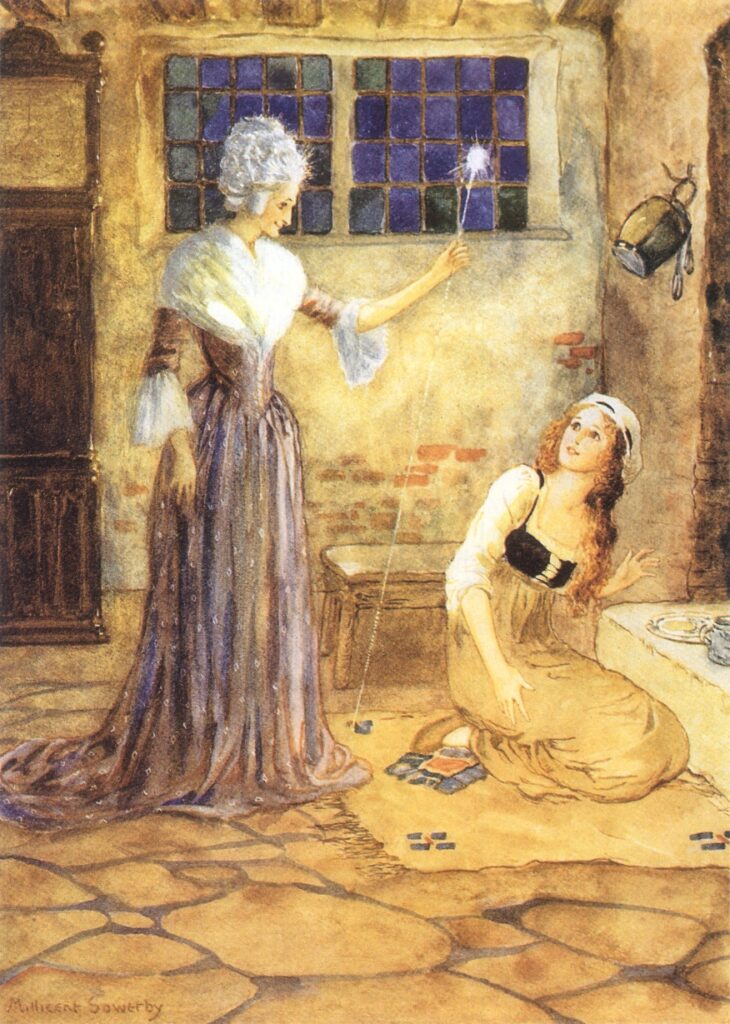
Cinderella stories have been adapted over time to fit certain narratives. The original tale allowed for gendered language to prevail and set a stage for misogynistic viewpoints to continue in adaptations of this tale through numerous types of media. Fairytales are a means for children to learn lessons about the world they will be growing up in. They can aid in warning of the dangers but provide an accessible and enjoyable mode of instruction. On the other hand, the embedded anti-female rhetoric cast out by Perrault can instill biases in children, allowing them to uphold patriarchal values, outcasting women in the world just as Cinderella is. As is demonstrated, Cinderella adheres to male standards as she dissolves into the background, never speaking against the wrongdoings committed against her. The entire tale revolves around the sole mission to attach herself to the prince and become his wife. When these values are being taught to children, they are led to believe that this is the correct way to act toward the opposite gender. Introducing Cinderella to children without allowing them to unpack the partisan ideas allows gender-based discrimination to thrive. “The embeddedness of appropriate gendered behaviors masks the fact that fairy tales are created and reproduced through the dominant discourse. Girls come to know that their value lies in men’s desire for them, and the characteristics and qualities that will assure their desirability revealed in cultural storylines” (Parsons 136). Many tales like Cinderella are incredibly popular and have impacted dominant cultural discourse. Most who read or have read this tale are unknowingly influenced by its structure regarding the view of masculinity and femininity, and what characteristics are required to embody one’s gender. Fairy tales are not unbiased ground., They are the product of common thought in a society shaped by the values that we deem important and worthy of upholding. When misused, they can be weapons that perpetuate gender stereotypes, especially in women, ensuring that these societal standards continue to influence children. Young, impressionable minds learn from Perrault that the depiction of girls as passive, accommodating, and unable to function without male influence is the truth that they should carry with them. Silencing Cinderella sends a message that a woman’s value is linked to her attractiveness and desirability as defined by men, reducing their abilities and condensing their achievements. Desirability being the only thing Cinderella is made for is made obvious through “the fact that a messenger of the prince discovers Cinderella and she is transformed once again by magic and beautiful clothes before meeting the prince indicates that in her humble state, she would not be worthy of the match. She must be beautiful to be worthy” (Parsons 144). Tying a woman’s worth to her appearance is deemed good enough to fit a male gaze tells young women that they have no value in this world if not yearned for by a man.
Young, impressionable minds learn from Perrault that the depiction of girls as passive, accommodating, and unable to function without male influence is the truth that they should carry with them.
Gendered language overpowers Perrault’s Cinderella, encapsulating the standard that women must present as the beings behind the curtain, not to be seen or make themselves known, especially when being mistreated. In a study of the tale, it is obvious that the utilization of certain phrases or words is meant to make Cinderella seem smaller and the prince, a powerful, pivotal role. The choice of language to describe Cinderella serves to minimize her importance, emphasizing her meekness and helplessness. Descriptions such as “gentle” or “beautiful,” aim to reduce her presence, portraying her as someone who should remain unseen and unheard, taking up no space, and allowing the male to serve as a protector. “As one of the most pervasive stereotypes, gender stereotypes reflect the general expectations about the social roles of males and females. For example, females are communal, kind, family-oriented, warm, and sociable, whereas men should be agentic, skilled, work-oriented, competent, and assertive” (Xu et al. 2). These adjectives return to the emphasized expectations for women to maintain poise and composure in all portions of their life, only marking value in the ability to be quiet and allow a masculine presence to work. In contrast to the ways in which Cinderella is described, the prince is upheld as a coveted being worthy of praise when little contribution is made from his character to the story. He is described as “able,” reinforcing how Cinderella should not be the one taking action against her circumstance, she should wait for a savior such as a man to change her situation (Xu et al. 8). “Those who consider women less competent would tend to believe that they are fragile and sensitive and need to be protected by men”, which is exactly what Perrault means to uphold in his character descriptions (Xu et al. 2).
Though the detrimental impact of Perrault’s Cinderella is still pervasive in renditions of the tale today, it has also created a rise in feminist recharacterizations to take control and power back, permitting agency and independence to rule. My favorite reshaping of the Cinderella story is seen in Rian Johnson’s brilliant 2019 film, Knives Out. As a self-proclaimed expert on this movie, I have uncovered that its roots in feminist ideals are introduced throughout as Marta finds her voice and overcomes the controlling influences pining selfishly to gain what she is rightfully given. Marta is a nurse and caretaker for a wealthy author Harlan Thrombey, who has leeches for family members, attaching themselves to his name and image to achieve popularity. Harlan is murdered in a twisted feat where blame ends up lying on Marta. Though Marta takes on the characteristics of what Cinderella traditionally is in certain aspects: kind-hearted, loyal, and compassionate, she gains what Perrault’s version does not. Marta’s initial reservation and meekness are reminiscent of Cinderella’s veil, not allowing readers to gain insight into her nature as she is forced to take a backseat even whilst in the face of her stepmother and stepsisters’ cruelty. We begin to see the transformation and development in Marta as the plot thickens and she becomes the prime suspect. She must navigate convincing deception, manipulation, and lies being thrust at her by Thrombey family members. Instead of shrinking into submission as the original Cinderella tale would like her to do, she finds her footing and finds faith in her honest nature. Though she is initially framed as the suspect, her journey to find her strength provides the dark answer to the whodunnit, finding the faux Prince Charming Ransom Drysdale, Harlan’s grandson, ultimately guilty. Similar to Cinderella, Marta is mistreated and taken advantage of. Differing from the traditional fairytale, her journey isn’t about lying in wait for a prince to come to her rescue and defeat the “bad guys”; it’s about her determination and confidence in herself as she knows her value lies beyond attachment to a male presence. She refuses to lower to the shallow levels of torment and hatred that the Thrombey family maintains, each of whom is more than ok with putting her in harm’s way to protect their interests. “The film ends with a powerful image: Marta, standing on the balcony of the Thrombey estate, looking over the rest of the Thrombeys as they gaze at her from the ground, speechless. She holds Harlan’s mug, which reads ‘My house, my rules, my coffee.’ As she sips that coffee, she humbly surveys all of the prosperity she is clearly shocked to have inherited, but that she even more deserves” (Manning). Marta emerges not just as a champion of the case but as a woman who has regained her power to speak up against injustice and mistreatment.
A feature of Knives Out that mirrors fairy tale standards is its character layout, with many roles reflecting key dramatis personae essential to fairy tales like Cinderella. Marta takes on the pivotal role in Cinderella, the princess, serving as the main character and the center of the film. Unlike the original, she possesses feminist-interpreted characteristics, bringing a modern spin to the standard. Harlan, Marta’s client, fulfills the trope of the magical figure. Amidst the disguised hatred and greed of the Thrombey family, Harlan stands out as a pivotal presence in Marta’s life, constantly showing her kindness and generosity when the rest of his family is cruel towards her. In a sense, the family’s German shepherds act as magical agents, similar to Cinderella’s birds. Their barking at Ransom—but not Marta—sparks Detective Blanc’s curiosity about Ransom’s whereabouts on the night of Harlan’s death, leading to the discovery of evidence against his self-proclaimed innocence. Benoit Blanc, the boisterous detective with a thick Southern accent, hints at the helper archetype but operates much differently than in Cinderella. While Blanc and Marta work well together, his main goal is not to prove her innocence but to uncover who is guilty. Marta must navigate her struggles—against herself, the Thrombey family, and her circumstances largely alone. Ransom Drysdale, Harlan’s overconfident and arrogant grandson, embodies both the false hero and the villain. Meanwhile, the entire Thrombey family exhibits moments reminiscent of the evil stepsisters, with even minor characters contributing notes of selfishness and malice that hinder Marta’s path forward.
Propp’s functions serve an essential role in laying the groundwork for fairy tales, and many can be identified as the plot unravels in Knives Out. The story begins with the abstention, or death of Harlan Thrombey, the king of the family, whose wealth draws in his greedy relatives. While Harlan wanted his family to succeed independently and bring kindness into their lives, they act in complete opposition to his wishes, mistreating his caretaker Marta and each other, embodying the greed and cruelty of the stepsisters and stepmother in Perrault’s Cinderella. A false hero is presented when Harlan tells Marta he knows of her mistake and pretends to be the hero, offering her a deal: if she renounces her inheritance, he will share half of it with her. The hero is recognized as Benoit Blanc, the famous detective, sees through Ransom’s falsehoods, proclaiming, “A donut hole in a donut’s hole. But we must look a little closer. And when we do, we see that the donut hole has a hole at its center. It is not a donut hole, but a smaller donut with its hole” (Johnson). Blanc recognizes Marta’s truthfulness, supported by her strange inability to lie without vomiting. Finally, in a significant deviation from the Perrault tale, there is no marriage at the end. Ransom unsuccessfully tries to manipulate Marta and assume a “Prince Charming” role, but her confidence and strength prevent this. Instead, Marta ascends the throne in the film’s perfect closing scene, stepping onto the Thrombey mansion deck with Harlan’s coffee mug, her perseverance and honesty having guided her through discrimination and into empowerment.
Marta Cabrera defies the traditional limitations placed onto Cinderella and rewrites the narrative that women must be docile, representing characters in storylines. Her journey of self discovery and strength in her femininity in Knives Out challenges the patriarchal structure of traditional fairy tales, especially the passive roles women are often confined to in stories such as Perrault’s Cinderella. Through her tribulations, Marta discovers that her strength lies not in waiting for rescue by male overpowering, but in asserting her voice and trusting her intuition. In order to save herself, she must be a loud presence, speaking up against injustice and having faith in her intuition. The triumph over the Thrombey family’s manipulation and greed symbolizes the reclamation of power and agency that traditional tales often deny female characters. Throughout the film Marta redefines what it means to be a Cinderella, proving that femininity is not a weakness but a profound source of strength, as she rises above adversity with resilience, integrity, and power.

Works Cited
Crowley, et al. “Feminist Frauds on the Fairies? Didacticism and Liberation in Recent Retellings of ‘Cinderella.’” Marvels & Tales, vol. 24, no. 2, 2010, pp. 297–313. JSTOR, http://www.jstor.org/stable/41388957.
Feeney, Megan. Cinéaste, vol. 45, no. 3, 2020, pp. 60–62. JSTOR, https://www.jstor.org/stable/26976403.
Johnson, Rian. Knives Out. Lionsgate, 2019.
Manning, Caroline. “Knives Out Analysis: An Allegory for America.” The Communicator, 20 Apr. 2020, chscommunicator.com/74714/a-and-e/2020/04/knives-out-analysis-an-allegory-for-america/.
Parsons, L.T. Ella Evolving: Cinderella Stories and the Construction of Gender-Appropriate Behavior. Children’s Literature in Education 35, 135–154 (2004). https://doi.org/10.1023/B:CLID.0000030223.88357.e8.
Xu, Huimin, et al. “The Cinderella Complex: Word Embeddings Reveal Gender Stereotypes in Movies and Books.” PLOS ONE, vol. 14, no. 11, 22 Nov. 2019, doi:10.1371/journal.pone.0225385.
