Categories
Fairy Tales

How Fairy Tales Reinforce Class Hierarchy through the Portrayal of Fashion

Lucie Mowat

Kirsty Mitchell, The Storyteller, from the Wonderland series. Photograph © Kirsty Mitchell, kirstymitchellphotography.com

Abstract

Past authors, philosophers, critics, and scholars have debated the importance of fashion design in our media and how judgments of it influence our culture’s choices and opinions. However, not many industry professionals have considered the impact that fashion in popular fairy tales has on societal stereotyping based on one’s outward appearance. In her article titled “Fairy Tales And Fashion Criticism,” Rachel Matthews brings up the frustrating dichotomy between wanting to care about one’s appearance and not wanting to come across as excessively vain and self-obsessed (Matthews). This conflict arises due to the media’s ruthless scrutiny and appraisal of fashion. Tales that identify a character by their clothing can greatly inform us about their attributes, sexuality, status, goals, and faults. While reading these stories, we must ask ourselves a question. How does fashion within fairy tales influence the social context of our lives and expose the ramifications of our implicit biases towards what someone is wearing? I will be identifying the importance of fashion design within fairy tales such as “Cinderella” and children’s movie classics such as Brave by examining the social repercussions that prominent articles of clothing in these tales have uncovered. I will articulate how fairy tales reinforce class hierarchy through the portrayal of fashion in a few ways. These tales construct happy endings as class mobility represented by one’s attire and depict beauty standards as the primary conduit for gendered class mobility over other methods of agency. In doing so, these iconic fairy tales relegate power to unattainable iconography in fashion. My extensive research illustrates how the stereotypes perpetuated in mainstream literary media are the root of common implicit biases we hold towards one another daily. We predominantly base many of our initial opinions of others on our judgments of their physical nature, i.e., their clothing. In just a few seconds of meeting someone, we have come up with assumptions, correct or not, about their gender, personality, status, and wealth. It is important to understand why we make these superficial judgments and where they materialize in our psyche in order to eradicate them effectively. 

How Fairy Tales Reinforce Class Hierarchy through the Portrayal of Fashion

While humans have worn clothing for over 170,000 years (“UF”), the intention behind the design and creation of garments only emerged 163 years ago (“History”). This purposeful construction of clothing characterizes what we have come to know as the art of fashion design. Today, avant-garde designs grace fashion runways and collections, leaving consumers hypnotized by these outrageous, typically unwearable, garments. 

To better identify where the inspiration for these looks comes from, we must turn to our cultures’ literary media consumption to see how different fashion designs popularize within our society. The decade-old medium of storytelling and fairy tales greatly influences our fashion choices more than most people realize. Fashion in fairy tales can escalate a character’s status, privilege, and power by transforming their outward appearance. The barrage of stereotypes in literary media encourages societal biases towards one another based on clothing. These judgments inspire the sexualization of women and the concept of clothing’s ability to elevate social rank. With this in mind, how does fairy tale fashion influence the social context of our lives and expose the ramifications of our implicit biases towards what someone is wearing?

To answer this question, I will articulate how fairy tales reinforce class hierarchy through the portrayal of fashion in a few ways. To support my argument, I will reference fairy tales such as “Cinderella” and children’s movies such as Brave. The stories provide iconic female characters whose personality traits, status transformations, and societal reputations reflect and depend upon their appearances and clothing. I will also briefly mention the fictional superhero, Superman, to aid my argument regarding the power of symbolism in fashion. 

The Brothers Grimm version of “Cinderella” follows the tale of a young girl whose two stepsisters and evil stepmother maliciously torment her after her mother’s death. With the aid of a white bird, Cinderella is able to attend the King’s three-day festival, each day showing up in a gown more stunning than the last. Due to her beauty, the prince falls in love with Cinderella and is adamant about discovering her true identity. In the end, Cinderella and her prince earn their happily ever after, and the stepsisters get “punished with blindness as long as they live” (Grimm). This classic fairy tale conveys to young children that people will treat you better if you have an attractive outward appearance. Cinderella’s value as an individual is ascribed to her clothing rather than her personality. 

Brave, Pixar’s first ever fairy-tale-based movie, greatly contrasts the leading female depiction in Cinderella by portraying a young Princess Merida as strong, athletic, and brave. While Merida’s family expects her to find a husband, she would rather be off practicing archery and exploring the forest. Merida decides to take matters into her own hands by consulting a witch who promises to change her fate. Merida is constantly being told by her mother to “act like a princess,” which perpetuates the idea she must act and look a particular way to be desired by the opposite sex. 

With the aid of these examples, I will articulate how fairy tales reinforce class hierarchy through the portrayal of fashion in a few ways. These tales construct happy endings as class mobility represented by one’s attire and depict beauty standards as the primary conduit for gendered class mobility over other methods of agency. In doing so, these iconic fairy tales relegate power to unattainable iconography in fashion.

These damaging literary depictions are significant due to the strong influence they have on young children who look up to the prominent figures in these tales. These tales teach young consumers that what someone wears is directly related to how that person should be treated. This dangerous mindset reflects harsh beauty standards that infest the fashion industry today. 

Fairy tales such as “Cinderella” construct happy endings as class mobility represented by the iconic dress, and in doing so, reinforce class hierarchy through the portrayal of fashion. In their version of “Cinderella,” the Grimm Brothers tell the story of a young woman who experiences a rags-to-riches transformation, a popular archetype in literature and media. At the beginning of the tale, Cinderella’s two stepsisters torment and treat her very poorly. The two girls “took her [Cinderella] beautiful clothes away from her, dressed her in an old gray smock, and gave her wooden shoes” (Grimm 148). From this moment on, Cinderella is cruelly mocked and mistreated by her stepsisters for looking “dusty and dirty” (148). Cinderella’s terrible treatment is directly reflective of her unpleasant physical appearance. Cinderella’s stepmother mocks her wishes to attend the King’s festival by declaring, “No, Cinderella, you have no clothes, and you don’t know how to dance. Everyone would only laugh at you” (Grimm 150). However, a white bird feels sorry for Cinderella and gives her a stunning gold and silver dress to wear to the festival. The stepmother and stepsisters do not recognize Cinderella and think “she must be the daughter of a foreign king “(Grimm 150). Cinderella’s beauty enchants the prince and causes everyone at the festival to treat her like royalty.

Through the use of lavish gowns and extravagant shoes, Cinderella drastically changes the way others perceive her. She is still the same person before and after the makeover, but her elegant attire has given her a superficial elevation of status. The rapid switch in Cinderella’s treatment shows how people’s minds explicitly relate someone’s looks to their status and self-worth. Rebecca-Anne Do Rozario, author of Fashion In The Fairy Tale Tradition, is fascinated by “the power of clothing to redefine identity” (Rozario 4) present in “Cinderella.” Rozario describes how Cinderella gains empowerment through wearing her lavish gown and slippers, similar to how certain clothes establish one’s public identity and authority in modern society. 

While I believe that fashion can be a source of empowerment and confidence for many women, how the status of one’s character has become ascribed to clothing is hugely damaging. Our literary media contains countless stories like “Cinderella” that only further reinforce a superficial culture dependent on external appearance for internal worth. The children that consume these tales, especially young girls, are constantly told that their self-worth is contingent upon their physical nature rather than their personality traits, intelligence, and individuality. The fashion industry capitalizes on fairy tales that hide behind titles such as “women’s empowerment” to exploit people’s inherent competitive nature towards elevating their social status. 

Fairy tales such as “Cinderella” and Pixar’s fairy tale movie Brave reinforce class hierarchy through the portrayal of fashion by representing beauty standards as the primary conduit for gendered class mobility over other methods of agency. As detailed above, the Brothers Grimm depicts Cinderella’s desirability as constantly defined by her appearances. Most fairy tales function this way, assigning women’s worth based on their physical attractiveness. Female characters are typically deemed good-looking if they are beautiful yet in a frail and delicate manner. This paradox holds true for most classic fairy tales, including “Cinderella.” To better understand this concept, we must engage a story that breaks away from this expectation. 

Pixar’s 2012 animated fairy tale film, Brave, depicts a princess who desires to break away from her expected path of marriage and future queenship. Leading female Merida is told by her mother that “a princess should not have weapons” and that princesses should “strive for perfection” (Andrews). However, Merida doesn’t want to fit the stereotypical role of royalty that her family expects of her. Rather, she is a strong, curious, adventurous, and overall productive role model for young girls. Many applaud Brave for its nuanced depiction of a princess that differs from past female characters of similar influence. CarrieLynn D. Reinhard and Christopher J. Olson, editors of Heroes, Heroines, and Everything in between, claim that movies like Brave are paving the way for more frequent and normalized representations of female empowerment (Reinhard and Olson 9). 

However, the movie succumbs to a common pitfall that many other films attempting to represent non-traditional characters similarly fall victim to. On the rare account that children’s media portrays leading females as strong and independent, they are seen as either having no suitors, incapable of attracting a man, or not interested in having one at all. While Merida is a multidimensional character in many other senses, she falls into the category of not being interested in attracting a person of the opposite sex. The movie renders this trait a character flaw of Meridas’; something is “wrong” with her for not wanting to pursue a man. To clarify, I do not aim to deduct from the recent progress made in terms of non-traditional representations of sex, gender, socioeconomic class, etc., in children’s media. While I acknowledge and appreciate the headway, we must be aware that the cultural dynamic of future generations depends upon expanding inclusivity in children’s media. 

The manner in which fairy tales relegate power to unattainable iconography in fashion influences and reinforces class hierarchy through the portrayal of clothing. There is an undeniable fascination surrounding the beautiful attire and marvelous realities we read about in our favorite fairy tales. There is also an interesting similarity between the idea of an out-of-reach world and the outlandish designs that grace runway fashion collections today.  Colleen Hill, the author of Fairy Tale Fashion, asserts that the eccentric designs in runway collections are inaccessible to the average person and, in doing so, evoke an awe factor that keeps our youthful curiosity for the fantastical alive. There is a yearning for fantasy within the fashion industry. Hill believes that fairy tales can get us back to that state of magic and wonder by feeding our human craving for a more utopian reality. 

Iconic garments and popularized looks within fairy tales perpetuate the message that particular significant articles of clothing contain the ability to assign power to an individual. Examples of this allurement can be identified in “Cinderella” with descriptions of “slippers embroidered with silk and silver” (Grimm 150) and dresses so splendid that everyone goes “speechless with amazement” (Grimm 152). High-end fashion utilizes similar awe tactics to captivate and lure consumers in with the promise of grandiose glamour and guaranteed adoration. 

While the story of Superman does not technically classify as a fairy tale, the fictional superhero operates similarly in terms of assigning an enormous degree of power to certain symbolic dress. In Andrew Bolton’s book, Superheroes: Fashion and Fantasy, he states how “the ‘S’ emblem inscribed on his [Superman’s] chest and cape functions as a simplified statement of his identity” (Bolton 25). In popular culture, Superman’s distinguished “S” epitomizes fantasies, stereotypically male, of a heroic character with exceptional powers and strength. 

However, there exists a predicament in the infatuation our culture has with media idols and fictional characters. The praise we give to these figures is dangerous because they live in realities where superhumans, fantasy, and magic exist. No human can attain Superman’s strength, similar to how no human can achieve Cinderella’s level of beauty and grace. These stories are not accurate reflections of the world we live in and therefore portray an unattainable expectation of power and status we expect to receive when mimicking their actions and clothing. 

By considering the research detailed above, we can make a concrete analysis of how fairy tales reinforce class hierarchy through the portrayal of fashion in a few ways. Tales like “Cinderella” indicate to young readers that a “happily ever after” is defined by the ability to elevate one’s status by transforming one’s physical appearance. Stories like Brave depict beauty standards as the primary conduit for gendered class mobility over other methods of agency. Lastly, the fictional characters and fantastic worlds children and adults idolize in these tales accredit power to unattainable iconography in fashion.

The stereotypes we see in the media consequently affect how we view others and ourselves. This truth holds even more robust for children who are in the process of developing their own ideas of gender identity, physical appearance, and individuality. Children’s media has all the power to evolve our societal expectations of gender by targeting the minds of our future generations, which is why it is so vital for children to consume media that reinforces positive messaging and imagery regarding sexuality, gender, and appearance. 

We experience real-life examples of these negative judgments in the way we insult someone’s clothing when we don’t like the person. We connotate their physical appearance to their identity and, in doing so, admit to associating their worth and status to their fashion choices. The idolization of significant figures or idols is present in how the media obsesses over catching and documenting celebrities wearing “normal clothing.” Our society sees superstars as much higher in status than the average person, so when their appearances begin to resemble ours, they lose their power and are suddenly just like us. 

Over the years, fashion design has lost some of the innovation and ingenuity that I initially fell in love with. The superficial culture that has woven itself in the threads of the fashion industry pulls us away from the place of creativity and wonder where fashion initially formed. Clothing has become a stressful task, a mask of garments we drape upon ourselves to portray a facade that will make us feel included within society. Fashion should be electrifying, provocative, and dangerous, but instead, it has become a source of conformity that puts people’s individualism at risk. 

Works Cited

Andrews, Mark, et al. Brave. Walt Disney Studios Motion Pictures, 2012.

Bolton, Andrew, and Michael Chabon. Superheroes: Fashion and Fantasy. The Metropolitan Museum of Art, 2008. 

Clothes 170,000 Years Ago.” News, University of Florida, 6 Jan. 2011, news.ufl.edu/archive/2011/01/uf-study-of-lice-dna-shows-humans-first-wore-clothes-170000-years-ago.html. 

Do Rozario, Rebecca-Anne C. Fashion in the Fairy Tale Tradition: What Cinderella Wore. Palgrave Macmillan, 2018. 

Grimm, Jacob and Wilhelm. “Cinderella.” The Classic Fairy Tales, edited by Maria Tater, W.W. Norton & Company, 2017, pp. 148-153. 

Hill, Colleen. Fairy Tale Fashion. Yale University Press, 2016. 

“History of Fashion Design.” Wikipedia, Wikimedia Foundation, 27 Mar. 2021, 4:30 (UTC), en.wikipedia.org/wiki/History_of_fashion_design. 

Matthews, Rachel. “Fairytales And Fashion Criticism .” Reading Design , AddressPublications.com, 2014, www.readingdesign.org/fairytales-and-fashion-criticism. 

Reinhard, CarrieLynn D., and Christopher J. Olson, editors. Heroes, Heroines, and Everything in between: Challenging Gender and Sexuality Stereotypes in Children’s Entertainment Media. Lexington Books, 2017. 
Categories
Fairy Tales

Capitalism in “Hansel and Gretel”: The All or Nothing Mentality in Starving Societies

Analysis by Maia Black

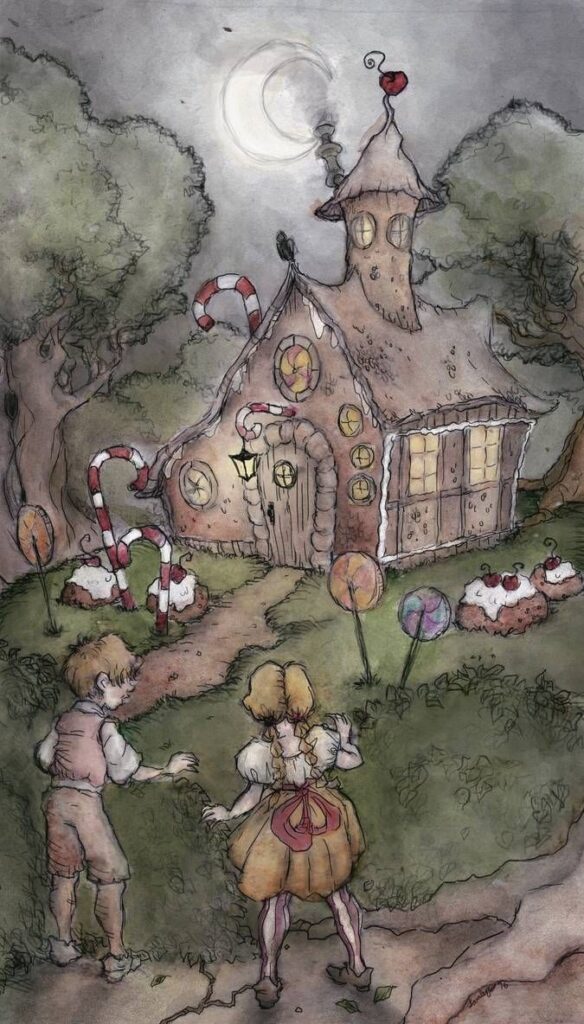
This image has an empty alt attribute; its file name is Hansel-and-Gretel-Approach-The-Gingerbread-House-by-LaraBerge-on-DeviantArt-1-584x1024.jpg
Lara Berge, Hansel and Gretel Approach the Gingerbread House, (Deviant Art), 2016

Abstract

As capitalism has developed through modernization, political scientists such as Christopher Calvo theorize that the American economic society has also led to gross increases in poverty in the United States. Political analyst Jasun Carr expands upon the poverty epidemic when he asserts that poverty has created a disparity between class systems, which is characterized by the wealthy over-consuming resources in a period of “economic stability.” Individuals who fall within the class systems defined under capitalism cannot look beyond the potential benefits of capitalist institutions and recognize the perils that oppress marginalized populations.  I argue that the all-or-nothing ideal is exacerbated in capitalist societies, such as the United States and “Hansel and Gretel” because they both are dignified by a community that prioritizes individualism over collective action; are sustained by the large divide between the wealthy and impoverished; and is characterized by overconsumption by those who have, and food insecurity among those who do not. Because the story of “Hansel and Gretel” dates back centuries before capitalism was introduced in modern societies, the understanding of capitalism’s institutionalized consumption of resources through the lens of “Hansel and Gretel” will be used to demonstrate the importance of how capitalism in struggling societies affects our social dynamics. Moreover, this paper will demonstrate that there is a lack of moderation in places where two extreme opposites are presented. Using “Hansel and Gretel” as a model for the potential ramifications of capitalist ideology will garner conversation on the potential effects of it on our real-life dynamics within the United States and how we can achieve solutions to the rising level of inequality, sustainability, and food insecurity that oppress vulnerable communities.

The themes of poverty, scarcity, wealth, and overconsumption demonstrated in “Hansel and Gretel” are identical to the principles that are exemplified in the United States under the ideology of capitalism. I argue that the all or nothing ideal is exacerbated in capitalist societies because the United States, a country that is built upon these fundamental concepts are signified by an economy that prioritizes individualism over collective action; is sustained by its large divide between the wealthy and impoverished, and is characterized by overconsumption by those who have, and food insecurity among those who do not. The understanding of capitalism’s institutionalized consumption of resources through the lens of “Hansel and Gretel” is important because it shows how capitalism in struggling societies affects our social dynamics. Additionally how nothing comes in moderation in places where two extreme opposites are presented. Using “Hansel and Gretel” as a model for the implications of capitalist ideology will garner conversation about how we can achieve solutions to the rising level of inequality, sustainability, and food insecurity that affect our marginalized communities.

Capitalism is an economic system composed of private actors that work towards their interests. The economic framework of capitalism has become institutionalized within our social constructs. Containing dualistic properties of theory and practice capitalism can be observed within even our most idealistic fairy tale stories. The Brothers Grimm’sHansel and Gretel” is a tale of two children who are living in extreme poverty. This story demonstrates the obstacles two children had to overcome as they endured living during a famine and were left in the woods to die. After leaving home they cross into uncharted territory filled with food. Trying to make the unfamiliar familiar, they subsequently resort to over-consuming the resources they are provided with. The story of “Hansel and Gretel” showcases the potential consequences of institutionalized capitalism on society that mirrors the real-world case example of the United States. Over the past decade, the U.S has seen a sharp increase in inequality by 11.2 percent in the past year alone(U.S Census Bureau). This epidemic is comparable to the poverty identifiable within the tale of “Hansel and Gretel.” After centuries of enduring capitalism; men, women, and children have suffered under a system that prioritizes individualistic values, unrealistic wealth, and overconsumption of scarce resources. 

                        Individualism Over Collectivism

In a capitalist society, there is a priority of individualism over collective action, where personal goals outweigh public good. This mode of action is particularly shown in “Hansel and Gretel” through the house of the Witch. The antagonist of the story has plenty of resources at her disposal, but under the ideals of capitalism, it is not her responsibility to help those who are starving as a result of a famine. She instead uses food as a tool to lure children into her lair and use them to the benefit of her agenda of personal nourishment. In the tale she tricks the children by saying “dear children come inside… no harm will come to you.”(Brothers Grimm 301). Despite what she promised, “the old woman pretended to be so friendly…she had built the little house of bread just to lure them inside. As soon as a child was in her power she killed, cooked and ate it” (Brothers Grimm 302). The witch is characterized as an evil character that audiences disdain for the tribulation she imposes on the children that originate from her hoarding of resources and lack of allocation to her starving community. Similarly in capitalistic nations working towards one’s interest is deemed to make an economy more “efficient”(Smith 2). In  The Wealth of Nations Adam Smith, a forefather of institutionalized capitalism argues “It is not from the benevolence of… The brewer, or the baker, that we expect our dinner, but from the regards to their interest” (Smith 2). Being individualistic in capitalist societies, according to Smith, is a fundamental aspect of a “healthy” society. The problem centers around prospects of individualism being deemed as more alluring than collective action. While capitalism has merely endured in the United States via entrepreneurial endeavors, its determinants are most distinguishable. These repercussions theorized by Karl Marx prove that capitalism is not sustainable in the long run. In The Communist Manifesto Marx asserts that “the essential condition for the existence, and the sway of the bourgeois class, is the formation and augmentation of capital…The advance of industry, whose involuntary promoter is the bourgeoisie, replaces the isolation of the laborers, due to competition, by their revolutionary combination, due to association. The development of modern industry, therefore, cuts from under its feet the very foundation on which the bourgeoisie produces and appropriates products” (Marx 13). Dissimilar to the proposed increase of individualism by Smith, Marx staunchly believed that individualism leads to exploitation, inequality, and in the end, an unbalanced system that supports no one.   

Similar to the witch, capitalism is led by personal motifs. In Smith’s assertion individualism is presented as a model framework of our economic system within the United States since there are individuals like the witch in “Hansel and Gretel” that are fortunate enough to have more than others. The witch is supported by those who have less than her but in the end, her deceitful individual aspirations led to her brutal death. As Marx notes “Society as a whole is more and more splitting up into two great hostile camps”(Marx 1). Working as a collective unit within our workforces would bridge the gap between two contrasting class systems  of the elite( bourgeois class) and working class (proletariat) within the United States.

                                      The Wealth Gap

A large divide between the wealthy and impoverished is characterized by struggling societies. As the United States continues to evolve economically so has the growing rate of inequality. Using the lens of Hansel and Gretel in comparison to the United States, there are significantly large wealth gaps between the privileged and impoverished exhibited in both societies. In the story of “Hansel and Gretel” the children are members of the lower class population that dabble in affluence. After being abandoned they discover a world of wealth and security that they lacked at home. Audiences of “Hansel and Gretel” can familiarize themselves with the personable family that Hansel and Gretel are a part of. The children are raised by their father and stepmother. Their father is “a poor woodcutter”(Brothers Grimm 297). With humble beginnings originating in a struggle they cross through the woods are met with a stark shift of lifestyle. The Grimm Brothers describe that “as they approached the house they realized it was built of bread and had a roof made of cake as well as a transparent window made of sugar” (Brothers Grimm 301). The scarcity of bread throughout the story highlights that it is seen as a luxury item for those who are impoverished. When the story repeatedly proclaims that there is a minimal supply of bread, this allows the witches’ home to symbolize a place of prosperity, where bread is so readily available, that it is used as material for a house.  

While the notion of inequality is not as substantial as a communal famine its effects on lower-class communities within the United States are monumental. In  Poverty: A New Perspective, George Wilber states that both an adaptation and a reaction of the poor to their marginal position in a class-stratified, highly individuated, capitalistic society. It represents an effort to cope with feelings of hopelessness and despair that develop from the realization of the improbability of achieving success in terms of the values and goals of the larger society”(Wilber 7). Akin to the children in “Hansel and Gretel”, most impoverished individuals within the United States do not have the ability to make it out of their class system. They are stuck in a cyclical nature in which Wilber references the “culture of poverty” (Wilber 42).  Moreover, aside from the sheer luck of finding the witch’s house, Hansel and Gretel would have never had the privilege of being financially stable. With a vanishing middle class in the United States, the wealth gap between the class systems has created a divided society that is becoming increasingly separate from each other. The experience of the poor and the experience of the rich within the United States are worlds apart.

                     Overconsumption versus Food Insecurity 

 The implications of capitalist society are characterized by overconsumption by those who have, and food insecurity by those who do not. Children often lack the resources and knowledge to be functioning, productive members in capitalist institutions alone, therefore in the  system children are solely reliant on adults to provide them resources. As demonstrated in “Hansel and Gretel”, without the presence of a competent adult figure children become insecure about food. We are introduced to the children of the story and their circumstance of “never having very much to eat in the house… during the time of famine, the woodcutter could no longer put bread on the table”(Brothers Grimm 197). These children living in a struggling household, are not able to contribute to the labor force to get nourishment for themselves. So when they are abandoned in the forest it is expected that they will not survive. Through great luck, they do and find a place that contains an infinite amount of delights at their disposal. It is noted that the children ate and “continued to eat without getting distracted”(Brothers Grimm 302). This new comfortability presents an extreme shift from the norms of food insecurity that encompassed their daily life back at home, that makes it difficult for them to show restraint. In “Examining Overconsumption, Competitive Consumption, and Conscious Consumption from 1994 to 2004: Disentangling Cohort and Period Effects” Jasun Carr, a political scientist, and professor in communications at Susquehanna University, argues that “when in a position of economic stability, our values and responsibilities shift and our desires as consumers lead to higher economic contributions in many sectors of the economy”(Carr 1). This is true for many wealthy individuals within the United States who have “disposable income” that can be dispensed on the whims of their desires. The drastic contrast in access to resources results in two extreme differences that require a middle ground. Highlighted within “Hansel and Gretel”, the children start at home that is a representative of where they are deprived of food. Their reality, encompassed by the absence of food, quickly shifts as they discover the Witch’s house, which is covered in a surplus of delights. Nevertheless, there is no in-between; no place that symbolizes balance. The common thread demonstrated is that individuals are either engulfed in poverty so much that they don’t know when their next meal is, or they have accumulated a surplus of wealth that allows them to over-consume food items at an unsustainable rate. The idea of gluttony and starvation are two sides of the same extreme coin of capitalism that forces individuals to choose from. 

                                        Conclusion

The antithesis of two options presented in facets of The United States socioeconomic system has created an environment where people within capitalistic societies are stuck within a perpetual cycle of having all or nothing. The tale of “Hansel and Gretel” showcases the symptoms of capitalism and serves as a warning sign to the implications these tendencies can have on the rich and poor within our society. The idea of “pulling yourself up by the bootstraps” and working individually to generate wealth has conflicted with the idea of working as a collective society to achieve goals. Living in poverty with little to no education, opportunities, and experience is skewed in contrast to the perception of wealth and living comfortably. Lastly, the divide between the rich and poor have created contrasting methods of consumption via food insecurity and overconsumption.  In “Hansel and Gretel”, the only solution presented for the two children to escape their situation was an experience. We must provide disenfranchised men, women, and children with opportunities and resources that will give them the expertise they need to overcome the perils of poverty and food insecurity. They cannot do it alone and without the help of strong governmental policies that include mutual aid, increased funding in welfare programs, and education. Becoming more collective with our allocation of resources is essential to solving issues that are created by capitalism in the United States.


Work Cited

Carr, Jasun D., et al. “Examining Overconsumption, Competitive Consumption, and Conscious Consumption from 1994 to 2004: Disentangling Cohort and Period Effects.” he Annals of the American Academy of Political and Social Science, vol. 644, no. 1, 2012, pp. 220-33. ProQuest. Accessed 8 April 2021.

Garner, Rosalie. Food Insecurity: Patterns, Prevalence, and Risk Factors. New York : Nova Science Publishers, Inc., 2016. eBook Collection (EBSCOhost).

Grimm, Jacob, and Wilhelm Grimm. Hansel and Gretel. 7th ed., Berlin: Dieterich, 1857. pp. 297-304.

Marx, Karl, et al. The Communist Manifesto (Penguin Classics). 1st ed., Penguin Classics, 2002.

Smith, Adam, and Alan Krueger. The Wealth of Nations (Bantam Classics). Annotated, Bantam Classics, 2003.

Tatar, Maria, editor. The Classic Fairy Tales. Second Edition ed., W.W Norton and Company, 2016.

Wilber, George L. Poverty: A New Perspective. Lexington : The University Press of Kentucky, 2015. eBook Collection (EBSCOhost).

Categories
Fairy Tales

Fairy Tales And Its Effect On Gender Role Comprehension During Childhood Development

An analysis by Logan Hurd

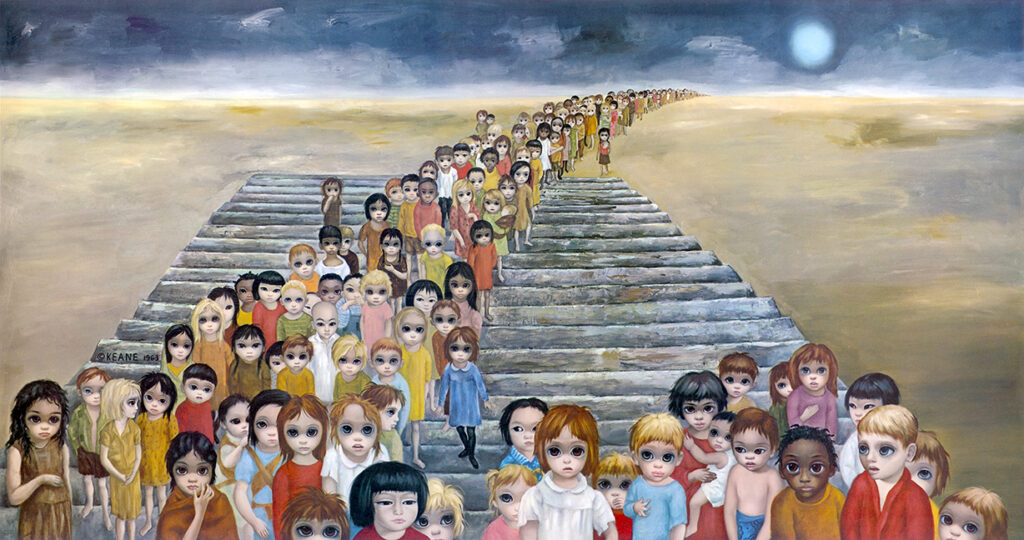
“Tomorrow Forever” (1963) by Margaret Keane  

Abstract

The paper has a focus on the topic of gender roles in fairy tales and how outdated views of women affect the development of children and their understanding of social structures. Child psychologists and professors of gender studies have observed the relationship between our social view of fairy tales and the analysis of gender within them and found that current day views do not align with the older viewpoints of women from the Grimm’s and Perrault. However, little research follows the social develop of children through the influence of fairy tales, despite evidence that fairy tales have a strong role in the development stages of children. The original base fairy tales provide children with false narratives of gender structures in society by promoting themes of old-world patriarchy, which hinders children’s environmental development as they are rewired to accommodate to more progressive social views later in their lives. By adapting more equal character roles it can help with the perception of female characters in these tales. I have used scholarly journals and a social study finding to compact evidence and build a reasonable argument structure. The evidence is analyzed through how relevant it is to the argument with children, and how specific the argument against gender roles is the thesis. Being able to specify certain quotes has helped narrow down the research process to finding evidence that will be most effective. The thesis of this paper should bring light that there needs to be a change in how fairy tales are read and perceived by children. The youth are the future, and it is important that everything is done efficiently to help their development and social growth in this fast pace world. 

Project 3

The Grimm brothers have long been criticized for their patriarchal viewpoints towards women in stories, highlighting female characters with little ambition and intellectual individuality. The original base fairy tales provide children with false narratives of gender structures in society by promoting themes of old-world patriarchy, which hinders children’s environmental development as they are rewired to accommodate to more progressive social views later in their lives. This is explored through understanding the finding the base root problem with stories like Snow White and Cinderella and the flaws they have as stories portraying a socially skewed narrative. Ideas of storyline change and modern-day adaptation is also explored to keep up with current day social standings and explore how children view their own take on classic fairy tales. The background of fairy tales and the importance of their development in children is also explored to understand why it is important to remove the social bias early. Just like other aspects of literature, fairy tales need to be adaptable and flexible in order to survive and remain relevant for children in further generations.  

Famous tales like Snow White and Cinderella depict biased gender roles that children learn from early on in their lives. While each tale has a clear story line that can be enjoyed and understood easily by children, all these tales promote an old-world view of women in society where they are expected to end in marriage and accommodate for the husband and family. In Snow White, children are taught that women simply cannot complete a hard task by themselves and in the end a “prince charming” will come along to save the day and finish the job. In Cinderella, she only receives the attention of the prince because her body fit the extreme standards allowed by the prince himself. The current theme of ending revolves around the man entering their lives and suddenly being able to have control of their issues. The end point for both concludes in marriage, seemingly as if marriage should be the final stand of individuality for women in their lives. Maria Tartar remarks at this undoubted standard that “…one shared aspect, for instance, is the domestication of women: Disney went further than the Grimm’s to make Snow White care and clean by nature and make the household jobs seem effortless and fun” (Tartar). At the end of the day, Snow White was just another young woman who became wrapped up in the social pressures of marrying to a man with while having little ambition for future plans of herself. Children at a young age do not understand self-individuality and ambition to a full extent yet, however these stories linger with them early on in life and remain references for how society operates and how women are supposed to act towards men. Children do not understand patriarchy and gender roles, and yet young girls will look up to Snow White and Cinderella because of social influence and the entertainment these stories bring.  

150-year-old stories with 1950 adaptations simply do not relate to the lives of current day children. For fairy tales to survive in a constantly changing world, they will need to adapt the ideologies of current day society. By being able to adapt and have fairy tales fit a real-world viewpoint, children can comprehend the messages being conveyed easier and ingrain it into their social development. Changing traditional storylines and re-inventing their meaning can help remove biased gender roles rooted in our culture and give children a new view on social structure. In a social experiment conducted to understand how children react and adapt to a change in characters and gender role in fairy tales, Dr. Wan-Hsiang Chou found that among 16 boys and girls, …”their reflection papers showed a heightened awareness and sensitivity of the cultural assumptions and values that go into the story as well as a self-understanding… Some students started to talk about the possibilities of applying this project in their future classroom and how they realize the importance of teaching children to be aware of the dominant discourse in popular culture” (Chou). Her findings concluded that not only were children socially aware of making a change in the social model of fairy tales, but she also found that their modified stories best supported future readings. Having characters fill modern day roles remove confusion and simplifies the interpretation of construct for a child. The more relevant a topic is in a child’s life, the more likely it is to stick with them and for them to expand on their new knowledge for later works. Likewise, Davidson University professor, Christine Jones, found a similar conclusion in the realm of breaking down gender contracts by applying cross dressing to remove the boundaries between male and female jobs in a particular story.  For Jones, “Cross-dressing and war seemed coextensive, and 1 pushed that affinity to suggest that women’s fairy tales waged a metaphorical war – an assault on exclusion and gender bias in the world of letters” (Jones). Cross dressing characters leveled the playing ground in a way as it removes the symbols of power and who is in control and has each character overlapping in status to promote total structural equality. Like Chou’s findings, it connected real world ideologies in neutralizing the view of structure in tales. It is time for the base fairy tales to be readjusted for the new generations for these tales to survive and stay relevant later.  Evidence that these tales can be adapted and altered further pushes for a change in structure.   

Early childhood stories are crucial for cognitive development in children and their comprehension of social structure. Fairy tales act as educational tools for children even before they step foot inside a school, and that is why it is so important that proper social morals are preached early in order to fulfill efficient development. Children must learn from these stories and be able to apply it later in their childhood when recognizing their surroundings, especially related to gender. If children grow up and only have the “base” fairy tales to learn from like Snow White and Cinderella, certain gender biases can be asserted from just recognizing themes in the language and story line. Child Psychologists Arlandis, Sergio, and Agustín Reyes-Torres find a direct correlation between childhood stories and themes of self-reflection in understanding themselves and their existence. Here they state, “So if, in a certain way, the aim of children’s and young adult literature is to accompany and reflect that transformation of the young reader, it is not surprising that the symbol of the mirror (and other analogies such as water or the moon) has a certain presence and continuity in its most emblematic texts” (Torres-Sergio). Children’s literature has the power to switch an individual’s perspective in a way that they have never viewed before, and this can be said for how a child reflects on his own self-worth and existence as either a boy or girl. Gender studies expert Janice McCabe states that “awareness of gender recognition with its related and associated features is a phenomenon which starts in the early stages of life and gets powerfully influenced by the type of literature children are exposed to in later stages,” (McCabe) and because of this we must recognize the setbacks society puts children in when the literature gears toward a patriarchal viewpoint. Literature and fairy tales are crucial for a child’s development, and society should be conscious of what message the children are receiving as they grow older in their lives.  

Gender stereotypes affecting women is still an ongoing issue today in our society. However, by slowing rerouting it from our literature it can become something of the far past that is seen with little weight. Fairy tales will always remain an important figure piece in literature and the culture it has created among children’s entertainment. It is important to realize that Grimm and Perrault stories are not perfect, and part of that is coming from an era far behind ours socially. Evidence from the social studies and developmental research do suggest that story line adaptation is beneficial for the change of pace in social views in children. Just because their moral structures are flawed, does not mean these stories should be shunned and forgotten forever, however only through slight character adaptations can these tales thrive again and survive into the next generation. Fairy tales have proved so crucial in the early and late development stages of children and removal of them would take away their purpose. The solution is a change of heart in character development for fairy tales that supports all genders equally and does not mean that these tales should be forgotten simply because they are outdated.   

Work Cited

Akbar, Tahira, Ra’ana Malik, and Farooq-e-Azam. “Gender Issues in Children’s Literature: An Analysis of Fairy Tales.” Pakistan Journal of Education 35.1 (2018) 

Arlandis, Sergio, and Agustín Reyes-Torres. “Thresholds of Change in Children’s Literature: The Symbol of the Mirror.” Journal of New Approaches in Educational Research, vol. 7, no. 2, July 2018, pp. 125–130. 

Chou, Wan-Hsiang. “Contamination of Childhood Fairy Tale: Pre-Service Teachers Explore Gender and Race Constructions.” The Journal of Social Theory in Art Education.27 (2007): 55,73,4. 

Jorgensen, Jeana. “The most Beautiful of all: A Quantitative Approach to Fairy-Tale Femininity.” Journal of American Folklore 132.523 (2019): 36,60,107. 

Jones, Christine A. “Thoughts on “Heroinism” in French Fairy Tales.” Marvels & Tales 27.1 (2013): 15,33,3,154. 

Tatar, M. Off with their heads1.: Fairy tales and the culture of childhood. Princeton, NJ: Princeton University Press. (1992) 

Categories
Fairy Tales

Fairy Tales and Their Impact on Female Objectification in Advertising and Entertainment Within Society

Analysis by Owen Hackman  

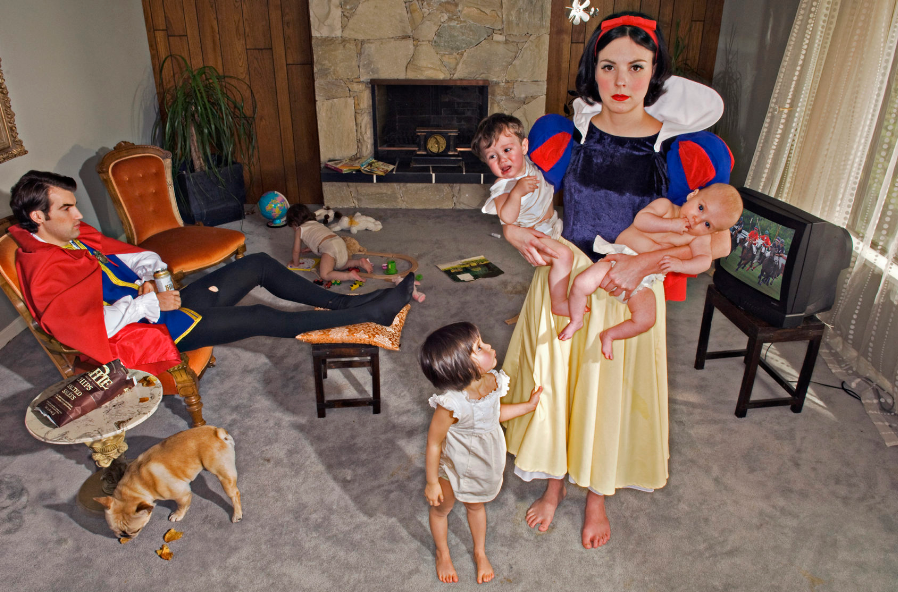
Goldstein, Dina. “SNOWY.” Dina Goldstein, 30 Apr. 2020, www.dinagoldstein.com/dina-goldsteins-fallen-princesses/. 

Abstract

The objectification of women within advertising and entertainment has become a culturally acceptable integration into our society today. Authors within the field of advertisements explain that there is increased usage of fairy tales and their motifs within advertisements because they get their message across to a wider variety of people. From a young age, children learn of gender roles through the form of fairy tales that demonstrate the dependence women have on men. The question at hand is: how do fairy tales enable this objectification of women within advertisements and entertainment as culturally acceptable? Through reading or watching fairy tales such as little red riding hood and snow white at a young age, gender roles and the dependence women have on men become engrained in children that allow for a society to see the objectification of women in advertisements and entertainment as culturally acceptable. For the purposes of this project, data analysis and studies conducted on both women and men demonstrate that our society today recognizes the sexualization of women as acceptable. The intervention of the use of fairy tales to demonstrate why this serves as a contribution is because it seeks to explain how they have enabled our society to come to see this as culturally acceptable. This understanding of the importance of fairy tales and stimuli upon a young child will help us alter and change our habits. This is significant because it will look at how the gender roles and constructs depicted within fairy tales create the notion of sexualizing and objectifying women as acceptable within society. 

Project 3:

Fairy Tales and Their Impact on Female Objectification in Advertising and Entertainment Within Society

We live in a society today where we are constantly surrounded by many types of advertisements and entertainment. There is no place that a person could go where they would not see a product, movie, or business being advertised in some shape or form. The ways in which advertisements are created are done in such a way to make people want to purchase their product. In particular, advertisements and entertainment today exploit women by objectifying them and sexualizing them. This new era of advertising has become seen as culturally acceptable and normalized by the people within our generation, and society as a whole. This objectification of women did not just happen abruptly where one day there were not any to the next where that is all there was. These new types of advertisements and entertainment were able to be ushered into our society through what they were taught and read as children. Many children watch or read fairy tales at some point in their youth. Fairy tales such as little red riding hood and snow white depict a society where women have this dependence on men and have very specific gender roles. So from a young age, children learn that men are the ones that do all the work and are supposed to provide for the family whereas women are supposed to take care of the house and children. The gender constructs presented within fairy tales like these teach children how society is supposed to look, and these teachings present themselves later in their lives as a result. Through reading or watching fairy tales such as little red riding hood and snow white at a young age, gender roles and the dependence women have on men become engrained in children that allow for a society to see the objectification of women in advertisements and entertainment as culturally acceptable.

Fairy tales like little red riding hood and snow white present gender constructs that demonstrate the dependence women have on men and expected roles within society. It is important to first understand the themes and lessons being learned within these fairy tales by children because it will play a role in how they view the world later on. The fairy tale of snow white demonstrates a patriarchal society where women are expected to only perform certain duties due to the gender constructs of that time. Within the Brothers Grimm version of snow white, Snow White is found by the dwarfs and is allowed to stay “if [she] will keep [the] house for [them], cook, make the beds, wash, sew, knit, and keep everything neat and tidy, then [they’ll] give [her] everything [she] need[s]” (Grimm 137). Snow White is only allowed to stay if she, in a sense, does all of the chores and takes care of the house. It is demonstrated through this that her only self-worth as a woman is being beautiful and to clean and take care of all the housework. These gender roles are very common within fairy tales as they were written in a society where men were the only ones that provided for the family and the women stayed home to take care of the children and house. Another fairy tale that demonstrates female dependence on men is Little Red Riding Hood. The female dependence is demonstrated through how the “huntsman realized that the wolf might have eaten Grandmother and that she could still be saved” (Grimm 47). Through the fact that she needed to be saved by a man, this demonstrates that she was unable to protect herself and keep herself safe. Had the huntsman not saved them, they would not have survived, symbolizing that women in society must be dependent on men in order to protect their well-being. Our society has grown and changed where women today now work and can provide for their families just as the men do. Even with this, these fairy tales are still present and teach children about these gender roles that are not necessarily as true as they once were. These fairy tales instead lead to a society where women are less dependent on men than they once were but are sexualized and objectified within entertainment and advertisements.

Through the incorporation of fairy tales and their themes within media in society today, advertisers can get their message across to a wide variety of people. Fairy tales have become more popular in society today because they are many television shows and movies that incorporate fairy tales into them. Fairy tales are explained to be “part of the collective unconscious [and] are rooted in the fundamental structures of the imagination, and reflect common experiences of human societies, even in the absence of contacts or exchanges among peoples [and because of this] fairy tales represent one of the best ways to reach the widest possible audience” (Carpi 162). Fairy tales are demonstrated to have immense amounts of influence within society because they are so common. Through how fairy tales are “rooted in fundamental structures” and “reflect common experiences” large numbers of people are able to connect with them in some sort of way. Because fairy tales can connect with many different people, the characters, morals, and lessons within them are also able to do the same. Keeping this in mind, the themes and morals within these fairy tales also reach large amounts of people. Due to many of these fairy tales representing women as dependent on men and objectifying them within them, these ideas and constructs have become more prevalent and present themselves in our society today. Additionally, people today do not believe everything that they see in advertisements to be true by any means. With this being said, “the fact that fairy tales are are used [in advertisements] and are generally successful means that they reach and get their message across [making it] seem that people are often ready to accept a message offered through a fairy tale” (Carpi 163). Through the fact that people are more likely to accept a message within an advertisement if it involves fairy tales, this demonstrates that the themes and ideas demonstrated within these fairy tales are also going to be accepted. The concepts of female dependence on men and the objectification and sexualization of women are being constantly perpetuated within society leading to them becoming culturally acceptable. Therefore because of the constant use of fairy tales within media involving advertising and entertainment, this narrative of women’s degradation is constantly being pushed and becoming normalized. This sexualization and degradation of women in media seem to be working as advertisement companies would have shifted to other ideas now if it had proven to be unsuccessful. This high rate of success demonstrates just how influential the constructs presented within fairy tales are and how they have impacted our society. 

Within our society today, the current use of women’s objectification in media has no negative impact on the viewers’ consumption habits and perception. During the last several decades, our society has shifted from one where women objectification within media and spoke out against it to one where women see this objectification in media and make a conscious decision to tolerate it. Within a study conducted several decades ago, women believed that they were “treated mainly as sex objects [and that advertsiements] showed them as fundamentally dependent on men and found the portrayal of women in advertising to be offensive… [and concluded that] an offensive advertising campaign would have a negative effect on company image and purchase intention” (Zimmerman 1). As demonstrated within this study, women would stray away from companies and businesses that sexualized and objectified women within their advertising campaigns because society had not yet normalized or saw this as culturally acceptable. This is before the era of when fairy tale characters, themes, and ideas became prevalent in many aspects of our day-to-day life. Fairy tales ushered in the acceptance of women being objectified as something normal, along with some changes in feminism. Within a study conducted several decades later within our society today, “educated women agreed that the specific advertisement viewed in this study uses sex, [and] viewed it as culturally acceptable, were less offended by the portrayal of women in advertising than women in the previous study, [and] will be more likely to maintain an existing positive view of a brand and will be inclined to purchase and use it, regardless of any sexual portrayal of women in that brand’s advertising” (Zimmerman 1). Through these results, we can see that women are being sexualized within advertising and do not alter their consumption habits or image on a business because of it. This demonstrates that women within our society have normalized their objectification and sexualization and has become a rudimentary aspect of media that seems to not be stopping anytime in the near future. Through the increased usage of fairy tale concepts within media, women have become more inclined and susceptible to normalizing something that was not normalized just three decades prior. Fairy tale motifs and concepts have allowed for this new era of media to be normalized, accepted, and encouraged. 

Overall, fairy tales have enabled society to normalize the objectification and sexualization of women within advertising and entertainment through their depiction of female dependence on men learned from a young age. These gender roles and constructs learned by children manifest themselves into their adulthood and have enabled media within society to become culturally acceptable when it would have otherwise not. Because fairy tale characters, themes, and ideas surround people today wherever they look, they have become more inclined to believe what is being told or shown to them. Fairy tales provide sentimentality and comfort to people because they read and watched them as children. This comfort has become increasingly exploited to make people view the media involving female objectification in an acceptable manner. It has come to a point where people are not even aware that what they are viewing sexualizes and objectifies women as they have learned that this is a normal aspect of society. Only our society as a whole can decide whether or not we create a change and until then, the same old habits will continue until there is a new era in advertising and entertainment.

Works Cited 

Carpi, Daniela. Fairy Tales in the Postmodern World: No Tales for Children.     Universitätsverlag Winter, 2016. 

Grimm, Jacob, Wilhelm Grimm (a). “Little Red Cap.” The Classic Fairy Tales, Maria Tatar, New York: W. W. Norton & Co.; 1999.

Grimm, Jacob, Wilhelm Grimm (a). “Snow White.” The Classic Fairy Tales, Maria Tatar, New York: W. W. Norton & Co.; 1999.

Zimmerman, Amanda, and John Dahlberg. “The Sexual Objectification of Women in Advertising: A Contemporary Cultural Perspective.” Journal of Advertising Research, vol. 48, no. 1, 2008, pp. 71–79., doi:10.2501/s0021849908080094. 

Categories
Fairy Tales

Fairy Tales and Gender Based Violence: An Analysis of Childhood Acculturation by Fairy Tale Motifs

An Analysis by Julia Pratt

Fairy Tales and Gender Based Violence: An Analysis of Childhood Acculturation by Fairy Tale Motifs

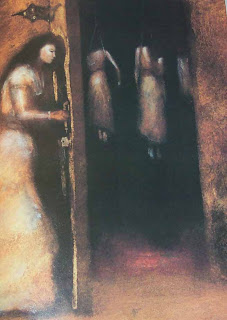
Mahurin, Matt. “The Predator Archetype.” Living in the Forest. July 12, 2013. 

Abstract:
Scholars such as Marcia Lieberman, Sandra M. Gilbert, and Susan Gubar have commented on the prominence of the patriarchal voice in fairy tales, but there is less scholarly conversation about the influence that this voice has on the young children who are exposed to the tales. A lack of understanding about the patriarchal narrative in fairy tales poses a danger to the children who absorb the story, as it acculturates children to a society that condones female suppression as valid and expected. Patriarchal acculturation of children poses a dangerous threat to women- a threat that can be seen in steady upwards trends in gender based violence. My research has shown that fairy tales perpetuate patriarchal cycles of abuse in the way that they describe romance and adhere to strict motifs. In particular, depictions of women in fairy tales influence cycles of gender based violence because they perpetuate antiquated depictions of women as helpless, enforce motifs of men as saviors, and have produced a vision of “happily ever after” that convinces young girls that the ideal life is one that is lived under the thumb of a male counterpart. For the purpose of this project I will analyze the romantic relationships between characters in the fairy tales Briar Rose, Snow White, and Bluebeard, and explore how they both support and stray from my thesis that fairy tales promote norms that influence cycles of violence towards women. The investigation of this topic will bring to light some of the subconscious beliefs that fairy tales have ingrained in our minds about how relationships and behaviors should be conducted. This understanding is significant because the commonality of domestic violence, though increasing, is consciously ignored and minimized by greater society. In order to bring an end to gender based violence we must begin to analyze how the cycle itself is created and established, beginning when we are children.

Project 3:
Fairy Tales and Gender Based Violence: An Analysis of Childhood Acculturation by Fairy Tale Motifs

Gender based violence, as defined by the World Health Organization, encompasses any violence that does or could result in physical, sexual, or mental harm to women (WHO, 1). A harrowing 2018 study emerged on the subject of gender based violence which revealed that 1 in 3 women have experienced physical or sexual violence at the hands of a partner or loved one (WHO, 1). In the wake of this evidence, vital questions must now be asked and answered: how does our society acculturate children to think about women, and how does said acculturation inform the trends of abuse? Despite their easy reading facade, fairy tales carry dark undertones that acculturate our children to antiquated gender roles that can be very harmful and discriminatory towards women. Fairy tales perpetuate patriarchal cycles of abuse in the way that they adhere to strict motifs and expectations of women. In particular, depictions of women in fairy tales influence cycles of gender based violence because they perpetuate antiquated depictions of women as helpless, enforce motifs of men as saviors, and have produced a vision of “happily ever after” that convinces young girls that the ideal life is one that is lived under the thumb of a male counterpart. We as a society face an urgent call to search ourselves for patriarchal influences that condone such violence and put an end to their circulation. This paper will analyze the romantic relationships of protagonists in the fairy tales Briar Rose, Snow White, and Bluebeard, and explore  how the descriptions of these relationships perpetuate norms of patriarchal abuse.

The first tale discussed in this analysis will be Briar Rose. This tale is a reiteration of Sleeping Beauty, and is one of the many hundreds of tales told by the Brothers Grimm. In this version of the tale, a king and queen give birth to a beautiful daughter, and invite the entire kingdom to a great feast so that the Wise Women of the land can bless their child with many good qualities (Grimm, 130). However, they do not have enough golden plates for all thirteen wise women, and so they decide to only invite twelve (Grimm, 131). The thirteenth crashes the celebration in anger and disrupts the ceremony, placing a curse on the child that on her fifteenth birthday she will prick her finger on a spindle and die (Grimm, 131). Luckily, the twelfth fairy had not yet blessed the child, and so she changes the curse so that when the child pricks her finger she will not die, but instead fall into a 100 year long slumber (Grimm, 131). All of this comes to pass, and the entire kingdom falls asleep, only to be rescued by a wandering prince 100 years later on the last day of the spell’s term (Grimm, 132). The prince kisses Briar Rose’s lips, she wakes up along with the rest of the palace, is promptly engaged to him, and they all live happily ever after (Grimm, 133).

The tale of Briar Rose perpetuates the stereotype of women as being helpless in the way that it describes her clueless character. First, it is important to examine the positive female attributes that the Wise Women bestowed upon Briar Rose: “one conferred virtue on her, a second gave her beauty, a third wealth, and on it went until the girl had everything in the world she could ever want,” (Grimm, 131). These are characteristics that are often positively attributed to women in fairy tales, and all of them serve to capture the attention of men. Scholars Sandra Gilbert and Susan Gumar remark that attributes such as these dismiss female autonomy and position women lower than the male characters in terms of sense and intellect, as male characters are rarely simply reduced down to their looks in the same way that female characters are (Gilbert, 390). Aside from this, Briar Rose’s character remains clueless to the events taking place around her, and she is clearly unaware even at age fifteen of the curse that has been placed on her. This suggests that no one told her of her fate, meaning that she was not entrusted with any sort of personal responsibility by her parents to protect herself. Even nuances like this leave young readers to assume that she was not entrusted with her own destiny, and serve to condition children to believe that she was not worthy of control.

Male heroism underlines this entire tale of a spellbound young woman. A wandering prince steps on her sleeping spell, and after a non-consensual kiss between him and Briar Rose, the day is reported to have been saved. Marcia Lieberman’s renowned article “Some Day My Prince Will Come” speaks on this phenomenon in which fairy tales condition young girls to wait for a male prince to swoop in and provide a happily ever after for them, and her assertion holds true in Briar Rose as well. Yet, perhaps the most irresponsible part of this narrative is that Briar Rose was about to be freed from her spell not by the kiss of a prince, but by time: “It so happened that the period of one hundred years had just ended, and the day on which Briar Rose was to awaken had arrived,” (Grimm, 132). This princess had served her due time and was about to be freed by no one other than herself, and yet the prince’s non-consensual interference earns him ample praise as well as her hand in marriage. This story supports the patriarchal norm that men can do whatever they want to women’s bodies and circumstances, regardless of whether or not they are asked to, and still be praised. This message teaches young girls in turn that their position is as quiet and helpless damsels who are in need of a male savior- a mindset which no doubt has a hand in the perpetuation of gender based violence against women. 

The second tale discussed in this analysis will be Snow White. In this Brothers Grimm rendition, a queen wishes for a child as white as snow, as red as blood, and as black as the wood of a window frame (Grimm, 95). She gives birth to this child, and promptly passes away, leaving her husband to remarry to a beautiful yet proud woman (Grimm, 95). While conversing with her magic mirror, Snow White’s stepmother finds out that she has been surpassed in beauty by the child, leading her to send a huntsman to murder Snow White in the woods (Grimm, 96). He lets her escape however, drawn to pity by Snow White’s beauty, and the girl runs until she finds a group of friendly dwarves who agree to provide her shelter so long as she cleans and cooks for them, to which she agrees (Grimm, 98). Not long after, her stepmother’s mirror alerts the woman to Snow White’s existence with the dwarves, and so she sets out three times to kill her (Grimm, 98).  She nearly succeeds twice, but both times the dwarves save her (Grimm, 99). On the third attempt Snow White falls asleep as if dead with a piece of poison apple stuck in her throat, and it is only after her assumed corpse is given by the dwarves to a wandering prince as a gift, that the apple is jolted from her throat and she breathes again (Grimm, 101). At this turn of events, she and the prince marry, the queen is forced to dance to death in red hot iron shoes, and they all live happily ever after (Grimm, 102).

The tale of Snow White is also an active perpetuator of patriarchal violence against women because it not only depicts women as helpless and in need of a male savior as in Briar Rose, but it also enforces the idea that a woman’s “happily ever after” is found by living a subservient life to men. While scholars Sandra Gilbert and Susan Gubar have done fascinating research centered on the ways that the patriarchal voice in this story pits Snow White and her stepmother against each other to compete for the beauty and status dictated by men (Gilbert and Gubar, 389), this analysis will focus solely on Snow White’s individual character and her relationship to the surrounding male characters in the story. Snow White is described as being exceedingly helpless, with the Grimm Brothers utilizing words such as “unsuspecting” and “foolish” to paint a picture of her character (Grimm, 101). While her intellect and judgement is severely lacking, there is ample description of her beauty, graciousness, and tenderness (Grimm, 101), all of which stress to young readers that physical attributes are desirable for women to strive for, while intellect and common sense are not. 

Similarly to Briar Rose, the tale of Snow White also glorifies male heroism not only in its descriptions of the dwarves’s valiant efforts to save Snow White, but also in the prince’s mishap with her casket that credits him with saving her life. Each time that Snow White falls victim to her own foolishness or naivete, the dwarves come in and save her, so enamored by her beauty that they cannot bear to let her die (Grimm, 101). When they are unable to be heroic themselves and revive her, instead of mourning her lost life and moving on, they instead gift her corpse to a complete stranger on the promise that he will “honor and cherish her as if she were his beloved,” (Grimm, 101). After Snow White is accidentally awakened she is immediately proposed to by this prince, who claims to “love her more than anything else on Earth,” (Grimm, 101).  In this tale, the same theme arises as in Briar Rose where a rudely awakened woman finds herself engaged to a man she doesn’t know yet who claims to have saved her, and it is expected for her to take it in stride with beauty and grace. The fact that Snow White develops “tender feelings” (Grimm, 101) for this prince on the moment of her awakening not only sends a message to young women that they owe men their lives and bodies for any action of kindness shown to them, but also that “happily ever after” is only found after becoming engaged and entering under her husband’s jurisdiction. The voice in this tale therefore perpetuates cycles of gender based violence because it describes an ideal world in which women have no control over their intellect, decisions, or destinies- an ideology that  ingrains in both young boys and girls alike that their gender roles are set in stone and absolute.

The third and final tale in this analysis will be Bluebeard. This tale, narrated by Charles Perrault, describes the story of a young woman who marries an extremely rich man with a blue beard. She at first thinks him hideous for his beard and is suspicious about the disappearances of his previous wives, but after enjoying a week-long party thrown at his mansion, she finally accepts his proposal and they are married (Perrault, 189). After some time, Bluebeard has to leave on business and gives her the keys to every room, warning her to not enter the smallest one lest she face the dire consequences of her disobedience (Perrault, 189). She promises not to open the door, but is overcome by curiosity and does so anyway, only to discover a blood bathed room filled with the corpses of his previous wives (Perrault, 190). In her shock she drops the key, which is then covered in a blood stain that cannot be removed (Perrault, 190). Bluebeard returns home unexpectedly that night and confirms her disobedience after seeing the stain on the key, and he gives her a few moments to say her prayers before he kills her as punishment (Perrault, 191). Before he can do so however, her brothers arrive in the knick of time and save her from her fate by killing Bluebeard themselves (Perrault, 192). She then inherits his entire fortune, remarries, and lives happily ever after (Perrault, 192).

This tale, in the same fashion as the first two, perpetuates the idea that women are helpless and reliant on male heroes to save them from their mishaps. Not only is Bluebeard’s wife helpless to save herself from his wrath, but she is also helpless to control her own curiosity at his orders to not look in the room. Perrault states that: “she reflected on the harm that might come her way for being disobedient..but the temptation was so great that she was unable to resist,” (Perrault, 190). This quote normalizes the misogynistic idea that women are not in control of their decisions or impulses- a notion which, for centuries, has fueled the perpetuation of patriarchal society. This tale could have been one which condemned Bluebeard’s- and consequently the patriarchy’s- violent and unacceptable actions towards his wife, and could have endeavored to showcase a young female character who saves herself and stars as the heroine in her own story. Instead, not only does Perrault never condemn the immorality of Bluebeard’s murderous tendencies, but he also shifts all praise for the happy ending to his wife’s valiant brothers, crediting them for saving their sister’s life by murdering her husband. This perspective yet again heaps glory onto male characters who arrive at the last minute to save the damsel in distress, and it also acculturates young boys to believe that righteous anger is justifiably expressed by violence- a belief that perpetrates much of the domestic gender based violence against women today (WHO, 1).

Bluebeard does not just glorify male heroism by having the woman’s brothers save her at the end of the day, nor does it just perpetuate the idea that women are helpless, but most terrifyingly of all, through Bluebeard and his wife’s conversation,  it teaches young men that it is just to harm women for not being obedient to their desires. Perrault presents a dangerously misogynistic moral at the end of this story which can be reduced to the statement: “women succumb to the fleeting pleasures of curiosity and pay the price for it,” (Perrault, 192). There is no moment of respect or remembrance in honor of Bluebeard’s previous murdered wives, and they are therefore quickly forgotten. Their stories are drowned out by the fast-forwarded ending of the tale, in which Bluebeard’s surviving wife gives away her entire inherited (and dare it be said, earned through suffering?) fortune on commissions to her brothers and marriages for her sister and herself (Perrault, 192). Once again, the story ends with a marriage between the main female character and a “worthy man” (Perrault, 192), further instilling into children that the only thing a woman needs to be happy is a man to control her every move. These three tales influence cycles of gender based violence because they perpetuate antiquated depictions of women as helpless, enforce motifs of men as saviors, and acculturate both young girls and boys alike to believe that “happily ever after” is lived under the thumb of a male counterpart. The tales Briar Rose, Snow White, and Bluebeard all feature helpless female characters who eventually meet men who have little to no part in their liberation yet take all the credit for it, and each of these women are successfully married off to their male saviors and live happily ever after. For centuries these tales have been told to children as bedtime stories and in gatherings, and through their communication have successfully perpetuated the patriarchal voices that they uphold. The consequences of the unaltered and uncondemned broadcasting of the patriarchal voice are harrowing increases in gender based violence against women, a lack of self esteem and self belief in young women, and a pervasive cultural idea that women are destined to be subservient to men (Lieberman, 384). These tales acculturate both young boys and young girls to see the world through a patriarchal lens, and until their role in popular culture is reevaluated, we will continue to face the same cycles of gender based violence against women.


Works Cited:

Brothers Grimm. “Briar Rose.” The Classic Fairy Tales: Second 

Norton Critical Edition, edited by Maria Tartar, W.W. Norton & Company, 2017.

 130-133.

Brothers Grimm. “Snow White.” The Classic Fairy Tales: Second 

Norton Critical Edition, edited by Maria Tartar, W.W. Norton & Company, 2017. 95-102.

Gilbert, Sandra M.; Gubar, Susan. “Snow White and Her Wicked Stepmother.” The Classic Fairy

 Tales: Second Norton Critical Edition, edited by Maria Tartar, W.W. Norton & Company,

 2017. 387-393.

Lieberman, Marcia R. “‘Some Day My Prince Will Come’: Female Acculturation through the

 Fairy Tale.” College English, vol. 34, no. 3, 1972, pp. 383–395. JSTOR,

 www.jstor.org/stable/375142. Accessed 9 Apr. 2021.

Perrault, Charles. “Bluebeard.” The Classic Fairy Tales: Second 

Norton Critical Edition, edited by Maria Tartar, W.W. Norton & Company, 2017. 

188-193.

“Violence against women.” World Health Organization. World Health Organization, March 9, 2021. https://www.who.int/news-room/fact-sheets/detail/violence-against-women.

css.php