By: Avery Eagleton

In the tales of “Snow White,” “Hansel and Gretel,” and “Little Red Cap,” the theme of consumption plays a crucial role in the narrative. For instance, Snow White takes a bite of a poisoned apple, Hansel and Gretel nibble on a house made of bread and sugar, and Little Red Cap ultimately meets her fate by being consumed. Food imagery is abundant in these stories, reflecting the characters’ complex relationships with nourishment. In these narratives, food can offer comfort, provide sustenance and allure, or pose a threat. Furthermore, it often symbolizes the connection to maternal figures; wholesome eating is associated with nurturing maternal instincts, while improper consumption is linked to the malevolent mother archetype.
The Grimms’ portrayals of food reflect the societal anxieties surrounding consumption that permeated all strata of society, transcending age and class, and these concerns remain relevant today. As Carolyn Daniel underscores in her work Voracious Children: Who Eats Whom in Children’s Literature, “food events are always significant, both in reality and in fiction. They reveal the fundamental preoccupations, ideas, and beliefs of society [. . .] and evoke visceral pleasure” (1-2). In this essay, I will demonstrate that positive representations of eating signify order, while negative depictions convey disorder. I will then examine the connection between food and parenting and discuss the prominent theme of the cannibalistic mother in Grimms’ fairy tales. I intend to illustrate that the Grimms emphasized food and eating in their narratives because they aim to reinforce appropriate consumption behaviors for children and adults.
In fairy tales, food often holds significant symbolism; when depicted positively, it represents stability and order, whereas negative portrayals indicate chaos and disorder. Zipes references Marina Warner, who observes that “food – procuring it, preparing it, eating it – dominates [fairy tales] because the overriding image of survival; consuming it offers contradictory metaphors of life and civilization as well as barbarity and extinction” (Zipes 224). Within the tales of the Brothers Grimm, food acts as a safety marker and a tool for deception and entrapment. For example, when Snow White arrives at the dwarves’ cabin, she is welcomed by a table set with a white tablecloth, and she helps herself to “a bit of bread and vegetables from each plate and [drinks] a sip of wine from each cup” (Tartar 97). This sense of security leads her to find the most comfortable bed and allow herself to rest.
Both protagonists and villains utilize food because it is a means to outsmart their opponents. A prime example is Snow White, who is deceived by her malevolent stepmother with a poisoned apple. Similarly, in the story of Hansel and Gretel, the children are enticed by a house “made of bread, with a roof of cake and windows of sparkling sugar” (Tartar 239). The very foods that these characters come to trust ultimately pose a threat to their safety. These narratives suggest that we should sometimes be wary of others, as well as the food that typically brings us comfort. Thus, the depictions of food serve because they are cautionary lessons regarding control and identity.
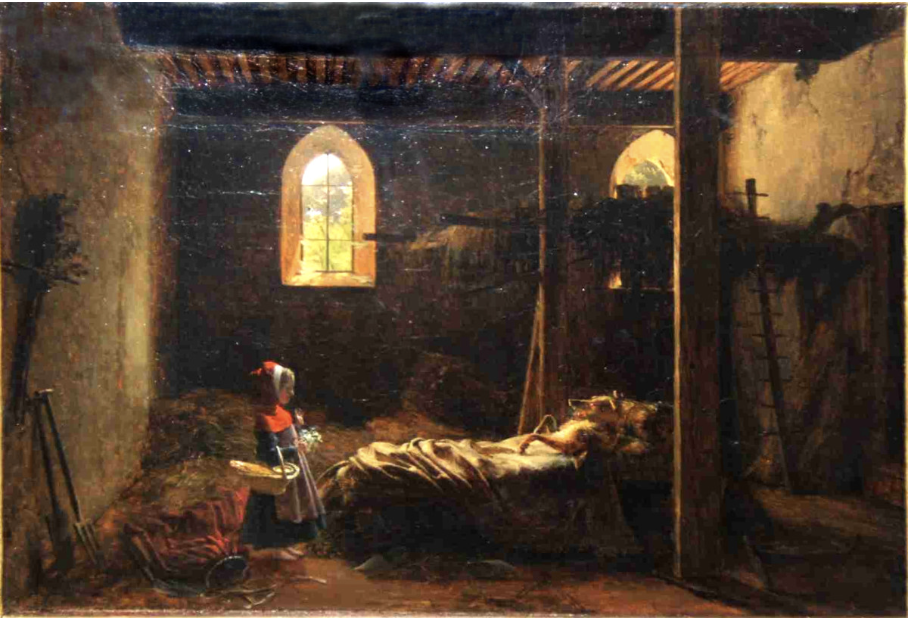
Self-control and caution are central themes in these stories. In these narratives, food does not always represent order and stability. They illustrate the importance of being wary when encountering strangers. Little Red Cap learns a vital lesson about trusting others when the wolf swallows her whole. However, she manages to escape and retaliates against the wolf by appealing to his appetite. She cleverly deceives him twice: first, by filling his belly with rocks to make him feel full and allow her to escape, and second, by enticing him off her grandmother’s roof with leftover water from cooking sausages.”The smell of the sausages rose to the wolf’s nostrils. . . he stuck his neck out so far that he couldn’t keep his footing. . . and he slid off the roof and slid straight into the big trough and was drowned”( Tartar 21).
The prevalence of the cannibalistic maternal role in fairy tales highlights the notion of a woman’s malevolence, which threatens children by transforming them into a source of nourishment. This idea epitomizes the extreme limits of maternal possessiveness. It often evokes fears surrounding swallowing and being swallowed, ultimately leading to losing personal identity. The purpose of such characters in fairy tales is to symbolize the danger encountered by children who stumble upon them. By sharing stories like “Hansel and Gretel,” we instill this fear in our children, which serves various functions beyond mere caution.
The Grimms condemned the greedy distortion of nature as a further attempt at real-life didacticism, encouraging parents to prioritize nurturing and sharing with their children, even in times of famine. Jacqueline Labbe suggests that the cannibalistic maternal figure trope encompasses more than just a lesson for parents.: “When food transmutes from nourishment for the child’s body to a metonym for the child’s body, eating is less about satisfying corporeal needs than about symbolizing moral needs” (Labbe 101). Being eaten as a punishment combines “bodily sensations like satiety and self-flagellation” (Labbe 101), and Labbe notes that it is only ever the bad children who end up “culinary delights” (Labbe 100). For example, Little Red Cap disobeys her mother by leaving the path, and she ends up eaten as a result (Tartar 20). In this context, the moral lesson emphasizes the importance of obedience for young audiences.
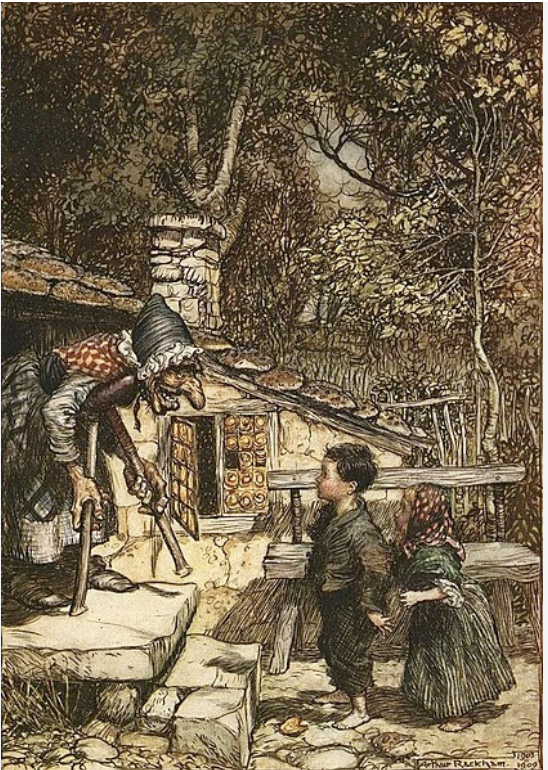
Gretel cleverly exploits the witch’s voracious appetite to her advantage. In this context, food—and its promise—serves as a means of deception and harm. These instances illustrate how food is intertwined with disorder, highlighting that what is intended to be nourishing can sometimes be distorted to deceive and ensnare. The positive connections between safety, comfort, and nourishment are rooted in a child’s fundamental relationship with their mother. The archetype of the nurturing mother, often found in fairy tales, is frequently associated with the notion of wholesome food. In “Little Red Cap,” the mother sends her daughter to visit her grandmother with a freshly baked cake. The girl explains to the wolf, “We baked yesterday, and we want my grandmother, who’s sick and weak, to have something nice that will make her feel better” (Tartar 18).
Connections arise between Little Red’s caring mother, the warmth of a secure home, the comforting aroma of baked goods, and overarching themes of nurturing and care. Daniel notes
“protagonists receive ’emotional nourishment’ (in varying degrees) and gastronomic pleasure from the food provided by maternal figures. The food symbolizes love, comfort, and safety.”
In the story of Hansel and Gretel, the children, facing starvation, are drawn to the witch’s house adorned with confections. Having experienced abandonment by their mother twice, the sweet treats they consume represent a deep yearning to reclaim the maternal comfort that has eluded them. The witch ultimately takes them in, who poses as a nurturing motherly figure, offering them “a fine meal of milk and pancakes, sugar, apples, and nuts” (Tartar 239). Despite her later revelation as a malevolent being, the children do not question her and mistake her for a caregiver, influenced by their association of rich, sweet foods with nurturing motherhood. In essence, fairy tales depict a mother who nurtures and adequately feeds her child because of the embodiment of love and order, establishing the standard against which all other maternal figures are measured.
Unfortunately for the protagonists, negative maternal figures are more prevalent in the Grimms’ tales than positive ones. These women are intricately connected to food and consumption, much like their benevolent counterparts; however, their nourishment is as unfulfilling and perilous because of the wholesome and safe sustenance a caring mother provides. In the story of Hansel and Gretel, the mother abandons her children to starve in the woods, offering them nothing but crumbling pieces of bread. This abandonment stems from her desire to enhance her own chances of survival during a famine. Because such a callous act may seem unimaginable to modern readers, the Grimms addressed a significant issue of their time. They likely employed this cautionary tale to “warn against child neglect in times of suffering.”
Starvation is not the only motivation for the neglect or harm inflicted by a cruel mother figure. As exemplified by the wicked stepmother in “Snow White,” jealousy can also play a crucial role. When the Queen realizes she is no longer the fairest in the land, “envy and pride [grow] like weeds in her heart… she [sends] for a huntsman and [commands]: ‘Get that child out of my sight. Take her into the forest'” (Tartar 96). Upon discovering that the girl has survived, the Queen devises a sinister plan to ensure her demise by intentionally crafting a poisonous apple.
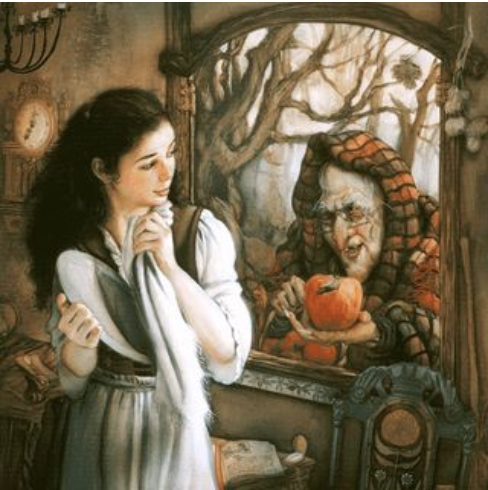
She presents it to Snow White, saying, “Look, I’m cutting it in half. You eat the red cheek, and I’ll take the white cheek.” However, the apple was so cleverly crafted that only the red side was poisoned. The Queen’s maternal instinct is lacking; not only is she depriving Snow White of safety and security by sending her into the woods, but she also intends to harm the girl by offering her a seemingly wholesome apple that she has deliberately tampered with. The mother figures in “Hansel and Gretel” and “Snow White” serve as the Brothers Grimm’s exploration of neglectful or misguided parenting. These portrayals of poor maternal care are often tied to associations with food, which starkly contrasts with the depictions of virtuous mothers in other fairy tales. The Grimms aim to educate children and adults about proper childcare and appropriate parental behavior through these narratives.
Mothers who take pleasure in feasting on their children can be even more terrifying than those who neglect, starve, or poison their children. Cannibalism represents the ultimate malevolence associated with negative mother archetypes. In both “Hansel and Gretel” and “Snow White,” the child who seeks love and safety through food ultimately becomes the object of the mother’s appetite. The witch in these tales is a disturbing parallel to Hansel’s troubled mother. The notion that a mother might even desire to consume her child thrusts readers and protagonists into a distorted world; traditionally, a mother’s role should be to fulfill her child’s needs, not her own appetite of her child.
In contrast to the nurturing mother, whose intentions are transparent, the woman’s reasons for eating the children are numerous yet vaguely defined. Much like the witch in “Hansel and Gretel,” this cannibalistic woman embodies the antithesis of the loving mother while outwardly resembling her. Children often struggle to discern whether this woman harbors intentions to consume them, which makes her appetite particularly menacing, positioning her frequently as the quintessential fairytale villain. Depictions of mother figure with a desire to feast on children exemplify the pinnacle of chaos and terror.
These tales resonate today because they address pertinent issues that remain relevant two centuries later. Starvation, poverty, obesity, and concerns over the origins and contents of our food are still contentious topics: food remains intricately linked to feelings of order and disorder as it was in the nineteenth century. For young readers, eating is inherently associated with survival, comfort, love, and stability, stemming from the primal bond between mother and child. By reinforcing the image of the nurturing mother through food symbolism because simultaneously instilling suspicion and fear through examples of sinister and cannibalistic mothers, the Grimms’ fairy tales reveal how food can also signify disorder. Whether depicted as rich or bland, sparkling or crumbling, saccharine or poisonous, the food motifs in these tales serve as compelling vehicles for reinforcing cultural norms surrounding appropriate and inappropriate eating, feeding, sharing, and parenting practices.
Works Cited
Daniel, Carolyn. Voracious Children: Who Eats Whom in Children’s Literature. New York: Routledge, 2005. Print.
Grimm, Wilhelm & Jacob. “Hansel and Gretel.” Folk and Fairy Tales. Ed. Martin Hallett and Barbara Karasek. Concise ed. Toronto: Broadview, 2011. 111-16. Print.
—. “Little Red Cap.” Folk and Fairy Tales. Ed. Martin Hallett and Barbara Karasek. Concise ed. Toronto: Broadview, 2011. 29-31. Print.
—. “Snow White.” Folk and Fairy Tales. Ed. Martin Hallett and Barbara Karasek. Concise ed. Toronto: Broadview, 2011. 116-22. Print.
Labbe, Jacqueline M. “To Eat and Be Eaten in Nineteenth- Century Children’s Literature.” Critical Approaches to Food in Children’s Literature. New York: Routledge, 2009. 93-103. Print.
Tatar, Maria. Hard Facts of the Grimms’ Fairy Tales. 2nd ed. Princeton and Oxford: Princeton UP, 2003. Print.
Zipes, Jack. Why Fairy Tales Stick: The Evolution and Relevance of a Genre. New York: Routledge, 2006. 195-243. Print.
