Categories
Fairy Tales

Princesses in the Media: The Memorialization of Princess Diana 

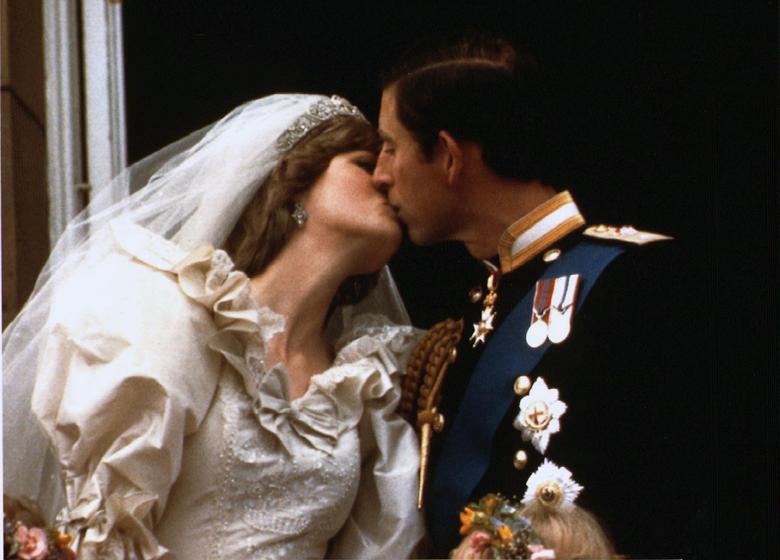
Princess Diana and Prince Charles kiss at their wedding on July 29, 1981.

By Amy Carlyle

Fairy tales seek to communicate themes and messages to readers, using people and magic as metaphors for idea we can apply to our own lives. Often intended for children, fairy tales rely on simplicity and repetition; they should be brief and easily understood, and often, their motifs and components are quickly recognizable. Film and television projects aim to take stories, often with the same structures and traits, and deliver them neatly to audiences. Through analyzing common fairytale tropes and classifications, we can identify generalization in media where the pursuit of a simple, clear narrative sacrifices the complexity that real stories and people innately offer. To demonstrate this, I will examine the life of Diana, Princess of Wales, and subsequent projects about her life produced after her death in 1997.

The constant media attention surrounding Diana, even long after her death, memorializes her life story and transforms it into fairytale, ascribing to it different classic fairytale identifiers. Cliff Skelliter, a museum curator, organized a traveling exhibit commemorating the twenty-fifth anniversary of Diana’s death. On the media coverage of her life, he said: “There is a lot of connectors to what feels like a fairy tale. We love fish-out-of-water stories because they act as a way for us to project ourselves easily into the character” (Roberts). 

Diana’s story is complete with uses of Propp’s functions. She exemplifies Counteraction and fights back as she begins to dress to her own standard, not the crown’s, in response to how Charles treats her. Reconnaissance, Delivery, and Trickery come into play as the tabloids devour everything they can about Diana, spying on her to get information, publishing that information, and using fragments of truth to manipulate her into interviews such as her famous sit-down with Martin Bashir (Vargas). Throughout this time, of course, Diana experiences significant Struggle. Instead of a happily-ever-after, complete with Propp’s Solution and Wedding, Diana’s life was tragically cut short. 

In addition to the plot of Diana’s story containing fairy tale components, the people in her life are also often reduced into their most obvious part for the screen. For example, critic favorite Spencer trims the excess off of the royals so audiences have easier characters to follow. The filmmakers characterized “Charles as a careless and unloving husband, the royal family aloof and controlling, and Diana as a romantic innocent, loving mother, betrayed spouse and forever, triumphantly, the people’s princess” (Roberts). In making the characters so clear cut, these characters are becoming stereotypes of who they were or could have been. Charles’ actions towards Diana and others remain true, but the royals’ family dynamic and marriage were certainly more complicated than what can be communicated in ninety-minute film, and while Diana often comes out on top in these narratives — the people’s princess, a victim to the cruelty of the monarchy — she too becomes merely a character over time. Diana has been cast as a protagonist in her own life’s tale, her community categorized into those who celebrated her and and those who betrayed her. 
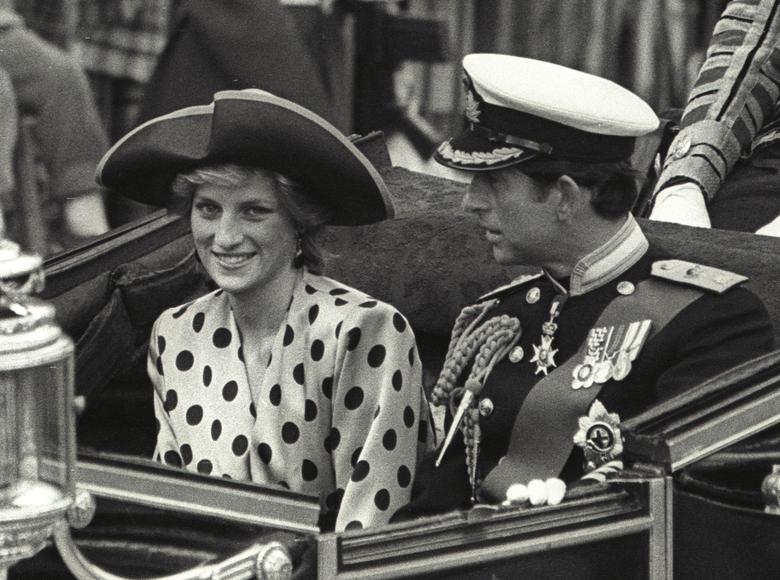
Princess Diana and Prince Charles ride to Westminster Abbey together to attend a royal wedding.

Commodifying Diana’s story into a fairy tale allowed her story to remain a fixture in the global public memory for longer. Fairy tales are made concise and brief over time as they are passed down by generations — often orally, especially centuries ago. Diana is survived by how writers and producers have chosen to represent her; audiences remember her most potent interview phrases that are repeated in every documentary and book chronicling her, leaving her less iconic moments to be forgotten. Despite the new works that are produced about her, like the recent Broadway musical Diana or film The Princess, moments are re-aired and repeated. “It’s all, rather, frustratingly stale: the same familiar footage. The same acknowledgments of Diana’s cultural influence on Britain and the world. The same vaguely voyeuristic exposés of her struggles … The same celebrations of her as a mother and humanitarian” (Hampson). 

In addition to extending her social shelf life well beyond her death, the fairy tale dramatization of Diana’s life allowed her story to reach more people. Her youngest son, Prince Harry, said in the documentary Diana, Our Mother, “…I was thinking to myself, how is it that so many people that never even met this woman, my mother, can be crying and showing more emotion than I actually am feeling?” (Vargas). The narrative of Diana in media promotes an adult emotional attachment to Diana reminiscent of children’s attachments to Disney princesses, attachments founded on inspiration and awe. “When somebody like Diana comes along, all these women who were around the same age, now in their 60s and 70s, projected themselves onto this young lady and forged this strong bond,” said Skelliter about exhibit patrons (Roberts). 
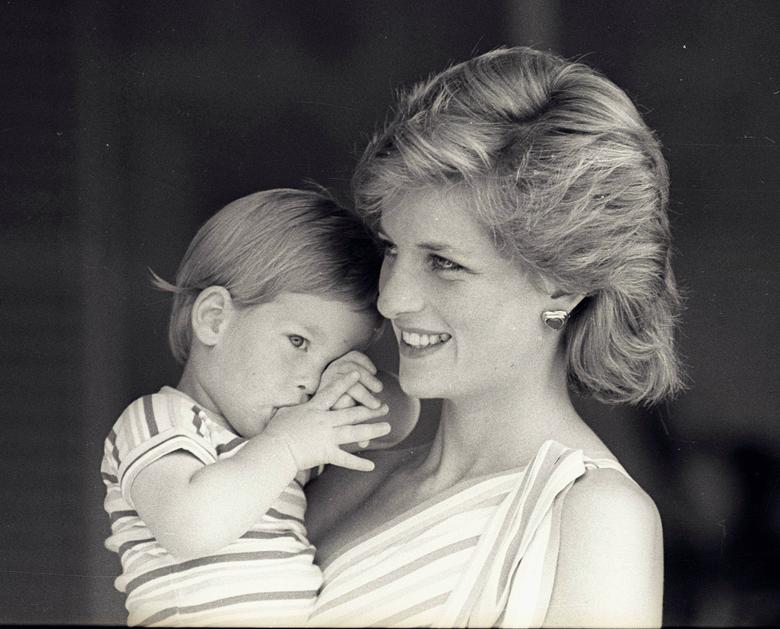
Princess Diana and her youngest son, Prince Harry, pose together for a photo shoot in 1988.

The consequence of building this narrative and making a fairy tale of Diana is the reductive nature of what her character becomes. In retelling Diana’s life this way, the audience views a whole person through a two-dimensional lens. On this, Roxanne Roberts wrote for the Washington Post

The story of Diana started like a fairy tale and ended like a Greek tragedy: a handsome prince, a beautiful princess, then fame, betrayal, reinvention and a fatal car crash 25 years ago in Paris … While Charles has calcified into a state of permanent suspension, Diana has been transformed into an archetype, a symbol of resilience and redemption. She is Everywoman, or what every woman wants her to be.

(Roberts)

This phenomenon is complicated by the fact that a substantial number of projects covering Diana have come out after her death, and aside from family input sought only out of courtesy, Diana and those who actually knew her have little to do with them. Diana’s story is taken out of her own hands as others, in her absence, decide for her how best to tell it. On a documentary relying on recordings of Diana to convey her story, Hampson wrote: “It is right somehow – and moving – that she tells her own story, her real feelings, against the images the world created and consumed. Everyone has had a say about Diana, even now her sons. Twenty years later, we should let her have the last word” (Hampson). 

With the benefits of establishing Diana’s life as an essential pop culture narrative, storytellers also risk reducing her into what can be made into a spectacle for profit and viewership. To take the full story of Diana’s life — all 36 years — and extract only the most quintessential moments and characteristics to pass on through stories limits the scope of how well the world can truly know her. As Roberts wrote, she becomes more symbolic than anything else, as did the other royals, with Charles a disloyal husband and Camilla a villain. Diana did not necessarily fit in with the family she found herself surrounded by, but her struggles became impersonal: the public knows only the moments others found worthy of sharing, and as audiences forget the specifics of those moments, we hold onto only the emotions we had while watching. She becomes no longer a person with her own unique experiences, but a figure emblematic of the feelings audiences may have about their own circumstances. She becomes a vehicle for understanding theme in another director’s or writer’s plot, just how fairy tales can educate or caution us about something. 

The glamorized and dramatized depiction of Princess Diana in media forces her story into the established fairy tale molds. Without her voice represented to its fullness, Diana is simplified into a character and her memories, both struggles and celebrations, are transformed into plot points. In selectively retelling her life experiences this way, the media reduces her personhood to make it more consumable for audiences, in turn underreporting the nuances of her circumstances and the details that made her a complete person. In memorializing Diana as a globally beloved princess denied her happily ever after, her life has been converted to fairy tale, a story that can be passed down for years to come but never with the full truth and substance she carried.

Works Cited 

Remembering Princess Diana: Her Life in Photos. Reuters. 29 Jul. 1981. 

Garber, Megan. “Diana, Princess of Tales.” Columbia Journalism Review, https://archives.cjr.org/the_kicker/diana_princess_of_tales.php

Hampson, Sarah. “A Troubled Fairy-Tale: Princess Diana Remembered 20 Years Later .” The Globe and Mail, 23 Aug. 2017, https://www.theglobeandmail.com/news/a-troubled-fairy-tale-princess-diana-remembered-20-years-later/article36064254/

Michel, Uli. Remembering Princess Diana: Her Life in Photos. Reuters. 23 Jul. 1986. 

Peralta, Hugh. Remembering Princess Diana: Her Life in Photos. Reuters. 9 Aug. 1988. 

Roberts, Roxanne. “Princess Diana Died 25 Years Ago but Endures as a Role Model for Women.” The Washington Post, 28 Sept. 2022, https://www.washingtonpost.com/lifestyle/2022/08/20/princess-diana-death-anniversary/

Vargas, Chanel. “How Prince William and Prince Harry Reacted to Their Mother’s Death.” Town & Country, 30 Aug. 2022, https://www.townandcountrymag.com/society/tradition/a10372852/prince-william-prince-harry-talk-about-princess-diana/

Categories
Fairy Tales

Prime Changes What Now? A Critical Analysis of The Relationship Between Fairy Tales & Advertising

by Jimmy Warshawsky

Fairy tales show up everywhere in our lives. From the time we are read them as small children, to movie adaptations left and right, and almost every ride at Disneyland. Who knows, one day you might even find yourself taking a literature class that focuses solely on fairy tales. One medium that these tales have found an interesting home from their very conception is advertising. Modern advertisers have been using fairy tale characters and motifs in their work for ages. In this project, I’ll essentially be examining the relationship between fairy tales and advertising, their similarities and differences, how one genre has used, or possibly abused, the other, how they have impacted the world around them and, vice versa, how they have been impacted by the world. We’ll go through a brief history of the fairy tale and its depiction in previous ads, and view the scenario from a marxist perspective centered on class and wealth inequality. The primary text that I will be analyzing is from a recent commercial for Amazon Prime, which I will break down, continuing from my prior lens, and discuss the possible positive and negative impacts of this specific advertisement and how it fits into today’s world at large. As a marketing student and someone who plans to spend a good deal of their life working in a corporate office developing advertisements, but also as someone who cares deeply about the structural and systemic inequalities that exist in the world often fueled by wealth and capitalism, I hope to use this paper to dive deep into the relationship between fairy tales and advertising and discover truths about it that could possibly shed light on some important topics and help make the industry and people’s lives better. 

The fairy tale genre comes from a long tradition of oral storytelling that was passed down for many generations. The fact that they were completely spoken by people and listened to by people was essential to their creation and their preservation. Folklore scholar Jack Zipes writes that the first fairy tales “were told by gifted [story]tellers and were based on rituals intended to endow with meaning the daily lives of members of a tribe” (415). No matter what the tales were about back then, it was certain the voice of the narrator was present and known, and they were told directly and in person. This meant that every time they were repeated, they were altered to match the changes of the group they were told in. Historian Marina Warner, who often focuses her work on feminism and myths and fairy tales, gives us further insight into the early fairy tales. She writes that they always include that circle of active listeners, who are invited to engage with the tales and identify with their characters, and that “Schematic characterization leaves a gap into which the listener may step. Who has not tried on the glass slipper? Or offered it for trying?” (Warner 412-413). It is important to understand that the original fairy tales were not written down, which meant that they were very fluid and constantly changing. Anyone who heard them then had the power to take control of the story and make it their own, for themselves or whoever they would retell it to. One could write, or rather think or speak, themselves into a story and become the hero. Also, fairy tales were for everyone; as long as one understood spoken language, they could engage. Marshall McLuhan, a communications scholar who I have studied extensively in my media studies courses, famously asserted that “the medium is the message.” This is an idea that stems from technological determinism, which is the idea that technology shapes not only the way that humans communicate but also a society’s cultural values and social structure. The way that the content is communicated can often tell us and predict more about the world than the content itself. When fairy tales were only communicated by speech and voice, passed down from person to person and told in face-to-face settings, it allowed for the listener to have a certain agency in relation to the stories that wouldn’t be possible in a more rigid medium.

Such violation of oral storytelling was crucial and necessary for the establishment of the bourgeoisie because it concerned the control of desire and imagination within the symbolic order of western culture.

Jack Zipes

Eventually, oral storytelling became much less popular, as it was overtaken by the written word. With the invention of the printing press, stories could be copied word for word and distributed in a way unlike anything that had come before. This new technology shaped the fairy tale, its essence, and who it was for. Soon, the oral traditions of the past were dominated “by a different social class, and the form, themes, production, and reception of the tales were transformed” (Zipes 415). The genre that we now think of as fairy tales was crafted from a wide range of folk tales that had been passed into this new wave of communication. It was transformed into “a literary tale that addressed the concerns, tastes, and functions of court society” (Zipes 416). Now that fairy tales were printed texts, they weren’t so easily changeable or relatable, and they were only accessible by the highest classes of society. Some oral traditions persevered and eventually, those were all written down too by authors such as the Brothers Grimm in the nineteenth century. Zipes posits, “such violation of oral storytelling was crucial and necessary for the establishment of the bourgeoisie because it concerned the control of desire and imagination within the symbolic order of western culture” (417).

It is my assertion that this is where fairy tales’ relationship with advertising begins, in the thought that these new forms of literary tales acted as ads themselves. The way that we often think about ads today may be in the forms of commercials we see on television, billboards on the side of the road, or sponsored posts on social media, but the definition of an ad can be taken further. They are a form of media that is meant to persuade its audience and affect their behaviors. They might be persuading you to buy the newest Samsung Galaxy phone, or maybe they are changing your attitude about who drives a Lexus, or wears Gucci perfume. Behavioral influence is what the literary fairy tales of the nineteenth and twentieth centuries were all about. Take, for example, the morals of Charles Perrault, who explicitly wrote out the underlying message of his tales as each concluded. After “Bluebeard,” he writes “Curiosity, in spite of its many charms, / Can bring with it serious regrets…” (192). Perrault isn’t selling a product, but he is selling a way of acting and behaving. All of a sudden, fairy tales were no longer fluid, and their readers, just like the characters in the tales, were stripped of any agency that they might have previously had to write their own stories. 

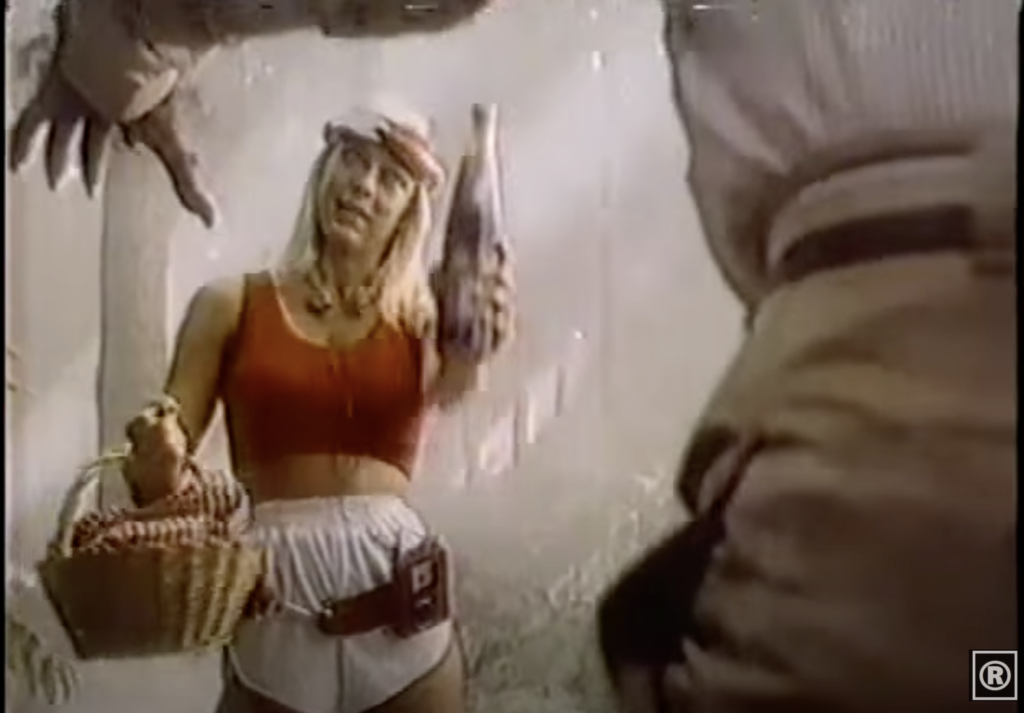
Pretty much as soon as television advertisements existed, they started relying on fairy tale motifs and never stopped. The first fairy tale television commercial crossovers featured classic figures like Cinderella and Goldilocks inserted sloppily in cartoons to explain products and why the public needed them (Wittwer). They were familiar names that audiences knew well and they added a sense of ethos and feel-good cuteness to the ads. Every decade saw fairy tale figures and motifs thrown into advertisements in an attempt to sell more products. Some continued to be sloppy, and some got clever. In many ways, the evolution of fairy tales in advertising mirrored the evolution of the literary fairy tale. They began as very straightforward, exactly what you would expect, but eventually, new authors and creatives began to take control of the tales and write their own versions. James Thurber wrote a “Little Red Riding Hood” story that ends with the young heroine shooting the wolf dead with an automatic rifle. How’s that for agency? In a Dr. Pepper commercial from the ’80s, little red also defeats the big bad wolf herself, but this time instead of using a gun, she gives him, you guessed it, a bottle of Dr. Pepper. Just last year, Amazon released a new series of commercials that rewrite old tales, giving the characters a newfound sense of agency, power, and individuality to reflect the modern world, all with the help of Amazon Prime.

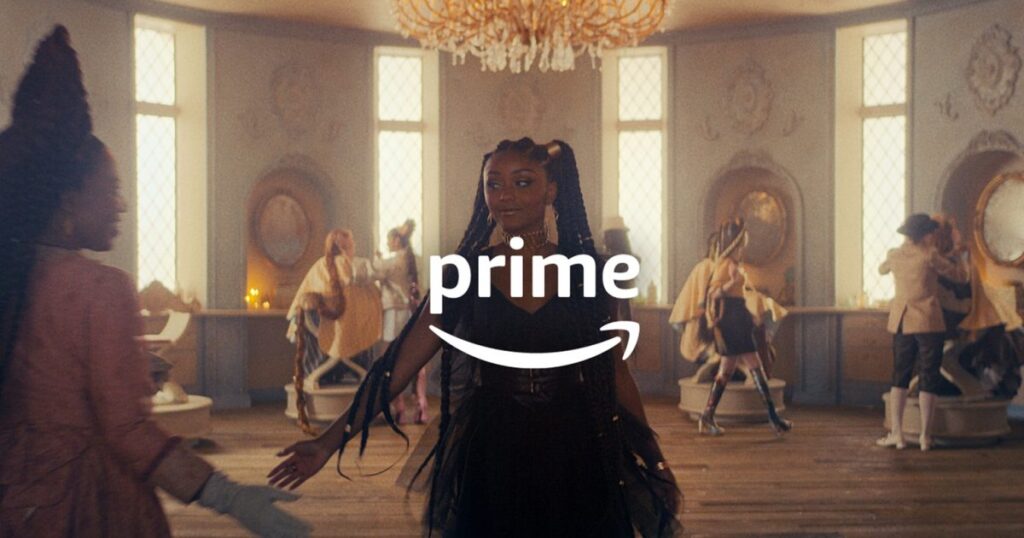
The campaign was titled “Prime Changes Everything,” and imagines the story of Rapunzel if she had access to Prime. The commercial opens on Rapunzel sitting in the window of her iconic tower, as the narrator speaks aloud, “Once upon a time there lived a princess with really long hair who was waiting for a prince to come save her” (Amazon). It’s a classic set-up to the story we all know, but it quickly diverges from the original when she continues, “But really, who has time for that?” (Amazon). Then comes the product placement, as we see Rapunzel grab her cell phone, which juxtaposes the medieval-like castle, and open up the Amazon app. Hip-hop music begins to play in the background, further removing the audience from the original fairy tale landscape that the ad started in. The narrator commentates, “She ordered herself a ladder with Prime one-day delivery and she was out of there,” as she does just that and a ladder appears at her window in that instant (Amazon). Rapunzel rides away through the forest and we see, assumedly a significant amount of time later, her running what looks like a modern-day hair salon in an old-timey village. The voice-over finishes, “Now, her hairdressing empire is killing it. And the prince, well who cares? Prime changes everything.” with the last line and Prime logo appearing on the screen (Amazon). The ad received outstanding feedback from the press and marketing communities, with Forbes calling it, “exactly the fairy tale that every girl needs,” and Clio, a company that runs one of the most recognizable and prestigious advertising awards ceremonies, writing, “Reappraising myths and tales of yore, with postmodern panache or through a progressive lens, feels right for our wearying times,” (Davis; Gianatasio). 

The way young girls view the roles of a woman in society are greatly influenced by the archetypes found in fairytales.

RaVal Davis

This advertisement from Amazon does deserve some amount of praise. It’s, for one, incredibly well-produced and it utilizes fairy tales in a clever, non-sloppy way. It’s also very persuasive and shines a good light on Prime and all of its benefits. There’s no denying that Prime delivery has made almost everyone’s lives easier or simpler or better in at least one way, and this commercial puts that at the forefront. Above the overall effectiveness of the ad, it also seems to do some good at social justice and feminist levels. Amazon successfully rewrites a story that traditionally sees the heroine locked away, with no sense of agency, at the mercy of a prince to come and save her. The Prime Rapunzel doesn’t need a man to escape and does so (almost) all on her own, and even goes above and beyond to become a businesswoman and hairdressing tycoon. That’s something that one would never find in your traditional literary fairy tale, but a message that is undoubtedly good for society. Little girls should know that they don’t need a man to succeed in life and they can overcome adversity on their own. Davis writes “The way young girls view the roles of a woman in society are greatly influenced by the archetypes found in fairytales” and “studies also show that children start to develop gender stereotyping between the ages of three and six—ages when they are most likely to encounter fairytales [sic].” Because we live in a world where children are being exposed to media and television, including ads, at increasingly young ages, it does seem important that prominent media that showcase fairy tales feature female characters that have agency, unlike many of the traditional princesses found in pop culture.

In addition to all of this, Amazon’s choice to cast a Black actress as Rapunzel is great for representation of minorities in roles that have almost always been played by White people. It was a bold choice from the internet shopping giant, especially when one considers how much controversy has erupted over Black actors and actresses being cast in roles usually played by White actors and actresses, but a very socially forward choice worthy of commendation. In some ways, this commercial brings fairy tales back to their original form. The ad is a demonstration of how stories can be rewritten, and anyone, including minorities and people of lower class, can step into them, and imagine themselves as heroes. The commercial is even narrated, rather than written, which is a nice touch for old times’ sake. 

The commodification of Western culture creates a magic spell over society…

Jack Zipes

That being said, though, there are negative aspects of the advertisement as well. While this commercial does some good for marginalized communities, it still exists in a capitalist, free market, neoliberal economy which pushes people down, especially minorities, more than it lifts anyone up. We can talk all we want about how progressive the advertisement is, but at the end of the day, that’s still exactly what it is: an advertisement. The commercial is not designed to get you to think differently about Rapunzel and the agency of fairy tale characters, it’s designed to get you to use Amazon Prime and buy Amazon products. It’s also difficult to fathom how something Amazon does could be good for the community when they are one of the largest companies in the world owned by one of the richest people in the world. We have previously discussed that using fairy tales in ads gives the brand emotional, trusted, and feel-good characteristics. Amazon is using this strategy to lull consumers into their trap. The main theme of the commercial is that “Prime changes everything,” but it really doesn’t. What Prime and this commercial actually do is perpetuate the systemically oppressive capitalist system that we exist in now. In discussing the harmful aspects of capitalism, industry, and commodification, Zipes writes, “the socioeconomic forces, particularly in the advanced industrialized societies of the West, split the individual, lame and pervert human potential so that the result is alienation, deprivation, violence, exploitation, and destruction. To a certain extent, the commodification of Western culture creates a magic spell over society, what Bloch and other Marxists would call false consciousness, so that, enchanted and blinded by commodity fetishism, we act against our own humane interests” (331). The commercial also overwhelmingly downplays the large and pressing issues of wealth, gender, and racial inequality, suggesting that all people need to make it in life is Amazon Prime. If that’s how it worked, then that would be great, but unfortunately, there are greater systems at play operating to keep some people from advancing in life and Prime cannot, and would not, stop them. 

Overall, the advertising world has been relying on fairy tales for as long as modern ads have existed, and they will undoubtedly keep featuring motifs and characters in them for a long time to come, generally to the benefit of the companies they are trying to promote. Their effectiveness in selling products is often high, which makes sense considering that fairy tales have been acting as advertisements in some ways for a very long time. The fact is, however, that advertisers have co-opted fairy tales to put a bit of a spell on consumers, leading them to believe that they lead these great lives that are full of agency and can do whatever they want. In reality, in the world we live in, consumers can’t do whatever they want. The free market is not free for the masses, and the lower and middle classes live trapped by the economy. No matter how many times Amazon or the next company rewrites Rapunzel, a ladder will never just appear. It’s not that simple.

But hey, next time you find yourself locked away in a tower, give it a try.

I just hope you have cell service. 


Works Cited

Amazon. “Prime Changes Everything.” Youtube, 12 Nov. 2021, https://www.youtube.com/watch?v=raaYkGHY0kY. 

Davis, RaVal. “Amazon Prime’s Rapunzel Commercial Is Exactly the Fairy Tale Every Girl Needs.” Forbes, Forbes Magazine, 27 Oct. 2021, https://www.forbes.com/sites/ravaldavis/2021/10/27/amazon-primes-rapunzel-commercial-is-exactly-the-fairytale-every-girl-needs/?sh=4511ff5858da.

Gianatasio, David. “Why Rapunzel and Cleopatra Really Could Have Used Amazon Prime.” Muse by Clio, The Clio Network, 3 Aug. 2021, https://musebycl.io/advertising/why-rapunzel-and-cleopatra-really-could-have-used-amazon-prime. 

Perrault, Charles. “Bluebeard” The Classic Fairy Tales: Texts, Criticism, edited by Maria Tatar, W.W. Norton Et Company, New York, NY, 2017, pp. 188–193. 

Warner, Marina. “The Old Wives’ Tale.” The Classic Fairy Tales: Texts, Criticism, edited by Maria Tatar, W.W. Norton Et Company, New York, NY, 2017, pp. 405–414. 

Wittwer, Preston. “Don Draper Thinks Your Ad Is Cliché: Fairy Tale Iconography in TV Commercials.” Humanities, vol. 5, no. 2, 2016, p. 29., https://doi.org/10.3390/h5020029. 

Zipes, Jack. “Breaking the Disney Spell.” The Classic Fairy Tales: Texts, Criticism, edited by Maria Tatar, W.W. Norton Et Company, New York, NY, 2017, pp. 414–435.Zipes, Jack. “Folklore Research and Western Marxism: A Critical Replay.” The Journal of American Folklore, vol. 97, no. 385, 1984, pp. 329–337., https://doi.org/10.2307/540613.

Categories
Fairy Tales

Fairy Tales in the Metaverse

By: Olli Personeni

The past couple of years have been marked by significant advancements regarding technology. There has been tremendous growth in Non-Fungible Tokens (NFTs), cryptocurrency, and the expansion of the metaverse. The metaverse has the potential to outstretch the physical world using extended, augmented, and virtual reality features. As technology becomes a more integral part of education and learning, comes the possibility of using the metaverse to teach children valuable lessons. Being immersed in a fairytale through virtual reality increases the impact of a cautionary tale by stimulating parts of the brain currently inaccessible through film and language. By being immersed in the story the reader becomes an active participant rather than a spectator and their immersion in the tale enhances the experience, which can lead to the moral of the story having a greater impact on the child’s learning. Furthermore, through immersive learning, children will have the ability to enter the story and through their experience, they will be better able to understand and apply the valuable lessons of fairy tales into their own personal lives.

As generous as they are, fairytales teach a lesson only when someone is reading or being told the story. Moreover, there is an additional space between the story and its moral. Readers or listeners need to see and hear beyond the characters and the plot to really understand the lesson they are told. If a fairytale is experienced through the metaverse, its impact increases because virtual reality stimulates the cortical areas of the brain currently inaccessible through ordinary movies and language (Georgiev et al, 2021). In fact, neuroscience explains that digital information can push the brain to react to immersive situations exactly how it would react in real life. Immersive learning is therefore a game-changer for practice-based learning since it simulates real-life settings. It uses virtual spaces to separate users from their environments and immerse them into a completely different one where they become part of the learning experience (Aptara). If the world was duplicated as a fairytale, the story would be fully experienced by the learner, and the chances for the moral to be wholly absorbed would be higher. The relationship that is then created by neurotransmitters upon experiencing the fairytale firsthand, is clearly different and deeper than any story read, or any movie watched. Immersive learning is the bridge that would allow children to learn the fairytale lessons within the metaverse and the most suitable learning tool for cautionary tales in the contemporary world.

The concept of metaverse includes virtual reality, augmented reality, and digital economy where users can create goods and buy and sell them. Metaverse’s potential impact on the way activities and businesses develop and grow is likely to be transformational as the distinct lines between physical and digital are becoming more and more blurry and very far from current perceptions. Even if the “full virtual experience” does not exist yet, researchers are increasingly examining the transformative impact of the metaverse (Dwivedi, 2022). Impacted sectors include marketing, education, entertainment, and healthcare. According to Hirsh Patek et al. (2022) understanding how to support learning goals “through harnessing the power of active, engaging, meaningful, socially interactive, iterative, and joyful contexts will transform flashy and fun digital experiences into truly educational ones with true social interaction at their core” (Hirsh Patek et al., 2022). Therefore, the metaverse can offer a platform to encourage cooperation, develop creative thinking, and foster learning. The idea of using virtual reality as a tool to improve the learning experience of children is gaining ground. According to Hirsh Patek et a. (2022), to create a good education app learning needs to be active, and engaging rather than distractive, and iterative, which allows learning through different paths, and encourages social interaction. The key to making these apps effectively educational requires the game/activity to have “a well-articulated learning goal” (Hirsh Patek et al., 2022). What if that goal is learning a moral in a way that can be remembered and can ultimately foster behavioral change? And what if the content chosen to explain the moral is a fairy tale? To host fairytales in the metaverse means developing traditional characters in apps such that children can fully interact with them. This would allow the kids to experience Propp’s narrative functions, play character types in sequence, and learn the moral of the story by living it in the moment. A fairytale app hosted in the metaverse will result in a positive learning experience since it will assure engagement and action, as the player/character will actively assume their role. It will also encourage social interaction as friends could play different characters in the story and take turns promoting an iterative experience.

Why a cautionary tale makes good learning content and has it the ability to motivate change? Maria Tatar makes a very compelling argument when explaining why fairy tales still matter nowadays, “in an era when cynicism seems to have driven out wonder” (Tatar, 2010). It is the transformative experience of reading that is making fairy tales meaningful from an educational perspective, as every child reading a story is opening “the gate that separates him/her from Elsewhere. It gives him/her choices.” (Lowry, in Tatar, 2010). Fairy tales are defined as “portals to the wonder worlds,” where imagination, exploration, risks, and illusion are possible. The child reading fairy tales enters “Elsewhere” to learn something. According to Tatar, children approach language through fairy tales and master the “linguistic conventions that allow adults to do things with words, to produce effects that are achieved by saying something” (Tatar, 2010). Language is then the form of expression that can support behavioral changes, can create illusions, can make people act or think in a certain way. These stories help children learn that actions have consequences, their causes, and effects, that there is good and evil, and so on, which “marks the beginnings of some form of agency” (Tatar, 2010). Moreover, fairy tales have the power to elicit what Richard Wright has described as a “total emotional response” (Tatar, 2010). If children learn agency and emotions from fairytales, then the educational potential hidden in these stories is extremely valuable.

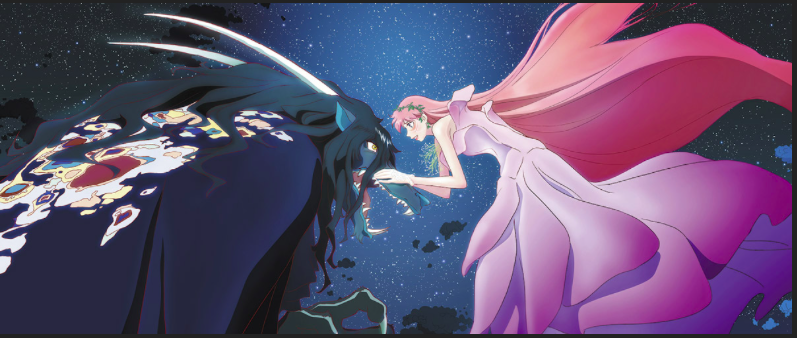
Not surprisingly, cautionary tales are adaptive enough to shape into the most suitable form at a point in time. Tatar shows the transformative power of tales starting from the way stories morph into new versions of themselves when told again and even more when they “migrate into other media.” Media are means to present a fairy tale, however, they also have the power to change the story, as the plot often is modified and some of the characters are adjusted to better suit the media where they are narrated. There are many examples of classical plots that were heavily adapted to better fit a movie, a cartoon, or a comic book. A recent movie that ties together fairy tales and the metaverse is the fantasy film Belle by Mamoru Hosoda. The movie takes place in modern Japan where the characters create an alternative identity for themselves in the metaverse, U. The story is a modern adaptation of the classic fairy tale, Beauty and The Beast. The main character of Belle is a quiet schoolgirl named Suzu whose alternative identity, Belle, becomes a singing sensation in U. In U she forms a friendship with the Dragon (the beast), the strongest and most feared user in the reality; much like the friendship that develops between Belle and the Beast. Throughout the movie, the characters bounce back and forth between the real world and U, and their lives become increasingly connected between the two. In the end, through the evidence and clues found in U, Suzu is able to identify the Dragon’s real identity and save him from danger. The fantasy film Belle shows a remarkable transformation of the classic tale and depicts a possible future where one’s ordinary life is strongly intertwined with the metaverse, and the potential positive outcomes that one can receive, such as new confidence, new friendship, and love.

Learning lessons through the metaverse, including the morals of fairytales, can be more powerful. Recent literature sustains that immersive learning through virtual reality increases “presence or agency” which maximizes the retaining experience of learners (Makranski and Petersen, 2021). “significantly improved retention, transfer, and self-efficacy when learning through virtual reality.” The findings were based on qualitative studies run on samples of undergraduate biochemistry students that are looking very promising in suggesting that when presence and agency are assured, and both are secured in immersive learning through virtual reality, learners benefit the most and retain the largest amount of information.

In more detail, Makranski and Petersen (2021) found that immersive learning in Little Red Riding Hood represents a very suitable example of how immersive learning through virtual reality can enhance the ability to understand lessons and foster behavioral change. In the Brother Grimm’s adaptation, (Little Red Riding Cap) it all starts with “I’ll do just as you say” (The Classic Fairy Tales, 18). The distended promise to her mother brings Little Red Cap to the forest and into the wolf’s arms. The girl leaves her path several times to see the sunbeams, the trees, and the beautiful flowers, and when she gets to her grandmother’s house, she finds the gate open and is taken by a “strange feeling” that something is not right. Indeed, it is not, as the wolf in disguise leaps out of Grandma’s bed and eats the girl. Luckily, the huntsman hears the loud snoring of the wolf, which fell asleep after his copious meal. The huntsman finds the wolf inside the house, understand that he might have eaten the girl and her grandmother, and opens his belly to extract both of them. In the end, the child promises she has learned the lesson as she says to herself “never again will you stray from the path and go into the woods when your mother has forbidden it” (20). Clearly, Little Red Cap could not act wisely because she did not understand the real importance of what her mother told her, just like children reading the story only remember the wolf deception, the hunter saving the little girl, and the happily ever after. They rarely absorb the moral of the story, which is to never trust strangers, as they might have bad intentions, and not to disobey your parents, who most of the time know better. Typically, children forget about what they have been told and pursue their interests, not seeing the risks nor dangers. Reading a fairytale is no different; it is like being told to follow a specific rule or to behave in a certain way, and very rarely it is enough for the child to remember the lesson and act accordingly. Through the metaverse, on the other hand, children can play the part of Little Red Cap themselves and they can feel the fear, can perceive the dismay and hopelessness when taken by the wolf, can understand the sadness when she figures out how much she risked just because she did not do as she was told. They will feel true happiness when saved and will respond to their mother’s reprimands with heavy souls. The beauty of immersive learning is that children could even play different roles. They would be experiencing the main character’s innocence and inexperience, then seeing how the wolf tries to take advantage of Little Red Cap’s naivety while being able to act as the huntsman who saves the young girl and the old lady. They would be able to feel all the emotions as if they were an active agent in the story.

Virtual reality increases the impact of a cautionary tale by stimulating parts of the brain that are inaccessible through film and language. The morals and lessons that cautionary tales represent and the significance they hold in children’s growth and maturation allow for fairy tales to be a suitable candidate to explore how immersive learning fosters understanding, retention, and ultimately behavioral change. Children as active participants rather than observers, experiencing the process of decision-making and its effects, entering each character and grasping their point of view and feelings will inevitably lead to the moral of the story having a greater impact on the child’s learning. The potential benefits of using the metaverse to teach children valuable lessons without putting them at risk are unlimited. When this possibility becomes a reality, it will lead to kids being able to better retain and learn valuable lessons.

page5image38693568 page5image38693760

page3image38598336 page3image38595456

Categories
Fairy Tales

Disney’s Snow White and the Great Depression

Animated Film Reviews: "Snow White" Secrets

By Erin Tracey

A visit to the cinema granted moviegoers the ability to escape reality for a brief period before returning to the intricacies of the Great Depression in the 1930s. At that point, Hollywood was in its Golden Age as major film studios cast bigwig stars in stories glamorizing high society life to entertain those scuffling to stay afloat in the United States. Yet, Walt Disney sought an alternative approach as is evident in his first feature-length animation Snow White and the Seven Dwarfs. Its fantastical elements make the fairy tale appear whimsical and mask its underlying capitalist themes that reflect the political context of the decade rather than avoid it. As an appropriation of the written fable associated with the Brothers Grimm, the 1937 film adaptation utilizes an array of cinematic techniques that promote, to a distressed population of viewers, notions of collectivism, diligence, and the new American Way.

If not for its theatrical release during a rise in animation, the story of Snow White would lose its mark as an emblem of Americana. At the time of its distribution, few held high hopes for the work’s success as “it was prophesied that nobody would sit through a cartoon an hour and a half long” (Plunkett). Yet, that did not dwindle the spark lit in Walt Disney. He “had decided there was only one way [he] could successfully do Snow White—and that was to go for broke—shoot the works… [with] no compromise on money, talent, or time” (Plunkett). A $1,499,000 budget proved worthy of every penny for the opening premiere brought in $66,596,803 and an additional three re-releases brought the lifetime gross up to $184,925,486 (IMDb Pro). Its positive commercial outcome could be attributed to both technical innovations (i.e. the synchronization of music and the use of Technicolor) and engaging characters (i.e. the Evil Queen). 

Disney’s choice to translate the story into the media of film places his version of the tale in the forefront while grisly literary and oral forms, ill-suited for children, disappear in casual discussions of the general public in the United States. As an institutionalization of the genre, cinema poses a great threat to the success of traditional print storytelling because these visual works give characters a voice, an appearance, and characteristics that may contradict those of past narrations. A film’s message and content hinges upon the beliefs of the director who integrates personal bias into these works via the pen of their artist. As a known supporter of Franklin D. Rosevelt, Walt Disney saw “work” as “the real adventure of life” (Batkin) and reflected these ideals through character’s behaviors and mindsets to make a product of nationalist propaganda in favor of the New Deal. In addition, his signature rags-to-riches pipeline reflects the upbringing of the creator himself who “came from a relatively poor family and suffered from the exploitative and stern treatment of an unaffectionate father” (Zipes 343) before rising to fame with the creation of Walt Disney Studios. 

Snow White and the Seven Dwarfs condemns the antagonistic Evil Queen meant to represent the greedy, individualist ideology of the 1920s. After the Wall Street Crash of 1929, the U.S. needed a scapegoat to blame for the “immeasurable depth of economic, social, and cultural turmoil” (Mollet 112). It was nearly impossible to pinpoint a direct cause, though bankers held accountable unrestrained speculation; analysts, the failure to raise interest rates; and financial writers, the Federal Reserve System (Klein 328). All could, in a general sense, point fingers at superficiality and material wealth as pitfalls of the Great Depression: definitive qualities of the ‘Wicked Queen.’ At the conceptualization stage of character development, she was set to be “a mixture of Lady MacBeth and the Big Bad Wolf” (Mollet 116). Her selfish demand to the magic mirror, “‘[w]ho is the fairest one of all?’” (Snow White and the Seven Dwarfs), becomes a recurring motif as she obsesses over maintaining her reign as enchantress of the land. As soon as she hears the words “she is more fair than thee” about a maiden with “lips red as the rose, hair black as ebony, skin white as snow,” the queen wraps her hand in fist, narrows her eyes, and, in an aggravated tone, exclaims “Snow White!” (Snow White and the Seven Dwarfs). A green tint covers the mirror, symbolic of the queen’s envy. Atop her throne, decorative set design in the background and a fanciful wardrobe emulate her villainous aristocratic demeanor with a purple gown, the color of royalty, and a gold ceremonial chair in the shape of a peacock. As a means of accentuating the lifestyle difference between the two main characters, Disney depicts Snow White as a scullery maid of the Evil Queen. In ordering a huntsman to kill her step daughter, the queen knows she will reclaim her grand title, “fairest of all,” and covet the princess’s wealth. As opposed to an absent father, a story beat of the Grimm Brothers, the film begins with the death of the protagonist’s parents, eliminating any “betrayal of a parental figure” (Mollet 116) and chance to deflect blame onto supporting characters for failing to protect Snow White; thus, the sole person to condemn remains the Evil Queen. A personification of past generations, her character warns audiences about the dangers of reverting to past egocentric principles that’ll never lift a weakened society out of the Great Depression.

A sharp contrast to the heartlessly ambitious Evil Queen, the compassionate and hopeful Snow White exhibits a middle class heroine of the 1930s. Accepting her subordinate position in the castle, the princess executes her daily duties with a graceful hum: fetching water and scrubbing a staircase on hands and knees, “rags” unable to “hide her gentle face” (Snow White and the Seven Dwarfs). Her mentality of patience and ability to reconcile her subpar living conditions echoes the spirit of Americans who stayed quiet during the Great Depression. At the same time, she remains hopeful and inspiring through her ability to dream. As doves coo around the wishing well, the princess sings, harmonizing with her own echoing voice, which summons a prince who overhears her melodious tune: “I’m wishing for the one I love to find me, today. I’m hoping and I’m dreaming of the nice things he’ll say” (Snow White and the Seven Dwarfs). Another song with lyrics about reuniting with the prince chimes in later on while she sings in front of the dwarfs, reiterating her persistent optimism. Her self-reliant and sincere character reaffirms the notion that “if [you] remain positive and hardworking, good will triumph over evil and [you] will be released from the suffering of everyday life” (Mollet 116) which was motivating for Americans nostalgic of the economic growth of the ‘Roaring Twenties.’ 

Snow White, on top of her charismatic nature, embodies the collective fear of most Americans in the late 1920s. As the nation’s economy went in a downward spiral, people began to take personal responsibility for financial failure and became weary of the unforeseen future. After she’s spared her life and told to flee faraway, the protagonist enters the dark, deep forests alone and unprotected with nervous feelings akin to those of the general population at the time of the film’s release in 1937. An intense instrumental soundtrack complements action sequences of her tangling herself up in thorn bushes, falling through a hidden sinkhole, and plummeting into murky waters below while the sound of her screams interject. It clearly being her first instance in the woods heightens her anxiety for she’s both unfamiliar with her surroundings and unaware of her final destination without any home awaiting her return. As she sprint through the terrain, the protagonist lets her overwhelming emotions get the best of her and she hallucinates “frightening trees as monsters” as well as “vicious river logs” as “crocodiles” (Mollet 115) until friendly woodland creatures reveal themselves under spots of sunlight and she admits to her delirious visions: “You don’t know what I’ve been through. And all because I was afraid. I’m so ashamed of the fuss I made. What do you do when things go wrong?” (Snow White and the Seven Dwarfs). Acknowledging her weak reaction to terror exemplifies the message of Franklin D. Roosevelt’s First Inaugural Address in 1933 which reads, “the only thing we have to fear is fear itself–nameless, unreasoning, unjustified terror which paralyzes needed efforts to convert retreat into advance” (Roosevelt). After overcoming the fear highlighted in FDR’s speech, the protagonist picks herself up, finds a place to stay, coexists with the dwarfs, and ends up living ‘happily ever after.’ 

Brothers Grimm’s Snow White excludes any notation of Snow White becoming a subordinate to the Evil Queen. Instead, the fairy tale emphasizes themes of familial drama without depictions of stark class differences. It’s evident that “Disney transformed [Snow White] into the leading role in the rags to riches story of the American Dream” (Mollet 114), Americanizing a tale traditionally known to be European. Additionally, the distinct resolutions in each version vary based on which subject receives greater attention. In the Brothers Grimm, emphasis lies on the death of the Evil Queen. At the royal wedding, “she had to put on red hot iron shoes and dance in them until she dropped to the ground dead” (Tatar 196), a painful suffering for her bitter jealousy. Disney’s Snow White and the Seven Dwarfs concludes on a lighter note with a glowing golden castle in the clouds, a vibrant pink sunset, a gleeful chorus, and the silhouettes of the lovely Snow White and the Prince. A decision to end with a romantic final scene as opposed to the queen’s death, which in the film occurs after she’s run off a cliff trying to crush the seven dwarfs under a tumbling boulder, accentuates the idea that an idealistic attitude will lead to a joyful and prosperous life. If the queen, disguised in her old hag garments, were the last character on screen, the motion picture would leave old values of individual greed in the spotlight and invoke fear in an audience already hopelessly suffering.

Alas, the seven dwarfs, perhaps the characters who vary most between the two tellings, gain an enthusiastic essense in the feature film as the bunch travel to work with a smile and a song, exemplifying the community spirit that grew as a result of FDR’s New Deal and the Works Progress Administration (WPA). After hundreds of thousands were left unemployed and impoverished due to the economy’s collapse, people set about teaming up to bring prosperity back to America. All types of employees came together, reverting “to a simple way of life” with the “repetition of manual labor tasks,” (Batkin) whether it be the Grumpys, the Sleepys, the Happys, or the Dopeys. Although the miners dig up a surplus of diamonds a day, the persistent blue-collar workmen never indulge in the financial benefits that come with cashing in these precious gems. Instead, the diligent dwarves mine just to mine without any material motivation: “We dig up diamonds by the score / A thousand rubies, sometimes more / But we don’t know what we dig ’em for / We dig dig dig a-dig dig” (Snow White and the Seven Dwarfs). As ideal members of society’s working class, the dwarfs are “rigid in their routine of going to work in the mines, despite the distraction of the princess hiding in their home” (Batkin) and take pleasure in the process, apparent in the jolly tune ‘Heigh-Ho.’ An accidental trip dislodging the “poisonous piece of apple lodged in” the unconscious princess’s “throat” (Tatar 198) becomes lost once the written text converts into an animation. Adopting a separate approach to awakening the protagonist, the movie puts these run-of-the-mill diggers in a new light as heroic saviors of Snow White. Disney’s choice to make the dwarfs active characters in the rescue of the protagonist demonstrates that “the ordinary man could still become extraordinary through his acts, as opposed to through his wealth” (Mollet 119). Audience members viewing the film exit the theater typifying the meticulous and driven attitudes of these ideal working class miners hoping to become heroes someday as well.

Walt Disney cast a hypnotic spell on every film made through Walt Disney Studios, especially Snow White and the Seven Dwarfs. Its content aligns with that of the film’s original decade, the 1930s, though an embellished score and intriguing characters shroud its strong political message. An abundance of story elements are based on the Brothers Grimm’s Snow White, yet the animation has a completely contrasting undertone reminiscent of the American Dream.

Work Cited:

Batkin, Jane. “Framing Snow White: Preservation, nostalgia and the American way in the 1930s.” Snow White and the Seven Dwarfs: New Perspectives on Production, Reception, Legacy. Ed. Chris Pallant and Christopher Holliday. New York: Bloomsbury Academic, 2021. 149–162. Bloomsbury Collections. Web. 6 Dec. 2022. <http://dx.doi.org/10.5040/9781501351198.ch-008>.

Disney, Walt, et al. Snow White and the Seven Dwarfs. Disney Plus, Walt Disney Studios, https://www.disneyplus.com/video/b78cf857-4cbb-492f-9fe6-0d56b7e3791a. Accessed 15 Dec. 2022. 

Grimm, Jacob and Grimm, Wilhelm. “Schneewittchen,” in Kinder- und Hausmärchen, 7th ed. (Berlin: Dieterich, 1857; first published: Berlin: Realschulbuchhandlung, 1812). 

“Inaugural Addresses of the Presidents of the United States : From George Washington 1789 to George Bush 1989.” Avalon Project – Documents in Law, History and Diplomacy, Lillian Goldman Law Library, https://avalon.law.yale.edu/20th_century/froos1.asp. 

Klein, Maury. “The Stock Market Crash of 1929: A Review Article.” The Business History Review, vol. 75, no. 2, 2001, pp. 325–51. JSTOR, https://doi.org/10.2307/3116648. Accessed 15 Dec. 2022.

Mollet, Tracey. “‘With a Smile and a Song …’: Walt Disney and the Birth of the American Fairy Tale.” Marvels & Tales, vol. 27, no. 1, 2013, pp. 109–24. JSTOR, https://doi.org/10.13110/marvelstales.27.1.0109. Accessed 15 Dec. 2022.

Plunkett, Stephanie. “Exhibition.” Snow White and the Seven Dwarfs: The Creation of a Classic, Norman Rockwell Museum, http://www.nrm.org/snowwhite/exhibition.html. 

“Snow White and the Seven Dwarfs.” Box Office Mojo, IMDbPro, https://www.boxofficemojo.com/title/tt0029583/?ref_=bo_se_r_1. 

Tatar, Maria. The Classic Fairy Tales. W.W. Norton Et Company, 2017. 

Zipes, Jack. “Breaking the Disney Spell,” From Mouse to Mermaid: The Politics of Film, Gender, and Culture, ed. Elizabeth Bell, Lynda Haas, and Laura Sells (Bloomington: Indiana UP, 1995), pp. 21–42. © 1995 by Indiana University Press. Reprinted with permission of Indiana University Press.

Categories
Fairy Tales

Physics Education Through Snow White

By Caden Swain

Introduction

Fairy tales are a staple of childhood, introducing children to complicated issues faced throughout life and serving to lay the foundations for critical thinking. From the lessons on the danger of wild beasts to the uncertainty and anxiety a young person may feel before marriage, a plethora of moral, psychological, and emotional lessons are taught. Within all these purposes for fairy tales, however, a critical component seems to be missing: lessons on the mechanics of the physical world. Given the complexity of the nature of physics, the vast majority of children will not be able to understand these concepts, even at the most basic level, unless mediums that do connect with children are utilized. Furthermore, this paper utilizes O. H. Kucheriavyi’s third option regarding transforming fairy tales into didactic lessons on physics and mathematics: “the story line and the plot of folk or author’s tales as a special integrity become a means for pupils to discover some new elements of the academic content in proactive training in the system of their problem-search methodological presentation based on fairy tale motives (elements of the plot and the story line of the basic fairy tale become a platform for methodological development of a special lesson to disclose its educational potential).” The scientific themes in Snow White – air resistance and heat transfer as taught through discussing the crystallization of snowflakes and the pain caused by hot iron shoes as well as the reflection of light as taught through discussing the mirror, respectively – are primarily found in the introduction, conclusion, and climax of the story. For this reason, Snow White is an ideal option for a didactic fairy tale, as the ebb and flow of the scientific focus throughout the fairy tale should keep the focus between educational thinking and simple enjoyment of the fairy tale at a good balance. This paper will utilize this method by taking inspiration directly from Kucheriavyi, creating a realistic fictional dialogue through which a Pre-K to ~3rd grade teacher would be able to educate a class on scientific concepts and enjoy reading through a classic fairy tale. (For this reason, I will model the teacher’s dialect as appropriate for the given grade level). Furthermore, through utilization of this method the core elements of Snow White may be extracted and used in a didactic reading emphasizing scientific topics, further displaying the importance and high feasibility of adapting fairy tales into physics education.

Didactic Reading of Snow White

Snow White begins with a captivating description of the landscape, describing the scenery as “in the middle of winter, when snow flakes were falling from the sky like feathers” (Grimm 95). An excellent learning opportunity presents itself within the first two lines of the fairy tale. In order to spike the children’s curiosity, the teacher would ask the class whether any of them had experienced a snowfall following the introduction of Snow White, following up by asking the children about the conditions for snowflake formation. In this way, a teacher may successfully deviate from the fairy tale very quickly into it while still retaining the children’s attention. After priming the children’s critical thinking skills, the teacher would give a short explanation both on how and why snow forms as well as why snow falls like a feather, introducing the advanced topics of heat transfer and air resistance through an exciting medium. The following would be a reasonable discussion for a teacher to hold in order to introduce these concepts: ‘Now, we know that it has to be cold in order for snow to form, right? Does anyone have a guess as to exactly how cold? If not, does anyone know snow actually is? Correct! Snowflakes are made of ice! So, because the freezing point of water is thirty-two degrees, it must be less than that in order for snow to fall. Does anyone know how snowflakes actually form? Well, “snow is formed high in the clouds from water vapor, which is water in the form of gas” (Britannica Kids). The water vapor freezes into tiny ice crystals which clump up to form a snowflake. In fact, “one snowflake can contain as many as 100 ice crystals. But some single ice crystals fall as snow, too” (Britannica Kids).’ At this point, the children will have learned the basic concept of snow formation, but they most likely will have lost fair amounts of interest, as the preceding lecture lacks a strict connection to the fairy tale. Not to worry, however, as immediately following this, the teacher would draw the children back in by referencing Snow White while simultaneously introducing the concept of air resistance. ‘Now, does anyone know why the fairy tale describes snowflakes as falling like feathers? Well, if you dropped a ball off a building, would it fall like a feather? Of course not, so why snow? The answer lies in air resistance. Air resistance “always tries to slow a moving object down” and increases as that object’s speed increases (K8School). Really heavy objects can get to a very fast speed before air resistance completely counters gravity, but really light objects reach that point very fast. This is because the force of gravity is bigger for more massive objects. So, it takes longer for air resistance to counter gravity, allowing the big thing to build up more speed than a small thing. I know that’s a lot of information, so to make things really simple, snowflakes fall like feathers because snowflakes and feathers are around the same weight. Now, what does the fairy tale say after that?’ Thus, the introduction of Snow White includes an attractive visual example of a physical phenomena that a class teacher may easily utilize to more easily teach the basics of snow formation and air resistance. As well, the snowflake example may also be utilized at the end of the fairy tale in order both to assist in an explanation of heat transfer and tie together the didactic reading of Snow White. Thus, the teacher would conclude this introductory derivation from the fairy tale by instructing the children to keep notice of any elements of heat present throughout the rest of the story, once again drawing the fleeting attention of the students and continuing to read through the fairy tale until the mentioning of the evil queen’s mirror.

Continuing through the reading of Snow White, the next important deviation point once again occurs relatively quickly into the story. While this could potentially discourage the children’s interest, as at this point there have been two interruptions in the reading within the first page, another important deviation point does not occur until the very end of the story. So, a simple promise that this will be the last scientific lesson for a while would most likely suffice to convince the children to participate. At this point, Snow White delves into a description of the queen’s mirror, stating that “[the queen] had a magic mirror, and when she stood in front of it and looked at herself, she would say: ‘Mirror, mirror, on the wall, Who’s the fairest one of all?’ The mirror would reply, ‘You, oh queen, are the fairest of all.’ Then she was satisfied, for she knew that the mirror always spoke the truth” (Grimm 95). The fairy tale presents a perfect opportunity for the teacher to connect the metaphorical truth of the mirror to the physical nature of reflection of light from a mirror. The teacher would begin the explanation, first questioning ‘Why do you think the mirror is described as truthful? Well, think about what you see when you look into a mirror; no matter how hard you try, you will always see a reflection of yourself. Can anyone guess why? Light coming from you reflects off the mirror and enters your eye.’ At this point, the teacher would demonstrate the angles of incidence and reflection using a real mirror or a model, displaying the nature of the mirror to reflect a backwards image. Continuing with the explanation, ‘“Light reflects from a smooth surface at the same angle as it hits the surface. For a smooth surface, reflected light rays travel in the same direction … For a rough surface, reflected light rays scatter in all directions” (Science Learning Hub). Because a mirror is completely flat, it reflects light evenly, which is also why your reflection is exact. Can you think of anything that doesn’t reflect evenly? Exactly! Water isn’t a smooth surface but it does reflect, so your reflection looks strange and distorted. Can anyone imagine what would happen if the evil queen looked into a magic pool of water instead of her magic mirror? I like to imagine the blurred image of the queen in the wavy water would make the magic water respond “You, oh queen, are the wrinkliest of all!” But, the magic mirror reflects the queen perfectly, and she is indeed the fairest of all, right now at least.’ Thus, although this scientific interruption occurs very soon after the first, the entertaining connections between the physical nature of mirrors and the presentation of the magic mirror in Snow White results in an intriguing lesson on the reflection of light that is sure to keep young children captivated and participatory. Following this didactic deviation, the teacher would proceed through the reading of Snow White, noting the different points at which the mirror is referenced and how its response changes until the final important scientific stopping point is reached: the hot iron shoes that are placed on the queen.

Ending the didactic reading of Snow White, the fairy tale presents a perfect opportunity to end the reading with a scientific lesson as well as to synthesize the entire reading by connecting to the first didactic deviation. The fairy tale ends with “iron slippers [having] already been heated up over a fire of coals. They were brought in with tongs and set right in front of [the queen]. She had to put on the red hot iron shoes and dance in them until she dropped to the ground dead” (Grimm 102). First, the teacher should downplay the death of the evil queen, perhaps even avoiding it altogether. Following this initial recognition of the gravity of the situation, the teacher would begin a didactic conversation on heat transfer, using the iron shoes as a grim example. ‘When the queen puts on the shoes, does the heat transfer from the shoes to her or from her to the shoes? That’s right; the heat transfers from the shoes to her. This always occurs in heat transfer: heat flows from the object with the higher temperature to the object with the lower temperature. Does anyone remember how snowflakes form? Well, in that case, does the heat transfer from the air vapor to the surrounding air or from the air to the air vapor? Correct, because the surrounding air is colder than the air vapor, heat transfers from the air vapor to the air, causing the air vapor to crystallize into ice. Back to the iron shoes, do you think more heat would transfer from iron shoes or from an iron coin if they are both at the same temperature initially? Well, the amount of heat transferred not only depends on the temperature difference between the objects but also the mass and type of object. [“Q = c * m * T where Q = heat applied to the system, m = mass of the system, c = specific heat capacity of the system, T = change in temperature of the system” (BYJUS)]. So, if the shoes and the coin are both made of iron and are held at the same initial temperature, then more heat would be transferred from the shoes than from the coin.’ Following this, the teacher would conclude with the reading of Snow White in whichever way they see fit, emphasizing the scientific processes that can be found and examined in fairy tales.

Conclusion

While fairy tales themselves do not specifically teach children the properties of science, many aspects of fairy tales may be expanded upon in order to connect a seemingly boring topic to many children’s favorite stories. I believe this could greatly increase children’s overall interest in science as well as help develop children’s overall critical thinking skills. As shown through this didactic reading, extremely complicated processes in physics may be condensed and explained in a relatively simple and understandable way by specifically utilizing O. H. Kucheriavyi’s third option for didactic fairy tale designing. As well, this paper presented a foundational structure for the implementation of Snow White in physics education, but the fictional lectures are evidently not complete. Teachers should adapt this foundation according to their class’s needs, adding/eliminating elements of the proposed lecture and changing the colloquial dialogue to enhance the learning experience. In terms of potential pitfalls of this fictional lecture, the elements of the Grimm’s version of Snow White may be too gruesome for very young children despite its potential educational content. As well, this lecture centered specifically around Kucheriavyi’s third option, but his first and second options are easily applicable to Snow White as well as various other fairy tales. In terms of potential enhancements, Snow White displays many more scientific properties than discussed in this paper that center around topics other than physics, such as the opportunity to explain the chemical properties of poison utilizing the themes of poison present in the fairy tale. Overall, however, this fictional didactic lesson indubitably acts as evidence for the broader implementation of a scientific criticism lens in fairy tale examination.

References

Brothers Grimm. “Snow White,” The Classic Fairy Tales. Edited by Maria Tatar, 2nd ed., W. W. Norton & Company, Inc., 2017, pp. 95-102.

“Snow.” Britannica Kids, snow – Kids | Britannica Kids | Homework Help.

K8School. “Air Resistance for Kids | What is Air Resistance? | Physics for Kids.” K8schoollessons.com, https://k8schoollessons.com/air-resistance-for-kids/.

“Reflection of Light.” Science Learning Hub. https://www.sciencelearn.org.nz/resources/48-reflection-of-light.

“Heat Transfer Formula – Definition, Formula And Solved Examples.” BYJUS, https://byjus.com/heat-transfer-formula/.

Categories
Fairy Tales

Out of the House, Into the Woods, and Onto the Screen: A Deep Dive into the Real Housewives as Fairy Tale Tricksters

By Christina Noravian

Once upon a time there was an elite social circle that was the most dramatic in all the land. This circle was just like all the rest – fueled by beauty, wealth, and perfection, of course – except there was one key difference: the women’s lives were filmed and broadcast on national television. And each day as their fights grew more intense, viewers flocked to their screens ever more excitedly, eager to see what life in this far far away land had in store. 

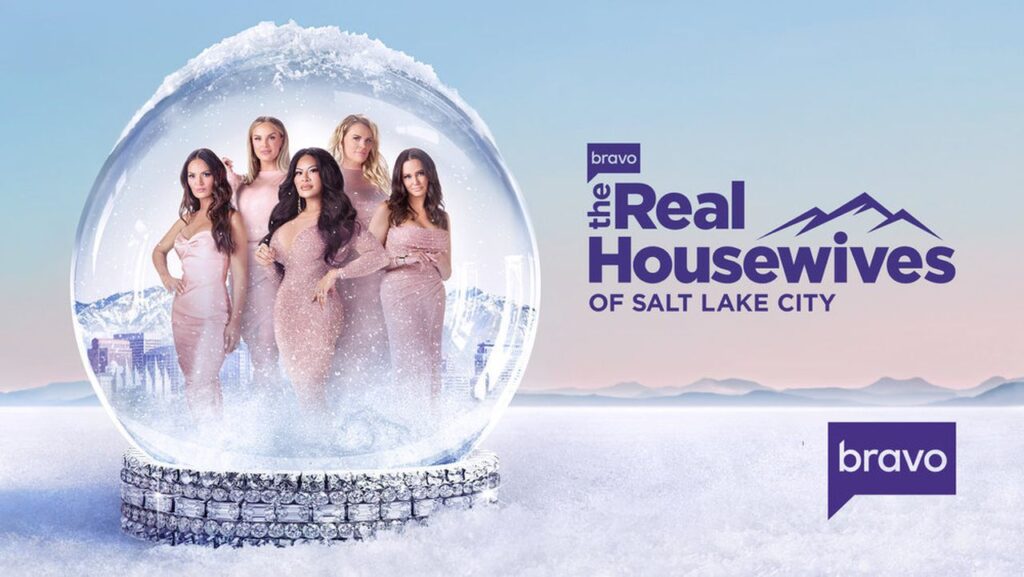
This story, however, is not one that takes place in a land as “far far away” as we may initially think. In fact, The Real Housewives of Salt Lake City (RHOSLC) is a reality television series that offers viewers a thrilling inside look into the drama-filled lives of a group of affluent Utah natives. As these women navigate their personal and professional lives, conversations surrounding Mormonism and cults, battles in the courtroom, provocative family drama, and countless explosive arguments shape their storylines. One housewife in particular, Jen Shah, stands at the center of the group as a self-proclaimed “queen bee and MVP” (RHOSLC S1E1). Shah garners much attention for her assertive, extravagant personality and sharp tongue, both of which often land her in trouble with her fellow housewives and, more recently, with the federal court of law. In March 2021, Shah was arrested by members of Homeland Security for conspiracy to commit wire fraud in connection with a telemarketing scheme that victimized and deceived countless elderly people for nearly a decade. Though Jen was involved in this scheme for over nine years, she presents a contrasting character on the show as a short-fused, yet well-meaning and dedicated mother, wife, and friend. Jen’s duplicitous identity, along with her capacity for deception and theft, all draw striking parallels to female fairy tale tricksters who use similar means to secure their autonomy and free themselves and others from harm or oppression. Jen Shah’s reality television fame and subsequent legal drama on The Real Housewives of Salt Lake City series exemplifies Maria Tatar’s reimagined female trickster as a figure who simultaneously exists at the center and the margins of our cultural conceptions to deceive society, rescue others, and save herself (or at least attempt to). As a trickster, Jen subverts heteronormative conventions to redefine what it means to be a “real” housewife; through her interruption of gender norms, she reimagines female power and expands women’s sphere of influence beyond domesticity to question normative societal assumptions of what a woman should be. 

Before exploring the connection between Jen Shah and female tricksters, we must first establish how The Real Housewives provides an effective lens to study fairy tales and female tricksters through. As scholar Lori Landay argues, to identify a female trickster we must look “from the margins of dominant society to the centers of women’s space – the parlors, kitchens, and bedrooms of domesticity,” or in this case, the reality television screen, to identify their core spheres of influence (McAndrews 190). Female tricksters are powerful, active agents who “operate using strategies both subversive and transformative in order to construct their own identities but also to effect social change” (Tatar 461). With such dynamic power to subvert, critique, and transform dominant power structures, it is important to note that just because “the female trickster migrated into fairy tales” and onto the television screen, her “mythic power” is “in no way diminished” (Tatar 467). In fact, that the female trickster figure survives in such a multitude of settings only proves her mastery in adapting to and existing under a variety of sociocultural conditions. Furthermore, her subversion of societal structures allows the female trickster to operate outside of the space allotted to her to ultimately expand her sphere of influence beyond domestic conventions.

Jen’s identity as a woman of color within a largely white community sets the stage for her elaborated career as a modern trickster figure. As a Tongan, Hawaiian, and Chinese woman who moved from Hawaii to Utah at “about six to seven years old,” she “often [sticks] out in her traditionally white, Mormon world” (RHOSLC S1E1; Malec par. 22). On the show, Jen states that “people in Utah have no clue what [she] is” (RHOSLC S1E1). In a state that hosts “the nicests racists you’ll ever meet,” Jen is perceived as “Black, [purely] because they don’t know any better” (Malec par. 12; RHOSLC S1E1). As a minority in her home state, Jen clearly sticks out from Utah’s dominant racial makeup and faces continual ignorance, marginalization, and misinterpretation. Similarly, female tricksters “exist quite openly but [are also] ignored, marginalized, manipulated, and criticized by dominant culture for crossing social boundaries” (McAndrews 189). Jen’s unique place within Utah’s social order, however, perfectly positions her as a female trickster who “has survived and endured simply by becoming invisible and flying beneath the radar that we use to understand our cultural stories” (Tatar 460). Jen’s marginalized identity is thus a tool that helps her acts of deception and trickery go unnoticed, even as she assumes a very public role on The Real Housewives series.

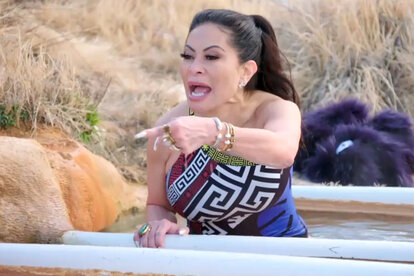
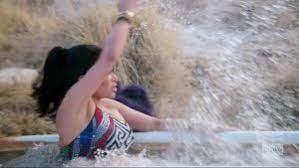
Though not immediately noticeable, Jen’s actions are riddled with gender-bending contradictions that aid in her subversion and help navigate her path to autonomy. A steadfast adherent of Western beauty standards and domestic norms, her dedication to plastic surgery and family alike reveal Jen’s obsessive control over her constructed image. What accompanies her image, however, are assertive, bold, and oftentimes violent qualities that stand in sharp contrast to the docility and innocence typically ascribed to a housewife. In mimicking seemingly masculine traits while maintaining the physical image of an idealized woman, Jen exists at the center of a cultural contradiction. As any female trickster, Jen’s “appeal derives in large part from her ability to serve as an ironic double on the classic male trickster, masquerading, performing, and imitating in ways that offer both serious reenactment and gender-bending parody” (Tatar 464). For example, while relaxing in an outdoor bathtub at a luxury spa, Jen vents to two other housewives, Whitney and Heather, about an incident which incited Jen’s temper and led her to shatter a glass on the floor: “I trusted you guys as my fucking friends… and Whitney, fucking roll your mother fucking eyes and look over there one more time I will drown you bitch … [proceeds to splash water at the camera]” (RHOSCL S1E10). Whether actively fighting with her fellow housewives, shattering glassware, or inflicting water damage onto camera equipment, Jen’s strong-willed dominance blurs the lines of how a housewife should act. Her interruption of gender norms and embodiment of a more fluid notion of gender and social identity negotiates autonomy in its exploration of life outside of feminine domesticity. In doing so, Jen “emerges from oppression to self-expression” as she struggles toward a selfhood outside of her prescribed sphere of influence (Jurich 278). 

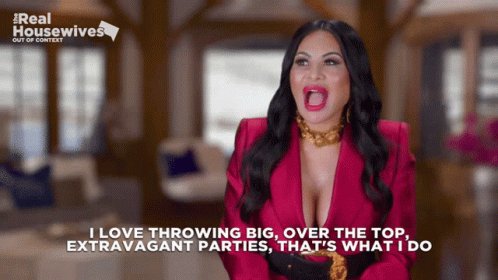
Like any successful female trickster, Jen is a shapeshifter – a master of duplicity, theft, and transformation – who leverages her skills to advance her place in the world. As an extravagant party host, she boasts that “Jen Shah parties turn into a grand transformation, okay? I don’t need Coach Shah [her husband] stepping up in here asking me questions, asking me how much shit costs, ‘where’s the furniture?,’ ‘what happened to our home?’ I don’t need all that” (RHOSLC S1E1). Evidently, Jen possesses the innate capacity to not only transform physical spaces, but also to transform herself, masquerading as a flamboyant, sharp-witted, and short-fused figure in her time on the screen. For Jen, the home transforms from a confining space to a place of welcoming others and engaging them in her subtle subversions; free from her husband’s command, Jen’s house parties stand in irony to “the cultural dictates that limit women’s place to the home” (McAndrews 190). These flashy transformations, however, also distract from the duplicity and deception Jen employs to establish her career as a business owner and “mom-trepreneur.” Knowing she helped orchestrate a telemarketing scheme “where ordinary people, vulnerable people, often elderly people, would be tricked into giving up their life savings for products” that really had no value, Jen embodies the “trickster tactics of deception, impersonation, theft, duplicity, and subversion in [her] attempts to secure autonomy” (ABC News; McAndrews 190). Similar to Scheherazade in Thousand and One Nights, who scholars view as the original female fairy tale trickster, Jen “knows better than to reason, beg, plead, bargain, preach or scold. Instead, she relies on the only strategy available to the powerless: deceit” (Tatar 461). And amidst the deceit, duplicity, and theft Jen employs for nearly ten years, her trickster transformations enable her to take on a dual-identity, with one side guilty of committing wire fraud and the other claiming innocence and arguing “the only thing [she is] guilty of is being Shah-mazing” (RHOSLC S2). 

Despite this trickster’s best efforts, however, Jen’s once upon a time does not guarantee a happily ever after – her guilty plea earlier this year was followed by moments of complete emotional collapse, despair, and anxiety amid an impending fifteen-year prison sentence. In July 2022, Jen unexpectedly pled guilty to her charges, stating that “from 2012 to March 2021, … [she] agreed with others to commit wire fraud” (Lang par. 3). Repeatedly stating on the show and in interviews that she is “at the lowest point of [her] life,” Jen’s downfall reflects Tatar’s argument that “there is clearly something compensatory in the psychological fragility of these women warriors: their gains in intellect and muscle are diminished by moments of complete emotional collapse. Vulnerability continues to attract” (Chavez par. 2; Tatar par. 7). Whether scripted in a fairy tale, broadcast on television, or simply living in modern society, Jen’s adversity suggests no matter how hard they try, women are all subject to the same fate: struggle, vulnerability, and collapse. As author Marilyn Jurich notes, “suffering appears to be what women are actively permitted to do to the exclusion of happier pastimes” (Jurich 276). Though we may not condone Jen’s criminal activity, part of us remains intrigued and invested in how far this trickster can push social boundaries and negotiate her own space within them. As a trickster rather than a villain, Jen’s trailblazing (though illegal) offers an admirable complexity; we want to see her win because we too want to reimagine a world where women like Jen are expected to succeed. Thus, by flipping reality on its head, Jen’s actions interrupt dominant systems of power and insert small, yet hopeful pockets of change wherein women are free to exist as fully-embodied beings.

Female tricksters like Jen navigate a space outside of oppression by subverting dominant social structures. Because Jen’s character is “shamelessly exploitative and exploratory,” she reminds us that “every culture requires a space for the disruptive energy” of trickster characters like herself (Tatar par. 10). When female tricksters subvert reality, however, we are ultimately called to question what makes that reality in the first place. As Tatar writes, heroines who “become enmeshed in cultural contradictions … unsettle and disturb us, obliging us to rethink how we have made the world” (Tatar 467). Though Jen’s interpersonal disruptions and gender-bending parodies on the screen surely reverberate and affect larger societal structures, she, like many other women, is ultimately defeated by the powers that she sought to escape. Jen may not be a perfectly reimagined role model for modern housewives, but her efforts to secure autonomy and disrupt gender norms highlight an opportunity for future female tricksters to soon follow in her footsteps. For although she is likely going to jail for many years, Jen successfully redefines womanhood and domesticity to “perform a part of the cultural work of transforming the feminine into the human” (McAndrews 192). And truly, there is no realer feat than that. 

Works Cited

ABC News. ‘Real Housewives’ Star Pleads Guilty to Fraud in Telemarketing Scam. YouTube, YouTube, 12 July 2022, https://www.youtube.com/watch?v=SZjRRTLRxB4. 

Chavez, Paul. “Real Housewives of Salt Lake City: Jen Shah Tearfully Declares Innocence to Husband Sharrieff Shah.” Daily Mail Online, Associated Newspapers, 13 Dec. 2021, https://www.dailymail.co.uk/tvshowbiz/article-10302913/Real-Housewives-Salt-Lake-City-Jen-Shah-tearfully-declares-innocence-husband-Sharrieff-Shah.html. 

Jurich, Marilyn. “She Shall Overcome: Overtures to the Trickster Heroine.” Women’s Studies International Forum, vol. 9, no. 3, 1986, pp. 273–279., https://doi.org/10.1016/0277-5395(86)90063-4. 

Lang, Cady. “Real Housewives Star Jen Shah Just Pled Guilty to Fraud. Here’s What Happens Next.” Time, Time, 11 July 2022, https://time.com/6194686/jen-shah-guilty-fraud-real-housewives/. 

Malec, Brett. “The Real Housewives of Salt Lake City’s Jen Shah on Racism, Leaving the Mormon Church & More.” E! Online, 11 Nov. 2020, https://www.eonline.com/news/1206922/the-real-housewives-of-salt-lake-citys-jen-shah-on-racism-leaving-the-mormon-church-more. 

McAndrews, Kristin M. Review of Madcaps, Screwballs, and Con Women: The Female Trickster in American Culture, by Lori Landay. Marvels & Tales: Journal of Fairy-Tale Studies, 14 , no. 1, 2000, pp. 189–192, JSTOR, https://www.jstor.org/stable/41380761. 

Tatar, Maria. “Female Tricksters as Double Agents.” The Classic Fairy Tales, 2nd ed., W.W. Norton Et Company, 2016. 

Tatar, Maria. “Sleeping Beauties vs. Gonzo Girls.” The New Yorker, 8 Mar. 2013, https://www.newyorker.com/books/page-turner/sleeping-beauties-vs-gonzo-girls#ixzz2MydRxnPs. The Real Housewives of Salt Lake City. Bravo, 2020.

Categories
Fairy Tales

Fashion and Fairy Tales: A Feminist Critique

By Brendan Baehr

Throughout history, the world of high fashion has fixed its eyes upon source material of great influence and scope to inspire runway collections, both in terms of storytelling and aesthetic. It is no mistake that the greatest of these runway shows find their inspiration in the world of fairy tales, the root of all storytelling. The universal nature of these tales allows for their fashion counterparts to evoke emotion across countless groups of people, inspiring sentiment through a vastly shared body of knowledge. In examining the way modern couture on the fashion runway has taken influence from traditional fairy tales, it would be difficult to miss the oftentimes altered representation of the dresses and clothes of women within these tales. On the runway, these characters are retold in a far more empowering and independent approach, through the use of color, texture, and shape. The exhibit “Fairy Tale Fashion” at FIT is a clear demonstration of this interpretation, showcasing runway pieces ranging from 1940 to 2016, encompassing a wide variety of styles. This exhibit demonstrates the contrast in representation of women between the world of the high fashion runway and the world of the traditional fairy tale, primarily along the lines of power, independence, and sexualization. 

Charles Perrault’s renditions of these everlasting tales create a stark contrast against the runway environment, influenced by Perrault’s own personal background as a member of the court of Louis XIV, existing in the birthplace of haute couture, a world of luxurious silks and elaborate patterns. Perrault’s version of “Little Red Riding Hood” exemplifies the difference in the way in which one article of clothing can be interpreted when cross examined with high fashion, this particular article being the iconic red cloak. It is firstly interesting to note that “It is likely that Perrault started the tradition of the iconic red cape”, and that “Early tellings do not describe her hood as being red”, as stated in an analysis provided by Ahlstrom Appraisals. The color red was chosen by Perrault likely as a result of the world of couture he surrounded himself with, in which red was a key signifier of nobility and purity. this choice is a notable one as it defines red riding hood as a character of vulnerable sexuality and danger. In Clothing The Child in Red, an analysis of this cloak states that “the little girl always wears the color red with a protective and salvific function”, and that in the time it was written, “children had always been dressed in red to make them more readily visible from afar”. This vision by Perrault of red riding hood as a symbol of untouched sexuality, only transgressed by the wolf, is a direct contrast to the way in which both Rei Kawakubo and Giorgio di Sant’Angelo envisioned red riding hood on the runway, instead turning her scarlet fervor into a symbol of power and strength. 

In Comme Des Garçon’s 2015 Spring/Summer collection, Kawakubo placed the character of red riding hood front and center on the catwalk, with a magnificent red dress that flows over the body in layers of crimson, with an incredibly pointed and enveloping hood, fully covering the model’s figure. The gloss of the hood feels impenetrable, casting the model’s face into a foreboding shadow as their cloak enwraps their silhouette. The choice of a glossy and waterproof material for the hood of the cloak reimagines Red Riding Hood’s character as being prepared for the dangers of the world outside, stepping firmly away from the thin cotton hood that Perrault prescribed her. A simple change in material and grandeur transforms red riding hood’s cloak from a symbol of vulnerable sexuality to that of sexual strength and protection, stating outwardly to the environment that she is armed to defend herself against worldly disasters and pitfalls.

An equally contrasting yet visually opposite parallel to Rei’s rendition of red riding hood is that of the work of Giorgio di Sant’Angelo, who enacted upon this tale his personal vision of women’s couture, stated as being “committed to an uncomplicated notion of freedom, eschewing the shift dress with zippers and buttons, and designing fluid, sensual garments that wrapped, tied, hung or clung to the body” as stated in a background from the CFDA. This influence is clear in Sant’Angelo’s version of red riding hood’s cloak as displayed by FIT, flowing down the body in a dark crimson, with bright and multicolored stitching outlining the hem of the hood, and crisscrossing the chest in the form of an X. This explosive freedom in color allows the dress to incite the feeling of strength and confidence when viewed, specifically when placed across the body in the form of a protective X, sealing the wearer’s innocence in a form of creative power, rather than a naïve vulnerability as portrayed by Perrault. Both the work of Rei Kawakubo and Giorgio di Sant’Angelo work in unison in this exhibit, each building on a vision of red riding hood as a source of sexual impenetrability and protection to break away from the victimizing and degradingly vulnerable image that Perrault defined in his original rendition of the tale.

Hans Christian Andersen’s tale of “The Little Mermaid” is one placed in equal contrast within the dresses on display at the “Fairy Tale Fashion” exhibit at FIT, specifically through the work of Thierry Mugler in 1988. Andersen’s tale describes the character of the little mermaid as one of strong and powerful desire, both for the man above the surface and for the possibility of obtaining a soul. This desire is exemplified through the little mermaid’s physical appearance in Andersen’s tale, as she is only able to reach an initial success in her quest of living above the sea when she abandons a significant portion of her body and the form of the mermaid, taking instead the form of the human. Once she reaches the surface, the prince takes her naked figure to safety and cloaks her in the finest silks and fabrics available, and at only this point is her character found to be in a situation of admiration and love from all around her. Andersen formulates his tale around the importance that the little mermaid places on physicality and physical validation, defining this validation as only attainable when she conforms to the body, clothing, and silhouette deemed beautiful by the rest of the world. 

As displayed at FIT, Thierry Mugler instead grants the little mermaid this power and grandeur through the form of her true self, crossing the catwalk in a cast of glistening silver, edges protruding like scales down the entirety of the dress in a way evocative of a knight in shining armor. The dress splits at the point of the wearer’s knees in the same way a fishtail would, embracing a tightly fitting silhouette reminiscent of a mermaid while still defining itself as aggressive and domineering. Mugler’s work with this dress reimagines the little mermaid not as a victim or compliant of the will of man and a man’s world, but instead as a weapon, armed to the teeth with the sharpness and beauty that ancient seamen’s tales had foretold. The terrifying beauty of this dress shines an even greater emphasis on the demeaning undertones in Andersen’s original tale, which strictly restrains the prince from ever witnessing the little mermaid in her true and powerful form, with him only finding her at her weakest, in a fully nude state. While Andersen’s tale of the little mermaid is unable to break away from its lack of exemplified feminine power, the work of Thierry Mugler seeks to both reimagine and bring attention to this absence, clothing the little mermaid in her own form, but giving her the sharpness and glamour within this form that Andersen constricts to granting only when she is dressed in the clothing of her oppressors.

This discrepancy between fairy tales and the world of high fashion is especially evident in the most fashion-oriented tale, “Cinderella”. In the version of this tale by the Brothers Grimm, clothing is the driving force for Cinderella’s character, constricting her to her housekeeper status, or alternatively, granting her a dance with the prince. Only through wearing the gown deemed beautiful by the world of the nobles is Cinderella able to find happiness, highlighting how the only path to success in this world is to embrace the standard of beauty as established by the patriarchy.

To reimagine the way Cinderella’s shift in clothing relates to her portrayal and treatment, Yoshiki Hishinuma emblazoned a dress of coarse ash and fiery tatters on the runway of his Fall 2001 collection, reframing the way in which her rags are viewed. The dress falls gracefully along the wearer’s body, using its constantly shifting texture to show detail and care in the dress’s design, created through a process of heat compression and tearing by hand. Hishinuma empowers the character of Cinderella in her determined “weakest” state by the Brothers Grimm, portraying her commanding rise from the ashes that constrain her.

In contrast to this dress, Vivienne Westwood’s Fall 1988 collection embraces the character of Cinderella in her moment of stepping foot onto the ballroom floor, clad in a dress of silver and silk. While this dress does capture the same level of craftsmanship that is implied in the Brothers Grimm vision, it immensely tones down the levels of grandeur and extravagance stated in the Grimm’s tale. By choosing to embrace the general form of the luxurious ball gown but remove all the frills and excessive splendor, Vivienne Westwood grasps the power of the patriarchy and restores it to Cinderella herself, a character able to adopt and then subvert the norms in women’s’ fashion deemed attractive by the patriarchy. The tale of Cinderella itself is a clear statement on how women should dress and act if they want to reap the benefits offered by their oppressors, and as stated in Fashion in the Fairy Tale Tradition: What Cinderella Wore, this tale exemplifies the “powerful political forces that have bound the status of women within layers of fabric, under the weight of gemstones, and upon teetering heels”. Cinderella’s ability to transcend this culture of misogyny through each of these dresses displayed at FIT brings great attention to the weight the patriarchy holds in the Brothers Grimm’s “Cinderella”, and the subsequent weight that can be lifted through simply a reimagining of dress. 

The way in which the world of high fashion has continued to draw inspiration from the world of fairy tales is indicative of the versatile and everlasting nature these tales possess, but it is equally important in its intention to reimagine these tales and bring voices to the female protagonists so often constrained by their assigned attire. Whether written by Perrault, Hans Christian Andersen, or the Brothers Grimm, nearly all fairy tales with female protagonists use clothing to repress or make vulnerable the women wearing them, or alternatively give them strength when the clothing matches what the patriarchy demands of them, only then granting a “happy ending”. The collection of dresses on display in FIT’s exhibit “Fairy Tale Fashion” each tackle the nuances of this misogyny through the work of designers ranging from the vibrant 70’s inspired Giorgio di Sant’Angelo to the powerfully sleek work of Thierry Mugler, each piece uniquely reimagining the oppressive and constrictive nature imposed by their original renditions in order to create a true “happily ever after” for the likes of red riding hood, the little mermaid, and Cinderella, without conforming to the patriarchal values that surround them. 

Bibliography

Andersen, Hans Christian. “The Little Mermaid.” The Classic Fairy Tales: Texts, Criticism, edited by Maria Tatar, W.W. Norton Et Company, New York ; London, 2017, pp. 351-371.

Perrault, Charles. “Little Red Riding Hood.” The Classic Fairy Tales: Texts, Criticism, edited by Maria Tatar, W.W. Norton Et Company, New York ; London, 2017, pp. 42-44.

Grimm, Jacob and Wilhelm. “Cinderella.” The Classic Fairy Tales: Texts, Criticism, edited by Maria Tatar, W.W. Norton Et Company, New York ; London, 2017, pp. 195-201.

The Museum at FIT. “Fairy Tale Fashion.” https://exhibitions.fitnyc.edu/fairy-tale-fashion/?url=cinderella%2Fcinderella_yoshiki_hishinuma-1 

Christy, C. A. (2022, January 14). “Little Red Riding Hood” – a tale of 18th century fashion? Ahlstrom Appraisals LLC. Retrieved from https://ahlstromappraisals.com/art-history-blog/little-red-riding-hood-a-tale-of-18th-century-fashion

Singh, R. (2017, August 18) “Fashion Flashback: Giorgio Di Sant’Angelo.” CFDA, https://cfda.com/news/fashion-flashback-giorgio-di-santangelo 

Rozario, Rebecca-Anne C. Do. Fashion in the Fairy Tale Tradition : What Cinderella Wore / Rebecca-Anne C. Do Rozario. 2018. Print.

Categories
Fairy Tales

The Influence of Economic Structures in Fairy Tales

By Xitlali Garcia

Fairy Tales, which are meant to educate children about real life, often occur in worlds with a clearly imbalanced economic and class system.  Most of these adventures and journeys thus take place within the constraints of those systems.  Fairy Tales like Cinderella, Jack and the Beanstalk, and Rumpelstiltskin end up teaching children about climbing social ladders and escaping their peasant status rather than focusing on systematic change.  Rumpelstiltskin shows how reanalyzing the way fairytale characters interact with their socioeconomic systems creates a useful tool for educating all kinds on economic injustice because of its multiple interpretations. 

First it is important to understand the current economic structure by looking at some of the most common fairy tales.  Stories like Cinderella and Rumpelstiltskin show obvious social classes through the use of monarchies.   Cinderella is born in a lower-class family and is often treated poorly until she marries the prince and lives happily ever after.  The same structure can be seen in the tale of Rumpelstiltskin as the miller and his daughter are considered peasant status until the daughter moves up when she marries the King.  People in fairytales are born into their classes and are meant to stay there unless they marry a monarch.  There is no doubt that these fairy tales have distinct social classes, but the more important detail is the different living conditions each class experiences.  For example, while Cinderella and the miller’s daughter are escaping their difficult lives, there are characters like Hansel and Gretel who do not get the chance to climb the social ladder.  Hansel and Gretel is a prime example of the impoverished conditions that the lower classes are trying to survive.  Due to the lack of resources and food, Hansel and Gretel are forced out of their homes because their parents cannot afford to feed them anymore.  As children read these various stories, they are constantly seeing the disproportionate distribution of wealth and power.  The most impactful part, however, is the character’s passivity to the system that these tales exemplify. 

The characters in these fairytales never examine or place any blame on the systems themselves.  In the tale of Rumpelstiltskin, the miller does not seem to hate the King for his high status even though his status was not earned.  Instead of questioning how unfair his role in society is, he commits to winning the attention of the King by offering his daughter.  The miller’s daughter takes every advantage to change her own position and fails to consider everyone else in the class she has left behind.  In the article Breaking the Magic Spell: Politics and the Fairytale by Jack Zipes, he describes fairytale stories as “direct, clear, paratactical and one-dimensional in its narrative perspective, and this narrative position reflects the limitations of feudal life where alternatives to one’s situation were extremely curtailed. So, it is in the folk tale. There is no mention of another world. Only one side of characters and living conditions is described. Everything is confined to a realm without morals, where class and power determine social relations,” (Jack Zipes, 125).  Because Rumpelstiltskin is presented to us with a single point of view narrative, we fail to realize that everyone else in the lower classes are equally suffering and thus do not see it as a systemic issue.  The success story of the miller’s daughter serves to distract from the unequal disparity of wealth and power by providing hope.  The hope comes from the story’s ability to give a more than average miller’s daughter the status of a Queen.  The miller’s daughter is meant to be the most average, neutral character so people who are in the working class who have no wealth or status can see themselves in the daughter.  The fairytale does not even give our protagonist a name which further solidifies her purpose of being a relatable character.   

Even through this one-dimensional narrative, it is still easy to point out all the ways in which the economic system is corrupt on a systemic level.  For example, the King abuses the miller’s daughter’s “gift” of turning straw into gold by stealing it all for himself.  His taking of the gold is a blatant example of labor exploitation by not letting her see the fruits of her labor.  The King continues to make the labor more demanding by increasing the amount of hay she must spin and threatening her with death.  Horrifyingly enough, through all these hardships, the relatability of the miller’s daughter and the working-class increases.  The use of the magical helper of Rumpelstiltskin creates a realistically unattainable allusion of hope.  The fairytale allows the poor nobody to become a member of the elite.  At the end of the day this is a far better dream for the working class to believe in than say a revolution that has the potential to disrupt the current social order.  Thus, the sense of hope in these tales must be false and they must not be replicable in real life.  In other words, these stories do more harm than good for the working class. 

Throughout history there has been one notable author of fairy tales written to inspire the working class.  Ethel Carnie Holdsworth was born and raised as a factory worker in the early 1900s.  She wrote her own version of fairy tales that empowered and uplifted her own class to find meaning.  In Ethel Carnie Holdsworth New Fairytales for the Working Class by Patrcia E. Johnson, she explains how “On the one hand, she harshly criticizes the ways in which societies are structured to make one class the slaves of another; on the other hand, work for the community is seen not just as a necessity but as a positive good. It is work that demonstrates personal integrity, and it is work that transforms the world, bringing light into darkness.” (Johnson, 256).  Ethel Carnie Holdsworth understood the impact fairytales had on the people that read them and recognized the damage of the messages that the current fairytales were sending.  She took this into her own hands by writing fairy tales that give recognition and purpose to her own kind.  For example, her fairytale “The Lamp Girl” describes the number of fairies that celebrate and honor the ones who complete the manual labor needed to keep the world running.  The fairies place these often-forgotten workers on a pedestal for all the blessings they provide.  Although this recognition does not serve as a replacement for the monetary value that these exploited workers deserve, it is still an important step in the right direction.  Ethel Carnie Holdsworth stories are a direct opposition of fairy tales like Rumpelstiltskin that showcase the miller’s distaste for his own class.  Instead of inspiring people to do everything they can to move upwards in the social hierarchy, Holdsworth inspires people to acknowledge their own capabilities and self-worth.  The issue of popularity still remains as many people never heard of or read any of Holdsworth stories.  People still most commonly refer to the problematic fairytales as a means to teach their children about society, which only assists in conformity within the current systems. 

Reanalyzing these common fairy tales and teaching them to children in a similar lens that Holdsworth uses, holds the power to disrupt the current systems.  There is no secret that fairytales are tools in understanding economic concepts.  “Huffing and Puffing through Economics” by Cynthia A. Weldon-Lassiter equates a fairytale to a basic economic principle that it adequately explains.  Some examples include scarcity seen through the Little Red Riding Hood, opportunity cost seen through Jack and the Beanstalk, and Trade seen through the Three Little Pigs.  Rumpelstiltskin can be analyzed in the same way as an example of classism or economic injustice.  Rumpelstiltskin is symbolic of the proletariat working class who are taken advantage of constantly, and the miller’s daughter is symbolic of the proletariat who capitalizes on others to get ahead.  The story highlights the damage labor exploitation causes to reveal the unsustainable nature of Capitalism.  Teaching this fairytale in this manner builds the skill in people to view issues in a more systematic way.   

Fairytales show the clear influence of a class system in our society. The characters in these stories have no choice but to interact within the constraints of their society. These stories show the power imbalance between the classes and how people will do whatever it takes to move up in the world. However, stories like Rumpelstiltskin can be used to teach children about economic injustice and systemic change. With the influence of authors like Ethel Carnie Holdsworth, these fairytales can be used to encourage the working class to rise up and fight for the respect they deserve. Fairytales can be used to learn about these economic issues in a meaningful way and can be used to create a more equitable future.

Categories
Fairy Tales

The Money in the Message

By: Jillian Caforio

Trailers have helped audiences learn about movies for a century. They have set the tone of a movie while also being a sneak peek into the many characters, actions, and themes within the film. The evolution of Disney’s fairytale-based movie trailers are especially interesting as they must draw an audience to a story they may already know, while giving us examples of different film styles as Disney created live action versions of previously animated movies. The early trailers for many of their popular animated fairytales focused more on character introduction and cinematic elements while their later trailers explore inspirational themes. Much more than educating an audience about a movie, the trailer’s main purpose is to generate box office results. A correlation can be drawn directly between a film’s box office results and its trailer’s effectiveness in developing the viewer’s connection to and perception of the characters, the story and message.

Films offer an escape from reality with meaningful messages and rarely break the fourth wall. In Lisa Kernan’s book, Coming Attractions, she delves into the hybrid between advertising and cinema, trailers. Kernan writes, “Trailers, on the other hand, have often spoken to us directly, frequently telling us to SEE! COME! JOIN IN! THRILL TO! . . . , even at times using characters or actors shown looking directly into the camera and at the audience” (Kernan 3). The purpose of the trailer is to bring people to the theater, while providing to a film what a summary would for a book. When the line between advertising and cinema is blurred, trailers can alter an audience’s complete perception of the film itself and as a result, either drive or destroy sales.

Film trailers were created in 1913 by Nilus Granlund, the advertising manager at Marcus Loew. Granlund edited together rehearsal footage from the stage productions at the theater and would air the montage he created to promote the production. Hermen Robbins then took on Granlund’s idea and created the National Screen Service in 1919 that served as a trailer creation company for studios and theaters to outsource their work (Dickey 2015). Some studios and directors then started to create their own trailers. Directors such as Alfred Hitchcock even took on the responsibility of cutting his own trailers together, while Walt Disney Studios decided to create their own trailers as well which gave the studio more influence in choosing what made the final cut.

These trailers frequently provided an overview of the action and characters, while beginning to hint at the messages of the films in the late 20th century. Interestingly enough, “Neither advertising theory nor narrative film theories adequately address what consequences the current ubiquity of the promotional message might hold for contemporary definitions and understandings of moving-image narrative forms” (Kernan 2). As the purpose of a trailer is to bring audiences to the theater, the true message of the film can be often overlooked or disregarded as the action or elements may appear more interesting within a minute long trailer, but in reality, may not be as inspiring to invoke audience members to attend the theater.

As Disney rose to prominence in the mid-1900s, all eyes were on its films and particularly its trailers. Cinderella was one of Disney’s first very popular animated fairytales to hit box office in 1950. It made a total of $96 million in box office sales, adjusted for inflation. This would not be considered a ‘box office smash’ by today’s standards.  It used the trailer to help bring people out to see the tale come to life. In focusing so heavily on the tale itself, however, Disney missed the opportunity to highlight the inner messages of the tale. It used quotes like, “two evil stepsisters, three mischievous mice… it’s the love story to end all love stories” (Disney). The more factual approach places the components of the film in front of potential audience members. The trailer is majority surface level and shares each shot almost equally between the characters. The trailer does not highlight Cinderella as the protagonist, forcing the audience to assume she is as the name of the film appears across the screen. The audience struggles to learn about her strong work ethic and immense kindness as the trailer is equally focused on every other character. This marketing choice aimed to bring each person to the theater for whichever character they resonated with the most. The approach, however, takes away from the powerful messages beneath the surface of the story.

Within the first few paragraphs of the Brothers Grimm version of Cinderella, a prior version to Disney’s adaptation, Cinderella is established as immensely hard working and very kind. Grimm writes, “She was always good and said her prayers… From morning until night she had to work hard. Every day, she got up before daybreak to carry the water, start the fire, cook, and wash” (Tatar 148). Not only was Cinderella doing all these chores while being ridiculed by her stepsisters, but she chose to always remain kind to them regardless of their actions. The Brothers Grimm sets the tone for the entire story as one that centers around Cinderella’s kindness and hardworking virtue while the Disney trailer only scratched the surface. While the approach Disney took with their animated film version did not encapsulate these defining characteristics of Cinderella the character, Cinderella the film certainly became one of the most iconic Disney princess films.

As time has progressed and marketing has matured, the surface level strategies have diminished. Trailers have begun to focus more on inspiring audiences with characters that encompass the messages like those found in the Brothers Grimm and within the tale itself. Disney was given a new opportunity to create a trailer with their live action version of Cinderella in 2015. This trailer chose a completely different marketing approach in comparison to the animated version in 1950 that directly corresponded to the shift toward inspiring the potential audience. Although Disney’s 1950 animated film did appear to have good success, in comparison to the live-action film, its box office sales appear significantly smaller. The live-action film made roughly $542 million. While nostalgia cannot be discounted, this drastic box office change was arguably significantly influenced by the trailer, as trailers are the main marketing tactic used to bring the audience back to the theater.

The 2015 trailer begins with the quote, “‘I want to tell you a secret that will see you through all the trials life can offer. Have courage and be kind’” (Disney). Within the first twenty seconds of the trailer, Disney has centralized its tale of Cinderella with a strong message that goes beyond the surface level prince and princess love story. It starts with this strong message that immediately highlights Cinderella as the protagonist in a positive light due to her inner beauty, unlike its push off depiction of her in the 1950 version. It empowers her kindness and courage throughout the different scenes shown of her working very hard with ease as mean and rude statements are thrown at her, ultimately bringing the kind and hardworking characteristics within the tale, similar to the Brothers Grimm depiction, to life. Although the tale is the same as it was in 1950, the trailer causes it to appear as an almost completely new tale. Both trailers brought audiences in to see the films, but it is important to see how the animated trailer did not bring the empowering messages the live action trailer brought to ultimately have a positive impact on its audience, to “have courage and be kind”, within the first twenty seconds. Because the trailer sets the tone for the overall movie and inspires audience members to come back, trailers hold power on the pocketbook. What Disney chose to do with that power changed the entire perception of the characters and the messages within the film.

Beauty and the Beast faced similar decisions when it came to the creation of their trailer launched to represent the animated film in 1991. The film had blockbuster box office sales of $425 million, adjusted for inflation. In this case, Disney chose to highlight the many musical components of the film. Specifically, the film opens with the very popular, “Be our guest, be our guest…” (Disney). The trailer has it followed by Belle’s character singing, “I want adventure in the great wide somewhere” (Disney). The songs continue as the trailer develops and it provides each character a moment in the spotlight. Disney, surprisingly, gives the song Gaston, a twelve second feature compared to Belle’s seven second feature in the beginning of the trailer. By providing every other character nearly equal or more features than the protagonist Belle, Disney sets up an approach to the film that the other characters are of a similar importance and caliber to the protagonist herself. The marketing choice to highlight many songs from the film made for a highly entertaining trailer but provided almost no representation of the deeper messages within the tale and ultimately the film.

The Jeanie-Marie Leprince de Beaumont’s version highlighted the many messages of Beauty and the Beast in its version of the tale prior to Disney’s adaptation. Leprince established Beauty’s kind character within the first few paragraphs and writes, “‘As for Beauty, we are very upset by her misfortune. She’s such a good girl! She speaks so kindly to the poor. She is so sweet and sincere.’ There were a number of gentlemen who would have been happy to marry Beauty, even though she didn’t have a penny” (Tatar 40). Furthermore, within the beginnings of the tale, Leprince has highlighted Beauty’s kind virtue. Her kindness is not only central to her character, but also to the many messages of the tale regarding how import kindness is. In hindsight, Disney may have missed an opportunity for even greater financial success with their lack of attention within the trailer to the key messages presented in its own adaptations and the many versions prior to it.

Similar to Cinderella, Disney was given another chance with their live action execution of the same tale, Beauty and the Beast, in 2017. The box office sales took the world by storm as the film made $1.3 billion. It is no coincidence that this increase was rooted in the changes within marketing. This time around Disney focused predominantly on key messages within the tale. The trailer begins with the Belle’s father saying, “‘My dear Belle, you’re so ahead of your time’” (Disney). This quote is followed by numerous clips of Belle demonstrating her kind heart. She proceeds to read to a child and walks around the town with a smile, brightening everyone’s day. Disney has nearly immediately established that Belle’s kind admirable character will change her life for the better. The trailer sets up the conflict of Belle’s father being held captive by the Beast, but ultimately highlights Belle’s kindness towards the Beast through a shot of her helping him recover from saving her life against a pack of wolves. The audience receives a glimpse of the Beast as a prince at the end of the film, instilling hope onto the viewers. Additionally, Gaston’s character is not highlighted nearly as much as he was in the animated trailer. Gaston’s character is shown looking at himself in the mirror and saying, “‘You are the most gorgeous thing I’ve ever seen’” (Disney). Disney established Gaston’s arrogance, while not placing his antagonist character at the forefront of the film. This choice ultimately causes Gaston’s arrogance to serve as a direct comparison to the kindness Belle embodies. By focusing more on Belle’s character than the components within the film, Disney was able to highlight the importance of being kind and inspire the viewers to that end before they even stepped foot in the theater to complete their journey.

Trailers have the power to alter and enhance messages that lie within films. While they certainly do offer a sneak peek into a film’s many components, they more impactfully set the tone for the film, one that the director and studio has worked diligently to create. Disney’s animated fairytale trailers for their popular fairytales focused more on surface-level components of the films while the live-action trailers, produced years later, approached the creation of these trailers with a message centered vision. These differences ultimately set different tones for the animation versus live action versions of the same tale. Both styles brought countless audience members to the theater, however, the message-centered approach brought significantly higher box office sales. This success correlates to the focus on positive themes within the trailers that gave the audience members emotionally moving perceptions of the characters grounded in inspirational messaging. There is money in the message.

Work Cited

“Beauty and the Beast.” Box Office Mojo, IMDbPro, https://www.boxofficemojo.com/title/tt0101414/?ref_=bo_se_r_2.

“Beauty and the Beast (2017).” Box Office Mojo, IMDbPro, https://www.boxofficemojo.com/title/tt2771200/?ref_=bo_se_r_1.

“Beauty and the Beast (1991) Trailer #1 | Movieclips Classic Trailers.” YouTube, YouTube, 1 Mar. 2018, https://www.youtube.com/watch?v=iurbZwxKFUE.

“Beauty and the Beast – US Official Final Trailer.” YouTube, YouTube, 30 Jan. 2017, https://www.youtube.com/watch?v=e3Nl_TCQXuw.

“Cinderella.” Box Office Mojo, IMDbPro, https://www.boxofficemojo.com/title/tt0042332/?ref_=bo_se_r_2.

“Cinderella (2015).” Box Office Mojo, IMDbPro, https://www.boxofficemojo.com/title/tt1661199/?ref_=bo_se_r_1.

“Cinderella 1950 Trailer | Disney.” YouTube, YouTube, 31 May 2017, https://www.youtube.com/watch?v=7UNEY2MgY_s.

Dickey, Elizabeth, et al. “A Brief History of Film Trailers, or: Turns out This Post Is Not about Peter Orner.” Michigan Quarterly Review, 1 July 2015, https://sites.lsa.umich.edu/mqr/2015/07/a-brief-history-of-film-teasers-or-turns-out-this-post-is-not-about-peter-orner/#:~:text=Film%20trailers%20were%20conceived%20in,films%20shown%20at%20Loew’s%20theaters.

“Disney’s Cinderella Official US Trailer.” YouTube, YouTube, 19 Nov. 2014, https://www.youtube.com/watch?v=20DF6U1HcGQ.

Kernan, Lisa. Coming Attractions: Reading American Movie Trailers. University of Texas Press, 2004. JSTOR, https://doi.org/10.7560/706002. Accessed 29 Nov. 2022.

Tatar, Maria. The Classic Fairy Tales: Texts, Criticism. W.W. Norton Et Company, 2017.

Categories
Fairy Tales

The Twilight Saga’s Eclipse as a Marketing Lesson

By Priya Dutta

The Twilight Saga is an adaptation of the 1756 Beauty and the Beast by Jeanne-Marie Leprince de Beaumont, expanding Beauty’s possibilities after her initial happy ending with the Beast. The third movie, Eclipse, illustrates the peak conflict of the series as the female protagonist, Bella, must decide between two Beasts, Edward and Jacob, transforming her identity in the process. The film’s marketing is compelling because its focus on “Team Edward” versus “Team Jacob” results in the objectification of Bella, the center of the storyline. According to agenda-setting theory, marketers do not tell people what to think but dictate what they think about, leaving crafted room for interpretation influenced by visuals and messaging. Although the movie highlights Bella, newly empowered and reclaiming her identity despite pressure to succumb to male manipulation, the marketing exploits the female gaze to make problematic male bodies more desirable. The complex male gaze present within and beyond Eclipse is made visible because of the misalignment between the storyline and marketing, which inaccurately promotes regressive societal values. In this paper, I will argue how Eclipse can be used as a marketing lesson – if it highlighted the actual female-centered and progressive plot, it would have disbanded critics equating the film to the principles of the original fairy tale.

Eclipse deviates from Beauty and the Beast because the female protagonist must now consider the demands of multiple men, including her father and original beast, Edward, and a new beast found in Jacob. With the introduction of a new suitor, Bella experiences more liberty in love than Beauty, but this implies more burden to satisfy external demands. Bella is at a turning point where she must decide between risky and effortless love, all of which require her to transform in different capacities: to appease her worried father, yield to traditional marriage values, or sacrifice love for safety. The conflict she experiences among these three men reflects the intricacy of battling the male gaze. 

Regarding her romantic relationships, on the one hand, Edward possesses unwavering love for Bella but maintains traditional marriage ideals that limit her scope of influence. Resembling the values emulated in Beauty and the Beast, Edward insists they get married before her virtue is compromised, adamant that he must protect her soul. His perspective, however, invalidates Bella into believing she is inferior and wrong for desiring more out of their relationship; “You really make me feel like some sort of villain trying to steal your virtue or something” (Eclipse). He continually warns Bella of the immense sacrifices she must endure, including converting into a vampire and abandoning her friends and family forever. Edward contradicts himself as he simultaneously pushes Bella away and acknowledges that Jacob is the safer choice but insists that she has the ultimate authority. To Jacob, he claims, “I know you can protect her…you can give her life, a human life. That’s all I want for her. But I’m not going to force her into anything ever again” (Eclipse). It is significant to note that this interaction occurs after Bella accepts Edward’s marriage proposal, asserting that he would never try to control her, even though he did so for the first half of the film. Manipulating her emotions, Edward tries to get Bella to choose him by telling her not to, posing himself as a forbidden love. Bella does not take this lightly as she considers Jacob, but her self-determination persists. 

On the other hand, Jacob represents a flawed but more human-like love that would require no transformation or sacrifice for Bella except leaving Edward. Jacob takes an explicitly forceful approach to sway Bella’s mind, repeatedly provoking that she is in love with him, “she just won’t admit it to herself,” and “she’s not sure what she wants” (Eclipse). He offers a more transactional perspective, arguing that he can provide more than Edward, like protection and warmth, despite her lack of feelings toward him. Compared to Beauty and the Beast, Jacob resembles The Beast, using hot-headed self-pity to lure Bella into loving him: when Bella accepts the marriage proposal, Jacob exclaims, “maybe I’ll get myself killed and make it simple for you” (Eclipse). Bella kisses him following this statement, so some may argue that his tactics worked, and she surrendered to the male gaze. Bella uses this, however, to demonstrate her influence over Jacob and establish clarity over her decision. She claims agency in this scene, revealing that she loves both men, but to distinctive extents.  

Finally, a role reversal appears between Bella and her father compared to Beauty and her’s. As Bella considers the advantages of marriage, her father remains skeptical of it, pushing her to wait as long as possible. He asserts, “Sure, marriage has value. When you’re older. Much older. Like your mom – it worked out great for her the second time. Later in life” (Eclipse). This difference in opinion demonstrates the familiar notion of wanting to keep young girls young, maintaining their purity forever. Considering how her father, Edward, and Jacob pull her in different directions gives context to the significance of Bella’s decision and her ultimate disregard for the male gaze. 

Laura Mulvey’s 1975 Visual Pleasure and Narrative Cinema is an influential work that defined the male gaze, revealing that cinema has a unique role in maintaining masculinity with activity and feminity with passivity. She concludes that in movies, there is no place for women to identify with a feminine agency due to a “psychic desire…voyeuristic, fetishistic, and possessive fantasy of the male gaze,” and as Kelly Oliver expands, “the male gaze is more relevant, and more dangerous, than ever” today (Oliver). Connecting this thinking with Eclipse, the film seems to romanticize a woman’s naivete in juggling two supernatural men, appearing to make no progress from the fairy tale original Beauty and the Beast. Throughout the story, Bella serves as the ideal woman for both men, reaffirming their masculinity as she attempts to satisfy their wishes. Jack Zipes, however, argues that illustrating the confusion in navigating the compounded issues women face, regardless of success or failure, holds immense value in feminist writing. He writes, “instead of focusing directly on gender issues and radicalizing the canon, women writers nowadays tend to depict baffled and distressed women and men caught in a maize of absurd situations. In doing this, they are endeavoring to unravel the causes of their predicaments and use narrative strategies that both reflect the degeneration of communication and are somewhat degenerate themselves” (Zipes 121-139). Like a fairy tale, the story resonates with reality because every woman falls victim to the male gaze in their life. Eclipse has an admittedly ludicrous storyline involving vampires and wolves, but because the writer embraced and worked through such absurdity, we can appreciate the growth of the story. Contrary to Mulvey’s caution, Bella triumphs over patriarchal values, as embodied by her final declaration. 

During the final scene of Eclipse, Bella justifies her long-awaited decision, empowered with newfound confidence. When Edward claims she continues to make sacrifices to please everyone, she refutes, “You’re wrong. This wasn’t just a choice between you and Jacob. It was between who I should be and who I am…I’ve had to face death and loss and pain in your world, but I’ve also never felt stronger, like more real, more myself because it’s my world too. It’s where I belong” (Eclipse). This simple yet compelling reframing of the decision from choosing love to declaring identity shifts the narrative back into Bella’s hands. She reclaims the power seized from the men in her life, making a decision best for her despite enduring and inflicting pain. Earlier to Jacob, she alludes “never had a choice with Edward” (Eclipse), thus revealing that she remained unimpacted by their manipulative attempts. Bella asserts that the story was about self-discovery, not determining the superior man.   

Jack Zipes crucially contends, “The fairy tale has become commercialized in America, and the majority of the fairy tales produced for children and adults pay lip service to feminism” (Zipes 121-139). Under this context, the mere ability of choice does not imply significant progress toward feminism, employing the Hermeneutics of Suspicion. While patriarchal values and reinforcement of misogyny persist throughout the film, it is essential to realize how these issues continue to infiltrate our lives and media. The film does not attempt to support these regressive values but acknowledges and expands on their depth. Jessica Taylor explains that “it is arguably the way the series caters for an emergent female gaze that firmly locates this series within contemporary society and makes it of our time” (Taylor). Eclipse promotes success for the female gaze because by choosing herself, Bella assumes self-empowerment and advocacy and abandons the objectification associated with the male gaze, all within the modern craze for supernatural circumstances. Within Laura Mulvey’s perspective, Eclipse remarkably associates femininity with activity. 

Despite the progressiveness of the story, the marketing of the film falls short, reinscribing patriarchal values by illustrating the violent male body as desirable, embodied by “Team Edward” versus “Team Jacob” (Taylor). As elaborated, the men continually provoke and pressure Bella for their own gain, but beyond the movie, this problematic behavior is disregarded for aesthetics. The argument that Eclipse skews the female gaze to value harmful male figures as appealing exists outside the primary text. Although it can be argued that objectifying the male characters through marketing depicts recovered authority for women, it fails to represent current feminist conventions as the promotions are not woman-centered; being anti-men does not imply pro-women. The marketing, instead, objectifies Bella’s character, using her as a pawn in everyone’s personal Edward or Jacob fantasy, thus it markets the male gaze. The movie’s intent to highlight the chaos surrounding the journey toward female empowerment became lost in the audience’s decision to idolize the two men and the marketers’ choice to capitalize on this discourse. As agenda-setting theory tells us, marketers cannot shape what people think but what they think about, thus leaving room for interpretation. The result of the film’s marketing should not take away from the illuminating heart of the story and should serve as a lesson for movie marketing. 

Literature, similar to marketing, is fundamentally about history, culture, and the nature of identity. Whether it is employed to make, reflect or reshape these fundamentals is up to the creator and audience. The marketing ultimately continues and changes the narrative. As exemplified with Eclipse, story intent does not always match the advertising or viewers’ interpretations, but this tension reveals what society values and desires to see. While the storyline progresses, the movie’s marketing indicates that we continue to validate society’s widespread beliefs instead of disrupting problematic discourse. The marketing for Eclipse could have focused on Bella’s choice between living up to society’s expectations versus her own, rather than “Team Edward” versus “Team Jacob,” thus allowing more people to consider the movie a victory for feminist thinking. The marketing dishonors the story as it promotes the male gaze to a female audience, just as Beauty and the Beast did. Eclipse’s marketing had the opportunity to rework the outdated function of stories as instruction manuals but failed to do so, telling young girls to resonate with the male characters. If the film acknowledged its inherent power as a fairy tale, we could have witnessed a more transformative approach to social cooperation. 

Examining Eclipse, the third movie of The Twilight Saga that illustrates the peak conflict of the series, the story contains a triumph for the female gaze, although not explicit at first. By re-establishing her struggle as one for identity over love, Bella shifts the entire narrative, demonstrating how she had authority over Edward and Jacob pitted against one another. Compared to Beauty and the Beast, Bella harnesses newfound agency, but the movie’s marketing tells a different story. Highlighting the respective desirability of each man, the marketing seizes attention from Bella, and the audience points blame at her for affirming or denying their personal choices in “Team Edward” or “Team Jacob.” Based on a fairy tale, Eclipse naturally has a significant influence in shaping people’s societal perspectives, but the marketing missed the mark by, once again, promoting the regressive male gaze. Comparing the misalignment between the film and its marketing holds value to audiences nevertheless – revealing that we must never take media at face value and dig into the story ourselves.

Works Cited

Meyer, Stephenie. The Twilight Saga: Eclipse. Summit Entertainment, 2010.

Oliver, Kelly. “The Male Gaze Is More Relevant, and More Dangerous, than Ever.” New Review 

of Film and Television Studies, vol. 15, no. 4, 2 Oct. 2017, pp. 451–455., https://doi.org/10.1080/17400309.2017.1377937. 

Taylor, Jessica. “Romance and the Female Gaze Obscuring Gendered Violence in The Twilight 

Saga.” Feminist Media Studies, vol. 14, no. 3, 11 Dec. 2012, pp. 388–402., https://doi.org/10.1080/14680777.2012.740493. 

Zipes, Jack. “And Nobody Lived Happily Ever After.” Relentless Progress the Reconfiguration of Children’s Literature, Fairy Tales, and Storytelling, Routledge, New York, NY, 2009, pp. 121–139. EBSCOhost, https://web.s.ebscohost.com/ehost/ebookviewer/ebook?sid=95cfeb96-3e08-4876-a72e-efaedfdf5726%40redis&ppid=pp_125&vid=0&format=EB. Accessed 2022.

css.php