Categories
Fairy Tales

All in the Name of Destiny

By Quetzali Lopez

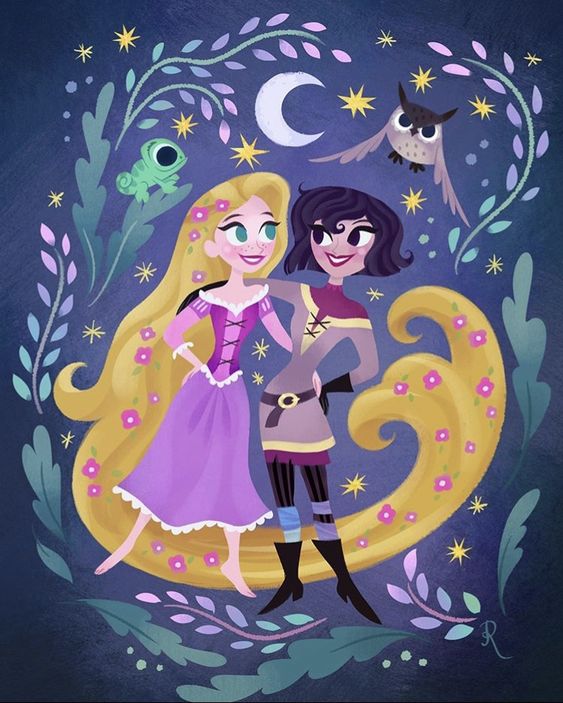
Every sweet, kind, and gentle princess needs a reality check from a snarky, cynical, and aggressive counterpart – but traditional fairy tales would never let you know that. The constant glorification of the individual, the chosen one, the fairest of all, demonstrates that “in fairytales there is no room for female friendships” (Maass 109). Feminist scholars perceive the complex nature of female friendships to be rooted in a fear of betrayal, whether it be over a man, social status, or opportunity (Chesler 317). Rapunzel’s Tangled Adventure, a series adaptation of the film Tangled (2010), diverges from fairy tale standards by centering around the friendship between Princess Rapunzel and her lady-in-waiting, Cassandra. The series examines multiple levels of tension between the two, regarding their class differences, the trust between them, and their power dynamics. Rapunzel’s Tangled Adventure breaks away from the conventional fairy tale structure, because the series focuses on the journeys of not one, but two characters, Rapunzel and Cassandra, whose struggle to fulfill their own destinies puts their relationship at odds.

The serial adaptation of the fairy tale film brings opportunities for Rapunzel to encounter the challenges of “life after happily ever after,” with new responsibilities and new relationships (Tangled: Before Ever After). The series begins when Cassandra sneaks Rapunzel out of the palace to escape the pressures of being royalty for a night, and she shows Rapunzel mysterious black rocks that have begun sprouting across the kingdom. When Rapunzel touches the glowing rocks, they magically restore her long blonde hair, and she embarks on a new adventure to solve this magical mystery. Cassandra, Rapunzel’s lady-in-waiting and a new addition to the Tangled canon, is nearly the polar-opposite of Rapunzel and is meant to contrast her sunny disposition. While Rapunzel is trusting, naive, and optimistic, Cassandra is standoffish, jaded, and sardonic. Rapunzel, despite initially clashing with Cassandra’s brooding demeanor, ultimately needs someone like Cassandra in her life, because she had spent her entire life being manipulated and lied to, so the one thing she truly needs is someone to be unabashedly, ruthlessly, and brutally honest with her.

“Why is it so important to you to be friends with Cassandra anyway?”

“Because she’s real.”

(Beginnings)

Rapunzel and Cassandra’s class difference as princess and lady-in-waiting is what brings the two together in the first place. What makes Cassandra most distinct from the characters who debuted in the film is that she does not immediately fall for Rapunzel’s charm when they meet. Cassandra, at first, wants nothing to do with Rapunzel and is even upset that she was assigned to “princess duty.” The qualities that most people find endearing about Rapunzel, her warmth, creativity, and positive enthusiasm, Cassandra finds annoying. Rapunzel, despite Cassandra’s clear intentions to keep their relationship at a professional distance, is eager and determined to build a friendship. As much as Cassandra resists Rapunzel’s relentless efforts, they ultimately form a connection through the fact that neither have ever had a close friend.

The social disparities between Rapunzel and Cassandra, despite their growing friendship, become prevalent through the privileges Rapunzel takes for granted in comparison to the obstacles Cassandra must overcome. As the series begins, Rapunzel is clearly the main protagonist of the story as she grows accustomed to life in the castle, and Cassandra is characterized as the sassy sidekick who shows her the ropes. The only information given about Cassandra’s backstory is that she’s an orphan, she was taken in by the Captain of the Guard, and she dreams of one day becoming Captain like her father. Cassandra, although being kept apart from the central narrative, constantly strives to gain respect from the rest of the kingdom, a privilege that Rapunzel does not even realize she has.

“I mean, you’re a princess, you’ve got nothing to prove. To you, this was just a fun way to blow off a Saturday, but to me, it was a chance to show everyone that I am more than just your lady-in-waiting.”

(Challenge of the Brave)

Rapunzel reaps the benefits of her social status without even grasping that she has so many social advantages. No matter what, when Rapunzel messes up her own responsibilities or even the work of others, she is still the princess and is easily forgiven. Cassandra, on the other hand, is constantly under threat of losing her job, being sent to a convent, and is never given the chance to prove herself as worthy to serve on the royal guard. The obstacles that Cassandra faces, however, remain in the background of the show’s main storyline revolving around Rapunzel. Within the world of the series, and from a storytelling perspective, Cassandra is always on the sidelines. She is Rapunzel’s lady-in-waiting, a literal servant, and as a foil character to the princess, her initial purpose in the show is to highlight Rapunzel’s qualities.

Over the course of the series, however, the narrative begins to shift as Cassandra’s character arc begins to rise and ultimately interfere with Rapunzel’s. As Rapunzel matures, she is no longer the simple, fresh-out-the-tower girl she was before. She craves independence as she ventures from her kingdom, with Cassandra by her side, in pursuit of the Moonstone, the cosmic counterpart to the Sundrop that is the source of Rapunzel’s powers. On their quest, Rapunzel takes initiative and for the first time she questions Cassandra’s judgement, much to her annoyance. Cassandra is tired of being treated as merely a lady-in-waiting, especially by Rapunzel, someone she views as her friend and equal. When Rapunzel begins to dismiss her input and opinions, Cassandra views it as a breach of trust that begins to chip away at their friendship.

Their relationship faces a major turning point when the characters are led into a massive tree that once belonged to an ancient demon, and Rapunzel discovers a death incantation, opposite to the flower song that gives her the power to heal. Worried about the dangers of the tree and the incantation, Cassandra insists that they leave, but Rapunzel overrides her. A heated argument ensues, causing Rapunzel to raise her voice at Cassandra, prominently asserting her authority over her. The moment is so jarring that even background characters grimace at the scene. Cassandra flinches back, responding with a solemn, “Yes, your highness” (Rapunzel and the Great Tree). Rapunzel’s sudden shift from treating Cassandra as a friend to treating her as a servant is a is a betrayal of their friendship, because her decision to pull rank reveals that, deep down, Rapunzel does not view them as equals. The conflict between the two women brings Cassandra closer to the forefront of the narrative, although not as a fellow protagonist but rather an opponent standing in Rapunzel’s way.

Cassandra evolves from being a static side character to a dynamic main character, as her true emotions are unveiled through song in her first solo in the series, “Waiting in the Wings” – featuring a phenomenal performance by Broadway star Eden Espinoza. Singing a solo portrays Cass in a vulnerable light that has never been shown to the audience nor the other characters in the series. Her words are honest about her internal struggle with living in Rapunzel’s shadow.

“Guess we all are born with parts to play

Some of us are stars and some are just in the way

I know I was meant for glory

But that’s never what my story brings

And yet I keep on waiting.”

(Waiting in the Wings)

The lyrics reveal that Cassandra is aware of her inferior position as a side-character in Rapunzel’s story, and although she longs for recognition in her strengths and abilities, she feels obligated to have to wait for her own story to begin. The rift that has opened between them plants a seed of jealousy within Cassandra. Her resentment is solidified when Rapunzel, once again, ignores her advice and uses the death incantation despite being unable control her own power, and when Cassandra reaches for her arm to snap her out of the spell, she burns her hand, leaving it scorched and scarred. Cassandra has been branded, and from this episode on, she dons a suit of armor, a symbol of her strength and guardedness. Her relationship with Rapunzel also transforms, with Cassandra becoming more distant.  

The female fear of betrayal finally manifests itself into reality when Rapunzel is face to face with the elusive Moonstone. Continuously throughout the series, the Moonstone had been considered Rapunzel’s “destiny,” because with the power of the magical Sundrop, she is the only one able to neutralize the Moonstone’s dark power. Just before Rapunzel is about to accept her “destiny,” she thanks Cassandra for sticking by her side throughout their journey and gives her an embrace. Cassandra does not hug back. The moment they have all been waiting for has arrived, but just as Rapunzel reaches out to accept the Moonstone, Cassandra snatches it first. 

“Cassandra? What are you doing?”

“I’m fulfilling my destiny!” 

(Destinies Collide)

To be hailed as a hero, or praised as a princess, is to possess power, and whoever is bold enough to challenge that power must take on the role of the villain. Cassandra recognized this power within Rapunzel as she was endlessly adored by everyone around her, while Cassandra felt that she always needed to somehow earn love and affection, “and when it came, it came with strings” (Rapunzel’s Return). Her decision to betray Rapunzel was a result of the pent-up pain and frustration she had accumulated from feeling powerless next to a princess. Cassandra’s acquisition of the Moonstone grants her magical powers, and in turn, she has become Rapunzel’s equal and rival. She uses her newfound power to enact her revenge, going on a rampage throughout the kingdom, not caring that she is also hurting the ones closest to her. Cassandra’s rationale, although flawed, still directs attention to the question of why only certain characters are granted the blessings of a fairytale narrative, while others must watch from behind.

“There’s a line between the chosen and the rest

And I’ve done the best I could

But I’ve always known just where we stood

Me here with the luckless

You there with the blessed”

(Crossing the Line)

The betrayal has placed Cassandra at center stage, as opposed to “waiting in the wings,” and in stealing the Moonstone she is also stealing Rapunzel’s spotlight. Cassandra’s anger is rooted in how she has constantly had to live her life in reference to Rapunzel, and she justifies her actions by telling herself she deserves to have the power that Rapunzel has always taken for granted. The other characters of the series, however, do not understand her point of view, and they begin to villainize her out of fear. Cassandra’s self-perception is representative of how every person sees themself as the hero of their own story.

“Cass, trust me, becoming the villain isn’t the answer!”

“Is that what you think I am?”

(Cassandra’s Revenge)

Rapunzel and Cassandra have parallel journeys. They are both women confined to societal restrictions, one as a royal and the other as a handmaiden, they both long for freedom and agency over their own lives, and they both wield cosmic power. Their stories diverge in the fact that Rapunzel fulfills the typical characterization of the fairy tale princess, whereas Cassandra is the antithesis. The iconography of the fairy tale princess, from storybook, to film, to television, is closely tied to her courteous demeanor, and “even as the fairy tale princess becomes hip, feisty, and updated she must maintain a kind, appealing, and approachable personality” – a personality type that Cassandra simply does not have (Wann 31). Even within their cosmic representations, Rapunzel is a gleaming ray of sunshine, and Cassandra is an ominous beam of moonlight. Cassandra had been set up to fail from the beginning. This is not her story, this is Rapunzel’s, it always has been. Cassandra realizes this during her meltdown in the series finale, and all of her mistakes, regrets, and self-doubt pour out.  

 The twist of the tale is that Rapunzel, the main protagonist, refuses to perceive Cassandra as a villain, and has always seen her as her best friend, no matter how strained their relationship had become. Rapunzel may have been naïve at times about her own privileges, but she never intended to make Cassandra feel less-than and always admired her. Cassandra may not fit into the mold of the perfect fairy tale princess – she is not a princess by any means at all – but that is what drew Rapunzel to Cassandra in the first place. Rapunzel and Cassandra have both betrayed each other in the past, and although the typical fairy tale structure aims to pit them against each other, they manage to subvert the narrative. Rather than having the protagonist battle and vanquish the antagonist, Rapunzel and Cassandra’s friendship survives and they both live on to see their own happily ever after. The series ends on a bittersweet note, with Rapunzel finally feeling ready to accept her role as crown princess and future queen, and Cassandra departing from the kingdom in search of her own destiny. The two exchange ‘I love you’s’ and part ways on their own separate journeys, owing their personal growth and transformation to their relationship with each other.

Works Cited

Chesler, Phyllis. Woman’s Inhumanity to Woman. New York, Thunder’s Mouth           Press/Nation Books, 2001.

Espinoza, Eden. “Crossing the Line.” Rapunzel’s Tangled Adventure: Plus Est           En Vous (Music from the TV Series), Disney, 2019.

Espinoza, Eden. “Waiting in the Wings.” Rapunzel’s Tangled Adventure (Music from the TV Series), Disney, 2019.

Maass, Vera Sonja. The Cinderella Test: Would You Really Want the Shoe to Fit? Santa Barbara, California, ABC-CLIO, 2009.

Waan, Regan M. The Persistence of the Fairy Tale Princess as a Cultural Icon.           1997. University of Louisville, Master of Arts Thesis.

Tangled: Before Ever After. Directed by Tom Caulfield and Stephen Sandoval,           Disney Channel, 2017.

“Beginnings.” Rapunzel’s Tangled Adventure, created by Chris Sonnenburg,           season 3, episode 7, Disney Television Animation, 2019.

“Challenge of the Brave.” Rapunzel’s Tangled Adventure, created by Chris           Sonnenburg, season 1, episode 4, Disney Television Animation, 2017.

“Beginnings.” Rapunzel’s Tangled Adventure, created by Chris Sonnenburg,           season 3, episode 7, Disney Television Animation, 2019.

“Cassandra’s Revenge.” Rapunzel’s Tangled Adventure, created by Chris           Sonnenburg, season 3, episode 14, Disney Television Animation, 2020.
Categories
Fairy Tales

Fairy Tales and Off-Page Space

By Grace Laubach

In most fairy tales, the story space presented is primarily focused on the main characters, but off-page there are so many other stories that are unexplored and not presented to the audience. Charles Perrault’s The Sleeping Beauty in the Wood defies this common occurrence though by utilizing its off-page space actively and, in turn, is better able to communicate its message while also allowing more room for the audience to immerse themselves within the world. In comparison, Joseph Jacobs’s Jack and the Beanstalk utilizes its off-page space passively and keeps its audience focused on Jack, leaving the lives of the off-page space up to our imagination and its overall message and character’s weak and underdeveloped. In better acknowledging off-page space and actively using it, stories are more easily and effectively able to extend their story into our own.

This idea of off-page space comes from the concept of off-screen space which is most commonly applied to video games and film. Passive off-screen space is the area in a movie or a video game that “logically…exists, but nothing happens out there” (Egenfeldt-Nielsen 137). For example, when a movie includes a car chase, logically, we know that there are cars driving around them but since the camera only shows the two cars in the chase, they are irrelevant and will not affect the outcome of the scene. Active off-screen space would be when we are able to hear someone talking outside of the shot that is shown on-screen. Logically, since we can hear them, we know they are near, and we know what they are saying, making it a part of the scene and something that can affect the outcome of the scene. Off-screen space allows us insight into the world around the characters and the world of the story. In video games that actively utilize off-screen space, “what happens beyond the frame inevitably affects the course of the game” (Egenfeldt-Nielsen 138). The same goes for film; what happens outside of the frame, in active space, will eventually have some impact on the course of the story or character’s journey. In terms of written fairytales, this concept would be better called off-page space. Everything that is happening outside of the world that is given to us is either active or passive depending on how the author utilizes story and language. The characters in the villages surrounding and the kingdoms across the way are logically there but they are only relevant if the author decides they should be and says that they are. Fairytales that utilize off-page space open their worlds to the audience and allow more insight into the story whereas fairytales that do not utilize this space force the audience to see themselves within its given set of characters.

In Joseph Jacobs’s Jack and the Beanstalk, the off-page space is not active. A giant beanstalk shoots up into the sky and logically when we are reading, we know that the people who pass by will be confused by it and/or affected by the child-eating giant, but because we are never introduced to them in the story, they’re thoughts, opinions, and lives are irrelevant. Jack is constantly disrupting the world and by the end of the tale with “another chop with the axe” (Jacobs 277) he brings down the beanstalk. Crashing into his world with the ogre in tow the beanstalk becomes fully a part of his world but still, we have no clue what the surrounding neighbors and villagers think or are experiencing. Did the beanstalk crash into someone’s house? Did the ogre’s crown fall onto someone when it broke in half with his fall? There are no answers to these questions because there is no room for them to even be posed in the story. In some ways this allows the reader to fully immerse themselves into Jack’s story but in other ways, it excludes the reader from accessing his world. Not being allowed into the world outside of Jack narrows the story’s scope which also narrows the audience’s ability to fully immerse themselves.

Further than that, the story’s message is only communicated in the beginning through the fact that Jack and his family need money, but eventually, that becomes lost in Jack’s lack of character development. The most prominent message being that one must take advantage of opportunities presented and do what one must to survive is strong in the beginning but eventually falls flat. After the first time Jack steals, he goes back twice more, further betraying the ogre’s wife’s trust who protects him from her husband multiple times. His family’s need for money is fulfilled after his second trip up the beanstalk when he steals a magical hen that can lay “a golden egg every time he [says] “Lay”.” (Jacobs 276). But still, he goes back for more simply because he “was not content” (Jacobs 276). By his third trip, Jack’s morals become muddled in his greed and quickly it becomes easy to dislike him. Without more information about himself, his family, and the world he lives in, his motives become weak when we consider that he’s maybe not such an honest guy and has been stealing past the point of what he and his family need. With more active off-page space we may get more insight into why Jack may need to continuously go back for more. Jack and the Beanstalk’s passive off-page space prohibits its message from being as effectively communicated as it could be because we are not allowed enough insight into Jack’s world and consequently his motives.

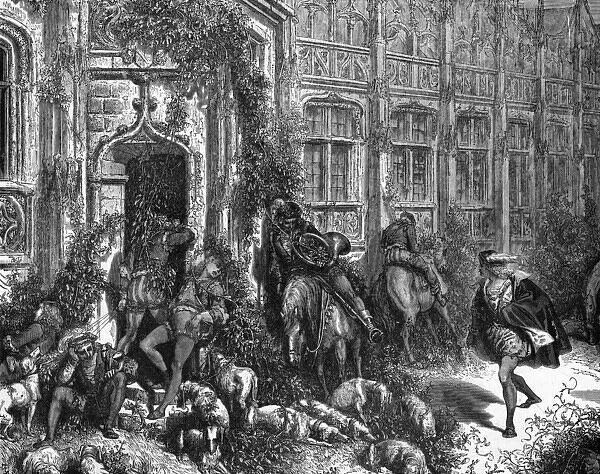
On the other hand, Charles Perrault’s, The Sleeping Beauty in the Wood has a broader scope and is more of a full-fledged story with a world that extends way past just Sleeping Beauty herself. When she pricks her finger on the spinning wheel, we often forget that she is not the only one to fall asleep. The entire palace, except for the king and queen, is put to sleep by the good fairy as well so “that when the princess finally woke up she would [not] feel…embarrassed” (Perrault 125) and for the next one hundred years their lives are taken from them, and they all must wait for the prince to come to their rescue. Due to her status, the consequences of her actions are far greater than just her own loss of time. So much so, that they extend off-page into the lives of every single person in the palace. Off-page every person in the palace is asleep waiting for the prince, missing out on one hundred years’ worth of memories and experiences that they’ll never get back. No matter if they are harmed or not, the world around them is still alive and thriving. They’re missing out on decades of innovation and their families outside of the palace are all wondering if they’ll ever wake up again. The people of the palace individually live off-page but collectively they are on-page, and they are active parts of the story that we logically know are there and logically know are being affected by this spell. In this way, The Sleeping Beauty in the Wood balances its off-page space by utilizing it both actively and passively. It’s active in that we know they are being affected and we know that they are facing the consequences of her actions, but it is also passive in that we never know how they feel about it, and we never know how they are affected by this huge loss of time.

Simply knowing that they exist adds to the story, however. We do not need to know everything they think and feel or else the story would be way too long. Active off-page space only needs to be utilized and active enough to contribute to the story otherwise it will only hurt the on-page space, which is ultimately the most important. In telling the story this way and utilizing the space as so, Perrault allows us to see ourselves and the people we know within Sleeping Beauty’s world. We are given more lives to care about and more lives to see ourselves in. Within the sleeping people of the palace are all our friends and family, and maybe even ourselves. With more people to think about and relate to we are better able to feel seen in a world that does not exist and does not explicitly include us.

In creating a world that is so, Perrault complicates the characters’ choices and lives in a way that only further drives home the story’s message. Perrault urges women to wait for the right man to come along and save them. ‘Pricking your finger’ too early results in a “reckless and a little thoughtless” (Perrault 124) girl according to Perrault. This is obviously problematic and forces women into traditional gender roles that prohibit them from acting independently in their own lives and doing what they want. Nevertheless, in sending the majority of the palace into a hundred-year slumber, Perrault instills the idea that waiting will be good for all. Everybody waking up with Sleeping Beauty when she is finally saved by her true love, the prince, reinforces the idea that waiting for the right man to come along will only benefit everyone around you. In the story, everyone who falls asleep works in the palace and to some degree knows Sleeping Beauty, works for her, or is related to her. In our own lives, we have people who fit these same or similar descriptions. We have people around us who care about us, know us, and/or are related to us and Perrault wants us to know that these people, just like the people surrounding Sleeping Beauty, will be affected by our choices. According to Perrault, impatience will only hinder ourselves and our relationships with those around us so we must wait for the right one to come along and save us and in turn those around us from the consequences that supposedly come from being an independent and free woman. Perrault is only able to fully communicate this to his audience though because he opens up the off-page space and allows us access to the lives of others in the world.

Not only does he allow access for his audience to relate and connect through creating active off-page space, but he also allows wonder. Every story needs wonder because it’s what captures us and immerses us in the lives of the characters and their world. In not knowing everything about these characters, Perrault is able to catch the audience’s attention while also getting away with vague reasoning as to why the people of the palace are directly affected by Sleeping Beauty’s actions and choices. The audience is never fully clued in as to why not waiting for the right man will negatively affect the people around us, but the story definitely does warn us that it will. This lack of reasoning and explanation is mostly just a flaw in the message itself which demonstrates why traditional gender roles are so absurd. Whether or not Perrault was aware of this is no matter, however, because due to the absurdity he is able to omit explanation and leave his audience in a cautious and wary wonder that, unless we look closely, is ambiguous and mysterious enough to scare us into listening. Perrault is again only capable of accomplishing this because the off-page space is active. If the people of the palace did not fall asleep and only Sleeping Beauty were to fall asleep the consequences may not be frightening enough to effectively get his audience, young children, to listen. Allowing access to the lives around Sleeping Beauty and extending her impact into their lives, makes her choices questionable and inevitably more important and in turn makes us, as an audience, wonder about the choices we make in our own lives and how they will impact those around us.

Off-page space opens the story’s world by extending it into our own. Revealing the world around and all the lives filled within it keeps the audience engaged and allows them more access to connect and feel seen. The Sleeping Beauty in the Wood by Charles Perrault utilizes its off-page space actively and in turn, effectively communicates its message while keeping space open for its audience to see themselves within the world. Stories like Joseph Jacobs’ Jack and the Beanstalk that do not utilize their off-page space actively, risk effectively communicating their message in return for a more isolated story. Either way, great stories can be told but ultimately off-page space is just as important as on-page space and must be understood by the author in order to have an effective and engaging story.

Bibliography

Egenfeldt-Nielsen, Simon, et al. Understanding Video Games: The Essential Introduction. Routledge, 2020.

Jacobs, Joseph. “Jack and the Beanstalk.” The Classic Fairy Tales: Texts, Criticism, edited by Maria Tatar, W.W. Norton Et Company, New York ; London, 2017, pp. 272–277.

Perrault, Charles. “The Sleeping Beauty in the Wood.” The Classic Fairy Tales: Texts, Criticism, edited by Maria Tatar, W.W. Norton Et Company, New York ; London, 2017, pp. 123–130.

Categories
Fairy Tales

Economics and The Little Mermaid

Clare Donahue

Opportunity costs refers to the value of what you must give up in order to choose another option. Fairytales exhibit basic economic concepts because protagonists are often faced with a series of decisions that will change the outcome of the story. This paper aims to extend the use of fairytales to economic instruction. Most students are acquainted with fairytales from childhood, so incorporating them into economic lessons allows students to read these stories through a new lens of understanding. The Little Mermaid teaches the economic concept of opportunity cost because the protagonist is faced with the decision to give up her voice to experience life on land. This choice represents an opportunity cost because the protagonist gains legs to go on land but loses her tail and voice in the process. The consequence of this choice sets off a chain of events that have ongoing costs.

“The Little Mermaid” from The Annotated Hans Christian Andersen trans. Maria Tatar, first written in 1837, demonstrates the economic concept of opportunity cost. The story follows the journey of a young girl who is willing to give up her life as a mermaid to become human. The Little Mermaid did not sacrifice everything for love alone. She had a curiosity instilled with her and even before she met the prince, she longed to see the human world. She had an intense fascination with the unknown and forbidden. 

The Disney version aims to convert the brutal, violent aspects of the original fairy tales and create a more child-friendly piece of media. The movie depicts her as constrained by patriarchal society. She dreams of a world where she is free from the grasp of her culture and conservative family. She experiences the sense of twoness as her body is under the water, yet her heart and mind yearn to be on land with the people. Because of this, she is willing to sacrifice what is most important to her, her voice. Similarly, migrants give up their voice when they venture to a new life and country.

When the little mermaid decides she is ready to live on land, she goes to the sea witch who says, “You have a voice more beautiful than anyone else’s down here at the bottom of the sea… I want the dearest thing you possess in exchange for my precious potion” (Andersen, 294). The sea witch demands the little mermaid’s voice because the sea witch’s own blood is going into the potion. The sea witch’s opportunity cost is her own blood in exchange that the little mermaid can be human. The sea witch is the lender who tells the little mermaid she will give her life on land in exchange for her most precious gifts.  The little mermaid is putting her future in the hands of the prince who will either fall in love with her and she will gain a soul, or he will fall in love with someone else and she will die and turn into sea foam. For her, losing her voice is worth the potential gain of an immortal soul and love. Although the concept is abstract, the consequences of her decision are concrete. 

Her voice is not the only thing she gives up. She also gives up her tail in exchange for two human legs in which every step she takes will feel like treading on a sharp knife. She is willing to give up her entire life as she knows it. She will feel pain with every step she takes, giving up comfort, for a new life. The little mermaid is confident in her choice to give up her life as a mermaid to become human.  She exemplifies the concept of risk because she is risking both her tail and voice, the two things that make her who she is for the prince and to become human. 

From an economic lens, life is full of choices, and we must evaluate the opportunity costs of the decisions we make. When weighing her opportunity cost, if she never became human, she would always have the longing for land and the potential ‘what if’ the prince fell in love with her. She would be with her family every day in the comfort of what she has grown up and she would never get to experience another world. She would still have her voice and would not have to endure the pain of taking every step. However, we live in a finite world, and she cannot be two things at once. The little mermaid applies the concept of opportunity cost to simple life decisions. Children reading these stories are forced to think about what path each decision will lead her down. Children reading this story are learning from her decisions and can implement the concept of opportunity cost in their own lives. Her ability to make a decision that is contrary to that in which the duration she will be human is unsure, she loses her ability to communicate, and she is a part of a world foreign to her represents her strength and curiosity. The little mermaid is the only sister in her family who yearns for something more.

In a classroom, after introducing the concept of opportunity cost and reading the fairytale, students would be asked what they would be willing to give up if they were in her position. Opportunity cost is individual and subjective. Factors such as what we already have, goals, and experiences may affect the amount we are willing to give up. After explaining the concept of opportunity cost in The Little Mermaid through these examples students would be asked to list out the other examples throughout the story. The opportunity cost they would be willing to take would be gauged by creating a chart with two columns for each decision. Suppose she stays a mermaid, what is she giving up? Suppose she becomes human, what is she giving up? Identifying opportunity costs encourages students to focus on the choice itself and the benefits or disadvantages. This fairytale is comprehendible and relatable for elementary students who are familiar with these stories. The goal of this lesson is to read the fairytale through a new, economic lens and analyze the opportunity cost of the little mermaid’s decision. 

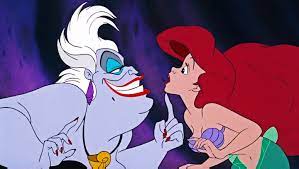
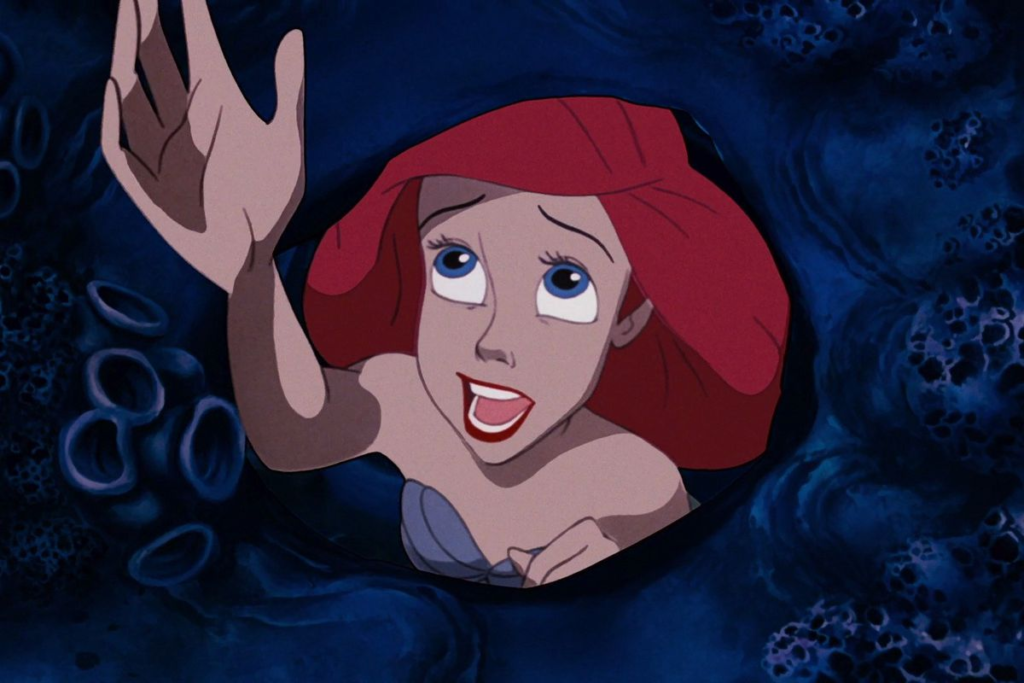
In the 1989 film version of The Little Mermaid, Ariel, the little mermaid, wants to be on land. Ariel visits the sea witch who can help her be on land forever. Ursula is the large purple sea witch. She is the gatekeeper and dealmaker who decides what it will take for Ariel to go on land. The dialogue between the mermaid Ariel and Ursula, the sea witch, in the Disney adaptation of The Little Mermaid (1989), in which they seek to negotiate a deal, shows this tradeoff rather clearly. Ariel must choose between a trip to the human world and life in her mermaid kingdom. Ariel is aware that she will never see her family again as a result of choosing to become a human. She obtains the freedom to live her life as she sees fit after becoming a human. Becoming human, she paradoxically gains the voice she has been denied for so long. Although she has a voice literally underwater, she lives in a society where hers is not listened to. 

The economic ideas of opportunity cost and decision-making are relevant to this clip. It is also noteworthy that Ursula tells Ariel that even in fairy tales, there is no free lunch. Ursula says. “Those who cross the bridge you’ve got to pay the toll” (Clements and Musker, 1989). This encapsulates the idea that you must ‘pay the toll’ which in this case is giving up her voice in order to ‘cross the bridge’ which means going to land. This saying explains the tradeoff that Ariel must make. 

Ariel’s interest in the human world before meeting Eric is always brought up, but less people emphasize how radical that makes her in the context of her own society. Ariel lives in a culture that is hostile to outsiders; Triton refers to humans as “barbarians,” “savages,” and “incapable of any real feeling” at various points. She is frequently reminded of this by the society she lives in. Her ability to seek out this opportunity characterizes her as curious and strong. In order to leave, she must accept that she will have lost her voice, her family, and life as she knows it just to gain the opportunity to go on land. This is an extreme opportunity cost to become human.

The film depicts a hand reaching into her and taking her voice which is represented as a glowing yellow fire. Ursula commands Ariel to sing, as she summons up a pair of hands from her magic cauldron, which slowly approaches her as she sings, and her voice pulsates wildly in her throat. The hands then rip Ariel’s voice from her throat, still singing, and proceed to place it inside the necklace, silencing it (Clements and Musker, 1989, 0:45:14). This illustration shows the silencing of Ariel visually through Ursula physically taking her voice. For students, the film depiction is easy to understand and illustrates the concept of trade-offs and opportunity costs. 

Making informed decisions includes weighing the additional costs and benefits of various options. The economic discipline can benefit from the usage of media in a variety of ways, including lectures, tutorials, homework, offline/online assignments, essays, and projects. According to research, using multimedia or popular culture can spark conversation in introductory lectures (Becker, 2004), demonstrate fundamental ideas (Hall, 2005; Hall and Lawson, 2008), and explain abstract ideas like game theory or option value at a more advanced level. Various students have different learning styles. Research demonstrates that people learn abstract, novel, and new concepts more readily when they are presented in both verbal and visual form. Additionally, visual materials help with subsequent recall, deep learning, and make things easier to understand than text alone (Cowen, 1984; Willingham, 2009). By providing students with both the fairytale and the clip, they can compare the differences in the plot and the consequences of her decisions. 

By analyzing media using the theories and concepts they are learning, students will likely be able to: (i) maintain their interest in the theories and concepts being taught; (ii) improve their analytical skills; and (iii) break down the barrier between formal learning and understanding, allowing them to see concepts and new examples when they use the same media in their daily lives (Mateer, 2011). The subject of whether this new understanding of opportunity costs could alter the course of the students’ own lives will be discussed, and they will be asked to share instances in which they have had to consider the potential cost of a particular course of action.

The relationship between economics and The Little Mermaid is demonstrated through this film clip and fairytale passage as the concept of opportunity cost is addressed. The little mermaid/Ariel must decide what the opportunity cost and trade-offs are to go on land.

Students can learn from her experience by gaining familiarity with the concept of opportunity cost and then considering it in their own lives. The Little Mermaid can help increase children’s economic literacy. Both the film and the fairytale depict the opportunity cost in the decision she will face, and it is the conflict of the story. The fairytale does a good job of explaining what will happen and providing a vivid description of the consequences of her decision. On the other hand, the film is easy to consume and visually illustrates the tradeoff she will have to make. The little mermaid can encourage students to think about opportunity cost in their own lives and provide an example of the strength of decision making. The little mermaid challenges her society and yearns for life on land despite its opportunity costs. 

Works Cited

“Activity: Opportunity Cost – an Introductory Lesson.” Economic Investigations, 25 Sept. 2015, peped.org/economicinvestigations/activity-core-concept-2-opportunity-cost/. 

Admin. “Huffing and Puffing through Economics.” About ALA, 18 July 2017, www.ala.org/aboutala/offices/resources/huffingpuffing. 

“The Little Mermaid – A Kiss for Humanity.” Economics Media Library, 30 Sept. 2017, econ.video/2017/10/01/the-little-mermaid-a-kiss-for-humanity/. 

“The Little Mermaid.” YouTube, YouTube, 11 Apr. 2021, www.youtube.com/watch?v=Y0JoW27fxUw. Accessed 11 Dec. 2022. 

Mandzik, Amanda. “Once upon an Economics Course: Using Fairy Tales to Teach Economics.” SSRN, 17 Mar. 2021, deliverypdf.ssrn.com/delivery.php?ID=447071097117024118015121118127082122033040063036031057022081082090121121018082126029045114020060007100109066002096004082067121122078037060059118026111088021030083107036079030007127086088126020114099080028118099088067095087012095110093064077027009116123&EXT=pdf&INDEX=TRUE. 

panelWayneGeerlingPersonEnvelope, Author links open overlay, et al. “Bringing the ‘Dismal Science’ to Life: Teaching Economics through Multimedia.” International Review of Economics Education, Elsevier, 24 Apr. 2015, reader.elsevier.com/reader/sd/pii/S1477388015300104?token=1517C79322B6B6610C87AA2C5C75A50425C44F492E4C190D71EAF7E24BDA9ABA3FE02533D19AB9A119F9FB6590B11B87&originRegion=us-east-1&originCreation=20221211172016. 

“Trade Offs and Opportunity Cost.” Foundation For Teaching Economics, 9 Feb. 2022, www.fte.org/teachers/teacher-resources/lesson-plans/rslessons/trade-offs-and-opportunity-cost/. 

Categories
Fairy Tales

Shrek as a modern-day anti-fairytale

Once upon a time there was a lovely princess. But she had an enchantment upon her of a fearful sort which could only be broken by love’s first kiss. She was locked away in a castle guarded by a terrible fire-breathing dragon. Many brave knights had attempted to free her from this dreadful prison, but non prevailed. She waited in the dragon’s keep in the highest room of the tallest tower for her true love and true love’s first kiss. (laughs) Like that’s ever gonna happen. What a load of – (toilet flush).

Shrek 00:49-1:35

Introduction 

Over the past couple of decades ever since the rise of the Walt Disney empire, our idea of fairy tales has been characterized heavily by their Disney adaptations. For many stories — such as “The Little Mermaid” or “Cinderella” — the title is synonymous with the Disney version of the story to a point that majority of viewers have never read the original version by Hans Christian Anderson or Brothers Grimm. Disney has monopolized the narrative of fairytales and built a kingdom on the sugar-coated version of the classic fairy tales that had been passed down for centuries. The romanticized, idyllic Disney version of these stories is now the primary narrative that circulates media today, with every “once upon a time” promising a “happily ever after.”

However, this is not always the case. Anti-fairy tales (or “antimärchen” in the original German) was a term that was introduced first in 1929, which initially referred to fairytales that did not have a happy ending, most famously stories like “The Fisherman and His Wife.” More recently, the definition of anti-fairy tales has shifted to describing “modern literary reworkings of fairy tales that stress the more negative scenes or motifs, since they appear to be more realistic reflections of the problems of modern society” (The Greenwood Encyclopedia 50). While Disney continues to churn out film adaptations of fairy tales — including the recent trend of live-action adaptations — there is a counter-culture of anti-fairy tales quietly brewing in the media. As we see from works like visual artist Dina Goldstein’s “Fallen Princesses” photography collection (Goldstein) and a set of New Yorker Cartoons that spoof traditional fairy tale narratives, (Mieder 92-93) audiences have become increasingly critical of the “Disneyfied” stories and messages that we grow up consuming. As our frustration over the mismatch between the ideals we were fed as children and the reality of life continues to grow, we have begun to see more and more anti-fairy tale works circulate in mainstream media. 

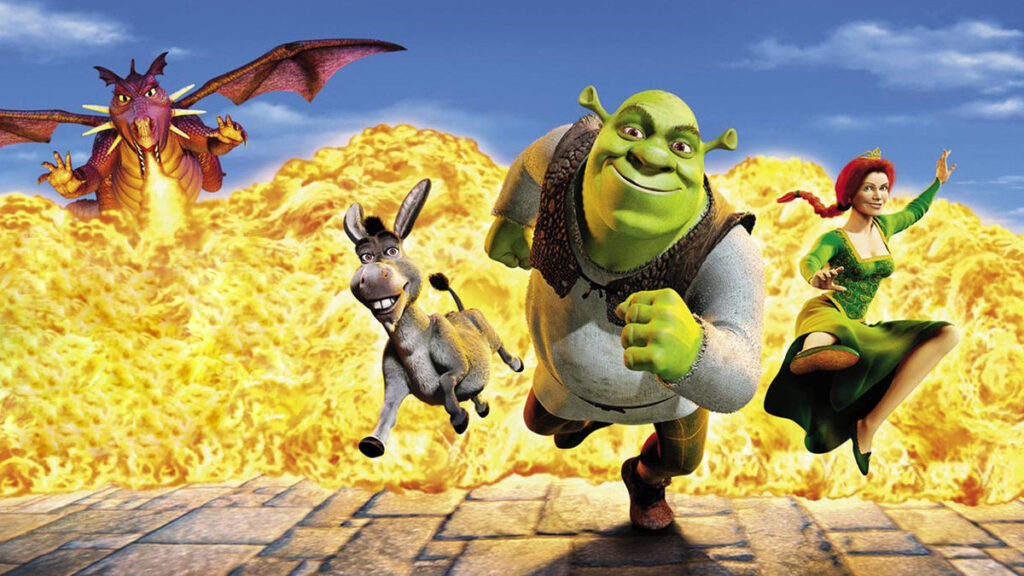
In this analysis, I will focus on the 2001 DreamWorks’ animated film “Shrek” and explore how this film is a modern critical response to the culture of romanticized fairytales that Disney has created. I will argue that it is an anti-fairytale that subverts viewer’s expectations by first establishing influences of fairy tales in “Shrek,” then exploring how it deals with a) the beauty-and-the-beast trope and b) the damsel in distress trope by comparing the film with its Disney version as well as the original fairy tales.

Shrek as a fairy tale

“Shrek” is the first installment of the fantasy comedy franchise of the same name, released in 2001 and loosely based on a picture book of the same name by William Steig. It follows the story of our ogre protagonist Shrek as he sets out on an adventure to reclaim the solitude of his swamp by completing the task set by Lord Farquaad to save the imprisoned princess Fiona. As he continues on the journey along with his sidekick Donkey, he gradually falls in love with Fiona. The story includes many caricatures and spoofed elements of a traditional fairy tale and presents itself as a comedic parody of the classic hero’s adventure. It remixes an overwhelming amount of fairy tale references — which is part of the story’s comedic flair — complete with a cursed princess trapped in a tower, an all-knowing mirror and an onion carriage. The situation that Fiona is in as the set up of the adventure is a mishmash of fairy tale princess tropes — she is imprisoned in a tower guarded by a Dragon “waiting” to be saved by a prince while simultaneously being under a curse that can only be broken by a kiss from her “true love.”

Beyond these nods to classic fairy tales, Shrek is arguably a fairytale because it follows the Propp’s function of a hero’s journey; it begins with “Interdiction” of Shrek finding out and warned about Lord Farquaad’s kingdom, “Delivery” of the villain (Lord Farquaad) gaining information about princess Fiona, “Complicity” of Shrek agreeing to embark on Farquaad’s mission, “Testing” of Shrek being challenged and proving his heroic qualities, “Claim” of Farquaad making unfound claims and attempting to marry Fiona and finally the “Wedding” of Shrek and Fiona being united in marriage. Now having established that Shrek is a fairy tale, I will explore the ways in which it subverts the expectations we have of fairytales in order to prove that it is a modern-day anti-fairy tale. 

Subverting the beauty and the beast trope

One of the most iconic Disney fairy tales is “Beauty and the Beast,” a movie based on the original story of the same name by Jeanne-Marie Leprince De Beaumont. This popular fairy tale is the origin of the “beauty and the beast” trope that we often see in various forms of media. The trope usually features a beast-like male who is physically ugly, mutilated, or is non-human, jaded from the world and filled with rage. The female counterpart is kind, gentle and patient, and sees the good in the man and falls in love with him, regardless of his appearance. At the end of the story, it is usually revealed that the man was cursed and with the love and acceptance of his female counterpart, he transforms back into the handsome prince he was all along. The message from stories that follow this trope is something along the lines of how “there is more than meets the eye” and “beauty is what’s on the inside, not the outside.”

This is the narrative we grow up within the Disney version, with Belle (the Beauty) slowly showing the cold-hearted Beast what it means to care for someone else. It is finally when the Beast learns how to be selfless and be a better person, with Belle expressing her love for the dying Beast that the curse is undone and — surprise, surprise — the Beast turned out to be a young, handsome prince this entire time (Beauty and the Beast). Although this Disney adaptation deviates from the original story by Beaumont here and there, the conclusion reached at the end is the same. In the original, after transforming back to a young, handsome prince, the Beast expresses that Beauty “…were the only person in the world kind enough to be touched by the goodness of my character. Even by offering you a crown, I still can’t fully discharge the obligation I feel to you,” driving the message that the beauty is what’s on the inside and that Beauty is virtuous for having been able to see past his ugly exterior (Beaumont 41). 

Although this is an important message for children to learn growing up, in both the original and the Disney versions, the Beast ultimately ends up turning back into a young, handsome prince. This brings up the question of how convincing this lesson of personality over appearances is if ultimately the Beast ends up transforming into a gorgeous prince as a “reward” for Belle for having stuck with him despite him having been ugly. Although the entire point of the story should be that appearance does not matter, the conclusion in a way undermines this message, presenting a conventionally attractive prince and princess. 

Shrek as a story subverts this trope and turns it around on its head. It also starts as a traditional beauty and the beast dynamic of Shrek being grumpy and unattractive while Fiona is a beautiful human princess. If this was a traditional beauty and the beast storyline, the conclusion would have been with the two falling in love, and Shrek turning into a handsome human prince. However, the story of Shrek cannot be more different. Even after the two get together and express their affection for each other, Shrek still remains an ogre, as green and as “ugly” as ever. What’s more, the big plot twist in Shrek is that princess Fiona herself is also in fact, an ogre. Fiona is under a curse where she turns into an ogre every day after the sun goes down. The only way to break this curse is for her to get a true love’s kiss, however, at the end of the movie, instead of doing so, Fiona chooses to continue being an ogre and spend her days with Shrek at his swamp rather than become a princess.

More than merely adding shock value to the storyline with the plot twist, this narrative decision to have both Shrek and Fiona end up happy together as ogres sends a better message about the lesson that “beauty is what’s on the inside, not the outside” truly means. It demonstrates better than the original or Disney version of the tale how one can be happy despite being an ogre because what matter is being happy with the people that make you happy. Therefore, I would argue that Shrek’s “happily ever after,” not only does it manages to subvert audience expectation for the beauty and the beast trope, but also deliver a more positive message about the importance of inner beauty.

Not a damsel in distress

Another common trope that always appears in fairy tales is the female protagonist being the “damsel in distress.” This appears very frequently within fairy tales that it’s difficult to pinpoint a singular tale that exhibits this trope the best. Take Snow White for example — in the Disney version of the tale, after having been put in a slumber by the evil witch, Snow White waits for her Prince Charming to come to rescue her since only her true loves kiss to bring her back to life (Snow White and the Seven Dwarfs). In the original, by Brothers Grimm, it is a lot less romantic with it being revealed that Snow White had a piece of the poisonous piece of apple lodged into her throat and accidentally jolting her brought her back to life. Nevertheless, it was still the same narrative arc in that it was the prince — having bought Snow White in her coffin from the dwarves after falling love with her at first sight — who prompted her to come back alive and therefore “shall be my wife.” (Grimm 89). 

This damsel in distress trope in fairy tales presents us with a female protagonist that waits around for the arrival of their Prince Charming and needs to be saved by them. Growing up with this as a primary storyline not just in our fairy tales but included in all sorts of media content that had been influenced by it, it has contributed to creating a culture in which girls’ primary purpose is to be patient and wait for their Prince Charming.

Princess Fiona in Shrek is set up as the classic damsel in distress. We are introduced to her through Lord Farquaad’s all-knowing mirror — who presents the different princesses that Farquaad can choose in a dating show format — that Fiona “is a fiery redhead from a dragon-guarded castle surrounded by hot boiling lava,” who is quite literally waiting for someone to come save her. Yet, when we meet her, we find out that she is nothing like the typical damsel in distress. Fiona is motivated, intelligent and strong, capable of anything, if not more than either Shrek or Farquaad. What is more, she has a story arc of her own in the movie beyond just being saved, actually being a cursed half-ogre trying to find a way to continue being a princess full-time. She has a journey of self-discovery in the narrative as well, giving more nuance and depth to the princess character who is very one-dimensional in most Disney fairy tales. Fiona is no damsel in distress and she needs no saving. She is powerful and independent, incredibly capable on her own, and it is purely through her choice that she ends up with our hero at the end rather than just because she was “saved” by him.

Conclusion

Shrek is a comedic masterpiece that while clearly setting itself up as a fairy tale, manages to spoof almost every classic fairy tale element and still deliver an incredible tale of a hero’s (and heroine’s!) journey. It subverts tropes of beauty and the beast and damsel in distress that audiences have grown wary of over the years and provided a satisfying alternative to it while cleverly pointing out the flaws of these inherently sexist stereotypes. By doing so, Shrek manages to utilize the fairy tale storyline to point out the problems with fairy tales, establishing itself as one of the best anti-fairy tales in modern history. That said, it is important to note that the fact that it is an anti-fairy tale means that it is not a happily ever after. Shrek was wrong when he said “Like that’s ever gonna happen. What a load of -” in the opening of the movie. There is a happily ever after — just not the happily after we have come to expect, it’s even better.

Work Cited

Beauty and the Beast. Directed by Gary Trousdale and Kirk Wise, Walt Disney Pictures, 1991.

Brother Grimm. “Snow White” The Classic Fairy Tales. Edited by Maria Tatar, 2nd ed., W.W. Norton & Company, Inc., 2017, pp. 283-300.

Goldstein, Dina. “Fallen Princesses.” Dina Goldstein, 12 May 2022, https://www.dinagoldstein.com/dina-goldsteins-fallen-princesses/. 

Jeanne-Marie Leprince De Beaumont. “Beauty and the Beast.” The Classic Fairy Tales. Edited by Maria Tatar, 2nd ed., W.W. Norton & Company, Inc., 2017, pp. 283-300.

Mieder, Wolfgang. “Grim variations from fairy tales to modern anti-fairy tales.” The Germanic Review: Literature, Culture, Theory 62.2 (1987): 90-102.

Shrek. Directed by Vicky Jenson and Andrew Adamson, DreamWorks Animation, 2001.

Snow White and the Seven Dwarfs. Directed by William Cottrell, David Hand and Wilfred Jackson, Walt Disney Pictures, 1937.

The Greenwood Encyclopedia of Folktales and Fairy Tales. United Kingdom, Greenwood Press, 2008.

Categories
Fairy Tales

The Impact of Fairy Tales on the Emotional Development of Children

By Adrian Wasylewski

Fairy tales are some of the first stories that children are exposed to. They are a big part of many people’s childhoods, acting as a means of bonding with family members and as a source of creativity and imagination. Not only that, but they also act as a guide and support children as they encounter real world issues, providing them with lessons to apply to whatever situation they may find themselves in. Although the contemporary significance of fairy tales has been contested, they play an important role in children’s development, impacting how they regulate their emotions and employ empathy.  

Before analyzing how fairy tales impact development, it is important to understand what fairy tales are, their characteristics, and how they have been integrated into our society. One way to look at fairy tales is as “timeless and spaceless stories that depict the gravity of individuals through fascinating circumstances,” which are based on real life events and reflect the culture from which they originate (Danilewitz, 87-88). These tales can be seen in contemporary media such as TV shows or commercials, book adaptations, or even school curricula. Although fairy tales may have originally been intended for adults, one of the main reasons they have been told and retold is because of their educational impact on children. Many of the characteristics present in fairy tales have major implications for children. Every “once upon a time” promises a “happily ever after,” reassuring the child listening to the tale that there will be a happy ending when it comes to growing up. Fairy tales also tend to simplify situations, eliminating all details except those strictly necessary and dividing many situations into dichotomies such as good and evil (Danilewitz, 88). The characteristics and structure of fairy tales are some of the driving factors when it comes to children’s emotional response to fairy tales and thus their emotional development. 

That being said, this argument raises the question, how do children respond to fairy tales? Because children’s minds are young and full of wonder, not yet influenced by logical thinking that focuses on causes and effects, they respond extremely well to fairy tales. These stories add an element of awe and perplexity in children’s lives which is important because “the intuitive metaphorical symbolic imaginal part of the self needs to be harbored in our children so as to balance out the rational aspects of our lives,” (Danilewitz, 91). Stories, such as fairy tales, are crucial for our development, preventing us from becoming cynical and pessimistic about life and, instead, helping us see the wonder and beauty in the world. Because “the fairy tale proceeds in a manner which conforms to the way a child thinks and experiences the world,” it is more convincing to a child than an actual scientific explanation about a certain phenomenon (Bettelheim, 45). Children do not have a grasp or understanding of complex scientific explanations because they are too abstract for them to comprehend. In a way, these factual explanations seem more unrealistic to them than the magical explanations seen in fairy tales. Fairy tales, therefore, offer children answers to existential questions such as “who am I?”, “where did I come from?”, and “what is the purpose of life?”, acting as a crucial guide for children to navigate the world without feeling an overwhelming sense of powerlessness and defeat. Imaginative and creative stories, such as fairy tales, not only bring children joy, but they also provide them with answers and explanations to real life phenomena that they may question or lack understanding of. 

Aside from the fact that fairy tales help children find meaning and purpose in their own lives, they also help them “engage in emotional growth and transcend their self-centered natures,” (Zehetner, 1). In other words, fairy tales can actually cause people to become more empathetic. The concept of empathy is something that dates back to the beginning of humanity, and can be defined as “the process of ‘feeling one’s way into’ an art object or another person,” (Mallan, 105). In a 1982 study by Sharon C. Milner, the effects of incorporating fairy tales into preschool children’s literature curriculum were tested in order to see how this curriculum change would affect their empathy levels. This study found that the fairy tale curriculum was successful in promoting the development of empathy in preschool children, and it stressed the importance of providing an environment that facilitates the opportunities necessary for empathetic development in early childhood (Milner, 122-123). Previous studies had already found that empathy gradually develops over time and has its early foundations laid down during childhood. The Milner study is important because it provides a method to help foster that early empathetic development for children. By incorporating fairy tales into school curriculums, schools can promote and support more emotionally intelligent people. 

It has been discovered that fairy tales do, in fact, increase the empathy levels in children; however, in what way do these tales actually induce empathetic responses in children? One way to do this is for teachers who are reading fairy tales to children to “deliberately provide emotional significance to an event within a fairy tale,” (Fleer & Hammer, 254). By intentionally assigning emotional significance to an event within a story, teachers can amplify the empathetic response felt by the students and ensure that they are experiencing proper emotional growth. For example, when examining the story of “Goldilocks and the Three Bears,” a teacher may ask her students, “Do you think if someone had broken your chair, you would feel angry or sad?” allowing children to synthesize knowledge and emotions from both the fairy tale and their real world lives (Fleer & Hammer, 254). The Brothers Grimm version of Cinderella reads, “[the two sisters] ridiculed [Cinderella] and threw peas and lentils into the ashes so that she would have to get down and pick them out. In the evening, when she was completely exhausted from work, she didn’t have a bed but had to lie down next to the hearth in ashes,” (Grimm, 148). This passage induces a feeling of sorrow and empathy for Cinderella that children can directly reflect upon. In this way, by deliberately giving children the opportunity to place themselves in the shoes of one of the characters in the story, they are exercising their empathy skills and learning how to become more emotionally intelligent. This concept is important because emotions act as a “special form of reflection on reality [that help] regulate a child’s behavior,” (Fleer & Hammer, 255). When children are given the opportunity to contemplate and discuss different emotional scenarios, it allows for the development of their agency and maturation of their emotional behavior. 

Although many people may experience empathy quite often, they are probably not aware that they may be biased in the way they show this emotion. It is important to recognize, take accountability for, and counteract any implicit biases we may hold when employing empathy. The “similarity bias” describes the phenomenon where “we are more inclined to empathize with people who are closer and more like ourselves than with those who are more distant and more unlike ourselves,” (Mallan, 105). One way to reduce the similarity bias and prevent it from developing in children is through literature. Many modern day children’s books incorporate multicultural stories and human rights efforts with the goal to convey equity and social justice to young children and foster their cross-cultural, empathetic responses. For example, one study examined multiple texts in order to understand how children’s literature can incorporate culture and use it to exacerbate emotional responses (Mallan, 111). One of the books examined in this study was Marty and Mei-Ling, which is about two characters with differences in gender, ethnicity, and behavior. Marty notices and points out many differences between himself and Mei-Ling, which causes Mei-Ling to think he is being mean to her, making her feel sad and lonely. Later on, Marty is at a Chinese kite festival surrounded by many people who are speaking a different language. Because he cannot understand them, he assumes they are making fun of him. On top of that, he loses his parents, causing him to feel sad and lonely. At this point, Mei-Ling finds Marty and provides him with comfort and companionship. Instead of being characterized by their differences, by the end of the story, Marty and Mei-Ling have become friends who share the same interest of kite flying. This children’s book provides kids with an example of how misunderstanding between members of different cultures can lead to negative emotions. Therefore, by learning about and understanding different cultures, we can create a society where everyone feels comfortable and safe being who they are. This is accomplished through empathy, which is one of the main emotions that books like Marty and Mei-Ling strive to emphasize to young readers. Although these stories may not be considered fairy tales, they act as an important model for how stories can be used to increase multicultural empathy. Because fairy tales are constantly evolving, being rewritten, and being adapted, it is simple to modify and apply an already existing fairy tale to induce more empathy towards different cultures. 

Fairy tales can help children feel more connected to and be more understanding of others. This is because “the fairy tale awakens in the child the feeling of participation with other human beings, with people not only of his immediate environment but of all nations and makes him aware that others too have similar thoughts and feelings,” (Danilewitz, 91). Not only do fairy tales help children feel more aware of the people immediately around them, but they also help them become aware that there are people all over the world whose emotions and experiences are just as important as their own. Because fairy tales expose children to many different types of people and environments, it helps them realize that there is a lot of variability in terms of what someone’s life may look like. This exposure gives children the opportunity to implement what they learn from fairy tales into situations that require them to empathize with someone who may not look, sound, or act the same as they do.

As previously mentioned, fairy tales can act as a door or a bridge to the unfamiliar. Authors can use fairy tales as a way to express different experiences or ideas to people who may otherwise not get exposed to those experiences and ideas. In fact, fairy tales can be used as “a tool for understanding not only your own life but also the experiences of others, particularly when those experiences are painful or even untellable,” (Cleto & Warman, 104). One way this is done is through Jane Yolen’s Briar Rose, a young adult novel that uses the tale of “Sleeping Beauty” to talk about the Holocaust through both fairy tale and realisitc story forms. The use of fairy tale motifs and functions helps readers get through an otherwise uncomfortable and difficult story. In this way, the fairy tale can be used to build empathy between two different groups of people. Similarly, fairy tales can be used to “talk through trauma more broadly” and to “say something too awful to speak aloud in any other way,” (Cleto & Warman, 108). The fairy tale can be used as a means for the author to convey something that he would otherwise not be able to share because of the nature of the subject matter. This can be seen through Hans Christian Andersen’s “The Little Mermaid.” Andersen had feelings for a man named Edvard Collin, and when Collin did not express the same love back, Andersen wrote “The Little Mermaid,” where he depicts himself as an outsider whose true love ends up marrying a different person. Andersen wrote, “She knew that this was the last night she would ever see the prince, the man for whom she had forsaken her family and her home, given up her beautiful voice, and suffered hours of agony without his suspecting a thing,” (Andersen, 298). The little mermaid was forced to silently suffer (both physically and emotionally) while she watched the love of her life get married to another woman, causing the reader to experience an empathetic response. Fairy tales can be used as powerful tools to encourage and engage in empathy. 

It is clear that fairy tales are immensely important for the development of young children. Their powerful ability to convey and induce emotional responses in readers makes fairy tales a good mechanism for teaching children to become more empathetic and to help them regulate their emotions. The unique and captivating stories provide children with a way to make sense of life’s intricacies in a way that they can understand; they show children that they can overcome life’s obstacles and anxieties by believing in themselves. In today’s society, fairy tales offer an escape from the harsh reality of hate and intolerance experienced by many. For these reasons, fairy tales should be incorporated into more school’s curricula in an effort to create a more empathetic and socially just society. 

Works Cited

Anderson, Hans C. The Classic Fairy Tales, edited by Maria Tatar, W. W. Norton & Company, Inc., New York, New York, 2017, pp. 283–300. 

Bettelheim, Bruno. The Uses of Enchantment. Vintage Books, 1989. 

Brothers Grimm. “Cinderella.” The Classic Fairy Tales, edited by Maria Tatar, W. W. Norton & Company, Inc, New York, New York, 2017, pp. 148–153. 

Cleto, and Warman. “Teaching with Stories: Empathy, Relatability, and the Fairy Tale.” Marvels & Tales, vol. 33, no. 1, 2019, p. 102., https://doi.org/10.13110/marvelstales.33.1.0102. 

Danilewitz, Debra. “Once upon a Time….. the Meaning and Importance of Fairy Tales.” Early Child Development and Care, vol. 75, no. 1, 1991, pp. 87–98.,  https://doi.org/10.1080/0300443910750104.

Fleer, Marilyn, and Marie Hammer. “Emotions in Imaginative Situations: The Valued Place of Fairytales for Supporting Emotion Regulation.” Mind, Culture, and Activity, vol. 20, no. 3, 2013, pp. 240–259., https://doi.org/10.1080/10749039.2013.781652. 

Mallan, Kerry. “Empathy: Narrative Empathy and Children’s Literature.” New Frontiers of Educational Research, 2013, pp. 105–114.,  https://doi.org/10.1007/978-3-642-36760-1_9.

Milner, Sharon C. Effects of a Curriculum Intervention Program: Using Fairy Tales on Preschool Children’s Empathy Level, Reading Readiness, Oral Language Development and Concept of a Story. University of Florida, 1982. 

Zehetner, Anthony. “Why Fairy Tales Are Still Relevant to Today’s Children.” Journal of Paediatrics and Child Health, vol. 49, no. 2, 2013, pp. 161–162., https://doi.org/10.1111/jpc.12080.

Categories
Fairy Tales

Uncovering Fairytales Using A.I.

By: Gavin Butts

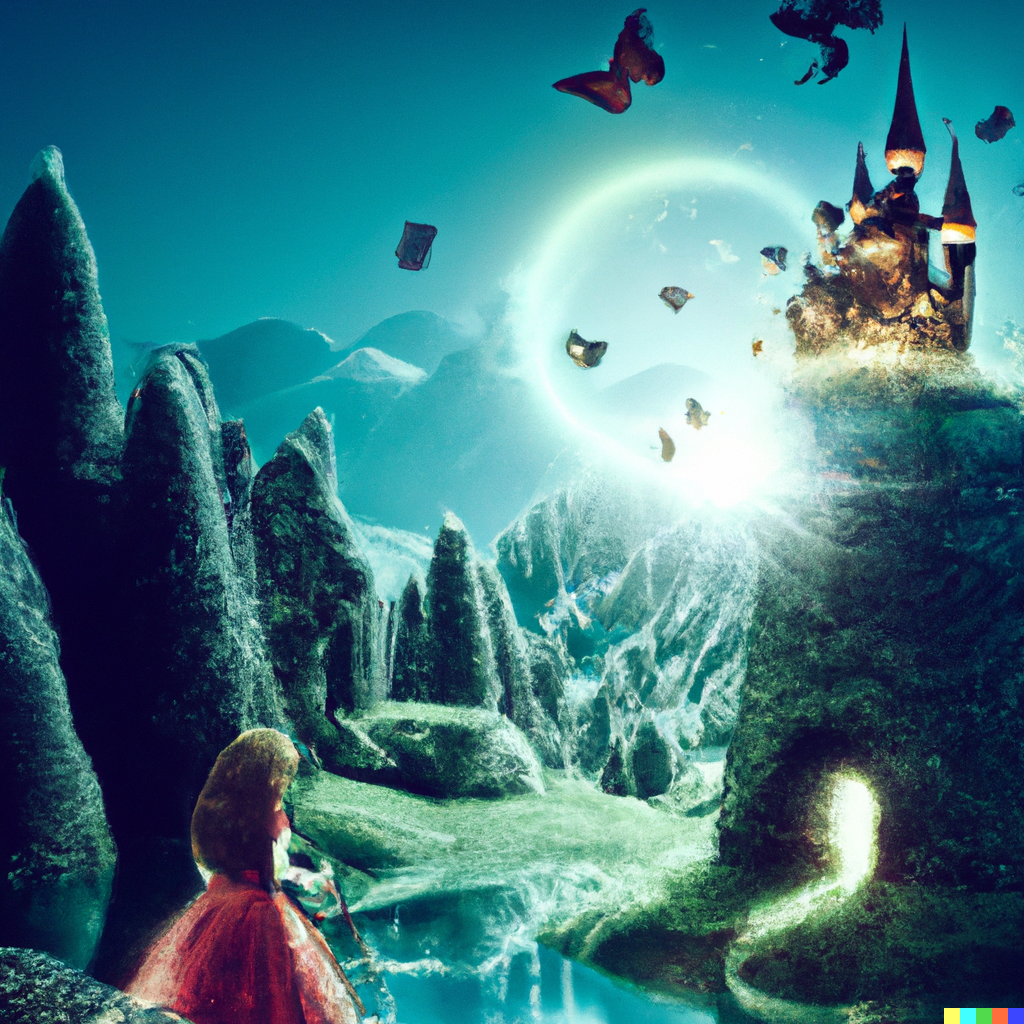
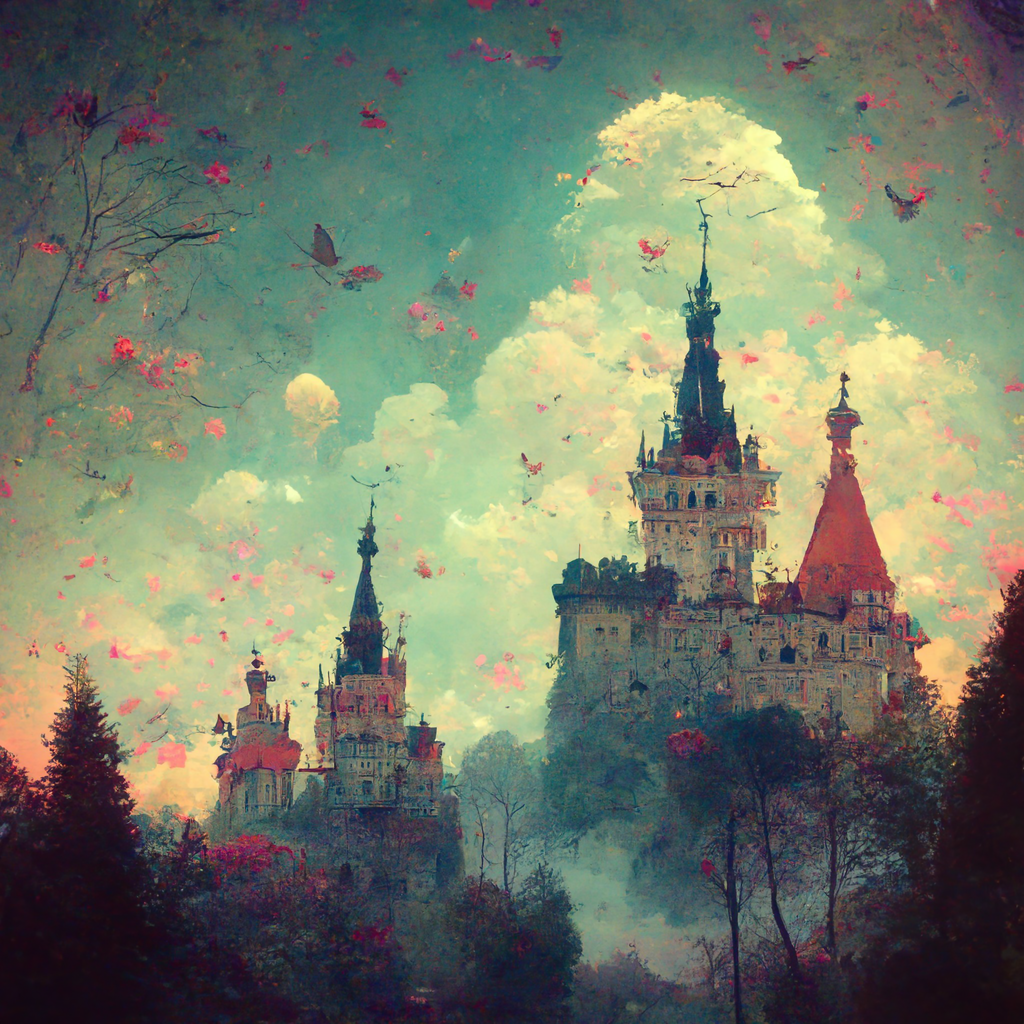
In recent years, the rapid development of machine learning and artificial intelligence has led to their widespread adoption in many areas of society. From voice recognition technology to the creation of the image above, A.I. has become an integral part of our daily lives. As A.I. continues to advance, it is natural to consider its potential applications in more fundamental areas of human experience, such as storytelling. Fairy tales, with their fantastical and unpredictable narratives, have long been a beloved part of human culture (Warner 309-311). These tales, which have been passed down through the generations, often feature magical elements and larger-than-life characters, making them a unique and fascinating test case for the capabilities of A.I. (Lüthi 375-379). Only through analyzing their unique idiomatic expressions are we able to create A.I. to predict whether a given text is a fairy tale.

Through combating the technical challenges of word frequency analysis, the analysis of fairy tales also offers the opportunity to explore the cultural significance of these stories. Through viewing fairy tales as deeply embedded in the human experience, rather than simply words on a page or lingual patterns leaving the mouth, we can provide valuable insights into the way that humans think, feel, and relate to one another (Bettelheim 50-53). Overall, the application of A.I. to the study of fairy tales represents a fascinating intersection of technology and culture.

To tackle this problem, I first sought to compile a comprehensive list of fairy tales by utilizing a precompiled list created by renowned folklorist Maria Tatar. This list contained over 60 commonly told tales, which I converted into epub format for convenient storage on a computer. I then utilized an I/O stream to separate each tale into its own file, allowing for efficient identification of chapter breaks. To further streamline the data, I removed the titles from each file and extracted only the words in all lowercase, using a parsing technique to remove any non-alphabetic characters. This process effectively reduced the program’s time complexity and set the foundation for subsequent analysis.

Finally, I performed a comprehensive word frequency analysis on our simplified fairy tale corpus to uncover the most and least commonly used words. This analysis involved examining over 60 tales to identify the ten most frequently used words in fairy tales and compare them with their frequency in classic English literature. This provided valuable insights into the linguistic characteristics of fairy tales and allowed for a deeper understanding of their unique narrative style. Shown are the 10 most common words in fairy tales, as well as their frequency in traditional English literature, respectively (Norvig).

‘the’, 5.56%‘the’, 7.14%
‘and’, 3.76%and’, 3.04%
‘a’, 3.52%‘a’, 2.06%
‘to’, 2.60%‘to’, 2.60%
‘was’, 2.45%‘was’, 0.74%
‘her’, 2.02%‘her’, 0.22%
‘she’, 2.00%‘she’, < 0.20%
‘of’, 1.74%‘of’, 4.16%
‘he’, 1.43%‘he’, 0.55%
‘it’, 1.41%‘it’, < 0.20%
‘in’, 1.19%‘in’, 2.27%
‘had’, 1.14%‘had’, 0.35%
‘there’, 0.98%‘there’, 0.22%

In both fairy tales and traditional literature, the most common word in English is ‘the’ by 1.8% and 4.1% respectively.  Contrasting to the chart above, it is also important to note what words are common in English literature that are not common in fairy tales. Most notably, the word ‘is’ only comprises only 0.37% of words in our text, but composes a staggering 1.13% of words in literature.

Simply looking at the frequency of the word ‘she’ and ‘her’ offers a valuable insight to how fairy tales might have originated. Originating as tales predominately told from feminine figures in society, fairy tales have a long history of empowering, yet fetishizing, women and young girls (Warner 310-311) (Rowe 302-305). It, then, is not surprising that words in fairy tales are 4.04% ‘she’ and ‘her’. Contrastingly, the word ‘her’ only composes 0.22% of words in literature and ‘she’ is so little that there is no measure to its frequency. In a patriarchal society, there is little resemblance to the society found in fairy tales due to the high prevalence of femininity and delicacy.

Another factor that contributes to the distinctive language of fairy tales is the frequent use of the pronoun ‘it’. The third-person perspective and the use of impersonal constructions in fairy tales often require the use of this pronoun to refer to objects, animals, and other entities (Blevins 2003). This extensive use of this word is evident in the data, with a frequency of 1.41% in fairy tales– compared to traditional literature which uses the word so infrequently that there is no known figure (Norvig). This difference reflects the unique narrative style of fairy tales and the way that they use language to create an atmosphere of mystery and uncertainty. 

With such unique linguistic differences, these factors were implemented directly into A.I. to see if these could determine if a story was a fairytale. This step requires a common linear algebra approach to data comparison called the dot product. If two pieces of data are entirely different, then their value is 0. On the other hand, due to the underlying construction of the algorithm, the dot product of two similar pieces of data is 1 (Ogita et al. 2005). Therefore, we set our algorithm to a threshold of 0.5, where a result of 0.5 and above is a fairy tale and anything else is not a fairy tale.

To evaluate the effectiveness of the algorithm, I compiled a dataset consisting of a diverse range of texts, including both fairytales generated using GPT-3.5 by OpenAI and non-fairytale literature sourced from various online sources. This allowed me to test the algorithm’s ability to accurately classify fairytales and non-fairytales in a variety of contexts. For example, GPT-3 was prompted, “Create an original fairy tale.” As a response, the following story was created:

“Once upon a time, in a faraway kingdom, there was a beautiful princess named Rose. She had long, flowing hair and eyes as blue as the ocean. Despite her beauty, Rose was very unhappy, for her kingdom was being threatened by a terrible dragon.

The dragon had been causing destruction and terror throughout the land, and the people were living in fear. The king and his army had tried to defeat the dragon, but it was too powerful.

One day, a brave knight named Sir Lionel rode into the kingdom. He had heard of the dragon and came to offer his help. The king was overjoyed and offered Sir Lionel anything he desired in return for defeating the dragon.

Sir Lionel accepted the challenge and set out to find the dragon. He searched high and low, but no matter where he looked, he could not find it.

Finally, after many days of searching, Sir Lionel came across a wise old woman who lived in the forest. She told him that the dragon lived deep in the mountains, and that the only way to defeat it was to outsmart it.

Sir Lionel thanked the old woman and set off for the mountains. When he finally reached the dragon’s lair, he saw that it was sleeping. Sir Lionel knew that he had to be careful, so he crept up to the dragon and pulled out a magical sword that the old woman had given him.

With one swift stroke, Sir Lionel cut off the dragon’s head, and the kingdom was saved. The king was overjoyed and rewarded Sir Lionel with anything he desired.

But Sir Lionel did not want wealth or power. Instead, he asked for the hand of the beautiful Princess Rose in marriage. She had fallen in love with the brave knight and happily accepted his proposal.

They were married in a grand ceremony and lived happily ever after. And the kingdom lived in peace, thanks to the bravery of Sir Lionel and the magic of the old woman.”

To evaluate the algorithm’s performance to correctly predict if fairy tales were fairy tales, the aforementioned response, as well as many others, we assessed. The algorithm responded with 87% accuracy– far from ideal. Using text from Brave New World by Aldous Huxley, Of Mice and Men by John Steinbeck, and Crime and Punishment by Fyodor Dostoevsky, the algorithm responded with 85% accuracy– again, far from ideal. Though not entirely inaccurate, the algorithm showed clear flaws.

While the idiomatic patterns present in fairytales may differ from those in other forms of literature, this alone may not be a sufficient basis for accurately classifying a given text as a fairytale. A quantitative comparison of these linguistic patterns is insightful, but this approach may not capture the full range of characteristics that differentiate fairytales from other types of literature. Rather, it is important to consider additional factors such as narrative structure and frequency of types of words– such as nouns, verbs, adjectives, etc.. Since fairy tales have such a deep root in our culture and history, simply knowing what words comprise a text does not offer as much insight as we may originally think.

Work Cited:

Bettelheim, Bruno. The Uses of Enchantment. Vintage Books, 1989. 

Blevins, James P. “Passives and Impersonals.” Journal of Linguistics, vol. 39, no. 3, 2003, pp. 473–520., doi:10.1017/s0022226703002081. 

Dostoyevsky, Fyodor. Crime And Punishment. Signet Classics, 2001.

Huxley, Aldous. Brave New World. 11th ed., Vintage, 2010.

Lüthi, Max. “Abstract Style.” The Classic Fairy Tales: Texts, Criticism, by Maria Tatar, W.W. Norton Et Company, 2017, pp. 375–386. 

Ogita, Takeshi, et al. “Accurate Sum and Dot Product.” SIAM Journal on Scientific Computing, vol. 26, no. 6, 2005, pp. 1955–1988., doi:10.1137/030601818. 

Rowe, Karen. “To Spin a Yarn: The Female Voice in Folklore and Fairy Tale.” The Classic Fairy Tales: Texts, Criticism, by Maria Tatar, W.W. Norton Et Company, 2017, pp. 393–404. 

Steinbeck, John. Of Mice and Men. Penguin Classics, 2000.

Warner, Marina. “The Old Wive’s Tale.” The Classic Fairy Tales: Texts, Criticism, by Maria Tatar, W.W. Norton Et Company, 2017, pp. 309–317. 

Categories
Fairy Tales

The Politics of the Disney Princess

By Brooke Lynch

The Disney princesses are an iconic group of female characters. Serving as role models for many young women, they often reflect the ideals for women of their time. Taking this further, Disney makes a point to deliberately choose fairytales which already reflect the societal and political ideals of the era they were released in and transform them to conform to society’s standards. Through a case study of The Little Mermaid, which parallels Ariel’s journey navigating the human world to women navigating the working world, it becomes apparent that Disney closely reflects the current events and political attitudes of the eras in which each Disney princess is introduced. 

Disney released its first princess movie, Snow White, in 1937. The movie followed the fairy tale of the same name, following the princess Snow White as she tried to escape her evil stepmother and find true love. In both the fairy tale and the movie, Snow White was valued for her household work. She is able to stay with the seven dwarves because she does all of their chores, such as cleaning the house and making them dinner. Because she performs the role of housewife, the dwarves come to love her. She is seen as having value and deserving love because of what she does for others, specifically the men in her life, and specifically through chores. The same can be said for the following two Disney princesses. Both Cinderella and Sleeping Beauty were also tales about women who were good housewives. Cinderella, just like Snow White, spends most of her life and time doing chores. Sleeping Beauty, in a different but similar take, is seen as achieving value through her beauty, hence her name, and is asleep when her prince meets her (in the fairy tale). While Disney does change her story so that she meets the prince before she falls asleep, it is only briefly, and he is drawn to her not for her personality, but for her beauty and singing voice. Sleeping Beauty is essentially the modern equivalent of a trophy wife.

These three Disney princesses who are mostly valued for their beauty and ability to perform household chores/work fit specifically into the political climate of the era they were released in. Ranging from 1937-1959, these three films were all released in the ‘housewife era’ when women were expected to be housewives, where their work was to raise the children and do household chores while their husbands worked in the real world and were the ‘breadwinners.’ While you could fit chores and household work into most fairytales, these three fairy tales already had those ideals built into them, which is why Disney deliberately chose them over other tales such as Rapunzel or the Princess and the Frog, but no deliberate choice is quite as accurate and deliberate as The Little Mermaid.

The Little Mermaid was released in 1989, a period of transformation for American society. Just as American society was undergoing transformation, the Disney princess was too. Ariel stood out compared to the three princesses who had come before her, for many different reasons but, mostly, Ariel objectively had more of a personality. She was outspoken about her wants and desires, but she also advocated and fought for them. Unlike the other princesses before, Ariel actively seeks out Ursula to give her access to her desires. While we see Snow White and Cinderella yearning for love and a life without abuse, they don’t put up a very strong fight against their current situations. Their entire happily ever after is completely reliant on the prince saving them, by either true love’s kiss or a magical slipper. While Ariel too is reliant on her prince to save her in the end, by kissing her as well, she still gives herself more agency in her ending because she consistently makes her best effort to persuade Eric to fall for her. But most importantly, what we see with Ariel, is that she fights for her future outside of just Eric. She wants to be human, not just because Eric is one, and she actively seeks out her way into that lifestyle.

Ariel’s breakthrough into the human world parallels exactly what was happening to women at the time of The Little Mermaid’s release. In the eighties, women were already an established part of the workforce, but this was the first time they were beginning to truly be acknowledged for their work. Around this time, women started to fight against the barriers placed around them in the workplace, they “fought for equal pay, persuaded employers to enact family-friendly policies, and protected equal opportunity rules in the face of an unfriendly federal administration,” (“1980s”). Beginning in the 30s and 50s, World War I and II made it possible for women to enter the workforce while many men were drafted into the military, but once the men returned from war, the women were looked down upon for keeping their jobs if they hadn’t immediately been replaced by a man. Women, instead, were encouraged to do their work in the home, just as we can see in Snow White, Cinderella, and Sleeping Beauty. “Ariel’s ascent to the ‘real world’ easily becomes metonymic of women’s access to the white male system.” (Sells 177). Disney almost outright compares Ariel with women during this time. In Ariel’s song “Part of Your World” she states, “Bright young women, sick of swimmin’, Ready to stand” (The Little Mermaid). Just as Ariel is physically “ready to stand,” “Bright young women” in the 80s were also beginning to figuratively stand for their rights and their place in the workforce.

Despite breaking the barrier between the sea world and the human world, Ariel is not allowed to enter the human world as a mermaid, she has to undergo a transformation in order to fit in. The Little Mermaid once again mirrors present events as women too had to undergo a transformation in order to fit in the workplace. Laura Sells compares the two, stating, “Autonomy and independence, as many feminists have recognized, is never easy; the cost for participating in the white male system can be quite dear. About to enter the real world, Ariel faces the pain of conforming to impossible ideals as she physically mutilates her own body by exchanging her fins for the mobility of human legs,” (179). Not only does Ariel physically mutilate her body in order to fit in, but she also loses her voice in the process. Similarly, women were largely expected to act in certain ways in the workforce where they were silenced as well. To be offered any high-paying job position in the workplace was advertised as a privilege to women. “Like so many women who enter ‘the workforce’ or any other ‘male sphere,’ Ariel wrestles with the double-binding cultural expectations of choosing between voice or access, but never both,” (Sells 179). Women were offered a seat at the table but they were expected to sit and look pretty, not speak, and Ariel reflects just that. 

While women were welcomed into the workforce, they were not allowed to be the ‘breadwinner’ of the family, and they were not allowed to make the same dollar to a man’s. They were allowed to have jobs but their first priority was expected to be their marriage and their family. Similarly, in The Little Mermaid, Ariel has wanted to explore the human world her whole life, however, when she is finally able to break through into the human world, what does she do? She does not explore the human world nor does she seek out all the different parts of human culture. Instead, Ariel’s “interest in the role of citizen becomes supplanted by her interest in the role of wife” once she saves Eric from drowning and quickly falls in love with him, transforming all of her desires from freedom to romance instead (Sells 180). While Ariel was a Disney princess that had never been seen before, who had more agency in her ending, she still is seeking exactly what her predecessors had sought as well, and in the end, her story/ending is reliant on a man, not on herself, parallelling the expectations that were still being felt by women in the 80s. 

Disney was well aware of these parallels before producing and releasing The Little Mermaid. The original Hans Chrisitan Andersen version of “The Little Mermaid” has become widely interpreted as a depiction of Andersen’s own journey as he reckoned with transitioning from the poorer class to a more aristocratic class (Sells 179). Easily transforming the story from fiscal hierarchies to social hierarchies, Disney deliberately chose to depict this fairy tale in order to actively portray the current events being felt by women in the 80s. Disney, however, would go on to change major features of the fairytale which would ultimately change the entire message of Andersen’s “The Little Mermaid.”

In Hans Christian Andersen’s version of the tale, the little mermaid does not win over the prince. Instead, he falls in love with another girl, and the little mermaid loses her chance of earning a soul, instead dying and turning into sea foam. However, we later see that she is a member of “the daughters of the air” who have the opportunity to “earn [a soul] for themselves,” (Andersen 300). While we don’t see her achieve the soul in the story, the tale ends on a hopeful note that she eventually will.  It is argued that Andersen’s ending of the fairy tale was to ensure that the little mermaid could achieve her desires on her own instead of “as an attachment of someone else”  but instead “Disney subverts the mermaid’s self-actualization process” (Sells 180). 

Some may argue that Disney changed the story of the Little Mermaid because its ending is more depressing than what children are used to or want, which is likely a leading factor in the major change. I would suggest, however, that Disney changed the ending to reaffirm women’s place in society at the time. That even though they were being given new opportunities, they were still expected to focus on love, marriage, and family first, not work. Women were vilified for being too committed to work, and their husbands were looked down on for ‘allowing’ it. Due to Disney’s adamancy in sticking to the status quo, Disney likely changed Ariel’s ending to fit with the societal ideals of the eighties. By allowing Ariel to achieve her happiness outside of her relationship with Eric, Disney would essentially be encouraging women to focus on what they truly desire which was not what society was advocating for women to do.

While The Little Mermaid appeared to take a feminist twist on the stereotypical Disney princess, it did not in fact go against any of the previous standards set against women. In actuality, it reinforced them by pushing women to seek out love above all else, including work. Notably, Ariel’s agency is completely diminished by the end of her story as “Ariel passes from her father’s hands to her husband’s hands” and the “autonomy and willfulness that she enacted early in the film becomes subsumed by her father’s ‘permission’ to marry Eric,” (Sells 180). Ariel’s story further enacts the idea that women are allowed to work but aren’t allowed to care too much about work, they have to either give it up or give up their higher positions within the workforce once they are married.

Disney mirroring The Little Mermaid so closely with the social and political climate of the 80s for women would hold true for both the princesses that came before and after Ariel. Just as we saw Snow White and Cinderella during the housewife era, we would also go on to see Mulan, Tiana, Rapunzel, and Moana in the new feminist and #Girlboss eras of the 90s and 2000s as they would take charge in their own wants and desires, and don’t always find love along the way. With new Disney princesses still being introduced today, we can expect that they will continue to reflect the current ideals and politics of their time. 

Works Cited

Andersen, Hans Christian. “The Little Mermaid.” The Classic Fairy Tales. Edited by Maria Tatar, 2nd ed., W.W. Norton & Company, Inc., 2017, pp. 283-300.

“1980s”. Women Employed. (n.d.). Retrieved December 12, 2022, from 

Sells, Laura. “‘Where Do the Mermaids Stand?’ Voice and Body in The Little Mermaid.” From Mouse to Mermaid: The Politics of Film, Gender, and Culture, edited by Elizabeth Bell, Lynda Haas, Laura Sells, Indiana University Press, 1995, pp. 175-192.

The Little Mermaid. Directed by Ron Clements and John Musker, Walt Disney Pictures, 1989.

Categories
Fairy Tales

How Fairy Tales Show Us What it Means to be Human

By Anna Schmalz

Bruno Bettelheim was one of the first scholars to recognize the psychological importance of fairy tales. He claimed that the magic in fairy tales conformed to a child’s animistic worldview and gave them the tools to answer complex questions about identity and their place in the world (Bettelheim 45). But fairytales have more to offer than just magic, fantasy, and escapism. They also force children to confront difficult existential truths about life and what it means to be human. One fairytale in particular, “The Story of the Youth Who Went Forth to Learn What Fear Was” by the Grimm Brothers, specifically addresses the role of fear in the human condition. Artist David Hockney added a visual element to this tale by drawing scenes that had the greatest emotional impact on him. By comparing the tale and the etchings, I will argue that just as the pleasant and magical parts of fairy tales serve a purpose by inspiring children’s imaginations, the scary and unpleasant parts of fairy tales teach children about fear and the human condition.

In “The Story of the Youth Who Went Forth to Learn What Fear Was,” the protagonist lacks a fundamental human quality – fear. The father constantly points out the boy’s deficits by comparing the protagonist to his brother. The boy exclaims, “They are always saying: ‘It makes me shudder! It makes me shudder!’ It does not make me shudder… That, too, must be an art of which I understand nothing” (Grimm and Grimm 269). Unlike his smart and resourceful brother, the protagonist cannot experience fear. Bettelheim writes, “Since polarization dominates the child’s mind, it also dominates fairy tales. A person is either good or bad, nothing in between. One brother is stupid, the other is clever” (Bettelheim 9). Although the polarization Bettelheim describes is heavy-handed, it allows this particular tale to emphasize fear as an innate part of being human. Without it, the boy is inferior.

The structure and polarization of fairy tales allow the stories to succinctly address complex existential dilemmas. Bettelheim notes, “It is characteristic of fairy tales to present an existential dilemma briefly and pointedly. This permits the child to come to grips with the problem in its most essential form” (Bettelheim 8). Appropriately, the existential dilemma presented in “The Story of the Youth Who Went Forth to Learn What Fear Was,” is what it means to be human. The tale presents fear not only as a precursor to intelligence and competence, but a variety of other human emotions, as well. In his frustration, the boy’s father sends the protagonist to live with the church’s sexton, who offers to teach the boy what it means to feel afraid. The sexton disguises himself as a ghost and hides in the bell tower with the intention of scaring the boy. Instead of fleeing, the boy pushes the sexton down the stairs and breaks his leg. When the boy’s father receives word of the accident and confronts his son, the boy expresses little remorse for his actions: “Father… do listen to me. I am quite innocent. He was standing there by night like one intent on doing evil. I did not know who it was, and I entreated him three times either to speak or to go away” (Grimm and Grimm 271). Just as the boy is lacking the human emotion of fear, he is also lacking the human emotion of empathy.

Fig. 1. David Hockney, The Sexton Disguised as a Ghost, 1969.

David Hockney visually represented the interaction between the boy and the sexton, which further illustrates the protagonist’s shortcomings and the existential themes in the tale. The protagonist’s combative stance and close proximity to the ghost convey his fearlessness. The written tale hints at the boy’s lack of empathy, but the etching communicates this visually through the boy’s cold expression. Bettelheim states, “The fairy tale simplifies all situations. Its figures are clearly drawn; and details, unless very important, are eliminated” (Bettelheim 8). Like the tale itself, the etching is simple and minimalistic. The blank background trains the viewer’s focus on the figures, but even the figures themselves are plain and nondescript. And yet, the frank nature of the drawing allows it to foreshadow the supernatural horror that will define the rest of the tale. The boy coming face-to-face with a ghostly figure is his first of many brushes with death, the supernatural, and the afterlife.

Just as “The Story of the Youth Who Went Forth to Learn What Fear Was” presents fear as an essential part of being human, it also presents mortality and death as an unavoidable dimension of the human experience. After the boy’s father disowns him, a stranger suggests that the boy sits under a tree containing seven hanged men if he wants to experience fear. While the sexton’s disguise made him appear dead and other-worldly, the sexton was still very much alive. Now, the boy is confronting death explicitly. When night falls, the boy makes a fire, unties the seven bodies, and situates them around the fire with him. When the clothes of the dead men ignite, the boy tells them, “Take care, or I will hang you up again” (Grimm and Grimm 272). In addition to lacking fear, the boy also lacks the ability to distinguish between living and dead beings. By extension, he lacks the existential fear of death and what awaits on the other side.

Fig. 2. David Hockney, Corpses on Fire, 1969.

David Hockney’s illustration of this scene expands upon the tale’s supernatural and existential themes. The etching of the burning corpses visually depicts what the tale only hinted at: hellfire. The corpses catching fire symbolizes hell-like punishment for their misdeeds, addressing the existential question of what awaits for humans after they die. But since the boy cannot differentiate between living and dead, he cannot comprehend the spiritual dimension of life. In fact, the image holds a mirror up to the protagonist himself. He is so sorely lacking a human element that he does not view the corpses as any different from himself.

The tale presents the supernatural side of life as real, immediate, and part and parcel of the human experience. A wealthy king promises his daughter’s hand in marriage to anyone who can spend three nights in his haunted castle. The boy accepts the king’s offer, hoping that he will finally learn how to shudder. After a series of situations that include giant black cats, a dismembered corpse, and the boy’s dead cousin fail to make the protagonist fearful, a large man later identified as a spirit confronts the protagonist. The spirit tells him, “You shall soon learn what it is to shudder, for you shall die” (Grimm and Grimm 275). But even this experience fails to make the boy afraid as he easily subdues the spirit, marking the end of his three nights in the castle. The boy’s lack of fear indicates a lack of appreciation for death. Just as the boy could not understand the corpses were dead, he cannot fathom his own mortality.

Fig. 3. David Hockney, Inside the Castle, 1969.

David Hockney’s etching adds another dimension to this scene. The position of the boy’s head and his harsh facial expression are nearly identical to the earlier drawing of him and the sexton. But unlike in the previous etching, where the boy stood face-to-face with the ghostly figure, the boy now sits with his back to the spirit. His posture communicates his inability to recognize death and, by extension, the spiritual element of life. Just as his back is turned to the spirit who plans to kill him, his back is also turned to his own mortality.

While the tale addresses the emotional and spiritual dimensions of life by describing what the protagonist lacks, it also addresses the physical element of being human. Once the boy subdues the spirit, the king informs him that he will marry the princess. The boy responds to this information by saying, “That is all very well… but still I do not know what it is to shudder” (Grimm and Grimm 276). The princess grows increasingly aggravated by her husband’s obsession with shuddering, which robs him of his ability to appreciate their wedding or their marriage. Finally, the princess’s chambermaid throws a bucket of cold water with minnows on the boy, at which point he exclaims: “Oh, what makes me shudder so? – what makes me shudder so, dear wife? Ah! now I know what it is to shudder” (Grimm and Grimm 276). In the tale, fear is always operationalized as the somatic sensation of shuddering. Just as the emotion of fear is an integral part of the human experience, so are the corporeal sensations associated with it.

Fig. 4. David Hockney, Cold Water About to Hit the Prince, 1969.

David Hockney’s etching further conveys the boy’s lack of humanness. In the drawing, the bed looks like a coffin, suggesting that the boy’s lack of fear effectively renders him dead. Just as he did not view the hanged corpses as any different from himself or exhibit any awareness of his own mortality, he is essentially dead to the world and oblivious to the full range and depth of the human experience. Both literally and figuratively, the boy is asleep. Even though the drawing depicts the boy seconds before the cold water awakens him – when he should be asleep – his eyes are open. The cold water allows the boy to experience the physical sensation of shuddering for the first time, opening his eyes to the dimension of life to which he was previously oblivious.

Although “The Story of the Youth Who Went Forth to Learn What Fear Was” addresses deeper existential questions about what it means to be human emotionally, spiritually, and physically, it is also a horrifying tale. Reminiscent of a ghost story told around the campfire, the tale includes death, gore, and murder. Although a fairy tale in its form and structure, “The Story of the Youth Who Went Forth to Learn What Fear Was” differs greatly from popular conceptions of the fairy tale genre which are decidedly more rosy – filled with fantasy, wish-fulfillment, and a promised happily ever after. In this case, the happy ending is merely a boy being released from his torment by learning how to experience fear. Why read a tale of this nature to children?

First and foremost, fear serves an evolutionary purpose. For all sentient beings, the emotional and physical sensation of fear allows them to avoid or overcome immediate threats – lack of food, a predator, or a natural disaster. Under the right circumstances, fear is motivating instead of paralyzing. However, psychologists and evolutionary biologists suggest that one type of fear is unique to the human experience – the existential fear of death. Terror Management Theory posits that humans cope with this existential fear of death “through the collective construction and maintenance of cultural worldviews” (Landau et al. 478). Fairy tales are one iteration of this cultural worldview and allow readers to confront death in a safe and sometimes pleasurable way. Although “The Story of the Youth Who Went Forth to Learn What Fear Was” is gruesome and unsettling, the situations in which the protagonist finds himself also border on comedic and absurd. And after all, it is just a story that ceases to exist once the reader closes the book.

Finally, scary stories themselves are valuable. Bruno Bettelheim notes that, “Many parents believe that only conscious reality or pleasant and wish-fulfilling images should be presented to the child – that he should be exposed only to the sunny side of things. But such one-sided fare nourishes the mind only in a one-sided way, and real life is not all sunny” (Bettelheim 7). In the same way that the protagonist in the tale was lacking a human element due to his inability to shudder, parents similarly rob children of the full range of the human experience when they refuse to expose children to scary stories. Although fear can feel paralyzing, fairy tales enable readers to confront the harsh realities of life in a manner that is empowering instead of demotivating. Maria Tatar notes that fairy tales “open up a theater of possibilities and create an unparalleled sense of immediacy, at times producing somatic responses with nothing but words” (Tatar 56). Physical sensations are essential to the way readers experience fairy tales, no different from the way “The Story of the Youth Who Went Forth to Learn What Fear Was” presents physical sensations as an integral part of the human experience. Ultimately, the human experience encompasses a range of emotions and circumstances, both pleasant and unpleasant. But exploring death, loss, and fear through stories prepares readers for the difficult feelings and experiences they will inevitably encounter in real life.

Works Cited

Bettelheim, Bruno. The Uses of Enchantment. Vintage Books, 1989, Archive.org,                                     https://archive.org/details/usesofenchantmen00brun/page/8/mode/2up.

Grimm, Jacob, and Wilhelm Grimm. “The Story of the Youth Who Went Forth to Learn What Fear Was.” Grimms’ Fairy Tales, Project Gutenberg, Champaign, IL, 2001, pp. 269–276, https://www.gutenberg.org/files/2591/old/grimm10.pdf.

Hockney, David. “Cold Water About to Hit the Prince.” Gerrish Fine Art, 1969, https://gerrishfineart.com/product/cold-water-about-to-hit-the-prince-the-boy-who-left-home-to-learn-fear/.

Hockney, David. “Corpses on Fire.” Gerrish Fine Art, 1969, https://gerrishfineart.com/product/corpses-on-fire-the-boy-who-left-home-to-learn-fear-2/.

Hockney, David. “Inside the Castle.” Gerrish Fine Art, 1969, https://gerrishfineart.com/product/inside-the-castle-the-boy-who-left-home-to-learn-fear/.

Hockney, David. “The Sexton Disguised as a Ghost.” Gerrish Fine Art, 1969, https://gerrishfineart.com/product/the-sexton-disguised-as-a-ghost-the-boy-who-left-home-to-learn-fear/.

Landau, Mark J., et al. “On the Compatibility of Terror Management Theory and Perspectives on Human Evolution.” Evolutionary Psychology, vol. 5, no. 3, 1 July 2007, pp. 476–519., https://doi.org/10.1177/147470490700500303.

Tatar, Maria. “Why Fairy Tales Matter: The Performative and the Transformative.” Western Folklore, vol. 69, no. 1, 2010, pp. 55–64. JSTOR, http://www.jstor.org/stable/25735284.

Categories
Fairy Tales

Creating Community Through Stories

By Graham Olson

The creation of fairy tale characters is important in that they are the ones that the reader is supposed to follow and relate to throughout the story. When looking at a fairy tale character they have certain traits that make them that character. Rapunzel has her hair, Cinderella has her slipper, and Ariel has her tail. When you show someone this one aspect and ask them to identify a character with that trait they immediately know what you’re referring to because the trait is specific to the character and iconic in its symbolism. Video game characters are the same in that the popular characters can be summarized down into a few characteristics that make up who they are. The conception of a fairy tale character like little red and video game characters like Mario create community through colorful character design, simplified storytelling, and character tropes.

One of the most important aspects of a character is their overall design. The design of the most unforgettable characters is typically simple in nature. In the Grimm Brothers’ “Little Red Cap” everything to know about the character is quite literally in the title. She is named after her most defining character trait, her red hood. When a reader pictures the character in their head they latch on to the character’s most defining feature. In Tom Bancroft’s book about Creating Characters with Personality, he says that it’s important that a character is “Iconic, extremely simple, almost graphic”. This is to capitalize on the character’s ability to be recognized. A simple character with standout features can be recognized by a wider audience. Take the video game character, Mario. Everyone knows what he looks like, and in reality, he’s not that special. Other than his big mustache and signature red look he is just a human plumber. But this is the point of the characters; being simple makes them easily recognized by a large group of people. This gives characters like Little Red and Mario a larger appeal because a fan of these figures doesn’t have to know a 2 hours backstory of these characters to be able to relate to them. They see a bright red icon that resembles the character and they don’t have to do too much thinking to remember who they are. Most people probably even know that Mario is a character that jumps high and Little Red is an innocent young girl who is going to see her grandma. The point is that their designs are simple with easy-to-understand stories. The character’s simple designs also give the reader clues as to which role they play in the story. It’s really important for a character to be recognized as their role because it makes it easier for the reader to understand them and relate to them. What role the character plays in the story is also called their archetype and it is important to make sure each character fulfills the role they are given (Tillman). This ensures that the reader can understand the character’s thought process and will begin to recognize what decisions the character would make. Little Red Riding hood plays the archetype of the protagonist but also the damsel in distress as she is tormented by the wolf. It is important that this is defined because if the reader begins to understand that character is small and helpless and then out of nowhere the same character starts acting invincible and standing up to other characters with no apparent change in between, it makes the character less believable and overall less relatable to the reader. The reader expects a level of consistency which helps build a bond of understanding between the reader’s knowledge of a character and the character themselves. The characters simple, colorful, expressive character design allows a lot of people to recognize them which builds bridges across communities. Both a 15-year-old kid with a Nintendo switch and a dad in his 30s that grew up with the Nintendo Entertainment System can recognize and relate to Mario. The same goes for fairy tales. There are adults that grew up listening to the same fairy tales told to our youth today. These stories span many generations and it is a way to bond people together from different lifetimes.

Video games and fairy tales also use simplified storytelling to be accessible to the largest audience. The best example of how simplified fairy tale stories are is to look at their prop functions. The entire design of Propp functions is to provide categorization and breakdown of a fairy tale’s story so that they can be analyzed and sorted with other tales (Finlayson). The ease that these stories can be broken down into their smaller parts with ease is a testament to how simple the writing is. Its the simplicity of the stories that make them accessible to a large audience by requiring a lower reading level and literature comprehension. Very few people can read and understand the Odyssey because not only do the themes require a lot of thinking to comprehend but the writing style is convoluted and takes lots of effort to decode. Even without comprehending the deeper meaning behind a fairytale, a child would be able to understand the surface-level story of these tales. This is seen in the original video game Mario for the NES. The character doesn’t need to exactly understand what the character is doing at the moment they just need to know how to progress the story. The low entry for skill into this genre allows a vast number of people to enjoy the stories. This leads to an unseen connection between groups of people over this literature. If two individuals of different ages and cultures have both read and sympathize with a character from a fairytale it creates a bond of emotion across borders. The importance of these stories is discussed in Matteo Stocchett’s report on storytelling in a digital world saying, “Through… narrative enquiry, the world of methodology [can be] demystified.” As a culture, we may discount the importance of these stories because they can be thought of as old or simple but it’s these two aspects that make them an accessible form of storytelling. The story of Little Red Riding Hood creates a connection between the new and old generations through emotional understanding. While your grandparents may not know who Mario is they probably read you fairytales as a kid because storytelling is part of our culture, and by remembering these stories the passing of knowledge from one to another forms community. This is explained in a very scientific way in Elsevier’s, creating a shared clinical plot through interprofessional interaction in biopsychosocial pain rehabilitation. As the title states the creation of a plot is explored through emotional trauma. When reading the story of Little Red her grandma is consumed by the big bad wolf and this is meant to give the reader the feeling of loss. This emotion is not one confined to a culture or individual but applies to the human race as a whole. This feeling is created through a simple story but through the words, it creates a shared human emotion. It’s this emotion that brings people together and connects them on a human level rather than an economic or social level. Through accessible storytelling, fairy tales are able to connect a large number of people despite social and economical barriers.

Lastly Mario and Little Red Riding Hood create community by using character tropes. While it may seem cliche to put character tropes into a story it is very useful when trying to tell a simple story because it lets the reader know what they should expect from a character. Tropes are “simple entities that, at the same time, are particular and have an intrinsic nature”(Jose). This means that they can be general while still remaining an individual. It is important to “Notice that character-making is a proper species of character-grounding. In general, a character-grounder is that in virtue of which something is charactered in some way”(Garcia). In character creation, a trope can help the author articulate to the reader what they are supposed to know about a character. Little Red fulfills the character trope of a damsel in distress and the actions that come with that trope. This means when someone is reading the text they can relate Little Red to other damsels in distress and that provides a foundation to their understanding of a character. She isn’t a new complex character that the reader has to piece together but rather something familiar that the reader has probably seen before. In the same way, Mario is the standard protagonist trope. He is there to destroy the villains and rescue the princess. This allows these works of art to be understood by a large group of people because they’re simple. The characters being simple is a strength of both of these characters because even children can enjoy it as much as an adult would. Simple characters don’t take away from the story in this case but rather expand the audience it appeals to. 

Community is important because our world can seem very divided at times. Through these forms of media, people are brought together across invisible barriers. Location, ethnicity, social status, all of these go away when people bond over things they’re passionate about. A 23-year-old student and a 60-year-old professor can both bond over their love for literature. A 13-year-old boy and a 40-year-old father can both bond over their love for video games. When we come together to express what we are passionate about with other people that creates community and fellowship with other humans. When both the rich and poor have the same vocabulary they can relate to each other. In this case, that vocabulary is the stories in both Mario and Little Red Riding Hood. If more people openly shared what makes them happy maybe we could live in a more united world.

Works cited:

Tillman, Bryan. Creative Character Design. Focal Press, 2011. EBSCOhost, search-ebscohost-com.electra.lmu.edu/login.aspx?direct=true&db=cat08516a&AN=hlec.b5043959&site=eds-live&scope=site.

Bancroft, Tom. Creating Characters with Personality. Watson-Guptill, 2008. 

Finlayson, Mark Alan. “Inferring Propp’s functions from semantically annotated text.” Journal of American Folklore, vol. 129, no. 511, 2016, p. 55+. Gale Literature Resource Center, link.gale.com/apps/doc/A449930138/LitRC?u=loym48904&sid=LitRC&xid=30f4db3a. Accessed 7 May 2021.

Stocchetti, Matteo. Storytelling and Education in the Digital Age : Experiences and Criticisms. PL Academic Research, 2016. EBSCOhost, search-ebscohost-com.electra.lmu.edu/login.aspx?direct=true&db=cat08516a&AN=hlec.b5410336&site=eds-live&scope=site.

Battin, Gudrun Songøygard, et al. “The Puzzle of Therapeutic Emplotment: Creating a Shared Clinical Plot through Interprofessional Interaction in Biopsychosocial Pain Rehabilitation.” Social Science & Medicine, vol. 277, May 2021. EBSCOhost, doi:10.1016/j.socscimed.2021.113904.

José Tomás Alvarado. “Natural Classes of Tropes.” Filosofia UNISINOS 15.2 (2014): 148-60. ProQuest. Web. 7 May 2021.

Garcia, Robert K. “Tropes as Character-Grounders.” Australasian Journal of Philosophy 94.3 (2016): 499-515. ProQuest. Web. 7 May 2021.

Grimm, Wilhelm, et al. Little Red Cap. CreateSpace Publishing, 2018. 

Categories
Fairy Tales

Fairy Tale Homunculi

The Incarnation of Gendered Fairy Tale Bodies

By Natalie Skaggs

Within the scientific community the homunculus is a representation, often used in teaching and memorization, to display the space dedicated to distinct body parts within the somatosensory cortex or motor cortex of the brain. The motor and sensory homunculi are depicted as human persons having disproportionately large or small body parts according to their prominence within that system. For example, the sensory homunculus possesses a very large tongue because a large portion of the somatosensory cortex is dedicated to the tongue (Saladin 524). While these figures are designed to be nothing more than to-scale mappings, one could argue that they represent the aspects of human anatomy most significant to us as individuals. These cortexes of our minds are primarily dedicated to the homunculi’s largest limbs which we use to understand and interact with the world. In this way, the motor and sensory homunculi are creatures which more fully represent our relationship with our physical bodies than that of the human figure. However, the homunculus medium has yet to display the human body according to its existence within fairy tales. These stories reflect ideas and understanding, acting as one cortex of the global human brain. As Bordo writes, “Our bodies, no less than anything else that is human, are constituted by culture” (Bordo 142). Thus it is time to incarnate a new profound creature, one which will expound our knowledge of our physical selves within society, especially the differences between male and female.

Figure 1: Sensory and Motor Homunclui from: Saladin, Kenneth S., et al. Anatomy &amp; Physiology: the Unity of Form and Function. Ninth Edition ed., McGraw-Hill Education, 2021.

Both quantitative and qualitative methods were used to conceptualize the fairy tale corpus. Previous research, especially that of Jorgensen, quantified the presense of human anatomy within European fairy tales. Through this method the importance of individual body parts, as proven through frequency of mention, was accounted for. Then, this understanding was used to create the bodies of three fairy tale homunculi. The first homunculus depicts a universal human body, not identified by sex. This neutral homunculus is the foundation of the later two, possessing large eyes, head, heart, fingers, hands, face, hair, and feet because these are the most mentioned body parts within fairy tales. Two other homunculi stand for the gendered dimensions of human anatomy within fairy tales. Contrasting these later two figures reveals an unbalanced representation of male and female anatomy. Further analysis of the symbolic understanding of body parts within the context of fairy tales and common symbolism gives a larger meaning to each formed homunculus. Ultimately, the ununiform nature of the three homunculi is evidence of a gendered dichotomy within fairy tales which plays into a larger cultural understanding.

Figure 2: Three “fairy tale homunculi” according to fairy tale proportioned anatomy. The left creature represents a male form, the center is a gender-neutral form, and the right is a female form.

The head is the largest body part of the sex neutral and male homunculi (figure 3). The head is the most frequently mentioned body part within the Brothers Grimm tales, having 152 mentions in total for both genders combined (Jorgensen). However, the head is not equally significant for each gender. Another data base shows that the noun “head” is predominately used in reference to men within fairy tales. Specifically, male characters account for 73.08% of all usage. (Jorgensen). Additionally, the neck, that which secures the head to the body, is only used for men and never for women within these tales. But what is to be made of this hypertrophy?

Figure 3: Male fairytale homunculus.

The male association with the head encourages an elevated perspective of all men. First, the head is a symbol of power and authoritative position. The phrase, “the head of the household” or simply “head of” a group is used to define the individual with the highest rank. Due to its role within the physical body, the head is also accredited with cognitive ability and intelligence. For this reason “having a good head on one’s shoulders” is a compliment of intellect. In colloquial terms, the head is also equivalent to logic and reason. An example of this is the phrase “use your head,” which is an instruction to think logically and rationally. This cultural understanding aligns with anatomical function. The head houses the central nervous system, including the brain and spinal cord which are responsible for conscious thought as well as responsible for the autonomic life-preserving functions of the whole body. One could argue that the brain is the most vital part of human anatomy, for without it no other organ could function. Finally, the head is incased in the protective skull. Without the skull the brain would be soft and fragile, rather it is protected and sturdy. In parallel, men are shown to have strength and are free of susceptibility. In these ways, men are represented as powerful, wise, and strong figures within fairy tales.

Figure 4: Female fairytale homunculus.

In contrast, the female homunculus possesses the largest heart of all the fairy tale homunculi. Previous studies show that the heart is the third most mentioned body part of all, having 141 mentions. The majority of the mentions are accredited to female characters. The implications of such a large heart are vastly different than those of the male’s large head.

The cultural connotations of the heart are vast and primordial. Largely, the heart is accredited with affection and love. Within American culture hearts are plastered distributed on every medium on valentine’s day, a holiday which celebrates romantic effection and relationship. One fairy tale with many mentions of the heart is Jeanne-Marie Leprince de Beaumont’s version of “Beauty and the Beast.” For example, female protagonist “loved [the beast] with all her heart” (Tatar 48). So, women are displayed as loving creatures. The heart also frequently symbolizes authenticity and good character. At the heart of a person or thing is its core or true colors, and a possessing a good heart means being good in entirety. Within the same tale beauty tells the beast “I am completely pleased with your good heart” (Tatar 46). Within these tales women are depicted as creatures of love, affection, and good will.

However, equating women with the heart also means equating them with weakness. The heart is considered a fickle organ, susceptible to emotional and physical injury. In the Brothers Grimm edition of “The King Frog” a servant of the young king, Heinrich, is “so saddened by the transformation of his master into a frog that he had to have three hoops placed around his heart to keep it from bursting with pain and sorrow” (Tatar 58). Heinrich’s heart is so fickle due to sadness that without additional support it would have been his demise. The heart is also a mechanism to portray other negative emotions such as fear. Brothers Grimm also write that the “king could see that [the princess’s] heart was pounding” at the sight of the disgusting frog. (Tatar 57). Hearts are frequently damaged within fairy tales, which includes many instances of broken heartedness, a state of grief over some sort of loss. The heart has many positive connotations but is ultimately weak and becomes the downfall of many fairy tale characters.  

The feet are an example of an anatomical part which is mentioned with similar frequency for both men and women but holds vastly different significance for each. There are 38 mentions of feet within the Brothers Grimm fairy tales. However, there is a pattern of essential “pillars of the body,” such as the bones and back, having a higher association with men (Jorgensen). For example, men hold 65.91% of all leg references. Although this does not directly include feet, there is a thematic similarity of stability between the men’s feet and their legs. Within this context feet represent a strong foundation for the body, holding a positive connotation. In “Little Thumbling” by Charles Perrault the male protagonist takes boots off an ogre and places them on his own feet. Little Thumbling was very pleased because the enchanted boots “had the power to become larger or smaller according to the feet wearing them. As a result they fit his feet and his ankles as if they had been made just for him” and felt empowered to continue on his adventure (Tatar 261-262). In other instances, women lower themselves to men’s feet, demonstrating men’s position of superiority. In Charles Perrault’s “Bluebeard” the same woman does this twice when she “threw herself at her husband’s feet, weeping an begging,” and then repeats the same action when she “threw herself at his feet” just one page later (Tatar 191-192). Whenever men’s feet are mentioned, it is in a manner which favors their strength and status.

On the flip side, references of feet including women generally depict weakness. There are many instances of foot amputation or foot torture within fairy tales.  In Hans Christian Andersen’s tale “The Red Shoes” one woman, Karen, finds her feet stuck in a pair of enchanted shoes which compel her to dance without control until her feet are eventually amputated (Tatar 280). This is far from the stable pillars which men’s feet are suggested to be. Another example of unsteady standing is in “The Little Match Girl” also authored by Andersen. In this tale the protagonist is “a poor little girl, with nothing on her head and with… tiny, bare feet, which were red and blue from the cold” (Tatar 301). Here feet are used to illustrate depravity. Perhaps the most famous mention of feet within a fairy tale is in “Cinderella” by Brothers Grimm. In this tale there is one girl, Cinderella, whose feet become her greatest asset. Yet, there are twice as many girls whose feet become a source of pain, the two stepsisters. One stepsister “sliced off her toe, [and] forced her foot into the shoe” and the other “sliced off a piece of her heel, [and] forced her foot into the shoe” (Tatar 152). Both stepsisters ultimately fail at their goals when their feet, bleeding from manipulation, expose them to the prince. Although feet are significant to both genders within fairy tales, they are a resource to men and a liability to women.

In summation, the homunculi demonstrate a deeper understanding of how humanity is represented within European fairy tales. If every anatomical mention is considered a synecdoche for the whole being, then we must consider how we define those individuals. Observing the frequency of, and associations with, body parts mentioned gives light to a dichotomous perspective of gender. Specifically, masculine connections with the head and feet depict men as the more superior, wise, and strong sex. This contrasts fairy tales’ illustration of women as loving yet vulnerable and weak through the symbolism of heart and feet. Fairy tales use human anatomy to tell a story which favors male empowerment and anticipates female failure.

A scientific method of understanding the fairy tale corpus is especially valuable considering how much culture, communicated through mediums such as fairy tales, impact the health sciences.  Recent research has linked gender bias with “negative attitudes and behaviors in healthcare providers” (Rhiannon 1) The forms of bias have been found within medical education through unequal representation in anatomy textbooks,  “the visualization of stereotypical gendered emotions, roles and settings; the lack of ethnic, age, and body type diversity; and in the almost complete adherence to a sex/gender binary” (Rhiannon 5) Despite increased awareness of the impacts of gender bias within the science fields little change is yet to occur. Change may only occur within medicine when those conducting the medicine become aware of the cultural practices which breed gender bias, like fairy tale telling. If people of the sciences acknowledge that the first things they learn about our heads, our hearts, and our feet come from these stories then perhaps they will become better at treating them.

Works Cited

Bordo, Susan. The Male Body: A New Look at Men in Public and Private. Farrar, Straus & Giroux, 1999.

Jorgensen, Jeana. “Masculinity and Men’s Bodies in Fairy Tales: Youth, Violence, and Transformation.” Marvels & Tales 32.2 (2018): 338,361,494. ProQuest. Web. 7 May 2021.

Jorgensen, Jeana. “Quantifying the Grimm Corpus: Transgressive and Transformative Bodies in the Grimms’ Fairy Tales.” Marvels & Tales 28.1 (2014): 127,141,216. ProQuest. Web. 7 May 2021.

Jorgensen, Jeana. “The most Beautiful of all: A Quantitative Approach to Fairy-Tale Femininity.” Journal of American Folklore 132.523 (2019): 36,60,107. ProQuest. Web. 7 May 2021.

Parker, Rhiannon, Theresa Larkin, and Jon Cockburn. “A visual analysis of gender bias in contemporary anatomy textbooks.” Social Science & Medicine 180 (2017): 106-113.

Saladin, Kenneth S., et al. Anatomy &amp; Physiology: the Unity of Form and Function. Ninth Edition ed., McGraw-Hill Education, 2021.

Steven, Van Wolputte. “HANG ON TO YOUR SELF: Of Bodies, Embodiment, and Selves.” Annual Review of Anthropology 33 (2004): 251-69. ProQuest. Web. 7 May 2021.

Tatar, Maria. The Classic Fairy Tales (Second Edition) (Norton Critical Editions). W. W. Norton, 2017. [Yuzu].

css.php