By: Caroline Baxter
William Faulkner, when describing his experience as a southern writer from the foothills of Appalachia in Mississippi, wrote “We need to talk, to tell, since oratory is our heritage”. My family is from differing parts of Appalachia, and that place, its accent, and its community comforts me in a complex but instinctual way. It’s a rich and unique culture that deeply values community and prioritizes storytelling despite its simplification or belittlement. The people of Appalachia emphasize and elevate the act of oral storytelling, the simple process of sitting with someone and telling them a story. Living in Los Angeles, we see oral storytelling as an old form, a precursor to our storytelling now—theater, film, novels, ect. But oral storytelling is still active and important to many cultures across the globe, especially one right here in the US. Appalachian Oral Storytelling is a modern example of the origin of fairy tales, because it permeates the everyday experience and represents a core identity within Appalachian culture. Their fairy tales and folk tales offer a unique style of mysticism within their storytelling due the landscapes isolation, the ancient quality of the mountains, and the greater reliance on the natural world. We can learn from this tradition to emphasize the importance of oral storytelling to deepen community bonds and celebrate cultural complexities.
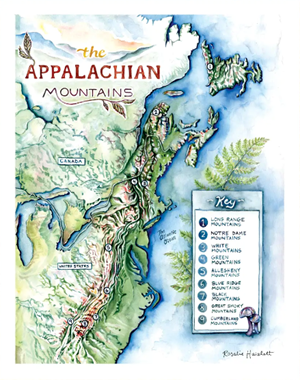
The Appalachian Mountains have a unique history and demography which informs the stories, identities, and culture of the area. It is not just (to put it plainly) a place that’s only “poor, backward, and white” (Baird). The mountains span from Canada to Alabama, but the region specified as Appalachia is the southern US section of the mountains south of New York. Its history and storytelling influences are tied to three major groups, the Cherokee tribe, “Scots-Irish, English, German, and Italian immigrants,” and African Americans as descendants from enslaved people (Sivinski 5). As Elizabeth Engelhardt states:
The Appalachian mountain range is one of the oldest on planet earth, has borne witness to more history, and has endured through more seasons of change than most any other place. The heights and depths, temperature range, and reach of the mountains across the continent mean diversity on a scale beyond the keyboard of human writers.
(Engelhardt 6)
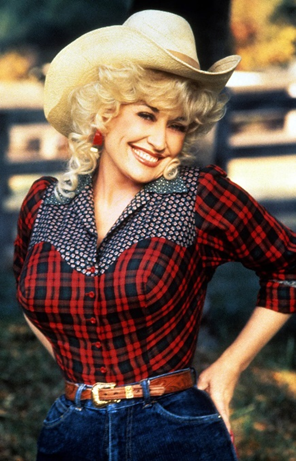
Too often as an American, I see our history and identity as new, at least in comparison to the histories of Europe or Asia, but this is due to the erasure of Native American history. To label this area and community as only one thing erases history, culture, and lived experience of a vast and complex place. If we want to find a true example of American fairy tales, in our “melting pot” sense of identity, Appalachia is the place to find it. Its isolation produced a unique and rich culture that had a huge impact on the greater American identity and culture. Think of the instrument of the banjo, or American folk, or Dolly Parton, the Patron Saint and Queen of Appalachia.
Appalachian culture has oral storytelling as a major part of their identity and everyday life, it is not just contained within the entertainment they watch or read. It is also supported systemically through organization and higher education. Stacy Sivinski describes her experience tied to Appalachian storytelling in her novel Fairy Tales of Appalachia, she states:
My family and community treated storytelling like a living, breathing thing. Tales weren’t just encountered between the covers of a book, but grew out of late-evening dinners, conversations with friends, and the long car rides we often took while traveling to visit my grandparents in West Virginia.
(Sivinski 3)
Sivinksi represents how much oral storytelling is used as a community building exercise that appears in all parts of her culture. She also represents how this skill was a “living, breathing thing” highlighting the development and uniqueness of every time each tale is told. It grows. As Sivinski describes her process of transcribing the regions fairy tales for her novel, she states:
Most of the recordings that I encountered in the archives featured a diverse set of individuals who were taking several hours.. from the normal rhythm of their lives to share a few stories with a visiting folklorist. In the background of these recordings, the sounds of daily happenings… can often be heard, situating these tales more firmly in their original context.
(Sivinski 11)
This description highlights the encompassing aspects of oral storytelling, it’s not just a formal story in the evening, but continuous and vibrant, even taking up hours of time. Rather than an event, it’s a daily occurrence. It connects directly to the tradition of fairy tales. In The Classic Fairy Tales by Maria Tartar describes the origins of fairy tales: “Once told around the fireside or at the hearth, with adults and children sharing the storytelling space, they captured the play that yoked luminous beauty with the dark side” (Tartar xii). So, it seems this Appalachian style pushes beyond this traditional image of the “hearth” but still honors the community and kinship in its process.
This process of storytelling is also embedded within the education and academic culture found within Appalachia. It promotes the tradition to be modern, to be a practice that is celebrated today. The Young Appalachian Story Summit occurred in 2021 in the International Storytelling Center in Jonesborough, TN. There are also storytelling undergraduate and graduate programs at East Tennessee State University. The National Storytelling Network originated in a small town in Tennessee in 1975. The promotion of the process of oral storytelling is not just contained within the Appalachian region, but rather it’s a passion that is cultivated in the region and spread across the country and the world.
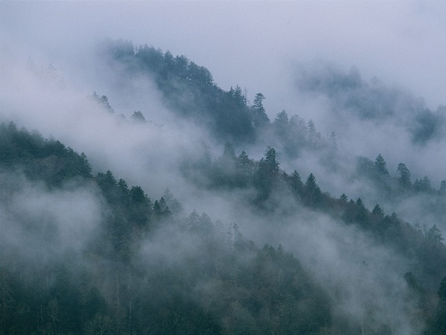
Appalachia, like many other cultures, contains pervasive stereotypes and preconceived notions, both within social structures and within their classic stories, which mostly tie with Jack tales and horror tales. Yet, the pervasiveness of these tales within the oral tradition reflects the scribes with these individuals deciding what is popular and staples of the genre. The Jack tales—or tales with the same trickster character as Jack and the Beanstalk—entered the Appalachian mainstream with the migration of Scot-Irish settlers, and have been identified as staples of the genres. Theres also a large fascination with horror tales in Appalachian folklore, both within the community and outside it. When you search for stories of Appalachia, you’ll mostly find article titles like “5 Spooky Mountain Stories to Keep You Up at Night” or “The Urban Tales of Appalachian Ghosts”. Theres a fascination and mysticism within these mountains, whether it may be its age, the isolation, or there really is something magical and ancient about that place. As Engelhardt stated previously, these mountains are some of the oldest in the world, adding to the depth and richness of this place. Their isolation and smaller population lead to a greater connection and reliance on the natural world, leading to stories that explore its beauty, magic, and horror.
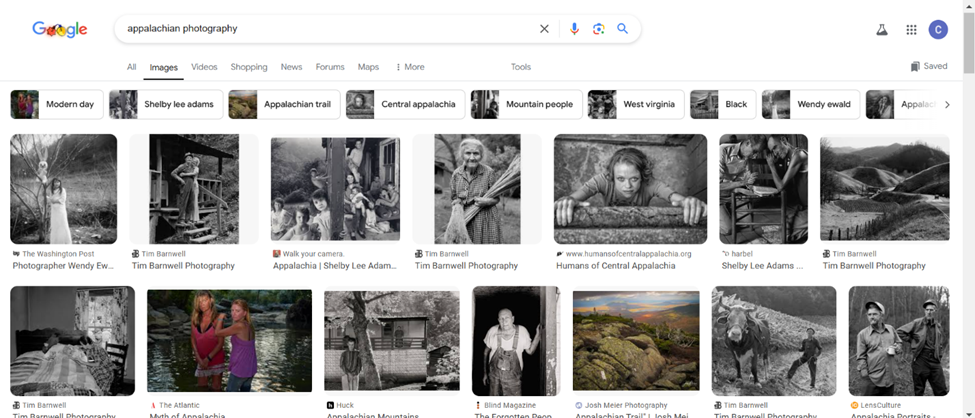
Within these mainstream depictions, Appalachia is seen as a place of the past, or as Engelhardt states, “Again and again Appalachia is relegated to the past tense: ‘out of time’ and out of step with any contemporary present, much less a progressive future” (Engelhardt 5). When you search “Appalachian Photography”, about 90% of the photos are in black and white, again reflecting this place as a relic of the past. (If you’d like a more balanced depiction of the region, look here– https://appvoices.org/2015/12/09/wide-angle-contemporary-photography/#comments) This is a deep erasure of the complexities, diversity, and engaging aspects of Appalachian culture , and its missing many female focused stories. As Sivinski puts it:
‘Who has historically collected folktales and decided what is worthy of preservation?’ As Donald Hasse points out, one of the main reasons well-know fairy tales often perpetuate certain narratives about women is that they were canonized primarily by men.
(Sivinski 16)
We’ve seen the same story play out in Europe, with the Grimms and Charles Perrault, yet only one group gets labeled as backward, and out of touch when analyzing an incomplete cannon.
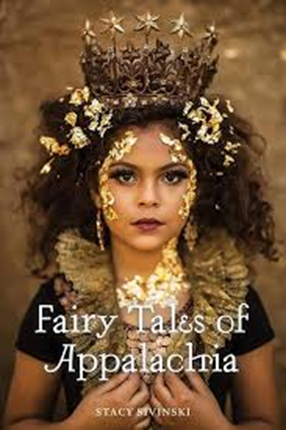
Appalachian culture is more than just their stereotypes, and so are their stories. They contain many complex and driven female characters. That is part of the mission of Stacy Sivinski’s work Fairy Tales of Appalachia, to highlight the diversity and representation that is already contained within these tales. She says, “because Appalachian women have historically assumed extraordinarily active roles in their communities, it is especially important that folktales with strong heroines become more readily available” (Sivinski 17). These stories have been classics in Appalachian fairy tales, they just haven’t been transcribed or highlighted. Within the novel, there’s retellings of Jack Tales with a female lead, Appalachian retellings of classic stories like Cinderella and Bluebeard, or stories which reflect the blending of Scot-Irish, African American, and Cherokee influence. One specific tale that represents a blending and originality is The “Little Princess of the Forest.” There are familiar fairy tale tropes and images, like a little girl wandering through the woods, a death like sleep and an awakening by a prince, a murderous mother-in-law, and a search for the princes’ missing bride. Yet, the tale has its own unique connection to the natural world, with our main character being taken from her parents by a bald eagle, and her later being turned into a water lily and a magnolia fruit. As Savinski states “”The Little Princess of the Forest’ thus pulls together a range of fairy tale tropes while also offering a plot that is distinct and does not traced back to a single story” (Sivinski 66). The tale deals with themes that permeate the human experience: poverty, grief, jealousy, and identity, another staple of the fairy tale genre. The most compelling characters in these stories are women, we focus first on the mother of the little princess, then the little princess herself, an old witch, and finally the evil queen. Its not surprising at all to see these tales hold modern sensibilities, because a huge aspect of this tradition is its growth as they are pass down and retold. The main characteristics of the men in this tale is how they relate to the women, with the old witches son, and the prince and king with their obsession with the Little Princess of the Forest. While the tale relies on and explores patriarchal conventions, it does so through the eyes and experiences of woman and paints them as a variety of characters. Appalachian women are just as complex, interesting, inspiring, and dangerous individuals as anyone, so they deserve to have their stories told, because they’ve always been there. Theres at least enough to write a book with 29 examples.
Maria Tartar states “Storytelling is a culture-building activity… one that makes the human world, but, as the tales included here are forever reminding us, they also make the world human” (Tartar xxv). Oral storytelling is an important way to build and strengthen our communities, and it is too often dismissed based off pre-conceived notions. The way we connect with others around us is by telling them stories. The first thing I always do when I come back from a trip or catch up with someone is tell them my favorite stories, and I love to listen to their favorite stories. These stories facilitate a bond and a deeper level of understanding. Appalachia, Oral storytelling, and Fairy Tales have been dismissed as traditions and places of the past, but we can learn community building and cultural identity through these seemingly “ancient” things.
Works Cited
“About – National Storytelling Network.” National Storytelling Network – National Storytelling Network, 17 Apr. 2024, storynet.org/about-nsn/.
Baird, Sarah. “Stereotypes of Appalachia Obscure a Diverse Picture.” NPR, NPR, 6 Apr. 2014, www.npr.org/sections/codeswitch/2014/04/03/298892382/stereotypes-of-appalachia-obscure-a-diverse-picture.
Engelhardt, Elizabeth S. D. “Trying to Get Appalachia Less Wrong: A Modest Approach.” Southern Cultures, vol. 23, no. 1, 2017, pp. 4–9. JSTOR, https://www.jstor.org/stable/26391674. Accessed 22 Nov. 2024.
FAULKNER, WILLIAM. “An Introduction to ‘The Sound And The Fury.’” The Mississippi Quarterly, vol. 26, no. 3, 1973, pp. 410–15. JSTOR, http://www.jstor.org/stable/26474057. Accessed 2 Dec. 2024.
Sivinski, Stacy, and Jamie Sivinski. Fairy Tales of Appalachia. The University of Tennessee Press, 2023.
Tatar, Maria. The Classic Fairy Tales. 2nd ed., New York, W.W. Norton & Company, 2017 (xi-xxvi).
Photo Sources
https://hollerhousebristol.com/products/print-appalachian-mountains-map
https://www.cntraveler.com/story/appalachian-mountains-may-have-once-been-as-tall-as-the-himalayas
https://www.vogue.com/article/dolly-parton-tennessee-nashville-travel https://www.nationalgeographic.com/premium/article/appalachian-mountains-ancient-geology-modern-horror-stories