The Miami Heat A Cinderella Story

Once upon a time, a few months ago, in the 2019- 2020 NBA season the Miami Heat had a run that took the league by surprise. The Miami heat climbed out of the Eastern conference with a relatively young core of rag tag players to the Finals. Miami was headed by the controversial Jimmy Butler, supported by role players, and had strategy provided by Erik Spoelstra. Both Butler and Spoelstra both had disappointing runs throughout their previous years leading up to the Butler Trade into the 2019 season. Butler had a rough start to the league. Earning a reputation to be difficult to work with, self-isolating and hard to work with. He bounced around the league with the 76’s and pistons and left both organizations with a bad taste in their mouths. The media called him a “diva” and said he had isolating tendencies. However recently there has been evidence that it was those respective organizations that were the source of the problems. However, once he reached the Heat, he took charge of the young core and mentored them.

No one expected the Heat to make it out of the eastern conference to the Finals especially after facing tough competition like the Boston Celtics, and Milwaukee Bucks who had established systems and stars. The Heat were the underdogs of the NBA with an exciting story, full of high stakes and more. While the Heat took the world by storm, they ultimately met their match. Three of their star players Bam Adebayo, Jimmy Butler and Dragic were injured heading into other finals.

First, let’s examine, why do we love the underdog story? This is a question that applies both in sports and in fairy tales. Fairy tale writers often use the word “little” in front of each of protagonists’ names. For example, little red, the little mermaid. In some form or another the protagonist is belittled. This can also be seen in Cinderella as the main character is ridiculed for simply existing by her mothers and stepsister’s. The key to the reader is that she is underserving of the conditions brought towards her. She must both overcome her status as “little” and overcome the trials of her family. Part of what makes that story magical is the transformation from a life of suffering and misfortune to a new beginning and happy ending.

Psychologically people find similarities to the underdog story because we all at one point have been the “youngest” ort weakest before. There is a level of similarity we can identify with. The psychology of the imposter syndrome can also insight to how being “little” can feel.

            The last time the heat had made it to the finals was in 2014. Between the 2010 and 2014 finals run the Heat assembled a “Big Three” comprised of Dwayne Wade, Lebron James, and Chris Bosh that dominated the league. Following the Lebron departure the team had a restructuring period. In the next few seasons, the other two members of the group also retired. Following an underwhelming 2016 season, they drafted Bam Adebayo in the first-round draft. In 2017 the heat had a brief hint of brilliance as Wade, Dragic and Bam had a solid run.

            In the 2019-2020 season the Heat signed All start Jimmy Butler and drafted Tyler hero. Buter and Bam both became all stars. They also acquired Jae Crowder and Andre Igoudala. They also gained the undrafted rookie Kendrick Nunn and Second Year Duncan Robinson. This was the core team. In the brief regular season, the team went on a 44 and 29 a respectable placing on the way to the finals.

The Heat “Big Three,” Lebron James, Dwayne Wade, Chris Bosh (from left to right)

The league favorite for the eastern conference was the Boston Celtics who were led by Jason Tatum however the role players stepped up. Tyler Herro played unprecedently well making history as the youngest player to ever score a triple double in the playoffs ever. Role players like Kelly Olynyk and Kendrick Nunn were essential in scoring quick buckets and the team as a unit was more cohesive than many of the other teams with depth. The narrative of the league quickly became that the Heat were on a role as a Cinderella team.

            Heading into the finals the Heat were optimistic. However quickly in the first game the three stars of the team Bam, Dragic and Butler were out. The Heat were outclassed and struggled on defense. Without their stars they were disjointed and uncoordinated. While Butler returned in the 3rd game his incredible spark was not enough to carry the team to victory. The role players like Herro and Olynyk failed to return to their old glory and the team was shut out in 2-6 against the Lakers. The Lakers were dominant playing some of the best of the basketball they had played.

            For many fans of the NBA following the Heat was very interesting. The journey for an unexpected team making it to the finals was thrilling. Marketing companies capitalized on this and there was a buzz round the league. Regardless of how well the team did the Heat struck a chord in the league, reaffirming their place as a contending team. Now with rumors of a trade between the Heat and Rockets for James Harden, making sure they will be a contending team for the future.
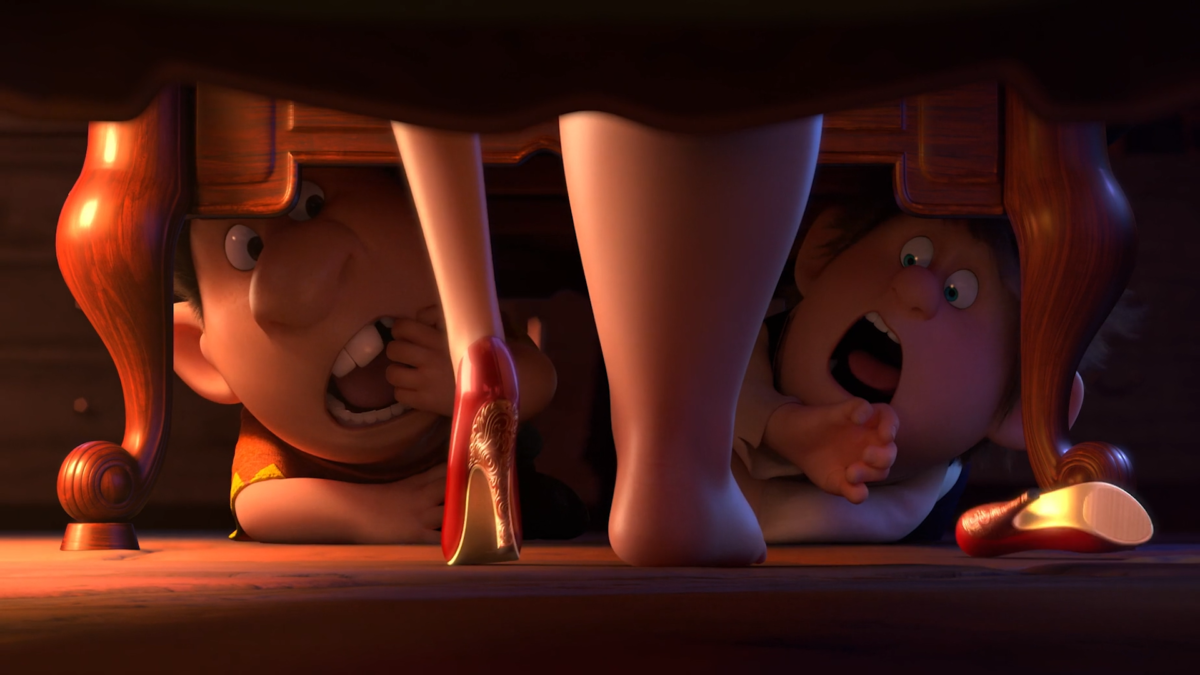

Fat-Shaming Marketing for Snow White Movie: A Video Analysis of the Ad Campaign for Red Shoes and the 7 Dwarfs.

By AnaMichele Morejon

In 2017, the internet blew up with controversy over a new “fat-shaming Snow White movie.” The movie audaciously tried to modernize the Snow White fairy tale by making Snow White a plus-sized princess. The producers shared that the movie’s message was intended to challenge the social standards of physical beauty and emphasize the importance of inner beauty. In their initial marketing, however, the movie seemed to say that heavier women are not beautiful. Two years later, the movie was quietly released with new character designs and a reworked plot, and unfortunately, it seems to have flown under the radar of the mainstream media. 

I was curious to see how the movie turned out after the initial controversy, so I watched it. While it was not perfect, I really enjoyed the film. I saw a massive improvement from the original marketing — so much so, that I decided to make a video essay comparing two trailers published before the controversy and a trailer published prior to the movie’s eventual release. I have seen a few videos on YouTube that defend the final movie, but I could not find any video that really delved into the original trailers and compared them to a newer trailer. 

This comparison helps reveal the effect that the critics had on the final outcome of the film and the power of fairy tales to shape how we view real-world topics. 

As a forewarning, the original trailers feature home invasion, voyeurism, fat-shaming, objectification, sexualization, and non-consensual contact. I want to make clear that, while I use a sarcastic tone in portions of the video essay, these are issues that I take very seriously. The depiction of women as objects and the body-shaming of the female protagonist are unacceptable. 

when the light hit upon it

by j. k. wang

I used to think of fairy tales as childish stories with little bearing on real life. It wasn’t until I took a fairy tale class in college that I actually sat down to really read them. During this class, I rediscovered these tales and found that they had a lot to say about the human experience. We analyzed these stories in class, but I wanted to go a step further. I wanted to read my own world as literature, to analyze my life through the lens of fairy tales. This poetry-photography project explores the topics of self-love, faith, and change through “Snow White,” “Sleeping Beauty,” and “Hansel and Gretel.”

~


my mirror

  • we were reading Snow White
  • and you talked about the importance of mirrors
  • how powerful they were
  • dangerous even

  • you said, maybe in jest, that we couldn’t look in the mirror
  • for ten minutes
  • a measly ten minutes
  • that we would be overcome with existential crises
  • and have to look away,
  • defeated
  • well, I, having dealt with
  • plenty of existential crises already
  • wanted to prove you wrong
  • and so I sat down
  • in front of my bedroom door
  • on which hangs a mirror
  • and stared into it
  • and for a while
  • there was nothing to it
  • I couldn’t understand why the Queen
  • loved her mirror so
  • but then I looked closer
  • and I could see my skin in relief
  • all the pores
  • the way it breathed
  • the way the light hit upon it
  • a surface like a planet
  • and I was struck
  • that
  • it was
  • beautiful
  • and I realized
  • that I had not yet ever had the opportunity
  • to lie down
  • and to look upon someone else’s face
  • their skin
  • so up close
  • so intimate
  • so loving
  • and I thought of the old Queen
  • who married for the kingdom
  • and though beautiful
  • was not loved
  • and how she
  • no longer had the opportunity
  • to look at anyone so close
  • like she was looking at herself
  • and I thought of us
  • so young and so old
  • one before her time
  • and one after
  • and how we were really in the same place
  • staring at the mirror
  • but really
  • staring at ourselves
  • loving ourselves
  • safe, and warm, and wonderful
  • and before I knew it
  • ten minutes had passed
  • and I had never looked away.


  • burnt spindles

  • after hearing the fairy’s curse,
  • Briar Rose’s mother and father
  • burned all the spindles in the kingdom
  • still
  • at the appointed time
  • Briar found the last, forgotten one
  • and fell asleep
  • anyway
  • why bother
  • burning the spindles at all?
  • it reminds me of my own
  • mother and father,
  • Christians,
  • one a convert during a severe illness,
  • the other third generation
  • but solidified after a mystical experience
  • they raised me and my kid sister
  • as serious Christians:
  • we went to church every week,
  • not like those Christmas-and-Easter-only types
  • I prayed
  • I believed
  • I even tithed
  • and I sacrificed
  • (maybe now I would say repressed)
  • parts of myself for the Faith
  • but I was never so sure that I heard the voice of God,
  • like my parents were,
  • and I would pray every night
  • to know him better
  • to have a real relationship with him
  • and when nothing came,
  • I figured it was my fault
  • eventually I went to college
  • learned more
  • and opened myself up to the world
  • and after much trepidation
  • allowed myself to finally
  • question my Faith
  • in good faith,
  • letting myself be honestly led
  • wherever the answers would take me
  • so the college student returns home
  • like many others
  • having shed their belief
  • though freeing for me
  • it must’ve been a bitter loss for my parents
  • who had to feel like the king and queen
  • when Briar found the spindle anyway
  • then I looked at my sister,
  • who after hearing my story
  • agreed she could not answer my questions
  • but said that she knew she could
  • trust God
  • despite her doubts
  • and that was assuring enough for her
  • and I couldn’t help
  • but see myself,
  • who would’ve said the same thing
  • in her place
  • and I thought it likely
  • that she would eventually
  • take the same path as me
  • and I thought of my parents
  • and Briar’s, thinking to themselves:
  • if we had done it all differently,
  • maybe it would have still turned out the same.


  • little bit of color

  • out of food
  • Hansel and Gretel’s parents
  • forced them out of the house
  • hearing that as a child
  • was strangely comforting
  • to know there was another in the world
  • that had to leave home
  • just like me
  • you see
  • my family had moved six times
  • by the time I was nine
  • but I had my own trail of breadcrumbs
  • for by 13
  • I had been living in Missouri
  • for five years
  • the longest I had ever lived anywhere
  • my dad had found his dream job
  • and my parents said we were going to stay
  • but things change
  • and dreams don’t turn out as well as you think
  • the birds swoop in
  • and we were moving again
  • to California
  • like the fairy tale children
  • trials came upon me
  • but my hungry witch was
  • sitting alone at lunch
  • or with people that didn’t see me
  • and not knowing what to do with myself
  • but in the story
  • the witch was defeated
  • and the children found the treasure
  • and strangely enough
  • I did too
  • moving allowed me
  • to reinvent myself
  • I learned how to be happy
  • I made wonderful friends
  • I think of all the things that have happened
  • the great, life-changing things
  • and I couldn’t see them happening
  • if I had stayed in Missouri
  • I don’t know how Hansel and Gretel felt
  • arriving at their happily ever after
  • but I was confused
  • what does it mean
  • that California was so good for me?
  • does it mean
  • my moving was good?
  • how could it be?
  • I was so angry at my parents for moving
  • I felt they betrayed me
  • how could it have turned out for good?
  • whenever people would ask me
  • if I liked Missouri or California better
  • I would always answer Missouri
  • maybe to spite my parents
  • but also because it was my home
  • and I loved it
  • and I missed it
  • but I was no longer so sure that my answer was true
  • and what did that mean
  • was I betraying myself?
  • you see
  • back then I was stuck in fairytale logic
  • black and white
  • where dragons were evil, and princes were heroes
  • princesses were loving, and witches were terrible
  • and that was that
  • California had to be good
  • and Missouri bad
  • or vice versa
  • and moving had to be good or bad and nothing in between
  • then when someone explained to me
  • that the world wasn’t black and white
  • I realized
  • my move wasn’t bad or good
  • it was both
  • I could grieve the loss of my old home
  • my old friends
  • and celebrate my new one
  • moving had its losses
  • and its gains
  • and they didn’t cancel each other out
  • out of my black and white world
  • I had found my little bit of color.


  • Fairy Tales in Advertisement

    By Amanuel Matias

                In everyday life, a small amount of intention can lead us to recognize the prevalence of fairy tales in our society. In the case of advertisement, adaptations have been made to some classic fairy tales in hopes of prompting a nostalgic reaction and leading potential consumers to purchase a product. In one sense, fairy tales and advertisements serve a similar purpose. They both paint a desirable picture and provide the means for attaining this satisfaction. A fundamental difference, however, is that fairy tales more subtly influence the mind of the listener, while advertisements attempt to explicitly show the viewer to fill a void in their life. According to University of West Alabama, “the use of narrative and storytelling has been proven to help consumers make emotional and personal connections with brands. This sentiment is backed up through research, which has shown that 55 percent of consumers who love a brand’s story are willing to make a purchase” (UWA). The synthesis of fairy tale motifs and commercials appears in many forms throughout modern-day commercials. The objective of this project is to identify aspects of various commercials that reflect the themes and nuances of fairy tales that are incorporated into television marketing.

    Pepsi One- Little Red Riding Hood (click to watch video)

                This Pepsi One commercial presents an extremely sexualized rendition of “Little Red Riding Hood.” The advertisement capitalizes on the seduction associated with the color red, which in the original fairy tale, is the color of only Little Red’s hood. In the commercial, red is the color of the woman’s entire outfit. This completion of her signature color represents the maturation of Red’s sexual desire as she shifts from a young, innocent girl to a grown woman. In the commercial, her voice is intentionally suggestive, which can be seen as a marketing tactic to entice the male audience. A key difference between the original fairy tale and this Pepsi advertisement lies within the intended audience. While the fairy tale appeals to children of all genders alike, the commercial’s focus on the male audience further heightens Red’s lust embedded into Pepsi’s work. This commercial epitomizes the common phrase, “sex sells.”

                Even though Little Red herself feels strong sexual curiosity in the original tale, the wolf still plays the role of the seducer. In the case of the Pepsi commercial, the seductive role switches to Little Red. In Bruno Bettelheim’s The Uses of Enchantment, he states, “The immature person who is not yet ready for sex but is exposed to an experience which arouses strong sexual feelings falls back on oedipal ways for dealing with it” (173). In the case of this commercial, Little Red is a grown woman, not merely a small, curious child. Since she has matured, she does not need to fall back on her oedipal desires in order to satisfy her sexual craves. Red unambiguously expresses her carnal craving while having a complete understanding of who she is as a woman. This contrast allows for the role of the seducer to switch from the wolf to the woman in red.

    Levi’s- Cinderella (click to watch video)

                In the Levi’s version of Cinderella, a young woman searches around the city for the man who fits the pair of jeans she holds. The original fairy tale involves a prince searching through the city for a woman who fits a glass slipper, but the Levi’s role reversal takes on a progressive, feminist viewpoint which provides a different perspective than traditional fairy tales. Originally, Cinderella’s happiness and fruitful future lies within the hands of a male character. She does have a strong mindset, filled with patience and kindness, but regardless, Cinderella lives a life of disregard up until her foot slips into the coveted slipper. In the Levi’s commercial, the young woman loses her slipper, and an anonymous motorcycle rider cuts off a man who is chasing her, but he drops a pair of Levi’s as he rides off. The role of Cinderella in the commercial ends up being played by the mystery man, and the young woman plays the role of the “prince.” 

                The young woman’s decision to scour the town portrays her initiative and independence, contrary to the original female character’s perspective of “good things come to those who wait.” After an extensive search, she finds a mechanic who fits the jeans she holds, and they find their happy ever after. The director of this commercial intentionally leads the viewer away from the classic Cinderella archetype and changes the storyline so that the young woman’s prosperity is not based on her patience to tolerate neglect and emotional abuse, but instead due to her independence and perseverance. Her independence effectively parallels the message Levi’s portrays at the end of the commercial, stating “no two pairs are the same.”

    AT&T- Hansel and Gretel (click to watch video)

                This AT&T commercial caters to the nostalgia induced by the synthesis of a well-known fairy tale, Hansel and Gretel, and the busy city streets that are so common in 21st century film. In the original fairy tale, Hansel and Gretel’s sense of comfort revolves around having access to food, which is provided in their home. Once they know they are going to be abandoned, the siblings realize that their lives are in danger. In the commercial, the erasure of their bread crumb trail as they travel through the big city symbolizes the parental abandonment they experienced in the old tale. Since knowing that they can find their way home means they will have food to eat, the crumbs act as a comforting bridge to home during their adventure. In the commercial, Hansel and Gretel’s sense of comfort is revived by accessing the cell phone GPS function, effectively portraying AT&T as the hero of this fairy tale remake.

                Since the commercial lacks some aspects of the original fairy tale, namely the wicked stepmother and the witch, the viewer is forced to refer to their familiarity of the Hansel and Gretel tale to fully understand the implications of the siblings’ longing for home. If the viewer has not read Hansel and Gretel, the commercial may not as effectively convey the message that the purchasing of their cell phone is crucial because the dangers of life away from the cottage are not depicted. While the dangers are not explicitly mentioned, they are implied by Gretel’s facial expression when the children realize that the bread crumbs are not still in their trail:

    _____________________________________________________________

                Whether commercials accurately portray well-known fairy tales or introduce significant redirections, fairy tale themes assist in inclining viewers to favor the purchase of an item because of the nostalgia that accompanies fairy tale references. In the case of the over-sexualized Pepsi One Little Red Riding Hood commercial, the inclination was aimed towards a specific audience, but in AT&T’s Hansel and Gretel rendition, the reminiscence was evident in all who were familiar with the tale. Regardless of the approach, fairy tale implementations in modern advertisement can lead to the purchase of the advertised products because of our yearning to bring childhood magic back into our everyday lives.

    _____________________________________________________________

    Works Cited

    Bettelheim, Bruno. The Uses of Enchantment: The Meaning and Importance of Fairy Tales. New York: Knopf : distributed by Random House, 1976.

    “Storytelling in Marketing: The Importance of Brand Narrative.” UWA Online, 22 Oct. 2019, online.uwa.edu/news/brand-narrative-storytelling/. 

    Project Breadcrumbs: Fairy Tale Text Generation

    Maddie and Merissa

    As Senior Computer Science majors taking both Natural Language Processing (NLP) and Honors Literary Analysis this past semester, Maddie Louis and Merissa Tan found a common interest in the intersections of NLP text generation and fairy tales. They therefore decided to embark on a mission to teach machines how to write fairy tales.

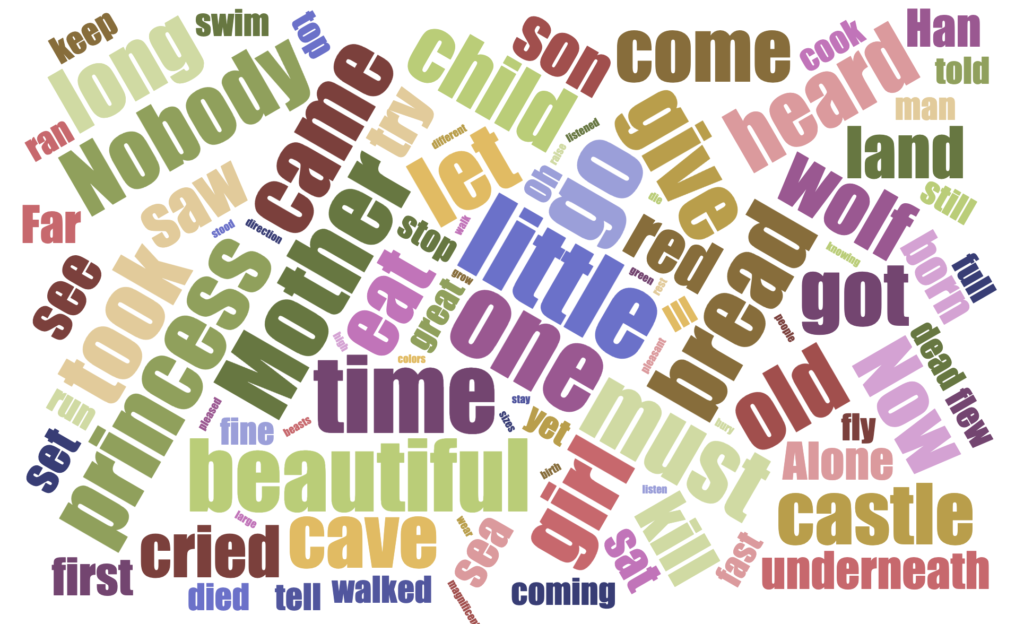
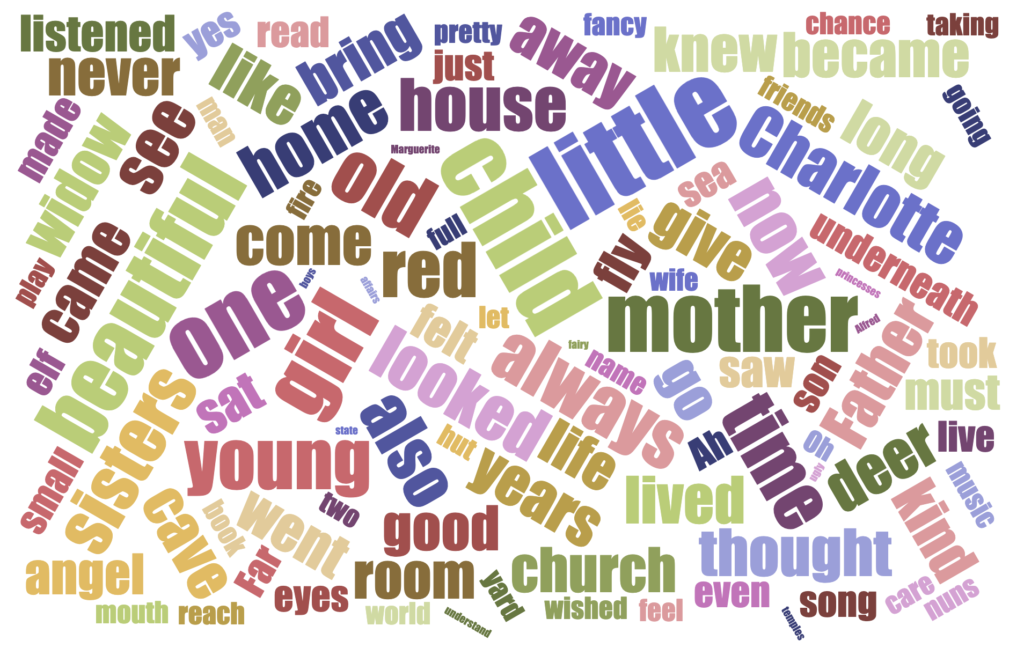
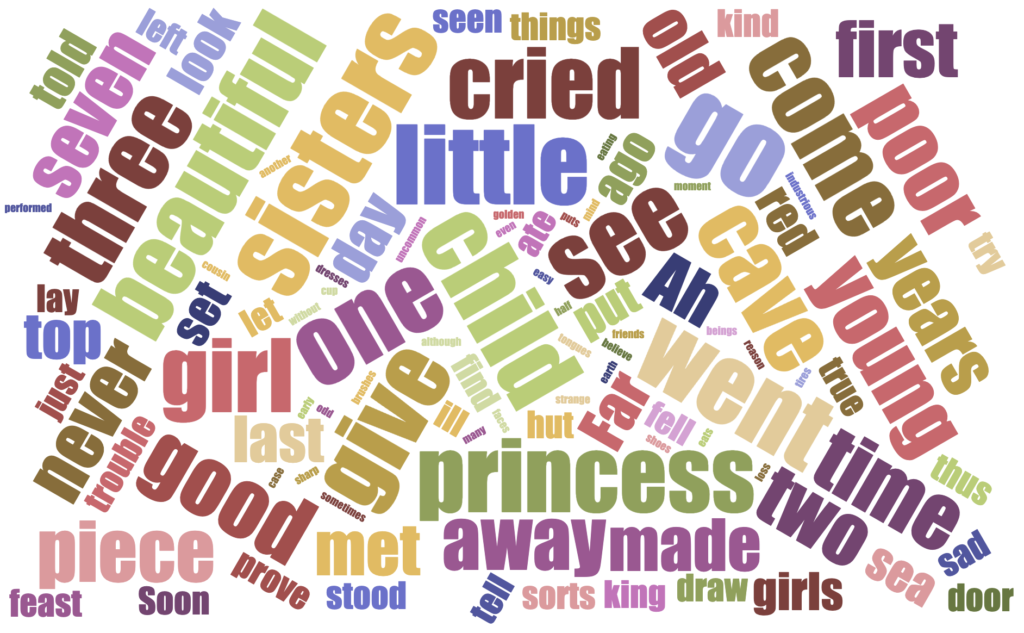
    The paragraphs below are sample stories generated by language and text-generation models that have learned from the works of prominent fairy tale authors. The models are given a prompt which are italicized in the text. The word clouds showcase the most common words in these generated texts.


    Model learned from Brothers Grimm’s tales

    Sample Generated Text #1

    Alone in the woods was a small girl in a red cape. She was on her way to bring bread to her grandmother.

    ‘Well, grandmother,’ thought the cook, ‘how can I make money from her, and cook my meal for you?’ ‘Alas,’ said Gretel, ‘I will eat only my bread’s half.’

    Then she took a red apple, and nibbled at it until she was satisfied. Then she thought: ‘I should like to get some for you, but I have no one I can reach.’

    At last she gave up the apple, and went home satisfied. With the exception of a few days when she had a little cow, the wild goose were very lucky.

    They came all the time to their great-great-great-grandmother to have their dinner, and had so very little that no one could get in.

    Sample Generated Text #2

    Out in a cave, there lived a horrible beast. Nobody dared go near it, and the cave remained untouched by the nearby village for thousands of years. But that was only the beginning.

    At last, a fisherman and his wife found shelter under a hillock, and heard the strange sounds of the beast, when it was about to leap upon their boat.

    They soon fell down upon one another, and as they had come to the place where the monster had been, the fisherman got up and tried to throw him on the top of his boat.

    The monster began to run after him with great speed, and began to sing and dance under the water.

    ‘Oh dear God, give me a break,’ cried the fisherman, ‘give me a break,’ as it sprang off the top of his boat again. But the fisherman sprang back, and, seeing that the monster was no longer there, went down again to the water.

    ‘Pray swim away,’ said he, ‘you can’t swim away,’ but he clambered out of the water, and said: ‘Oh dear God, grant me a break,’ and clambered on again; and again, he ran upon his boat as fast as he could.


    Model learned from Hans Christian Andersen’s tales

    Sample Generated Text #1

    Far underneath the sea, there lives a young princess who has seven sisters.

    Their names are Charlotte, Charlotte, Charlotte; they are all beautiful, and one of them is a little daisy; she is beautiful, and Charlotte is beautiful.

    The daisy is not only Charlotte but also Charlotte who also is a lovely human being, because in her soul she lies, and does her bidding; she is the one who knows what is at stake in the future.

    Charlotte can neither lie nor lie about herself, so that nothing in the world may be expected of her. But the little daisy can be held together and strengthened by the love which she gives to it.

    Charlotte is a girl who can be read; but the book she is reading is nothing, because she has never read the book she had intended to read, but only a sketch, for the drawing will remain for years; she cannot think of that again.

    Now when she looks at the daisy, she sees a young angel, and a beautiful girl, but she cannot perceive them. She cannot see them, for the angels are not there.

    The little daisy is sitting up in her arms, and the little angel has been kissing her, and they are kissing her heart, and her lips are moving through the air.

    Sample Generated Text #2

    Once upon a time there was a young girl who was the fairest of them all. Her sisters were jealous of her beauty. She was beautiful, they believed.

    And when she was about ten years old she was married to a noblewoman.

    The girl was very clever, and had all the qualities, while her mother believed that this girl should never have a chance to be with her; so that she had no chance of ever being with her.

    The only thing which the daughter of her master could wish to know was how she was to remain in a kind home with the noble people of her birth–in which the mother remained for half a year, and the child was always with her. It was a very beautiful time, in the summer.

    The Dryad came out of the country in winter to visit her, which was certainly of great importance; so it was very pleasant and interesting to see her, to have her, and to see all her beautiful gifts.

    The Dryad had a splendid home in the town; a pleasant house that had been built on top of hers; and a splendidly furnished yard; but the whole arrangement was only to give the dryad much entertainment; and so she became quite convinced that the house, in which she lived, was to serve as her home.


    Model learned from Charles Perrault’s tales

    Sample Generated Text #1

    Alone in the woods was a small girl in a red cape. She was on her way to bring bread to her grandmother.

    Now this poor thing had got a good deal of money out of the boy, and had given him money to buy a pretty little hut, which he had cut up on the outskirts of town.

    Now this little hut was called The Fox’s Fair, because, as far as was known, it lay on a ridge above, behind the house, and was called The Fox’s Mountain, for the hill that is just at the top of this rock, over there a very dangerous place.

    In the forest stood a deep ditch.

    Here there was once a girl who was very kind, and to give good advice to the man who was to come out of the forest, and tell him why his brothers had got into this dangerous place; but he had a wicked old cap lying upon his head, as the poor little girl told him.

    Sample Generated Text #2

    A long time ago, there was a couple who wanted more than anything to have a child of their own.

    The eldest was very fond of having one, and the other very fond of having two; so she laid hold of her father’s neck, and asked: ‘Dear father, do you wish to have a child?’ ‘Yes,’ replied the father, ‘but if my child be given to me I will give you to the poor girl, for she cannot bear to keep herself in this world.’

    So she was given a little child, and by marriage her mother lived with her, and they lived for three years together very happy.

    Then she sent them all up into the world, for they called the little people: and this the eldest sister did, and was called Rose-red, and was called Lily-red; and when she was old enough, and could go no farther, she left the little children to her, and set them to work and get wood, and make furniture, and clean the house; and it was not long before she got pretty well enough to draw some wood out of the wood, so as to put one in every corner of the house, to make beds, beds for her maidens, and cook the cook’s table, or whatever else she would like.


    Project Report

    css.php