Categories
Fairy Tales

Space: The Deep Dark Woods of the Modern Day

By Anna Kunze

Astrophysics might seem like the furthest thing from the humanities one could study. Even other sciences seem more connected–botany, maybe, could relate to the flora of Rapunzel, or, what about psychology? Those, at least, seem relevant to the time period from which folk and fairy tales originate. How could the study of deep space have any connection to a story about three pigs building little houses or a little girl who gets eaten by a wolf? However, there are many parallels between space exploration and fairy tales that should be explored because comparisons between the two allow us to understand each of them better through the universal truths they jointly reveal. Though they may seem distantly related, each of them provides unique insight to the other based on their unexpectedly similar bases. A central theme connecting the two is curiosity–not the Mars rover, though that is a good example, but the significance of curiosity in propelling the cultural significance of both space and Mother Goose.

Space is often referred to as “the great unknown,” or “the final frontier.” The popular interest in space exploration is based on innate curiosity; the same trait as that which leads fairy tale protagonists to violate interdictions so often that Propp classified it as one of his functions. This curiosity, especially in female characters, tends to have immediate and negative consequences: Red Riding Hood’s eaten, Bluebeard’s wife nearly gets murdered, Sleeping Beauty falls asleep for 100 years. However, after getting to know what lurks in the dark, they take important lessons away from their experiences. By drawing comparisons between the rebelliousness which makes fairy tale characters so relatable to so many and the determination of scientists to delve as far into space as possible—to venture into a space so vast and unknown that it seems like God has forbidden knowledge of it to us—the fiery desire to discover and to know what has been kept from us is made apparent. Children especially are fascinated by space–‘an astronaut!’ is a common answer to the question ‘what do you want to be when you grow up?’ This starry eyed, childlike wonder about space never really disappears even as kids grow into adults who have a more fleshed out understanding of the world around them and for whom the curtain has been pulled back a bit, dissipating a bit of the magic in the mundane that comes with the innocence of childhood. Space is unknown to everyone. The magnitude of it is not meant for human comprehension, so there is a lingering awe even in the eyes of the most learned astrophysicists who know of the scientific explanations for many cosmic phenomena when viewing images from the Hubble Space Telescope, or more recently the James Webb Telescope. There is a reason why viewing a total solar eclipse is regarded by so many as a life-changing experience. Seeing ourselves from a cosmic bird’s eye view provides a perspective not often seen–not outside of works of fiction. Fairy tales and mythology offer the same broad feeling of camaraderie with the rest of humankind because they offer the same (albeit more symbolic) bird’s eye view of ourselves as simply tiny little creatures being subjected to nature.

A hellish-looking spiral galaxy captured by the Webb Space Telescope (image credit: NASA, ESA, CSA, STScI, Janice Lee (STScI), Thomas Williams (Oxford), PHANGS Team)

On an entirely different note, the financial investment in space exploration is often difficult to justify, but many countries still fund national space programs. There is not a clear-cut cost-benefit analysis to do in order to determine how much money should be spent for the potential of discovery. Some knowledge has value beyond profit, and paying for an opportunity to learn is quite a familiar experience for all college students. Neil deGrasse Tyson, one of the most famous astrophysicists in the modern day argues that part of the reason that so many scientists believe in the value of researching the cosmos is that looking outward to other planets and other galaxies can prepare us for the future of Earth. He writes that knowing more about potential futures soothes us and gives us more hope for survival and that seeing our own planet’s siblings at different stages of development allows us to plan ahead to develop necessary technology for similar future eras (deGrasse Tyson). The value deGrasse Tyson places on discovery and knowledge is explained explicitly in fairy tale retelling Into the Woods. In the show, Little Red Riding Hood sings an entire song about how important it is to learn about the world and how “isn’t it nice to know a lot?” She does, however, immediately bring up a counterpoint to deGrasse Tyson’s appeal and continues to sing about how while it is nice to be a person that knows, it can also be unpleasant to discover and accept harsh realities. This caveat is not often considered in scientific endeavors, though it might be wise to analyze. There are always the questions: “What if we’re not meant to know?” “What if knowing makes it worse for us?” These questions are particularly applicable to science, which is entirely founded on the principle that knowing is always better than not. But have we learned nothing from original sin? Eve ate the apple from the Tree of Knowledge and Pandora opened the box so they could know, and these were the original sins that created evil in our world. A logical follow-up question would be, Does opening our minds to possible cosmic, Lovecraftian horror indicate that we have learned nothing from these stories? However, this is a misinterpretation of these tales meant to show that curiosity does not follow logic and telling a child not to do something only makes them more likely to do it. It reveals that ignorance is only bliss as long as it is possible to maintain it, but in every story, there comes a point where the hero must become a ‘knower,’ just as a child must grow up. There is an inevitability built into these tales–eventually, one will always become a knower; Eve will always eat the apple; Little Red Riding Hood will always be eaten. Therefore, Neil deGrasse Tyson’s point still stands–learning more about the place where we live has more potential to soothe our fears about the future than to create new ones.

This assumption plays into the fact that horror and consequence can be digested more easily with a degree of separation. The separation that “once upon a time” creates is similar to the separation of “in a galaxy far, far away.” Distance, whether that be through time or space, allows us to see the potential results of our actions without being completely overcome with anxiety. Experiencing something new for the first time can be softened by hearing about other experiences with the same thing. Many fairy tales explain experiences like sex, marriage, childbirth, and becoming financially independent indirectly. They are created to pass knowledge from the knowers to the innocent in a way that does not magnify fear. Being aware that these are things that must happen allows for a period of mental preparation that makes the real experience more manageable. Not knowing things about yourself or your body is a terrifying experience– a theme of movies and books like Carrie, by Stephen King, which binds the protagonist not knowing about menstruation to not knowing of her own psychic ability and eventually killing most people around her and dying herself. This is a heightened, fictional example, but the intense fear that can come with new experiences is very real. The NASA website has an oddly similar explanation for why funding for space programs is important. It states that observing other planets and creating potential space travel and colonization options allows humans to feel better about their odds of survival as the Solar System grows older and enters new phases of its life. With looming threats on Earth like climate change and overpopulation, space travel technology opens up potential options for the improvement of living conditions for all people (NASA). Specifically, observing galaxies and solar systems that are further along in their life cycle makes us feel more secure about the future of Earth because we can know what to expect, just like how fairy tales allow children and young adults to look intimately at the experiences people have as they grow up and feel more secure about their future because they know what to expect.

The morals/lessons that fairy tales teach us support the arguments that scientists and scientific organizations make for why it is important for the human race to continue to sink resources into space exploration. The two subjects, while vastly different at first glance, can easily be woven into analyses of each other. They both are inextricably linked to the human experiences of fear, rebelliousness, and curiosity, and the analysis of why fairy tales are relevant and what they are trying to communicate can easily be transferred and applied to analyze why space is so appealing to so many people.

Works Cited

deGrasse Tyson, Neil. “The Case for Space: Why We Should Keep Reaching for the Stars.” Foreign Affairs, vol. 91, no. 2, 2012, pp. 22–33. JSTOR, http://www.jstor.org/stable/23217218. Accessed 15 Apr. 2024.

Griffin, M. (2007, July). The real reasons we explore space. Smithsonian Magazine. Retrieved from https://www.smithsonianmag.com/air-space-magazine/the-real-reasons-we-explore-space-18816871/. 

King, Stephen. Carrie. 1974. Hornsea, England, Ps Publishing Ltd, 2014.

NASA. “Why Go to Space – NASA.” Nasa.gov, 2023, www.nasa.gov/humans-in-space/why-go-to-space/Sondheim, Stephen, and James Lapine. I Know Things Now. Into the Woods, 2014.
Categories
Fairy Tales

The Symbiotic Relationship of Art and Fairy Tales

By Luke Ridder

Fairytales are known to be universal. Their appeal extends beyond age or nationality and the tales themselves reflect emotions, dilemmas, and characters that anybody can relate to. The same is often said for art, the universal language. Therefore, it is no wonder that art and fairy tales have become so inseparably intertwined. A union of two ubiquitous forms of human expression, creating one beloved experience. In other words, a symbiotic relationship in which each partner elevates and benefits the other. In order to demonstrate this relationship, we will explore the transformative effects of illustration, highlight art and artists that have benefited from fairy tale inspiration, and detail how fairy tales transformed the animation industry.

The oldest and most common fusion of art and fairy tales is found in illustrated stories. A staple of nearly every childhood and for good reason, as the benefits of illustrations and fairy tales themselves in developing literacy, creativity, and emotional expression among children are widely documented. As said by Einstein, “If you want your children to be intelligent, read them fairy tales. If you want them to be very intelligent, read them more fairy tales”.Words on a page to a child do not have sound or meaning, it is only through memorizing the definition given by another where they can extract anything from them. This can be an arduous process for everyone involved, and it requires the child to draw knowledge from an outside source. However, illustrations are able to expedite this process dramatically, for while the letters of the word “ice cream” mean nothing to a child they will undoubtedly recognize a drawing of a bowl of ice cream. Allowing a child to draw on their own knowledge in this way will significantly strengthen and expedite their literary abilities. As is described in the article How illustrations affect parent-child story reading and children’s story recall, “Exposure to information both verbally and pictorially may result in the construction of memory representations in both modalities that then provide redundant retrieval routes” (Greenhoot et al.) This benefit applies especially to fairy tales, as their fanciful topics may initially leave a child lost. An illustrated tale however will not only aid their understanding of major plot points, characters and setting, but greatly increase their retention and enjoyment of the tale itself. Having the visual aspect to the tale stimulates the mind further, making the experience more engaging for a younger audience. This will ultimately foster a greater love for reading as well as an active imagination. An important factor in a child’s development that often gets overlooked is imagination. A child’s imagination is not merely their source of entertainment, it is often their reality and method of reacting to and experiencing the world around them. This is visible especially in kindergartners and preschoolers as their most common form of social interaction involves role-play or pretending. This is suggested in a Journal titled Emotions in Imaginative situations where it states, “Vygotsky (1925/1971) discussed emotion and imagination not as two separate processes but, on the contrary, as the same process” (Fleer et al.) If a child’s ability to express themselves is closely linked to their imagination, one must supply ample stimulants to strengthen that ability. The mind is often called a muscle, and like any other muscle it must be trained in order to keep it strong and healthy. With the emotional appeal of fairy tales and the inspirational powers of illustration, these illustrated stories serve as a perfect exercise for children to develop their emotional literacy in order to maintain healthy relationships in the future.

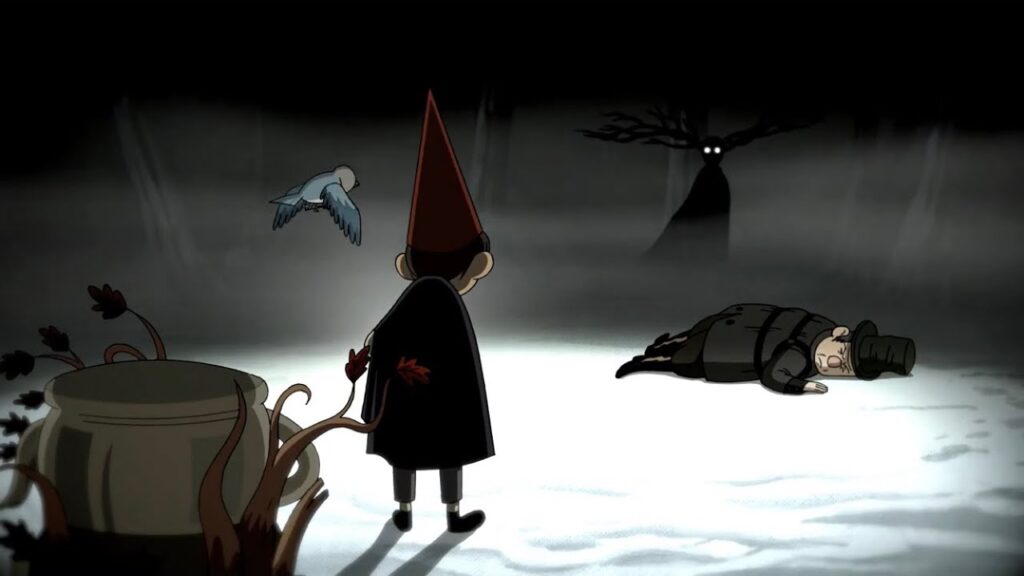
With the influence illustrated fairy tales have had on countless young minds, it is no wonder that so many artists eventually draw inspiration from these beloved tales. There are so many works of art that greatly benefit from their fairytale roots, however two in particular stand out. Over the Garden Wall, a short animated series created by Patrick McHale, and The Witcher, specifically the video game adaptations based on a series of novels by Andrzej Sapkowski. Over the Garden Wall features two brothers who are seemingly lost in the woods, trying to find their way home. The series originally aired throughout October up to Halloween, and for good reason because it is chock full of spooks and scares. In this lies both the show’s genius and its relation to fairy tales because, considering it is technically a kids show, it pulls no punches with its dark themes and violent insinuations. Examples of this are Adelade the witch who attempts to transform the brothers into her slaves by stuffing their heads with wool or The Beast, a very clear anthropomorphization of death, who feeds on despair of those lost in his woods. While one might think this would deter younger audiences, it is in fact quite the opposite. As has been proven by the Grimm’s fairy tales, children love scary stories. Children often connect with the vulnerability of the protagonists of these tales and are able to experience the harrowing encounters vicariously through the characters. Kids are attracted to this experience as it is a way for them to process fear in a safe setting. It is also this attraction which allowed the show to exist in the first place. Because while the show is quite dark for younger audiences, the precedent set by scary fairy tales and how successful they are with children allowed the show to push through the sterilization of Cartoon Network.

The Witcher series on the other hand is set in a fantasy world, one which is immensely inspired by fairy tales. The story follows Geralt, a monster hunter for hire who travels from place to place trying to earn a living. The monsters and creatures of this world mainly come from folklore and legend, like the Striga, a creature directly i​​nspired by a Roman Zmorski fairytale in which a cannibalistic, monstrous prince is born of an incestuous union between two siblings. The author even creates his own renditions of popular tales such as Beauty and the Beast and The Little Mermaid. These versions are more gritty and offer more mature and realistic morals and interactions. This realism is only amplified by the video game adaptation of the story, as the interactive elements allow the audience to be one step closer to experiencing the world’s first hand. Immersion is something that is often strived  for in fairytales, visible through the non specific characters and settings that allow readers to place themselves in the shoes of the characters. Video Games are the logical next step, you are in direct control of the adventure.

Over The Garden Wall and The Witcher both utilize animation for storytelling, an artform whose success can be directly traced to fairytales. Specifically, Disney’s first full length animated film, Snow White and the Seven Dwarves, which revolutionized the animation industry. The choice to depict a fairytale was effective for numerous reasons, the first and most important was the previously discussed universality of the tale. Especially during the thirties, every generation was familiar and fond of fairy tales. This made the film appeal to an audience of all ages. For children it would be a more engaging version of the tale they loved, for adults they could be transported back to their childhood years if even for a moment. This began the family movie tradition that is the backbone of animated films to this day. Prior to Snow White, Disney was producing mainly slap-stick style shorts geared towards a younger audience. While these shorts were impressive in regards to the animation, it was not enough to engage a large audience. They lacked the drama and serious tones that Snow White brought to the table. In a recounting of Snow White’s Hollywood premiere, provided by the article Wow, We’ve Got Something Here, the effect of such a tone shift becomes  evident:

As the film deepened to darker tones–the Queen transforming into a hag–the atmosphere changed, as though individual audience members were wired together, experiencing the film through a series of shared emotions (Pierce).

Giving the film a serious tone was key to engaging the audience. It created a story with stakes in which the audience could root for the characters. The emotional moments with Snow White were particularly moving thanks to the expressiveness the animation captured. Regular films at the time would have to be carried by the realism of their actors, animation however requires no such realism. The separation from reality ironically allows the audience to be fully absorbed in the moment as they are not thinking about the nuances of the performance. While the film benefited greatly from it’s serious tones, it is also important to mention how its light hearted nature also added to the film’s success. At the time of its release, the country was in the midst of the Great Depression. With the spirits of the masses at an all time low, the whimsical and comedic moments offered by Snow White were the perfect medicine. It not only served as a distraction from the harsh realities  families face, but the fairy tale promise of a happily ever after inspired hope. Something desperately needed by many at the time. All in all,  Disney undoubtedly revolutionized the animation industry with the success of its film Snow White and the Seven Dwarves. A success that was gained with the aid of the universality, drama, and hope provided by the fairy tale source.


Works Cited

Fleer, Marilyn, and Marie Hammer. “Emotions in Imaginative Situations: The Valued Place of Fairytales for Supporting Emotion Regulation.” Mind, Culture and Activity, vol. 20, no. 3, 2013, pp. 240–59, https://doi.org/10.1080/10749039.2013.781652.

Greenhoot AF, Beyer AM, Curtis J. More than pretty pictures? How illustrations affect parent-child story reading and children’s story recall. Front Psychol. 2014 Jul 22; https://www.ncbi.nlm.nih.gov/pmc/articles/PMC4106274/

Pierce, Todd James. “Wow, We’ve Got Something Here: Ward Kimball and the Making of ‘Snow White.’” New England Review (1990), vol. 37, no. 1, 2016, pp. 123–36, https://doi.org/10.1353/ner.2016.0022.

Categories
Fairy Tales

Storytelling Through Dance vs. Fairy Tales

Written By: Jimmy Long

Jimmy Long

Dr. Younger

FYS 1000

29 April 2024

Art is meant to be consumed, interpreted, and tell a story. Concert dance and fairy tales are no exception to that. Concert dance is a form of dance that uses ballet, modern, contemporary, and jazz styles in performative showcases, rather than the commercial style hip hop dancing seen on a worldwide tour with a super big pop star. While they have the similarity of storytelling, the way they do so is quite different. It makes sense that two different art forms tell stories in different ways, but what is very intriguing is the difference in the method of imagination and interpretation in both. Concert dance and fairy tales relay their messages very differently because in concert dance the story is visually displayed but the moral of the story is up for interpretation while fairy tales are usually written or spoken and make the moral of the story clear.

As fairy tales evolved, their primary audience became children which forced authors to make their main message comprehendible for younger consumers. Tales are used as a tool to teach children basic life lessons while also giving them room for imagination. Kids can create a world using fairy tales as a creative outlet, but when it comes to the lesson in the tale, it is never ambiguous. The term “pedagogical reduction” has been used to describe this simplification. The method of “pedagogical reduction requires the interpreter to consider which story to choose as well as how the story should be told, such that the hermeneutical conditions of understanding are kept in mind” (Lewin). Finding the etymology of the term can help understand the meaning of the word. The word pedagogy comes from the Greek word paidagōgia meaning “education, attendance of boys”. Reduction is known to mean making something smaller or simpler. As Lewin describes, pedagogical reduction is used so that children can be able to comprehend the messages behind them. In the article, it also dives into the creation of the concept of childhood. This is prevalent because when the idea of childhood became popularized, it was realized that children are very impressionable when they are younger. Adults took advantage of this, and made children’s literature that had centralized moral concepts that could be easily understood through pedagogical reduction so that they could help teach children what is “right” or “wrong”. Teachers and parents used (and currently still use) children’s literature, such as fairy tales, as a tool to help teach their children lessons that they believe to be critical in forming children’s moral compass. In certain fairy tales, the moral of the story is sometimes blatantly written out so that there is no confusion. In fairy tales that have been read in class, there was a section after the tale that details what the reader should be taking away from the story. For example, in Charles Perrault’s version of the story Little Red Riding Hood, he fully writes the moral saying “From this story one learns that children, especially young girls…are wrong to listen to just anyone, and it is not at all strange if a wolf ends up eating them…but watch out if you have not learned that tame wolves are the most dangerous of all” (Perrault 35-36). Rather than giving the child the room to figure it out themselves, Perrault felt the need to make the comprehensibility of the message so clear that he wrote it out so everyone who read the story would learn the same lesson. 

Even though dance paints a visual picture, the message behind concert dance pieces is always left up to the audience’s interpretation. When a choreographer starts creating and choreographing a piece, there is always an intention behind what the piece is truly about. However, the intention of the choreographer is never clearly stated or displayed during the dance. This allows the audience members to be able to take away the message that they want from the choreography they are watching on the stage. At Wesleyan University in Connecticut, the dance major program had a senior thesis project where the senior dance majors were tasked to choreograph dance pieces that had an intention or meaning behind them. The article goes on to detail the first piece of the entire showcase. This piece was an adaptation of the popular fairy tale Hansel and Gretel, and the piece was titled “Alternatively”. This dance used a spoken narration of the well-known Hansel and Gretel tale rather than using music which is typically used in concert dance. At the beginning of the dance, a trio does choreography to this narration. Then the performance resets, and the background transitions from a typical forest where the original tale takes place to a cityscape with the blaring sounds of traffic you would expect to hear in a cityscape. From there the dance is repeated by three new dancers with the same choreography. By the end of the piece, the narration was repeated 4 times as the city and forest backgrounds started to blend together. As this was occurring the narration was continuously getting more distorted as well. The choreographer of this dance, Steven Fields, discusses his experience choreographing this piece saying, “the choreography process has been more about exploring abstract ideas through movement, and I wanted to get back to that love of storytelling” (Fields). Having the process include the exploration of these abstract ideas showcases that, even if the piece did have an original meaning to the choreographer, the meaning of the piece is up to the audience’s interpretation of what they want to take away from the piece. Dance is not necessarily catered to children, which is why the ideas behind dance pieces are allowed to be a lot more abstract than the fairy tales we read in class. It takes a different kind of imagination for someone to be able to see abstract art like dance and be able to figure out what the message behind it is for themselves.

Dance tells stories while also being self-reflective. However, fairy tales are for an external audience that is not the author. In the Institute of Social and Cultural Anthropology at the University of Oxford, anthropologist Dr Karin Eli and dance company owner Rosie Kay worked together to implement dance into the healing process of eating disorders. For their research, they used girls from the ages of 19-31 who all had varying experiences and eating disorders. For eight weeks seven participants would gather in a dance studio without mirrors where they would have time to be creative through dance for two hours a week. After each session, they would have a sit-down discussion to reflect on the choreographic experience. Toward the end of the eight weeks of the creativity dance workshop, the participants were asked to choreograph a solo based on their experiences with their eating disorders. After the workshop was over they interviewed the participants. One participant Lauren talked about her experience saying, “I’ve done quite a lot of therapy, so I’ve done quite a lot of the talking thing… but I think I connected with stuff in a different way, I, I actually felt stuff in myself inside me, that you can think about, but it feels different when you go back to that place and you feel that stuff again” (Lauren). When a dancer does their choreography, like Lauren, it puts them into the story that they created. So, when a choreographer bases their piece on an experience or trauma they had/have, it causes the dancing and choreographing to become more self-reflective rather than performative. Rather than telling a story to an audience, Lauren was re-telling herself a story that she experienced. That makes dance so much more personal. Also, the fact that Lauren got to tell her own story through her own body, rather than her words made the message behind the choreography more personal because only the choreographer knows the true intent behind every single dance move as they put the moves together to create a story that can later be interpreted by others. Lauren made the dance for herself rather than for an audience to view. In my contemporary jazz dance class I took this past semester for my dance minor, we analyzed this video of Ulysses Dove’s choreography.

Dancing On the Front Porch of Heaven (Start at 1:03)

 I found this extremely interesting because, in the beginning of the video, Dove goes on to explain  what the dance means to him which then puts the piece into perspective when we watch it later in the video. Dove talks about loved ones passing and the toll that the grief took on him. Even though this piece was performed for an audience, it was still extremely personal because it allowed Dove to “come to some kind of terms with the issue of loving people and losing them” (Dove). He used choreographing this piece as a tool for self-reflection on coping with the grief of losing loved ones. Unlike concert dance, fairy tales are very different because they are not personal to the author/creator whatsoever. Fairy tales have been passed down and adapted for centuries. Our textbook even discusses how “no one person can claim to be an authoritative source for a fairy tale” (Tatar 8). She then goes on to quote the author of The Virago Book of Fairy Tales Angela Carter saying “Who first invented meatballs? In what country? Is there a definite recipe for potato soup? Think in terms of the domestic arts. This is how I make potato soup” (Carter). That quote exemplifies how a fairy tale cannot be claimed as their own because the author of these adaptations of ancient fairy tales did not create the characters or the story. These tales have been told by word of mouth for centuries. This makes fairy tales not personal at all. Also, these tales are always for an audience and never for oneself. As we talked about earlier, fairy tales have been marketed towards children to teach them lessons, meaning that these authors are not creating these stories for themselves. They are doing it to teach impressionable children life lessons that they think are important for them to learn before they get older and become adults.

Fairy tales and specifically concert dance are both art forms that use their art to portray stories completely differently. They differ in the way imagination is incorporated into the storytelling. Fairy tales allow the reader or listener to create a whole world in their head, but the moral of the story is always extremely clear in order to make sure that everyone can understand and learn the same life lesson. Concert dance paints the scene for the audience members with movement and choreography. However, dance is more abstract than fairy tales which causes the message behind the piece to become vague. This lets the people watching the dance interpret the message of the dance for themselves. Also, dance allows the choreographer to make the message more personal. The choreographer intentionally picks out each individual move and puts them together in order to tell a story that can be personal to them. Fairy tales have been passed down by word of mouth for centuries making it impossible to trace the origin of them. This makes the tales we are reading not personal at all. The author’s intent is not to tell their own story in these tales but to adapt an old tale in order to get a very clear and basic message across. Overall, fairy tales and dance are both different forms of art that tell stories, but they do so very differently.

Work Cited

Eli, Karin, and Rosie Kay. “Choreographing lived experience: dance, feelings and the storytelling body.” Medical Humanities, vol. 41, no. 1, 2015. BMJ Journals, https://mh.bmj.com/content/41/1/63.

Joy, Tara, and Arts. “From Folk Dance to Fairytales, Senior Dance Theses Tackle Intricacies of Storytelling.” University Wire, Apr 04, 2019. ProQuest, http://electra.lmu.edu:2048/login?url=https://www.proquest.com/wire-feeds/folk-dance-fairytales-senior-theses-tackle/docview/2202993142/se-2.

Lewin, David. “Between horror and boredom: fairy tales and moral education.” Ethics and Education, vol. 15, no. 2, 2020.

Tatar, Maria. The Classic Fairy Tales (Second Edition) (Norton Critical Editions) (pp. 9, 35-36). W. W. Norton & Company. Kindle Edition. Ullysee dove dancing on the front porch of heaven. YouTube. (2023, August 12). https://youtu.be/JwXMUtaUyJU?si=7TNiTyR1CtbBQkxm

Categories
Fairy Tales

Exploring the Interplay of Myth and Modern Medicine: Ethical Insights from “The Frog Prince”

By Khalid Alani 29 April 2024

Fairy Tales have always represented the fabric of a culture that entwines the mysteries of human experience. These tales are considered different from the scientific world. However, if one critically analyzes, fairy tales operate similarly to how scientific inquiry proceeds, especially at its frontier, revealing our deepest concerns and the most revolutionary discoveries. The Brothers Grimm’s “The Frog Prince” is a story that has its historical roots in Germany during the 19th century. The story itself highlights global themes of metamorphosis and ethical duty. “The Frog Prince,” a fable that describes transformation, is analogous to modern medical technology like CRISPR-Cas9 and stem cell therapy. Its longevity and deep moral content assure a suitable backdrop for the ethical examination of modern genetic and regenerative medicine breakthroughs. Analysis not only deepens the comprehension of medical advancements but also brings back the life of the legendary stories that create the feeling of magic for humans. The Frog Prince symbolizes the transformative nature of medical advances, providing the socio-ethical dimensions of emerging medical technologies like CRISPR-Cas9 and stem cells.

“The Frog Prince”: An Exploration of Transformation and Revelation

“The Frog Prince” is a classic fairy tale about a curious girl who discovers a frog in the water and then promises to be his friend. Through the princess’ curiosity, the frog experiences a transformation and reveals his identity as a prince. The story starts with a young princess who is sad about losing her beautiful golden ball in deep water and meets a frog. Frog offers to get back, saying: “I can help you, but what will you give me if I bring back your plaything?” and sets the conditions for the friendship to be maintained” (McKay et al., 2010, l. 5). She does not think it through and responds to her emotions. However, as soon as the ball returns, she immediately breaks her word and does not want to stick with the frog. The story reaches its peak when the frog, who cannot shake his faith off, goes to the palace following the princess. When he hears the frog’s promise from the princess, the king, her dad, asks her daughter to be faithful to her words. Reluctantly, the princess allows the frog to sit in the room and the princess gives him food. As stated in the tale, she became bitterly angry and threw him against the wall with all her might. “Now you will have your peace, you disgusting frog!” However, when he fell, he was not a frog but a prince with beautiful, friendly eyes (McKay et al., 2010, l. 13). The story ends with the prince and the princess getting married. Their marriage not only marks a physical transformation of the prince and princess to be each other’s soulmates, but it also epitomizes a transition from the former mood of indifference and loathing to the latter of acceptance and love.

Key Themes and Motifs and Metaphorical Implications

The main happenings in “The Frog Prince” are the transformation and the promise’s power. Metamorphosis not only results in a physical change, as seen in the frog’s transformation into a prince, but it also bears the character and the emotional charge of the princess. As the story’s events unfold, the princess starts to understand all three things – efforts, promise-keeping, and understanding. The princess’ fulfillment of promises is vital, as they set up the character to pass the moral tests. The narrative illustrates that pledges become covenants to be respected for their weight and consequences. The medical world, especially transformative genetics, and regenerative medicine technologies has found profound connections with “The Frog Prince,” which are very rational. In a similar way as the frog is transformed into a prince, medical discoveries these days often disclose new opportunities and perspectives that were previously unimaginable. In addition, the theme of future commitment manifests the ethical responsibilities of medical professionals and scientists. In medicine, implicit or explicit promises entail sustaining patients’ trust, preserving medical confidentiality, and devoted to patients’ well-being. Such partnership vows form the foundations of practice and research, instructing decisions and duties.

Introduction to Genetic Engineering

Genetic engineering is now an indispensable part of modern medicine, with an astounding amount of power and precision it brings to the genetic structure of biological organisms. Human genome editing is a discipline involving several approaches, of which CRISPR-Cas9 is typically the most popular for its ability to cut and paste into a DNA sequence precisely (Akram et al., 2023). As per research, “CRISPR/ Cas9 is most preferred because it is easy to use, has a low mutation rate, has great effectiveness, low cost of development, and decreased rate of advancement,” Leading to results that confirm that it is effective for treating monogenic diseases, e.g., cystic fibrosis, and complex diseases like cancer (Akram et al., 2023, l. 6). The third intriguing aspect of genetic engineering is the synthesis of biology, a technique that organisms reject for valuable purposes by engineering organisms to have a new ability, such as the production of pharmaceuticals.

Other Medical Technologies

Scientists use stem cells to replace or repair damaged tissue and organs. Technology plays a crucial role in regenerative medicine, which aims to restore function and repair damaged organs and body tissues, with applications ranging from spinal cord injury repair to heart tissue regeneration (Fuchs & Blau, 2020). Moreover, the opposite of this is individualized medicine, which is the most used form of treatment for each patient based on their characteristics. However, this solution examines the complex interplay of genetic composition and environmental and lifestyle factors. Personalized medicine radically changes how healthcare providers provide treatments for oncology, pharmacology, and chronic diseases by using effective targeted therapies with fewer side effects.

Journey of Discovery

Unlike the fairytale Frog Prince’s unexpected transformation, each technology has grown from an innovative idea and is now an essential field of medicine. Similarly, the fairy tale reveals the human potential to understand the hidden truths of life, bringing hope and capabilities that no one had before. The same can be said about scientific inquiry that now changes the ordinary course of our lives (Gottschall, 2021). Such as genetic engineering for example, in the 1970s, recombinant DNA technology, the first technique that enabled researchers to insert DNA from one organism into the genomes of others, was born. The research into stem cells was no less groundbreaking; a decade later, scientists isolated the first human embryonic stem cell, paving the way for the therapies today. Personalized medicine has come of age since the completion of the Human Genome Project in the early 2000s, which provided the platform for understanding the genetic bases for diseases.

Comparative Analysis: Parallel Themes of Transformation

“The Frog Prince” masterfully narrates the profound transformation of a frog into a prince, encapsulating themes of redemption, identity discernment, and the restoration of natural balance, far beyond mere physical change.The dramatic transition is more than just a change of the outer surface but also conveys the more profound concepts of redemption, the discernment of fundamental identity, and the restoration of the natural balance. In the same way, medical technologies shape the basis of medical practices and patient outcomes through their influence on both components. In that regard, genetic engineering can alter basic biological concepts and turn them into practical applications that can be used to write the genetic code of organisms, eliminate genetic diseases, and improve human health. Similarly, stem cell therapy embodies the body’s power by using its cells to regenerate damaged tissues, thus opening new frontiers for once untreatable diseases (Anselmino & De Ferrari, 2020). Personalized medicine revolutionizes the mode of treatment by changing it from a one-size-fits-all method to a pharmacological approach closely tailored to each patient’s genetic makeup, thus resulting in significantly enhanced success rates. These technical transitions are just as transforming as the frog’s fast metamorphosis into a prince. They show the world in a new light and open up new opportunities. They are as disruptive to the medical field as the frog is to the princess’s set beliefs and conventions, no less than causing her to reconsider her perceptions and attitudes (Casula, 2022). The quote from Casula (2022) about the impact of “The Frog Prince” on the princess’s perceptions mirrors how medical technologies challenge and reshape existing paradigms within the field of medicine, like how the frog’s transformation compels the princess to revise her preconceived notions. Emerging technologies like CRISPR-Cas9 and stem cell therapy disrupt traditional medical approaches by introducing revolutionary treatments, akin to how the unexpected prince challenges the princess’s views and expectations. These medical advancements force a reevaluation of ethical, procedural, and philosophical aspects of healthcare, much like the princess’s altered understanding of love and duty. This juxtaposition highlights how both narratives and scientific innovations provoke reconsideration and transformation of foundational beliefs, illustrating the profound, disruptive impact of new possibilities in both fairy tales and modern medicine. In her research, Casula stated,“Metaphors and narratives are intended to address a creative unconscious that can autonomously make connections that promote a process of evolutionary change without having to sift through the logic and rationality of the conscious mind,” asserting that a person undergoes a profound transformation that affects them personally and the world beyond (Casula, 2022, l. 9). The unity of the theme sends the message of a collective journey of development and Enlightenment. In “The Frog Prince” and modern medical progress, the central metamorphoses could be used to discuss the persona, capacity, and ethical side of using power.

Ethical Considerations: Medical Advancements and Fairy Tale Morals

Just as the princess learns to honor her promise, medical staff, and researchers should abide by the ethical imperative to ensure that new technologies are used reasonably (beneficence) and not for bad (non-maleficence). The transformational power of medical technology also opens incredible opportunities, for example, to cure genetic afflictions or customize therapies to increase precision and minimize side effects (Gostimskaya, 2022). Nevertheless, these developments can also evoke concerns regarding unintentional genetic mutations, privacy violations, or healthcare equality. Along with the fairy tale’s moral that all characters should be treated equally irrespective of their appearance, the ethical obligation to ensure the fair distribution of these medical services is a reminder of this theme. As the medical field develops and capacities improve, society is confronted with the issue of fair distribution of these benefits, making it possible for all people with different social backgrounds and places of residence to receive the same opportunities for lifesaving treatments. The mirror of fairy tale morals back into medical ethics shows that putting equal weight on innovation with a meticulous analysis of its broader impacts on humanity is still essential.

Critical approach to: “The Frog Prince” and Medical Technologies The Role of Serendipity in Breakthroughs

The element of uncertainty, i.e., an indulgent stroke of luck in fiction, is relatable in both the fairy tale and science. In the story “The Frog Prince,” the princess’s impatient action in throwing the frog against the wall is most likely from her frustration rather than foresight, which is why she conquers the enchantment. “In her vexation she seized the frog with two fingers, threw it with all her might against the wall, and said, ‘Now will you be quiet, you horrid frog!’ But as he fell, he was no longer a frog but a prince with beautiful kind eyes” (Grimm & Grimm, 1812). The unexpected despair results in the frog’s fortunate transformation into a prince, as fate has it, something that was unplanned yet came in handy. Alongside this are the diaries of medical history to prove that such acts of serendipity have influenced the fortunes of medical research. As stated by Voung in his study: “For the lucky break of a Penicillium mold that befell Alexander Fleming when he noticed a mold growing in one of his Petri dishes, and with it,” the notion of antibiotics is symbolic of such happenstance where an unintentional spore and a missed Petri dish converged into a medical revolution (Vuong, 2022, l. 49). Chance plays a vital role in these discoveries, be they in the world of fairy tales or laboratories, and thus inspires reflection on the potential consequences of unexpected events. It conveys the idea of an additional dimension of discovery, which is beyond the scope of a calculated hypothesis and systematic research. Acknowledging the serendipity role in this process, it becomes clear why the journey of discovery is always exciting, whether in the story of a prince’s metamorphosis or in the process of inventing new medications..

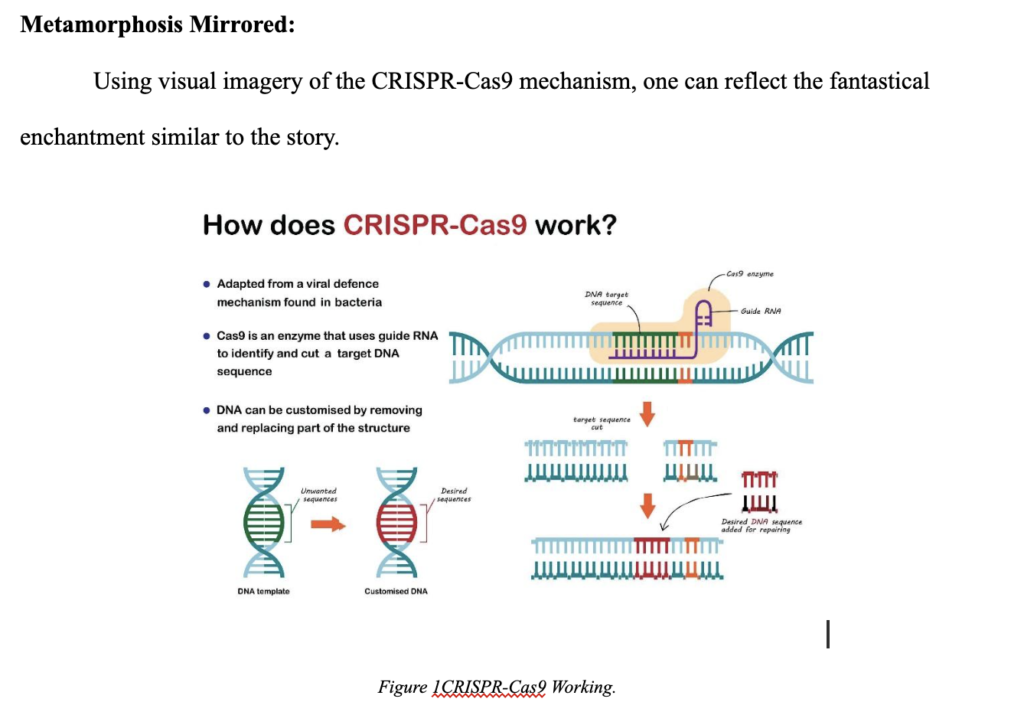
‘The Frog Prince’ wherein a chance kiss will shatter the curse to uncover the prince’s proper form. Besides, CRISPR-Cas9 is the top scientific discovery that can be compared to the ability of wizards in movies to rewrite the genetic code of humans in the biological bible with accuracy. (FHR, 2024). The painting, therefore, is an allegory that is not merely a representation of a scientific process; it is a modern-day incantation that promises to give human health power that used to dwell in the lands of mythology and fairy tales. Where a princess’s kiss brings a new life, CRISPR’s molecular ‘kiss’ gives hope to those cures once thought impossible, linking the mythical with the medical and presenting a powerful literary narrative of healing that spans from the old stories with princesses to modern medicine that enhances our lives.

The Evolution of Healing Narratives

In ” The Frog Prince, “the curse of the prince and his recovery by an event that at first glance seemed unrelated – the magical recovery reflects the narrative of the unforeseeable recovery that matches the spirit of the healing processes of folklore that involves accidental recovery and serendipity. The fairy tale, in essence, conveys this transformation that is more spiritual than physical, re-establishing the individual’s identity and a role in the royal hierarchy, akin to moral health and wholeness. The motif reflects the journey of medical narratives from the old way of healing, where herbs, chants, and rituals were used to bring back balance and health, to the more modern form of regenerative medicine, which involves the latest technologies such as stem cell therapies and organ regeneration. These modern techniques and healing methods have their origins in the age-old narrative. As Alicia, in her study, writes: “Fairy tales and medicine both deal with the things that go bump in the night,” as you go to a hospital, you enter the realm of the sick — the ill, and it is a transition from the outside world (Rohan, 2020, l. 17). She further states, “Medicine is about reaching deeper and having compassion for everyone around you even if they do not look or sound like you,” and fairy tales also deal with the human spirit and condition (Rohan, 2020, l. 18). They accomplish this cellular restoration and genetic repair, which would seem like a magical practice to the practitioners of ancient medicine. It illustrates how healing narratives have evolved yet remain fundamentally aimed at the same goal: the regeneration of the individual to a state in which they are complete and healed.

The interdisciplinary analyses, cloaked in the fantastical and grounded in scientific reality, share a common theme: the idea of the rebirth into a new life, highlighting the imminence of radical change. Another significance of the link between literary motifs and medical advancement is that it makes it possible to present and give a human dimension to the narrative of medical progress. Literature serves as an accessible platform for debate on dilemmas and consequences that are closely related to medical technologies and their progress. Therefore, this Fairytale and Science fusion enriches the dialogue about technological developments by bringing in a personal and moral aspect, which creates depth to the conversations. Every lesson from fairy tales teaches that human stories are what make scientific endeavors so exciting.

Work Cited

Akram, F., Sahreen, S., Aamir, F., Haq, I. U., Malik, K., Imtiaz, M., Naseem, W., Nasir, N., & Waheed, H. M. (2023). An insight into modern targeted genome-editing technologies
with a special focus on CRISPR/Cas9 and its applications. Molecular Biotechnology,
65(2), 227–242.

Anselmino, M., & De Ferrari, G. M. (2020). Future perspectives and new “Frontiers” in cardiac
rhythmology. Frontiers in Cardiovascular Medicine, 7, 126.

Casula, C. C. (2022). Stimulating unconscious processes with metaphors and narrative. American
Journal of Clinical Hypnosis, 64(4), 339–354.

FHR. (2024). Spotlight on CRISPR-Cas9.
https://wp.lancs.ac.uk/futureofhumanreproduction/spotlight-crispr/

Fuchs, E., & Blau, H. M. (2020). Tissue stem cells: Architects of their niches. Cell Stem Cell,
27(4), 532–556.

Gostimskaya, I. (2022). CRISPR–cas9: A history of its discovery and ethical considerations of its use in genome editing. Biochemistry (Moscow), 87(8), 777–788.

Gottschall, J. (2021). The story paradox: How our love of storytelling builds societies and tears them down. Hachette UK.

McKay, S., Grimm, W., & Grimm, J. (2010). The frog prince. Treasure Bay.
https://search.worldcat.org/title/1043533259

Rohan, A. (2020). Happily ever after: The lessons of medicine and fairy tales. UAB News.
https://www.uab.edu/news/campus/item/2164-happily-ever-after-the-lessons-of-medicine-and-fairy-tales

Vuong, Q.-H. (2022). A new theory of serendipity: Nature, emergence and mechanism. Walter De Gruyter GmbH.

Categories
Fairy Tales

Fairy Tales’ Psychological Effects on Readers

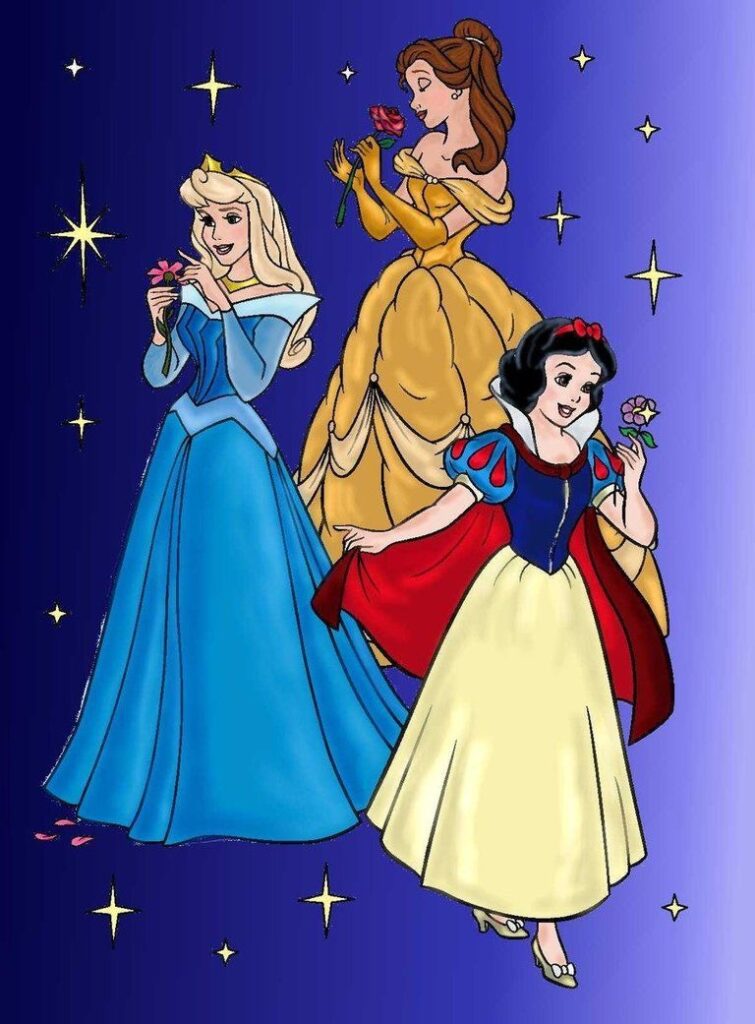
Grob, Virginie. Aurora, Belle, and SnowWhite. 2011, Deviant Art.

By: Katelin Dunagan

Fairy tales are so popular because of their similar themes, tropes, and character types. Readers feel comforted knowing who the real heroes and villains are, unlike in the real world. They root for princes to save their passive, delicate maidens and despise evil queens for being wicked. However, these classic fairy tale archetypes can affect more than just a person’s grasp of a story being told. Fairy tales have distinct psychological effects on those who read them; they affect people’s personalities and interactions with others, expectations and expressions of behavior, and even views on social status and class.

Fairy tales affect readers through each story’s characters. These characters maintain roles that are easy to understand. Each character serves a specific purpose to either aid or obstruct the heroine in the story. Russian fairy tale expert, Vladimir Propp, classifies these character types as dramatis personae. The dramatis personae types include the following: a villain, donor or provider, helper, princess (sought-after person), and her father, dispatcher, hero, and false hero. Using the Grimm’s “Cinderella” to demonstrate this model, characters can be organized into their dramatis personae with the main villain being the stepmother, the princess being Cinderella, the donor or provider being Cinderella’s father, the helpers being the birds, the hero being the prince, the dispatcher being the king’s announcement, and the false heroes being the stepsisters (Tatar 160-166). Essentially, every fairy tale contains character types that fit into the dramatis personae framework, and “Cinderella” is just one example of this.

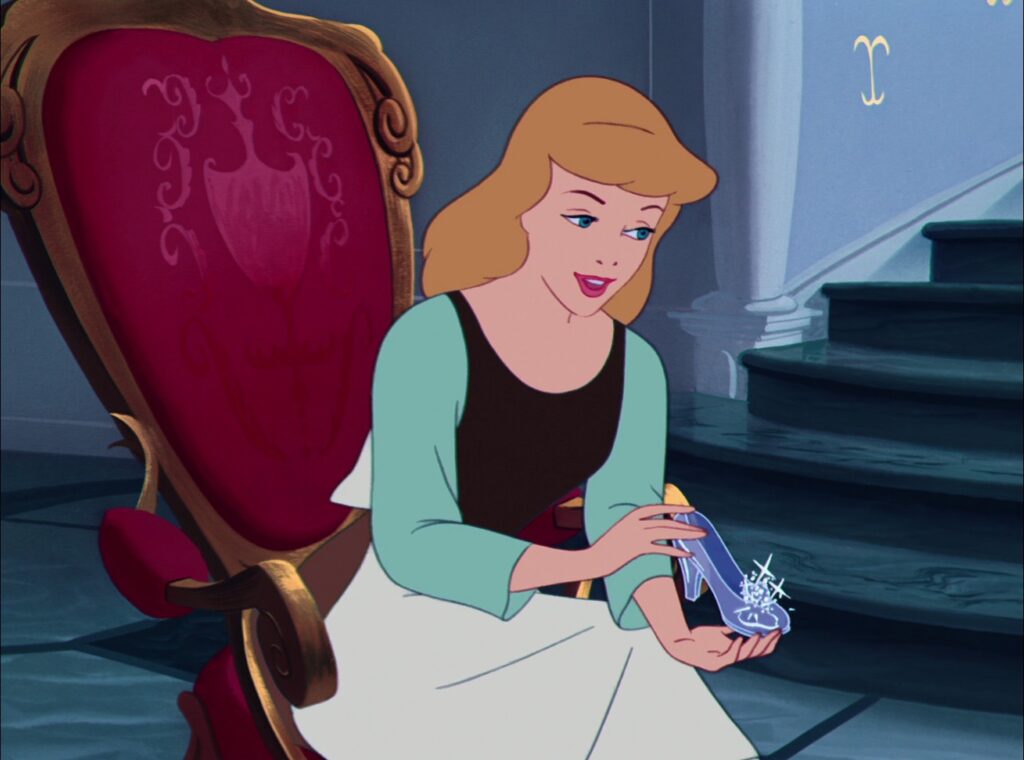
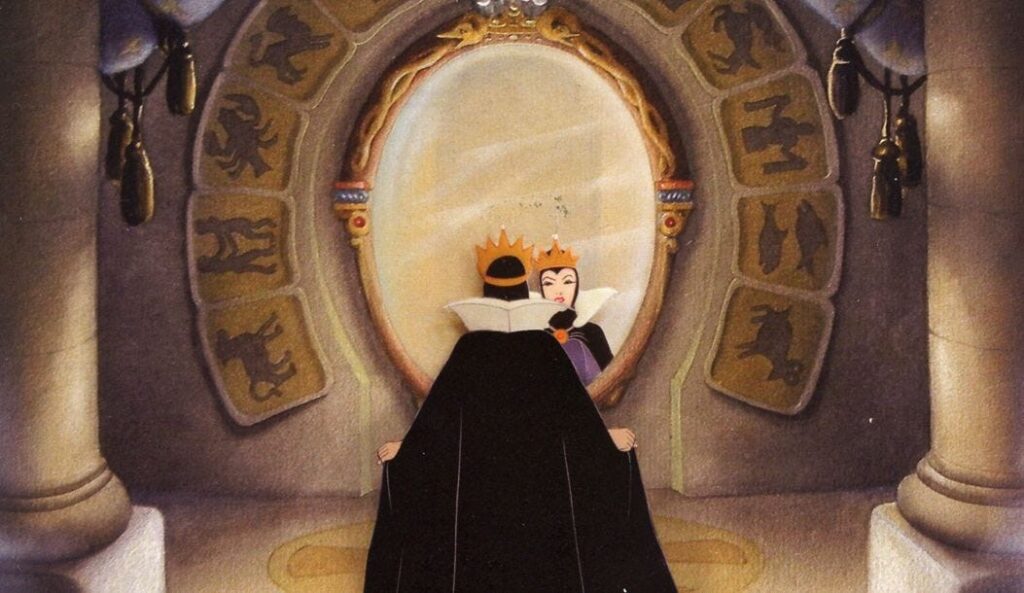
Cinderella. Directed by Clyde Geronimi, Wilfred Jackson, and Hamilton Luske, RKO Pictures and Walt Disney Productions, 1950.

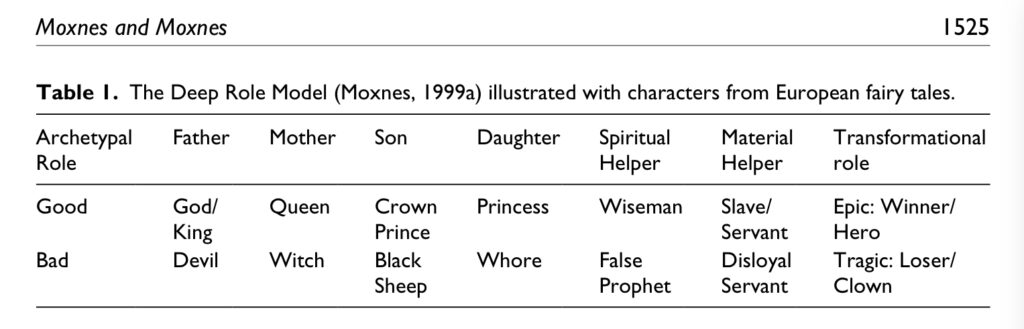
Propp’s dramatis personae structure is also a just singular representation of the many classifications of fairy tale characters into types. Based upon these different structures of classification, psychologists have been interested in the connections between character roles and human behavior. Psychologist Carl Jung contributed to these ideas, “proposing that it was primarily unconscious fantasies and symbols that steered human actions,” (Moxnes & Moxnes 1522). Inspired by Jung’s archetypal views, Paul and Andreas Moxnes created a study that examined the connection between fairy tale roles and group work. 

Their study involved developing fourteen roles representing, “14 fairy tale characters” (Moxnes & Moxnes 1526). These roles are based upon seven archetypal roles, with a good and bad version of each role. The good and bad versions or “deep roles” are “a subset of seven instinctual archetypal roles split into antithetical components portrayed as four primary family roles plus three supplementary roles, each split into a good and bad part” (Moxnes & Moxnes 1525). For example, under the archetypal role of “Mother,” they created the deep roles of “Queen” and “Witch” (Moxnes & Moxnes 1525). The “Queen” corresponds to the good part of “Mother” and contrasts perfectly with the bad part, the “Witch.” 

Moxnes, Paul & Moxnes, Andreas. “Are We Sucked into Fairy Tale Roles? Role Archetypes in   Imagination and Organization.”Organization Studies, vol. 37, num. 10, 2016, pp. 1519-153.

After developing the fourteen roles, Moxnes & Moxnes had each participant assign everyone in their group to one of the roles. They determined how similar each person’s assignments were to the rest of the group. They found that their “quantitative observations strongly suggest that group members attribute fairy tale roles to fellow group members in a non-random fashion far more often than would be expected by chance alone” (Moxnes & Moxnes 1535). The study surpassed the threshold of chance and found that many participants identified a group member as the same character type chosen by other members of their group. While this is not confirmation that every person in a group identifies others as fairy tale characters, it supports the idea that people are affected by fairy tale character types, even if it is on a subconscious level.

This is important information for those involved in fields where teamwork is key. Character types can parallel stereotypes that brand people as one thing or idea. It can be difficult to share or contribute high-quality work if someone is branded as the “Witch” on their team. That person becomes controlled through “projective identification” (Moxnes & Moxnes 1534). This is a psychological concept where the stereotyped person, “becomes a character in the group that is created by the group and controlled by the group” (Moxnes & Moxnes 1534). They can subconsciously mirror the behaviors that their peers project onto them and act as the group sees them. Understanding how fairy tale roles impact a group can help keep harmful stereotypes from causing negative consequences such as projective identification. 

It has been determined that there is support for fairy tale characters influencing people’s views of one another but how does this apply to people’s views of themselves? For young women specifically, fairy tales often set unrealistic expectations of purity and selflessness. In both “Cinderella” and “Snow White,” the heroine, “endures her plight virtuously, seemingly without hostility or even complaint. Her salvation and happiness rest on winning the love of a prince, who has the power to rescue her” (Bassen 238). This communicates the idea that women shouldn’t have autonomy or express their negative emotions towards others. 

This is problematic for young women facing coming-of-age conflicts comparable to those portrayed in these tales. These stories perpetuate unhealthy standards of emotional expression for a group that already, “consciously or unconsciously equate asserting themselves with being selfish and unlikeable” (Bassen 248). Women shouldn’t be afraid to be advocates for themselves or to strive for success. Unfortunately, this issue stems from conflict in relationships between mothers and daughters as well as patriarchal influences. Bassen describes this saying, “Unconsciously, many women believe that the only way they can retain their mother’s approval and love is to remain dependent, a carbon copy or a narcissistic extension who denies any wish to separate, compete, or surpass” (249). In essence, to keep their mother’s approval, daughters believe they must not be more successful, desirable, or free-thinking. 

Through recognition of the mother-daughter opposition, one can prevent harmful habits from seeping into other relationships as well. An imbalanced mother-daughter relationship can affect that daughter’s eventual interaction with a partner. Bassen notices this behavior in some of her psychological patients as they became afraid of their partner’s anger, stemming from their relationship with their mother (249). Fairy tale readers must understand that “Snow White” and “Cinderella” handle coming-of-age and mother-daughter conflict poorly. They dismiss natural emotional responses to situations and reinforce outdated concepts of how women should behave. However, they do demonstrate that mother-daughter conflict has occurred for centuries and that it is an issue most women will face at some point in their lives. With the appropriate lens, one that highlights the shortcomings of these tales, there is a lot to be gained from reading these stories. As long as one is not negatively influenced in their perception of themselves.

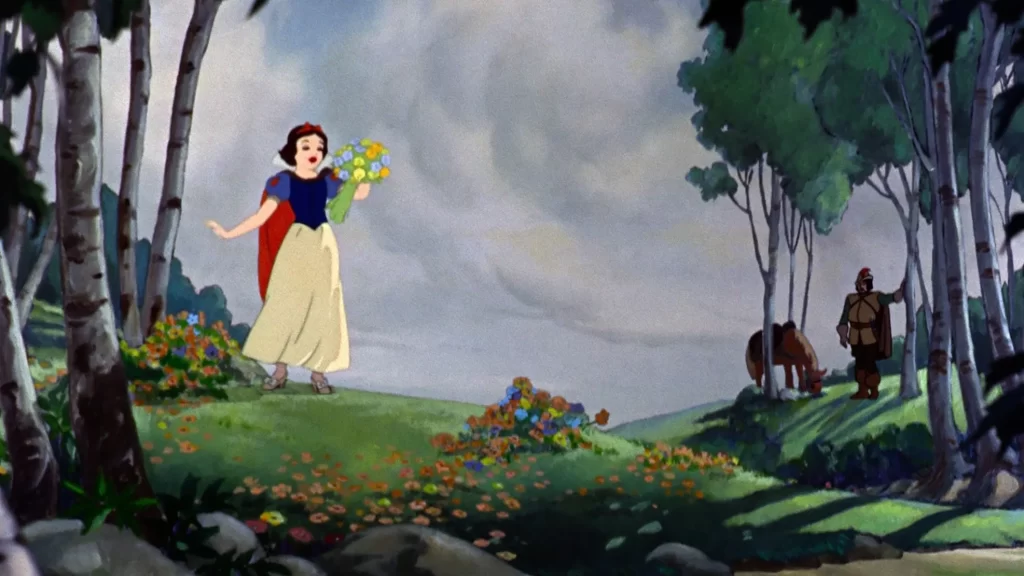
Snow White and the Seven Dwarfs. Directed by David Hand, Perce Pearce, Larry Morey, Wilfred Jackson, William Cottrell, and Ben Sharpsteen, RKO Pictures and Walt Disney Productions, 1937.

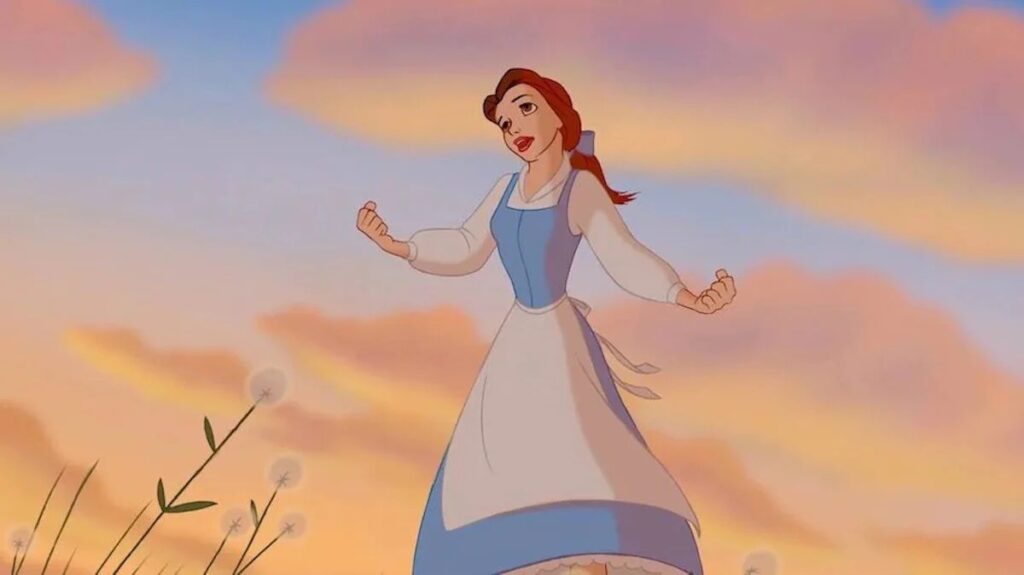
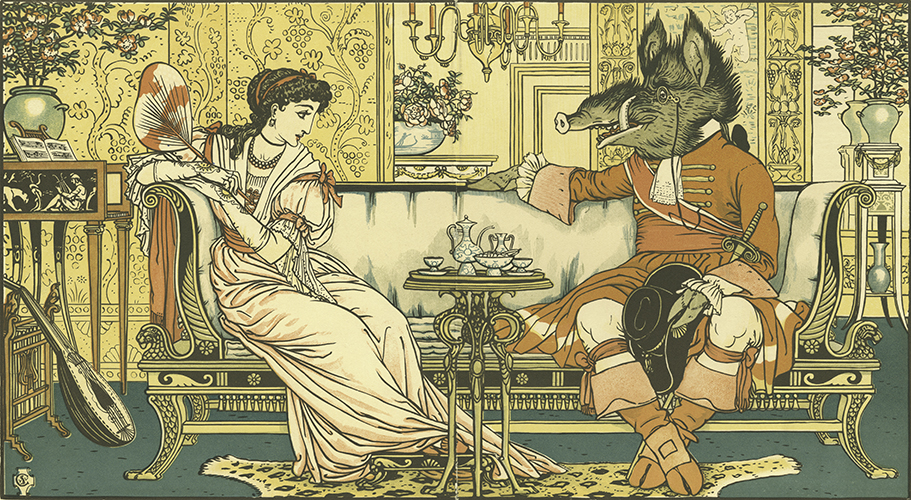
The last way fairy tales psychologically influence readers is through ideologies and social structures. In “Beauty and the Beast” by Jeanne-Marie Le Prince de Beaumont, there are very distinct social classes present that play a major part in the tale’s wish fulfillment. Beauty’s family, “are an upwardly mobile merchant family,” that has fallen upon hard times and is forced to farm and lower their status (Rucki & Ortiz 43). Eventually, Beauty meets the Beast, and throughout the story, they form a partnership that leads to marriage. Notice, that Beauty’s family do not start as peasants or farmers originally, which makes Beauty’s eventual rise in class more acceptable. She was once close to the class she would rise into, so it is more acceptable for her to marry into nobility with the Beast. 

Beaumont is using his 18th century, aristocratic perspective, to structure his tale according to the class system he wants to uphold. He does this by incentivizing the virtues he deems appropriate. For example, Beauty, when compared to her sisters, is, “…neither prideful nor social. She is kind, loyal, self-sacrificing…” (Rucki & Ortiz 42). She contains the virtues Beaumont believes women of status should have and therefore she is rewarded with a rise in nobility. He is influencing his readers to accept and understand this structure as the social rule. 

Beauty and the Beast. Directed by Gary Trousdale and Kirk Wise, Walt Disney Studios Motion Pictures, 1991.

This tale is a very effective piece of persuasive propaganda because it will be read by the exact demographic Beaumont intends to reach. The upper aristocratic women he believes should embody more virtuous, selfless behaviors. It can also be dangerous; it is an example of conditioning readers to do as the author wishes. They may not realize this is what is occurring because it is in the form of a fairy tale. This kind of conditioning influences readers and familiarizes them with a “correct” social structure, in this example, it is the structure Beaumont supports. 

It is evident that fairy tales have profound psychological effects on readers. Through their archetypal characters, fairy tales shape perceptions of self and others and reinforce outdated behavioral expectations. They influence readers concepts of social structure by leveraging happiness and wish fulfillment. Only through critical examination of these tales, can valuable insights be pulled from the stories without negative consequences. While fairy tales continue to enchant and captivate audiences, it is essential to approach them with a discerning eye, mindful of their ability to shape beliefs and attitudes in both subtle and significant ways.

Works Cited

Bassen, Cecile R. “Happily Ever After: Depictions of Coming of Age in Fairy Tales.” Psychoanalysis and Women Series, edited by Tognoli Pasquali, Laura & Thomson-Salo, Frances, Karnac Books, 2014, pp. 237-254.

Beauty and the Beast. Directed by Gary Trousdale and Kirk Wise, Walt Disney Studios Motion Pictures, 1991.

Cinderella. Directed by Clyde Geronimi, Wilfred Jackson, and Hamilton Luske, RKO Pictures and Walt Disney Productions, 1950.

Grob, Virginie. Aurora, Belle, and SnowWhite. 2011, Deviant Art.

Moxnes, Paul & Moxnes, Andreas. “Are We Sucked into Fairy Tale Roles? Role Archetypes in   Imagination and Organization.”Organization Studies, vol. 37, num. 10, 2016, pp. 1519-153.

Rucki, Shelia M. & Ortiz, Lisa. “Hegemonic Systems and the Politics of Happiness: The Fairy Tale as Ideology.” Perspectives on Happiness: Concepts, Conditions, and Consequences, vol. 121, 2019, pp. 1570-7113. 

Snow White and the Seven Dwarfs. Directed by David Hand, Perce Pearce, Larry Morey, Wilfred Jackson, William Cottrell, and Ben Sharpsteen, RKO Pictures and Walt Disney Productions, 1937.

Tartar, Maria. The Classic Fairy Tales (Second Edition) (Norton Critical Editions). W. W. Norton & Company, 2017.

Categories
Fairy Tales

Killing the Evil Witch

Written by Kendell Weis

The words “folklore” or “fairy tale” often remind individuals of a seemingly harmless form of media including enchanted forests, talking animals, and fairy godmothers. Although these types of media are seen as an enchanting form of entertainment on the surface, they wield significant influences beyond their common tropes and schemes, contributing to the negative impact beauty standards have on young women. Fairy tale plots are often driven by a young female protagonist with a slim figure, pale skin, and attractive features that ends up marrying an attractive, young prince. The lack of diverse skin tones, body types, and overall appearance will inevitably alter the mind of young children who choose to indulge in fairy tales. The beauty standards emphasized in these tales have the ability to lead young women to an unhealthy place with food and body image as they grow up and mature. Many tales focus on body image and aesthetic appearances throughout the story, but some fairy tales contain underlying messages that depict the harmful impacts beauty standards may have on young women. Instead of depicting, for example, a young beautiful princess in a castle, some fairy tales, like “Little Red Riding Hood” or “The Three Little Pigs” center around vulnerable young children that are manipulated and taken advantage of. These stories indirectly expose the depth and complex impacts beauty standards have on young children and specifically young women. Through the experiences and feelings of the young and vulnerable protagonists, one can identify the strong connection these stories have towards the feelings of an eating disorder. In the fairy tale, “Hansel and Gretel” by Brothers Grimm, the complexities and harsh realities of an eating disorder are displayed through symbolism in moments of psychological and emotional turmoil, environmental influences leading to an unhealthy connection with food, and the manipulative relationship between the evil witch and the protagonist, Gretel. 

The feelings of deprivation and intense fear that stem from psychological and emotional turmoil Gretel faces in the beginning of the tale directly relate to the feelings of an eating disorder. Gretel and her family’s relationship with food security is completely unstable, “There was never much to eat in the house, and once, during a time of famine, the woodcutter could no longer put bread on the table”(Grimm 236). The lack of certainty Gretel feels towards her food intake places her body in a “fight or flight” mode. Individuals who struggle with eating disorders often experience this same dilemma when they are faced with extreme deprivation. Their obsessions regarding what they eat and how much they eat dominate and narrow their thoughts to one controllable area: food (Hill 584). Whether a person is deprived of food, people, love etc., they can often turn to the comfort of food as their cure. Restriction can often lead to experiences of emotional and psychological turmoil which can manifest in a binge-restrictive cycle, mood swings, depression etc. Individuals who struggle with restriction run the risk of losing their sense of self and independence as they give up all power to their eating disorder. 

Gretel is not just deprived of food, she also faces emotional neglect that contributes to her psychological turmoil. When Gretel overhears her mother speak about how she cannot take care of the children anymore, she faces a lack of familial love. Gretel hears her mother say, “The children have to go. This time we’ll take them deeper into the forest so they won’t be able to find their way back home”(Grimm 238). The mother, wanting to abandon her children without thinking how it may impact those around her, is forcing her daughter to believe that she is not ‘wanted’. Similarly, a victim of an eating disorder chooses to leave their old bodies behind to create a new and improved version of themselves. In their efforts to create a more ‘wanted’ version of themselves, they obsessively control their food, exercise, and other aspects of their life that they are able to control, which leads to an unhealthy and unsustainable lifestyle. The strong tendencies for an external locus of control are related to the fact that the person with eating disorders has little to no sense of self (Hill 584). The constant chase for a ‘better’ version of oneself, stemming from insecurities, can result in the individual losing sight of who they truly are. Gretel and a disordered individual share similar circumstances such as deprivation from food and a weak sense of self, leading to psychological and emotional turmoil they have to carry with them.  

The eerie, ominous, and unsafe environment Gretel is subjected to in the story influences her unhealthy relationship with food. Gretel and her brother are left out in the cold dark woods without parental figures which only enhances the neglect she once felt in her own household. These rough and bleak environmental conditions puts Gretel into a position of starvation which will inevitably cause her to feel worn out and weary. The lack of food and energy in the woods is taken to the extreme as she and her brother are using all of their efforts to keep themselves alive. “After a while they were so tired that their legs could no longer carry them, and they lay down under a tree and fell asleep” (Grimm 239). This extreme exhaustion that Gretel and her brother are facing is the reality of many individuals with malnutrition. Exhaustion can show up in various ways in those struggling with food restriction, but a very common type of exhaustion is recovery fatigue. Similar to how Gretel has to continue walking in the woods to find her way home, individuals with an eating disorder have to continue fighting their self-deprecating inner voices to make sure they consume an adequate amount of nutrition. Jenni Schaefer, the author of an eating disorder recovery novel, Life Without Ed, says, “Food is something I am going to have to face at least three times a day for the rest of my life. And I am not perfect. But one really bad day does not mean that I am hopeless and back at square one with my eating” (Schaefer 28). Scheafer perfectly illustrates how recovery or, in Gretel’s situation, a search for a home can be extremely exhausting, but any progress in great progress.  

As the siblings’ fatigue and malnutrition becomes overwhelming, Gretel and her brother could not help but eat a house they came upon made of bread, cake, and sugar. After being left in the woods to starve, finding a house made of sweets may have made her feel as if everything was going to be alright- that if they had food, she and her brother would be ok (Madison). Without a second thought, their deprived bodies begin eating the house, unaware of who may be inside. Gretel’s brother exclaims, “…Gretel, and you can try the window. That’s sure to taste sweet” (Grimm 239). Once Gretel and her brother are faced with food, the deprivation subsides as they are overcome with the sweet pleasures of the edible house. Nutrient deprivation and the act of overindulging in food has similar impacts on disordered individuals in the form of a binge-restrict cycle. Dieters and restrained eaters have lost touch with internal hunger and fullness cues that are necessary for normal eating (Matz et al. 7). Certain people with disordered eating may lose all control or even find comfort when faced with food because it may help to cope with certain feelings or emotions. Many people that experience a binge often disassociate and are not aware of their surroundings because of the internal noise that occurs while they are eating. The binge eater experiences overeating as evidence of being out of control, and begins to yell at themself internally by thinking of ways to counteract the overeating, such as tightening food restraints (Matz et al. 6). Although Gretel is not necessarily binging on the candy house, she carries a few of the same traits as a binge eater, such as dissociation and rapid refeeding. 

As Gretel and her brother are in an unvigilant state, they are slowly being manipulated by an evil old woman, representing the controlling relationship between an individual with an eating disorder and the voice inside their head. When the old woman in the house starts speaking to the children, they are unfazed and continue eating. The woman calls to them, Grimm writes, “The children replied: “The wind so mild, the heavenly child.” and they continued eating without getting distracted” (Grimm 239).  This nonchalant response relates to the manipulative and sneaky side of an eating disorder. Many people fall victim to an eating disorder through a ‘harmless’ diet or clean eating habits that go too far. This is the first instance in the fairy tale when the reader sees how the old woman in the house represents the eating disorder voice. Through the children’s responses and alluring candy house, the old witch is able to grab a hold of the naive children’s attention. The witch deceives young Gretel the moment they meet through kind and enticing tactics. However, Gretel explains, “The old woman had only pretended to be so friendly” (Grimm 240). A seemingly gentle, friendly, and warm old woman does not threaten Gretel, making her feel in control of the relationship she is creating with this strange woman when she in fact is just being manipulated by the witch’s allure. Similarly, when an individual is in the beginning stages of an eating disorder they too feel as though they are ‘in control’, when in reality they are being completely manipulated by their voice inside their head promoting the disordered eating habits.

The feeling of being out of control and living life for the eating disorder’s voice in one’s head is extremely intimidating and terrifying. Gretel, similar to the victim of an eating disorder, is frightened when she discovers the true intentions of the evil witch, similar to the eating disorder voice. When the old witch demands Gretel to cook and feed her brother who was trapped in a cage so he can be eaten, she “…cried bitter tears, but it did no good. She had to do what the wicked witch demanded” (Grimm 240). Gretel has a choice to speak up for herself at this moment, but it is more intimidating than others may think because manipulation can be extremely impactful on such a naive mind. Often, individuals that are controlled by the voice in their head feel as though there is no way to escape besides giving in to what the voice wants them to do. For eating disorder victims this typically revolves around restriction. Forcing oneself to commit to actions that will put their body into an unhealthy and unsustainable state just to please a voice in one’s head or, in this case, an evil witch in a fairy tale, is never worth it. Standing up for oneself is one of the hardest parts of eating disorder recovery, but as Jenni Schaeffer says, “Recovery is about making room for the real me to exist” (Shaeffer 22). Despite the fact that the old witch choses to beguile the young Gretel, the ball still stands in her court; she has the power to choose what is right for her future.

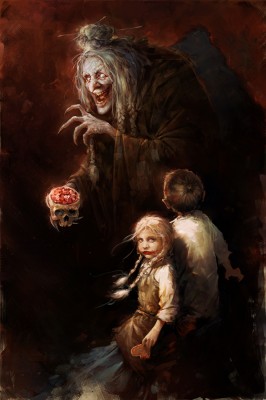
Hansel and Gretel by Blaž Porenta

This painting depicts the fear in Gretel’s eyes when faced with the evil witch. The eye contact she is making with the audience is a powerful stance that illustrates her wise and mature outlook on defeating this evil woman.

Through Gretel’s character growth, she rounds up enough courage to conquer the evil witch which allows her to experience true freedom. Gretel tricks the witch into going into the hot oven, and the success of this plan results in overwhelming amounts of joy from Gretel and her brother. “Gretel ran straight to Hansel, opened the little shed and cried out: “Hansel, we’re free! The old witch is dead.” Hansel hopped out as soon as the door opened, like a bird leaving its cage” (Grimm 241). Gretel’s unwavering confidence in this moment allows her to trust her intuition, ultimately leading to the relief and triumph that came along with the salvation of the threatening intentions of the witch. The transition of fear to confidence when overcoming an obstacle is often seen in eating disorder recovery. The initial fear and anger towards one’s eating disorder during recovery is unbearable, but the thought of disobeying the eating disorder’s voice is still chilling. However, with courage, the victim can decide to actively choose recovery and ‘kill’ the eating disorder voice. The liberation that comes along with this moment is overwhelming and is unparalleled to the short bouts of pleasure when giving into the eating disorder voice. The emotional and physical freedom a victim feels can be the most encouraging part of recovery because the victim is able to see their hard work pay off. When speaking about her recovery journey, Jenni Schaeffer states, “Even one minute of freedom was proof I was getting better” (Schaeffer 55). The bravery Gretel and an eating disorder’s victim carries in this moment of redemption is critical to the arch of positive personal and emotional development. 

While the tropes and schemes of “Hansel and Gretel” accurately illustrate the development and overall feelings of an eating disorder, the depiction of Gretel’s fright and loneliness has the ability to touch the reader in a more deep, emotional manner. This story resonates with me because I am able to see myself through Gretel’s character development, resourcefulness, and resilience. As someone who has recovered from a life threatening eating disorder, this story is able to show me how far I have come psychologically and physically. I once was just like young Gretel, lost, overcome with exhaustion, and emotionally manipulated. I deeply feel for her complex conflict with the old witch because I too used to feel manipulated and controlled by the voice inside my head. Having the confidence to break away from a controlling relationship takes a toll on oneself, but, as seen in this story, the freedom and liberation that comes with emotional and physical independence has the potential to change one’s life. 

Many young women grow up reading fairy tales that contribute to unrealistic body standards, but “Hansel and Gretel” is a wonderful example of a fairy tale that, when seen through the correct lens, is able to spread a positive message about eating disorder recovery and give individuals courage to recover. Fairy tales offer possible solutions to transitional problems and anxieties by serving as external structures upon which an eating-disordered individual can project their desired identity and draw self-control (Hill 584). Fairy tales can be used for a vision-to-action treatment alternative for mental health issues. Laura Hills, referring to the vision-to-action treatment for young women with eating disorders in the “Journal of Counseling & Development” says, “Often what the client cannot say about herself, she can verbalize about fairy tale characters” (Hill 585). I carry a tremendous amount of empathy for people who have gone through a similar struggle as mine, and I take pride in the passion I have to help people work towards recovery. In this paper, I want to educate readers that both do and do not struggle with eating disorders about the connection they can make with their sense of self, their anxieties, and developmental fears through fairy tales. 

The story of the young Gretel in “Hansel and Gretel” by Brothers Grimm, symbolically expresses the complexities and harsh realities of an eating disorder. Gretel’s psychological and emotional turmoil in the beginning of the tale, derived from her history of nutrient deprivation and harsh familial neglect, represents a disordered individual’s restrictive behaviors and weak sense of self. When Gretel travels away from home, the harsh and unsafe environment she is subjected to puts her in a state of exhaustion, similar to the exhaustion many eating disorder victims experience. Exhaustion is present in various parts of an individual’s experience with an eating disorder such as recovery fatigue, a binge-restrict cycle, and even a refeeding stage. Gretel, similar to an eating disorder victim, is emotionally manipulated by the evil old witch in this tale, and is forced to carry out action she does not agree with. However, with determination, she celebrates the fact that she was able to set her and her brother free from this evil control, similar to the freedom a person experiences in eating disorder recovery. The metaphorical and symbolic connection between this fairy tale and the impacts of an eating disorder should not be underestimated. Fairy tales can provide a reader with a sense of relaxation, allowing them to engross themselves into the character’s thoughts, feelings, and actions. Tales like “Hansel and Gretel” serve as a reminder that anyone is capable of overcoming obstacles with courage and resilience, even when the intimidating presence of an evil witch stands in their path of true freedom and happiness. Gretel mustered up the courage to break free from the grasp of the manipulative evil witch, illustrating to all readers that an escape from the eating disorder’s evil trap is, in fact, possible.   

Works Cited 

Porenta , Blaž. Hansel and Gretel. 30 Jan. 2021. Blaž Porenta Portfolio, http://www.blazporenta.com/?attachment_id=496. Accessed 2024.

Grimm, Brothers. “Hansel and Gretel.” The Classic Fairy Tales, edited by Maria Tatar, W.W. Norton & Company, New York, New York, 1999, pp. 236–241. 

Madison. “Eating Disorder.” Twice Upon A Fairy Tale: Adaptations of “Hansel & Gretel,” 1 Apr. 2016, fairytale2016.wordpress.com/tag/eating-disorder/. 

Matz, Judith, and Ellen Frankel. Beyond a Shadow of a Diet: The Comprehensive Guide to Treating Binge Eating Disorder, Compulsive Eating, and Emotional Overeating. Routledge, Taylor & Francis Group, 2014. 

Hill, Laura. “Fairy Tales: Visions for Problem Resolution in Eating Disorders.” Journal of Counseling and Development : JCD 70.5 (1992): 584. ProQuest. Web. 14 Apr. 2024.

Schaefer, Jenni, and Thom Rutledge. Life without Ed. McGraw-Hill Education, 2014.

Categories
Fairy Tales

Is Hollywood “Woke” Enough?

In the vast landscape of literature, fairy tales have held a significant place, weaving themselves into the fabric of cultures across the globe. However, as time progresses, these tales have undergone a metamorphosis, evolving to reflect the changing societal norms and ideals. The adaptation of fairy tales into modern Hollywood productions shows the juxtaposition of them with their original counterparts from Brothers Grimm and Charles Perrault. Through this exploration, aiming to unravel how themes such as feminism, the concept of true love, and diversity have been reimagined and reshaped in contemporary retellings. The transformation of fairy tales in modern adaptations through Hollywood films reflects not only a progressive shift in societal values but also serves as a reflection of our evolving cultural landscape, providing insights into the complexities of gender roles, relationships, and inclusivity. By exploring these themes through characters like Aurora, Rapunzle, Ariel and more I aim to demonstrate how the narrative surrounding these characters has become a prominent topic of discussion in contemporary critics and media judgment. 

One of the most notable changes in modern adaptations of fairy tales is the portrayal of female characters. Gone are the passive damsels waiting for rescue; instead, there is an emergence of empowered heroines who navigate their own destinies. ​​In “Tangled,” Rapunzel emerges as a vibrant embodiment of female empowerment, challenging stereotypes and inspiring audiences with her unwavering determination and resilience. Raised in isolation by the villainous Mother Gothel, Rapunzel’s journey to self-discovery is characterized by a steadfast resolve to break free from the confines of her tower and explore the world beyond. Central to Rapunzel’s empowerment is her agency and ability to navigate challenges independently. Unlike traditional fairy tale heroines who passively await rescue, Rapunzel takes matters into her own hands, wielding her intelligence and creativity as tools for survival. For instance, when faced with imminent danger, she ingeniously employs her long, magical hair not only as a means of escape but also as a means of defending herself, showcasing her resourcefulness and ingenuity. The portrayal of Rapunzel as an empowered heroine has far-reaching implications for how female characters are perceived in popular culture. By subverting traditional gender roles and showcasing the agency and resilience of women, “Tangled” challenges societal expectations and empowers audiences to embrace their own inner strength and potential. Furthermore, Rapunzel’s character resonates deeply with young girls, providing them with a relatable role model who embodies qualities of independence, bravery, and resilience. Through her journey of self-discovery and empowerment, Rapunzel teaches audiences that true strength comes from within and that they possess the power to shape their own destinies.

It is imperative to recognize that such qualities of independence and strength, while undoubtedly commendable, represent only a fraction of the multifaceted spectrum of feminine attributes deserving of celebration and admiration. Aurora from “Maleficent” is a prime example of how nuance can be introduced to the idea of feminism. In the original telling of sleeping beauty, the Grimm’s “Briar Rose”, Aurora’s character languishes in passivity, propelled only by the actions of others. When reimagined in the movie “Maleficent”, it strays from  the conventional route of imbuing her with physical prowess, a common trope in contemporary retellings. Instead, the film delicately weaves Aurora’s strength to showcase her innate kindness and femininity. In this nuanced portrayal, Aurora’s character design becomes a poignant reminder of Louisa May Alcott’s timeless wisdom, echoed in the words, “Just because my dreams are different from yours does not mean that they are unimportant” (Alcott). This line instantly reminds me of the complex dreams and roles women can have and play in society. We are not confined to a pursuit of careers and independence, so it should also be an honor to pursue motherhood and the art of nurturing a home. Herein lies the beauty of embracing femininity not as a compromise to be made, but as an intrinsic source of strength and resilience. In redefining the narrative landscape of female characters, there emerges a conscious effort to broaden our collective perception of women’s agency and empowerment. It is a narrative that transcends the confines of traditional archetypes, inviting us to celebrate the myriad facets of femininity and the inherent strength that resides therein. As we navigate the complexities of gender dynamics in our modern world, let us heed the profound lessons imparted by characters like Aurora, embracing the diversity of female experiences and embracing the inherent strength of kindness and sincerity.

The traditional narrative of true love’s kiss as the ultimate resolution to fairy tales has been challenged in contemporary adaptations. The motif of true love’s kiss as the ultimate resolution to conflicts was a staple to the original tales. This trope, popularized by narratives like those collected by the Brothers Grimm and Charles Perrault, has ingrained itself deeply in our cultural consciousness. However, contemporary adaptations of these tales have begun to challenge this traditional notion, offering alternative perspectives on love and its transformative power. Films like “Frozen” emphasize the power of sisterly love, while “Maleficent” explores the complexities of maternal affection.

Disney’s “Frozen,” is a great example of this form of challenging as it shifts the focus from romantic love to the profound bond of sisterhood. In classical fairy tales, true love’s kiss is depicted as a magical solution to breaking curses, waking sleeping princesses, and overcoming various trials. The Grimms’ and Perrault’s tales often culminate in a romantic kiss between the protagonist and their love interest, symbolizing the triumph of love over adversity. It usually has a simplistic storyline where a prince “could not turn away his eyes; and presently he stooped and kissed her. And she awaked, and opened her eyes, and looked very kindly on him. And she rose, and they went forth together” (Grimm). This narrative formula, while enchanting, can perpetuate the idea that romantic love is the only form of love capable of saving the day. In contrast to traditional fairy tales, “Frozen” challenges the primacy of romantic love by placing emphasis on the bond between two sisters, Elsa and Anna. Throughout the film, it is their unwavering devotion and sacrifice for each other that ultimately saves the kingdom of Arendelle. Elsa’s act of true love, not a romantic kiss but rather an act of selflessness to protect Anna, breaks the icy curse that had engulfed the land (Frozen). Overall, Frozen highlights the complexities and depth of familial relationships, showcasing how familial bonds can be just as powerful, if not more so, than romantic ones. 

Disney’s “Maleficent,” is another example of a movie  which subverts the traditional narrative by emphasizing the significance of maternal love over romantic love. In “Maleficent,” the story unfolds from the perspective of the eponymous character, who, betrayed by love, curses Princess Aurora. Yet, as Aurora grows, Maleficent finds herself drawn to the child, developing a maternal affection that transcends the darkness of her curse. In the climactic moment, it is not a romantic kiss but Maleficent’s maternal kiss that awakens Aurora, symbolizing the power of maternal love to break curses and heal wounds. By challenging the importance of romantic love, the film offers a more nuanced and inclusive portrayal of love’s transformative potential. Maleficent’s journey from a vengeful fairy to a loving mother subverts stereotypes and expands our understanding of love in all its forms. This narrative was subject to criticism though. Audiences can accept the notion to make true love come in different forms. But Disney then gets accused of its poor writing of mothers. Their motherhood is their only importance to the story, not them as individuals. It is criticized for the lack of effort they put to humanize the parents when they are so pivotal in the trajectory of their children’s stories, “​​none of the dead mothers are even named in the films, including Pocahontas’ mother, whose spirit is visually present, guiding her and other characters throughout the entire story”(Kadlec). However, I disagree with Kadlec, I think that the film acknowledges the agency and autonomy of maternal characters, allowing them to navigate their own paths and make choices that transcend conventional expectations. Regardless of the commentary on the mothers themselves though, the reimagination of true love as more than just a romantic gesture is still very significant progress from the traditional tales. By expanding the definition of true love beyond romantic relationships, these adaptations offer more diverse and inclusive narratives that reflect the complexity of human connections.

In recent adaptations, there is a noticeable effort to introduce diversity both in terms of culture and representation. Films like “Encanto” celebrate the richness of Latinx culture, while the casting of Halle Bailey as Ariel in the live-action adaptation of “The Little Mermaid” signals a move towards greater inclusivity. Disney’s “Encanto” stands as a vibrant testament to the beauty and richness of Latinx culture. Set in Colombia, the film immerses audiences in a world filled with colorful imagery, lively music, and authentic representation of traditions and customs. From the vibrant landscapes of the Colombian countryside to the spirited rhythms of cumbia and vallenato, “Encanto” embraces its cultural heritage with pride and authenticity. At the heart of the film lies the story of the Madrigal family, each member endowed with unique magical gifts that reflect the diversity of Latin American folklore. Through characters like Mirabel, who embarks on a journey of self-discovery and empowerment, “Encanto” celebrates the resilience, strength, and interconnectedness of Latinx communities. These aspects of the film can both educate children that have never had exposure to these cultures but can also make people of that race or ethnicity feel represented. By centering the narrative on a diverse cast of characters, the film not only entertains but also educates and empowers audiences, fostering a greater appreciation for Latinx culture and heritage.

The casting of Halle Bailey, a talented African American actress, as Ariel in the upcoming live-action adaptation of “The Little Mermaid” represents a significant milestone in the pursuit of greater inclusivity in Hollywood. By reimagining a beloved character traditionally depicted as white, Disney sends a powerful message of representation and diversity to audiences worldwide. Bailey’s casting not only challenges conventional norms but also opens the door for more inclusive portrayals of iconic characters in mainstream media. It is a testament to the importance of representation and the recognition of talent beyond racial boundaries. As Bailey steps into the role of Ariel, she not only brings her own unique interpretation but also paves the way for future generations of diverse actors to claim their rightful place in the spotlight. However, her acceptance into this role was not without its trials. One of the main complaints was that this was an attempt for Disney to come across as “woke” or “force diversity”. More complaints include: “trolls declared that Bailey was #NotMyAriel. Many claimed that her casting was an example – surprise, surprise – of “woke” culture gone mad” (Vassell). I think this conversation of preformative activism is a conversation that should absolutely be capitalized in this conversation of diversity. Throughout my studies as an actress I have been told repeatedly that the only time race is important to casting is if it is a part of the script. No where in the original tellings of “The Little Mermaid” does it specify that Ariel is white. The casting of Halle Bailey as Ariel serves as a beacon of progress in the ongoing quest for greater diversity and inclusivity in Hollywood. While criticisms may arise, it is essential to engage in meaningful dialogue surrounding these issues and to continue championing representation that authentically reflects the diversity of our society. 

As displayed, these strides are not without their share of criticisms and controversies, raising questions about authenticity, tokenism, and the boundaries of representation. Critics argue “For a brief period, there were more films and TV shows that featured diverse casts and themes” (Lidaka). The notion that the diversity in Hollywood today is forced is from critics who are sharing a narrative based on internalized racism and a poor interpretation of society. The Disney we are seeing today is one attempting to replicate the actual diversity in our county. It is imperative to navigate these discussions with nuance, acknowledging both the progress made but also allow these things to be challenged. While the evolution of fairy tales in modern adaptations is a testament to our evolving consciousness, it is not immune to scrutiny. Critics argue that certain adaptations, despite their progressive facade, perpetuate underlying stereotypes and fail to truly subvert entrenched norms. Moreover, the commodification of diversity and feminism in mainstream media raises concerns about authenticity and the co-optation of social movements for commercial gain. These criticisms underscore the need for a discerning eye and a critical lens when engaging with modern adaptations of fairy tales. 

The journey of fairy tales from their humble origins to their modern adaptations reflects a larger narrative of societal transformation. Through the prism of feminism, the reimagining of what love means, and the embrace of diversity, these adaptations serve as a reflection of our evolving values and aspirations. However, amidst the celebration of progress, it is crucial to remain attentive and interrogate the complexities inherent in these narratives. By doing so, a meaningful dialogue can be engaged that not only honors the legacy of fairy tales but also paves the way for a more inclusive and equitable future. The evolution of fairy tales in modern adaptations through Hollywood films represents a dynamic interplay between tradition and progress, reflecting the changing societal norms and ideals. Through the exploration of themes such as feminism, the concept of true love, and diversity, contemporary retellings offer nuanced and multifaceted narratives that challenge traditional conventions and expand our collective understanding of these timeless tales. By engaging in meaningful dialogue and interrogating the complexities inherent in these narratives, it challenges us socially to both honor the legacy of fairy tales while also paving the way for a more inclusive and equitable future in storytelling.

Works Cited

Rowe, Karen E., (1986) “Feminism and Fairy Tales” from Zipes, Jack,  Don’t bet on the prince : contemporary feminist fairy tales in North America and England  pp.209-266, Aldershot: Gower

Kilmer, Alyson, “Moving Foward?: Problematic Ideologies in Twenty-First Century Fairy Tale Films” (2015). All Master’s Theses. 73.

Maria Tatar. The Classic Fairy Tales (Second Edition) (Norton Critical Editions). W.W. Norton & Company, 2017. 

Nicola @ Thoughts on Fantasy. “How the Last 300 Years Have Changed Fairy Tales.” Thoughts on Fantasy, 13 May 2016, thoughtsonfantasy.com/2014/09/29/how-the-last-300-years-have-changed-fairy-tales/. 

“Maleficent.” Walt Disney Studios Home Entertainment (Distributore), 2014. 

“The Backlash against Halle Bailey’s Little Mermaid Is as Silly as It Is Predictable.” The Independent, Independent Digital News and Media, 15 Sept. 2022, www.independent.co.uk/life-style/little-mermaid-ariel-movie-halle-bailey-ursula-b2166767.html. 

Alcott, Louisa May, 1832-1888. Little Women. Melbourne ; London ; Baltimore :Penguin Books, 1953.

Nathan Greno, Byron Howard, et al. TANGLED . USA, 2010.

Buck, Chris, and Jennifer Lee. Frozen. Walt Disney Studios Motion Pictures, 2013.

Bush, J., & Howard, B. (2021). Encanto. Walt Disney Pictures; Walt Disney Animation Studios.

Rob Marshal. l(2023). The Little Mermaid. Walt Disney Pictures.

Lidaka, Maris. “Wokeness in Film Isn’t the Problem.” LinkedIn, 15 Apr. 2024, www.linkedin.com/pulse/wokeness-film-isnt-problem-maris-lidaka-4rj4c. 

Categories
Fairy Tales

Understanding the psychology within Beaumont’s “Beauty and the Beast”

By: Alex Khanna

In the version of the fairy tale “Beauty and the Beast”, written by Jeanne-Marie Leprince de Beaumont and published in 1756, there are many psychological concepts at play. There is so much going on within the story and between all of the characters regarding this topic. I identified the main psychological ideas regarding the individual characters.  The first of them was the Oedipus complex syndrome, a syndrome where a child will feel very attached to the parent of the opposite sex (Dolloff). Then I identified Stockholm syndrome, a syndrome where a hostage develops a psychological bond to the person who captured them (White). After that I recognized depression, a constant or prolonged feeling of sadness (“Depression”). Then personal growth or self actualization from Maslow’s hierarchy of needs, where a person reaches their fullest potential. This can only happen after all of the other thighs have been met within Maslow’s hierarchy of needs (Mcleod). Also isolation, specifically, social, emotional and cultural. Lastly, fear of rejection, where someone is afraid to open themselves up to others out of fear they will not be accepted by them (“Deconstructing the Fear”). The psychological themes from the individual characters are similar to the ones for the story in general, but not exactly the same. For the general story, the main psychological ideas present are transformation (Meintassis). This theme goes for both physical and mental transformation as they are both present. Sacrifice is also something that is apparent in the story in multiple ways (Horkovska). Lastly, there is the theme of attachment (“Attachment Theory in”). This theme is present in every single character in “Beauty and the Beast”. It is also a theme that presents itself differently in individual characters.  In this essay, my aim is to holistically analyze all the prominent psychological themes present in “Beauty and the Beast” in order to show how the presence of them offers a better understanding of the characters and offers an enhanced overall message of the story.

Beaumont’s version and Disney’s adaptation of “Beauty and the Beast” were both based on a fairy tale called “La Belle et la Bete” by a French author named Gabrielle-Suzanne Barbot de Villeneuve. Villeneuve’s “La Belle et la Bete” was published in 1740. Her story was based on someone she knew personally who suffered from a condition known as hypertrichosis causing hair to grow all over one’s body and face(“The True Stories”). While both Jeanne-Marie Leprince de Beaumont’s and Gabrielle-Suzanne Barbot de Villeneuve’s stories are very popular, the most well known and iconic adaptation of this story is Disney’s Beauty and the Beast. Disney’s adaptation of Beauty and the Beast is a musical romantic fantasy film. It was released on November 22, 1991 and was produced by Walt Disney ( Contributors to Disney). 

The Disney version of this story is a more simplified tale meant for a younger audience. In the majority of the adaptations of Beauty and the Beast, there are certain lessons and values that can be taken from them. The most apparent of these are selflessness, acceptance of others, and inner beauty. All of these are present in the character Beauty. There are many examples of Beauty being selfless throughout the tale. The most important one would be when Beauty refuses to let her father go back to the Beast’s palace and takes her place. “‘Rest assured, Father,’ said Beauty, ‘that you will not go to that palace without me. You can’t keep me from following you. I may be young, but I am not all that attached to life, and I would rather be devoured by that monster than die of the grief which your loss would cause me’”(Beaumont 43). She does this not knowing what will become of her and aware of the possible life threatening danger that could await her. Beauty’s acceptance of Beast shows how she was willing to look past the apparent negatives of Beast. She is truthful in telling the beast that he is ugly and not very smart. Though she still is able to see the inner beauty within Beast. She is then rewarded for doing this by the fairy making her a princess and living in a castle. “‘Beauty,’ said the lady, who was a grand fairy, ‘come and receive the reward for your wise choice. You preferred virtue to looks and intelligence, and so you deserve to see those qualities united in a single person. You will become a noble queen, and I hope that sitting on the throne will not destroy your many virtues’”(Beaumont 49). This teaches the lesson that being a good person and seeing people for what is on the inside rather than the outside will be rewarded. 

A significant amount of the psychology in play derives from the main character in “Beauty and the Beast”, Beauty. This character displays stockholm syndrome, Oedipus complex syndrome, and self actualization. Stockholm syndrome is somewhat apparent in Beauty. She develops a strong connection with Beast, her capturer, while she is staying in his palace. Although, this is a disputed claim for a few reasons. For one, Stockholm syndrome requires that the person who is held hostage is actually kept there against their will (White). While Beauty does willingly bring herself to Beast’s palace thinking she may be devoured or kept prisoner, she is in fact treated very well by Beast and free to do what she pleases. This is evident when Beauty requests to see her father for a week. “‘I would rather die myself than cause you pain,’ said Beast. ‘I will send you back to your father. Stay there, and your poor beast will die of grief’” (Beaumont 47). This is enough cause for one to dispute the stockholm syndrome claim as she was not kept against her will. So while there still is an argument for Stockholm syndrome being in play in “Beauty and the Beast”, it is not definitive enough to be sure. On the other hand, there is a much more sound argument for Oedipus complex syndrome created by Sigmund Freud, in “Beauty and the Beast”. Beauty is shown to have a very special and loving relationship with her father. She displays her affection and loyalty to him throughout the tale. The most prominent examples of this are Beauty giving herself to Beast to save her father and her constant worry and care for her father while she is living with Beast. A problem that comes up for the claim that an Oedipus complex is in play in “Beauty and the Beast” is that an Oedipus complex also states that there would be an “…envious and aggressive feelings toward the parent of the same sex”(“The Oedipus Complex”).This is an issue because Beauty’s mother is not mentioned in the Jeanne-Marie Leprince de Beaumont “Beauty and the Beast”. Although, it is still a valid claim to make because Beauty’s relationship with her mother was never described. The claim for Beauty reaching Self actualization, I feel, has the strongest evidence. Self actualization is a part of the famous psychological concept, Maslow’s hierarchy of needs. Self actualization is the final step of this hierarchy. The levels on the hierarchy required to reach this level are physical needs, safety and security, love and belonging, self-esteem. After these needs have been met, one can reach self actualization (Mcleod). It is clear from reading Beaumont’s “Beauty and the Beast” that her physical needs are being met. While Beauty’s family is not nearly as wealthy as they once were, there is no mention of her family struggling to maintain their physical health. The need of safety in Beauty’s story is something that, in general, it met. The only time where her safety and well being are questionable was when she was on her way to Beast’s palace. “‘You see father,’ she said while forcing a laugh, ‘the beast wants to fatten me up before eating me, since he paid so dearly for me’”(Beaumont 44). While Beauty was not sure of her fate at this moment, she ended up not being in danger at all. The need for love and belonging is clearly met for Beauty. This is evident from her relationship to her father and then later on, her relationship with Beast. For self-esteem, it can be assumed that beauty had no issue with this as she was constantly treated well by everyone and being asked to marry them even after her family lost their fortune. “There were a number of gentlemen who would have been happy to marry Beauty, even though she didn’t have a penny”(Beaumont 40). Seeing as the four previous needs from Maslow’s hierarchy are met, Beauty can potentially reach self actualization. The moment where Beauty reaches self actualization was when she realized that she truly did love and care for Beast, regardless of his traits from the outside. “I give you my hand in marriage, and I swear that I belong to only you. Aleas, I thought that I felt only friendship for you, but the grief I am feeling makes me realize that I can’t live without you”(Beaumont 49). Exploring Beauty’s psychology can help readers fully process the story with all of its nuances.  

Analyzing Beauty’s psychology in Beaumont’s “Beauty and the Beast” gives us a better insight into the mind of Beauty and a more full understanding of her character. Understanding Stockholm syndrome, and the way that it applies to Beauty in the story helps us understand why she ended up having such a strong attachment to Beast. Again, the claim of Stockholm syndrome being in “beauty and the Beast ” can be disputed, but it gives us one possible explanation for her feelings and actions. Recognizing the Oedipus complex present in Beauty’s character also allows for a better understanding of her motivation behind sacrificing herself to Beast in aid of her father. Having a good grasp of Maslow’s hierarchy of needs and its reaction to Beauty as a character allows for a much more complex understanding of the growth her character goes through throughout the story.  Beauty displays many of the psychological concepts discussed previously, but the character Beast also has psychological concepts integrated within him.

The character Beast displays psychological ideas such as isolation, depression, fear of rejection, and self actualization. Ever since Beast was cursed, he has lived in isolation from the outside world. This is part of the reason why he experiences depression and loneliness. This isolation and the feelings that came along with it caused Beast to believe that he was not good enough and destined to be alone forever. His cure for this was when Beauty ended up living in his enchanted palace with him. While Beauty’s character possesses the quality that she is able to accept people for who they truly are, contrary, Beast has quite the substantial fear of rejection. The cause of  “…fear of rejection may be our fear of experiencing hurt and pain”(“Deconstructing the Fear”). Beast always seemed to be very unconfident in himself when speaking. This is apparent when he first meets Beauty. “‘If I bother you, order me to go, and I will leave at once. Tell me, don’t you find me very ugly?”(Beaumont 45). Because of Beast’s fear of rejection and lack of self confidence stemming from his outward appearance, he seems to think that he is worth very little and bothersome to people. This fear that Beast has is something that can be fixed in a few ways. One being if someone is willing to accept who you are on the inside and the outside. This happens when Beauty has a realization and tells Beast that her fear of losing him made her realize how much she truly cared for and accepted him. This allows Beast to get past his fear of rejection and achieve self actualization. In other words, he was able to grow and move on as a person because he finally felt accepted. Both Beauty and Beast went through their own hardships and were able to achieve personal growth through doing so.

The psychology themes that are present in the general story are very similar to those of the individual characters, although they are shown in different ways as this includes the entire story, rather than an individual character. One of the main themes I identified within the general story was attachment. Attachment is a very important theme within “Beauty and the Beast” as it is the motivation for many characters’ actions. To start, the whole reason why the father of Beauty didn’t just stay at the palace when he first arrived there was because of his attachment to his children. Adding on to this, Beauty’s attachment to her father is also the only reason why she even ends up in Beast’s palace in the first place. And then Beast’s attachment to Beauty is also the reason why he is found in very poor condition. “… The thought of having lost you made me decide to starve myself”(Beaumont 49).  Attachment is defined as “a deep and enduring emotional bond between two people”(“Attachment Theory in”). This theme is also present in less important characters such as Beauty’s two sisters being attached to their previous wealth and way of life. It is clear that the theme of attachment plays a pivotal role for the plot of “Beauty and the Beast”. Another essential theme for the general story is transformation. This is evident from both Beauty and Beast. Beauty goes through a mental transformation realizing her true feelings for Beast. And Beast goes through both mental and physical transformation by feeling truly accepted and cared for by Beauty. Both these characters play an essential role in each other’s transformations and growth throughout the tale. And lastly, sacrifice. This is a theme which stems from the previous two themes, transformation and attachment. Because of the attachment certain characters have to one another, they are willing to make sacrifices. This is due to the fact that they realize how much they care for each other and are willing to put their own needs second rather than first. Beast and Beauty both make sacrifices in the story. Beauty does this for the sake of her father and for Beast. While Beast makes a sacrifice for the sake of Beauty. “‘I will send you back to you father. Stay there, and your poor beast will die of grief’”(Beaumont 47). Beast has the realization that he cares more for the needs and well being of Beauty than himself. This causes him to make the decision to let Beauty see her father even though he may die. From this action by Beast, it is evident that he has already started to go through a transformation mentally as he puts the needs of those he cares for before his own. Having an educated interpretation of Beast’s psychology gives readers a more complete understanding of him as a character and his character’s development. Recognizing Beast’s isolation gives the readers an explanation for some of his other issues. Such as his depression and fear of rejection. His depression and fear of rejection also offer readers clarification regarding his motivation and his actions through the tale. 

Throughout this assignment, I have analyzed the key psychological themes present within “Beauty and the Beast” and found how crucial they are for the characters’ individual development and growth as well as the message of the story. Having done this I have found that personal growth, attachment, acceptance and sacrifice to be the most important psychological themes present in the story. This is due to the fact that without these themes present, the story would have been able to take place the way that it did and for the characters to develop as they did. These themes have a crucial role on the overall lesson or message of the story. Without them, we would not have been able to understand the development of the story and individual characters the intended way. Having and understanding of these themes has allowed for a better understanding of the overall message from “Beauty and the Beast”. This message being the importance of inner beauty and acceptance of others. 

Works Cited

Moore, Hannah. “The True Stories behind Beauty and the Beast and Other Disney Stories.” BBC News, BBC, 18 Mar. 2017, www.bbc.com/news/newsbeat-39302636#:~:text=Disney’s%20version%20is%20based%20on,bride%2Dto%2Dbe%20Catherine. 

Classic Fairy Tales: Texts, Criticism; Ed. by Maria Tatar. W W NORTON, 2017. 

White, Snow. “Beauty and the Beast: True Love or Stockholm Syndrome? – SWW.” SWW – Fairy Tales & Writing Inspiration, 14 Oct. 2021, snowwhitewrites.com/beauty-and-the-beast-stockholm/. 

Dolloff, Lauren. “The Oedipus Complex.” The Oedipus Complex, 16 Nov. 2006, www.uvm.edu/~jbailly/courses/tragedy/student%20second%20documents/Oedipus%20Complex.html#:~:text=Oedipus%20Complex&text=The%20attachment%20of%20the%20child,parent%20of%20the%20same%20sex. 

John Amodeo, PhD. “Deconstructing the Fear of Rejection: What Are We Really Afraid Of?” Psych Central, Psych Central, 17 Mar. 2014, psychcentral.com/blog/deconstructing-the-fear-of-rejection-what-are-we-really-afraid-of#1

By, et al. “Attachment Theory in Psychology Explained.” Simply Psychology, 17 Jan. 2024, www.simplypsychology.org/attachment.html. 

“Depression.” World Health Organization, World Health Organization, www.who.int/health-topics/depression#tab=tab_1. Accessed 28 Apr. 2024. 

By, Saul Mcleod, Updated on, January 24, et al. “Maslow’s Hierarchy of Needs.” Simply Psychology, 24 Jan. 2024, www.simplypsychology.org/maslow.html. 

Meintassis, Harry. “The Psychology of Transformations.” LinkedIn, 20 Mar. 2023, www.linkedin.com/pulse/psychology-transformations-harry-meintassis. 

Horkovska, Iryna. “What Is Chronic Self-Sacrifice? Is Self-Sacrifice Schema a Bad Thing?” Calmerry, 16 Mar. 2023, calmerry.com/blog/self-esteem/what-is-chronic-self-sacrifice-is-self-sacrifice-schema-a-bad-thing/#:~:text=Psychology%20defines%20self%2Dsacrifice%20as,others%20much%20more%20than%20yourself. 

Wiki, Contributors to Disney. “Beauty and the Beast (1991 Film).” Disney Wiki, Fandom, Inc., disney.fandom.com/wiki/Beauty_and_the_Beast_(1991_film). Accessed 29 Apr. 2024. 

Categories
Fairy Tales

Interweaving fairy tale elements through God of War’s narrative

Written by: Cristian Tapies

Most fairy tales are short, sweet, have a happy ending, and teach a simple lesson. From the cautionary tales surrounding Little Red Riding Hood, to the inner appreciation of beauty in Beauty and the Beast or the dangers of gluttony in Hansel and Gretel. Most fairy tales follow a kind of archetype of storytelling. Vladimir Propp so graciously termed these common tropes and themes into the Propp’s functions. These functions serve a great purpose in progressing a story and deepening the meaning underneath the text. But they don’t apply to just fairy tales, but to one of my favorite kinds of media, video games. Many triple-A quality video games use these tropes to enhance their story. One such example is the God of War 2018 and the God of War Ragnarök (2022) video games. These games are based on mythology and they balance fictional stories with the old myths to create new storylines. These games expertly combine and interweave common fairy tale elements to help streamline the story from many separate journeys to one rich narrative. This is something new that God of War is doing and something that many video game creators/developers can learn from.

The God of War franchise is an extremely successful video game series that follows an old (fictional) Greek god of war, Kratos. For the first 3 games based in Greek mythology, the players followed a story of rage and vengeance, but in the newer games based in Norse mythology. It’s a story of reconciliation and fatherhood. In both of the newer games, the largest selling and marketing point wasn’t Kratos and the continuation of his story. But his new child Atreus. Who, if looked at through the lens of a fairy tale, would undoubtedly be the main protagonist. Atreus and the role that he plays in the newer games is the key to utilizing these fairy tale elements that enhance such tales.

To keep the summary of the story brief. Once Atreus becomes a teenager, his mother dies and her dying wish is for Atreus and his father Kratos to spread her ashes on the highest peak in all the realms. Upon setting out on their journey, Kratos and Atreus encounter many allies, and many adversaries, the most notable of which being Odin, the power-hungry, knowledge-seeking king of all the realms. These allies and adversaries are what make the story so rich. Atreus is the key to all of these allies and adversaries because, throughout the entirety of the games, any attention to other characters and their storylines is initiated by Atreus. Kratos is reserved, stone-cold, and shows very little emotion. What is interesting is that each new adversary or ally seems to connect with a certain fairy tale function.

These functions help structure stories and understand why parts of a narrative are necessary for the overall product and are great additions to any kind of video game narrative. But their use in a video game is different from that of an actual fairy tale. Because most video games today explore an extremely comprehensive story with an extended run time. More of these elements can be expanded upon. What God of War does differently is interweave these functions into other characters’ stories to create a much richer narrative.

Some functions are blatantly present and serve a very specific purpose. For example the Absentation at the beginning of the first game. The death of the mother Faye is the very reason Kratos and Atreus set out on their journey. The reconnaissance function is most utilized by Odin, who uses his ravens to watch the player’s every move. But the functions that are most interwoven throughout the story are the Donor function. The struggle/conflicts between the protagonist and the antagonist. And the many interdictions throughout the story. These three functions are so ingrained into the narrative and streamline all the events into one story so well that this game won the award for “Best Narrative” at the 2022 Game Awards show. The equivalent of the Oscars for video games.

As said before, one of the functions that is ingrained into the story the most is the donor function. Near the beginning of the first game, you encounter Brok and Sindri, the master weaponsmiths, who happen to be brothers. Instead of serving their only purpose and giving Atreus a magical agent or helper. They have a story. Continuously throughout the first game, it’s drilled into your head that both brothers have a rough history and are constantly trying to one-up each other, helping the player upgrade resources and weapons and doing their best to be better than their brother. In addition to helping Kratos and Atreus on their journey with new quests and better rewards. Every time you encounter one of the brothers, they give your weapons an upgrade free of charge, to prove they are better than their brother at what they do. But this is only for the first game. At the climax of the first game, they reconcile with their past and decide to work together to fight Odin and continue to work together, for you, in the second game. Up until one of them gets murdered, but we’ll come back to that.

The brothers have a story that makes them notable characters and their presence always invokes feelings of safety within the game. In terms of analysis, they not only constantly provide items to the protagonist the way that a donor would in a fairy tale. But they have a story that isn’t isolated from the main characters. Their story begins when they realize you have the Leviathan Axe. Which the Huldra brothers crafted and gave to Faye when she was still alive. They also had goals and dreams of crafting the most destructive weapon in all the realms, and having it be wielded to take down the Norse gods. This destructive weapon came in the form of the Draunir spear given to Kratos. Yet another action a donor would typically have. What they also provide to the main characters is a different perspective. Similar to the dualistic nature of the playable characters Atreus and Kratos. Brok is a stone-cold worker who likes to fight, and Sindri is a calm weaponsmith who hates being dirty. The layout of their story is expertly littered throughout the narrative to give a deeper meaning to the dualistic nature of Kratos and Atreus. In an interview with the narrative leads and directors, the Huldra brother’s story was meant to be similar to the story of the two playable characters. The story of the Huldra brothers is always one step ahead but never carries the same weight to the story as the main characters do. Almost as if they hint at what comes next in the story. Thus providing not information to the characters, but directly to the player, although they just don’t know it yet. This expansion and elaboration of two characters that are only meant for one purpose, to be the donor, is why the narrative of these video games is so well done.

Another reason most video games tend to have more complete stories compared to other types of media is that they typically have long runtimes, especially in recent years. With certain games reaching upwards of 60+ hours of playtime. Narrative leads needed to find ways to keep players engaged in every aspect of the game, whether it be story, gameplay, or combat. What this leads to is not just one encounter with the final boss, but many encounters spanning the entire game, while not all encounters are fights, each moment that you share with the antagonist is information to the player that enhances the story. The God of War video games do this extremely well through the use of the Aesir gods, who are portrayed to be the main antagonists. Baldur, Magni & Modi, Thor, and the valkyries are characters you encounter many times each with their motives and priorities. This spread of antagonists that fall under the power of the one true villain Odin allows for the different characters to involve themselves in other plotlines, thus making for a more rich narrative. Two main plot points are worth noting in the context of a struggle/conflict between the antagonists and how they fit into the overarching theme of these games, which I may remind the reader, are reconciliation and fatherhood. These are the stories of Baldur and his hatred towards Freya, and Odin’s disguise leading to one of the most shocking events in recent gaming years. 

The first of the two that occurs is the hatred of Baldur towards Freya. It is learned halfway through the first game that Baldur is invincible and can’t die. At the cost that he doesn’t feel anything, no pain and no pleasure. This is what Odin wants, a perfect tracker, an assassin that can’t die, doesn’t feel, and is under his control. But Freya, Baldur’s mother, is the character who laid the curse upon Baldur. Baldur was so torn at learning this fact that he attempted to murder his mother for the lifetime of pleasure she stole from him. This moment is where the player realizes the connection between Kratos and Atreus. Both stories involve a parent attempting to do their best for their son at any cost. But the difference is that Baldur is mature and much stronger than Freya, who doesn’t have the power to talk him down like Kratos does for Atreus.

The other plotline regarding Odin’s disguise is introduced before we are aware of it (disguises, right?) when Atreus is manipulated to join Odin and help him uncover a Norse secret. This entire section of the game is one large battle for intelligence, which Odin is adept at fighting with. Odin knows that Atreus doesn’t trust him fully, he is aware that at some point, Atreus will betray him. So Odin tricks Atreus, knowing Atreus thinks he tricked Odin, and does the same thing back to him. Odin disguises himself as Tyr. A character whose intelligence is sought after by Kratos. For hours worth of play time Odin now pulls the strings from every side of the battlefield. It’s only until Brok uncovers this trickery that Odin stabs Brok and reveals himself in one swift motion. This death is the motivation for the final battle of the series.

The last function that is truly ingrained in the games is interdiction. The players have always known that Kratos is a badass character who can topple over anyone who stands before him, a rage-induced warrior meant for one thing, to fight. So seeing Kratos in his best attempt to raise a child after his skin was stained with the ashes of his daughter he was tricked into killing (harsh backstory) would surely make for an interesting story. It’s the father-son dynamic that carries the story throughout both of the newer games and is the reason it has received so much praise upon release. 

Throughout the game, Kratos is grappling with trying to raise his son in a world in which he has to fight, as said by Richard Gobert, the lead writer “His greatest fear is that he’s passed that evil that’s inside of him, onto his son.” Kratos is constantly commanding Atreus to show mercy and prevent combat. While also teaching him to not show remorse or regret for killing. These are extreme teachings for an impulsive teenager. After enough pushback from an arrogant Atreus, Kratos snaps “You are quick to temper! You are rash! Insubordinate! And out of control! You will honor your mother and abandon this path you have chosen” The constant back and forth is very well placed in the narrative to create a story about gods and legends, and yet still feel relatable. After all, who hasn’t been mad at their parents and wanted to test how far they could push their parents’ patience? It’s the dichotomy of two characters who have extreme methods to portray emotion and their constant fighting/reconciliation and eventual learning and mutual respect that create this amazing narrative that never gets tiring. 

All of these functions and scenes are expertly placed throughout the video game to provide great stories for players. But this essay wasn’t about the functions themselves, it was about how they are all connected, how they interweave and streamline the story. While it may seem that all that has been analyzed is three separate plotlines. They connect in the best ways. It’s hard to see the connections between every plotline with every other if you haven’t played the game before. But in my best attempt to do so, I will portray it as such.

Soon after Atreus and Kratos begin their journey, they meet Brok and Sindri, the weaponsmiths who despise one another due to the conflicting values of forging weapons for Odin. This is because Odin seeks to avoid his death prophecy by any means necessary. By weapons or curses, one such curse is to prevent the death of the trigger of his prophecy, which happens to be the death of Baldur. Odin convinces Freya to place a curse on her son to make him immortal at the cost of everything that he cares about. Baldur then uncovers this truth through tracking Kratos and Atreus. Baldur then attempts to murder Freya and is interrupted by Kratos. This causes Kratos to reflect on the ways he teaches his son. This reconciliation repairs the broken and separated nature of the father and the son. This act then inspires Brok and Sindri to also reconcile their past and work together. All to defeat Odin who has been manipulating everything, every step of the way.

This extremely short description of the series perfectly showcases how these games expertly interweave fairy tale elements to help streamline many different plots into one story. This is the exact reason that God of War Ragnarök won best narrative. This style of storytelling needs to be used more for video games to enhance narratives more than ever before. Richard Gobert used this technique extremely well but only utilized a fraction of the Propp’s functions. There are so many possibilities in combining more fairy tale elements into one plotline that allow for so many more stories to be told. And nowadays with more video games reaching those 60+ hours of runtime, there are all the more possibilities for amazing narratives to experience.

Categories
Fairy Tales

Exploration of business and economic concepts through fairy tales

By Krish Tyagi

Our knowledge of storytelling, literature, cultural identity, art and human psychology has been greatly influenced by fairy tales. However, fairy tales have also shaped our understanding and perception of modern political and economic concepts, which has led to the development of numerous business theories and tools. This demonstrates the extent to which fairy tales have impacted multiple entrepreneurs mindsets, as evidenced by the business tools and theories that can be discovered concealed in stories like Momotaro, The Hare and the Tortoise and The Little Mermaid. Though there are many other ideologies and notions present in these fairy tales, I believe that the small exchange between the mermaid and the sea witch in The Little Mermaid by Hans Christian Andersen defines the crux of the barter system in economics. Using the concepts of friendship and sharing, Momotaro written by George Suyeoka deftly dissects the BCG Matrix model, a popular business tool. Meanwhile, The Hare and The Tortoise authored by Aesop uses its two central characters to physically illustrate how a product life cycle functions. Even though the connection between the business tool and fairy tale may not be immediately apparent without careful examination, it does have an effect on children’s perceptions, who are the intended audience, and it subtly registers all the business data that may help these kids develop sophisticated concepts about the future of entrepreneurship or macro and microeconomics. Moreover, The Hare and The Tortoise, The Little Mermaid and Momotaro explore business and economic concepts by utilising symbolism and imagery while helping children transition into more complex entrepreneurial ideas. These business concepts and entrepreneurial ideas also assist in introducing young children to analytical and critical thinking abilities. 

  1. The Little Mermaid and The Barter System 

The Little Mermaid explores the concept of the barter system in economics. The barter system relies on direct trading between people or entities based on their respective needs and offerings. It is a non-monetary means of exchanging commodities or services, which involves the negotiation of value between parties without the use of a defined means of exchange and predates the adoption of money. The very first instance that explored this concept was the initial trade off between the little mermaid and the sea witch regarding the witch’s magical potion in exchange for the mermaid’s voice. The little mermaid reaches out to the evil sea witch to assist her get legs instead of her tail in order to pursue her true love. The little mermaid already had to bear tons of hurdles to maintain her legs including the feeling of being sliced by sharp swords as her tail splits into legs, followed by the pain of knives piercing her legs as she walked. However, in addition, she was also faced with a legitimate formal trade off by the sea witch. The sea witch demanded her beautiful voice in exchange for her magical potion of obtaining legs. She emphasised the input equals to output system in business studies by demanding her lovely voice in return for her magical elixir that gave her legs. This demonstrates the basic fundamentals of a barter trade-off, specifically a direct barter exchange, in which two goods are directly traded in the absence of money. The voice and the potion symbolise business products in this situation. As the sea witch states “and it is no trifling price that I’m asking. You have the sweetest voice of anyone down here at the bottom of the sea, and while I …sharp as a two-edged sword.”(Andersen 293). Her choice of words helps create a sense of visual imagery as she refers to the mermaid’s voice as the most beautiful voice in the ocean, as if it’s a premium/luxury product. Since, the primary audience of the little mermaid are children, this trade-off creates a visual imagery in their minds, of two tangible products being exchanged. 

Furthermore, this simple idea is briefly examined as the story proceeds, bringing up more complex ideas regarding the barter system. As the mermaid sets foot on land and extends her legs, the narrative inevitably takes a turn for the worse. The mermaid’s misery as a result of the trade is described in the story’s latter half. The young mermaid passes away and transforms into a sea creature as a result of the horrifying and brief description of her excruciating bodily suffering. This acts as proof for the unjust nature of their trade-off. In the end, the mermaid made more sacrifices than the sea witch. In comparison to the little mermaid who sacrificed her physical well-being and her entire family only to die, the sea witch just gave up a few drops of her blood for the potions. This fully captures the unfair and the sly deceitful characteristics of the barter system. Due to its inherent ambiguity and lack of a regulated value measuring method, the barter system in business can foster unfairness and deceit. Bartering parties may alter perceptions of value, take advantage of information imbalances, or exaggerate the quality or scarcity of their offerings. For example, the witch states “tomorrow, once the sun is up, I wouldn’t be able to help you for another year.”(Andersen 293). By adding a time limit to her offer, she creates a strong desire in the mermaid’s mind for her potion. In terms of business management, she creates a limited-edition product which manipulates the customer into buying the product instantly due to its limited availability. In general, proving the barter system erodes trust and fairness in economic transactions because it relies on subjective assessments and lacks official monitoring, which provides an environment that is conducive to manipulative practices and intuitive decision making.

Moreover, The Little Mermaid is successful in breaking down the concept of barter system in dept. This gives young readers and listeners a general understanding of the economic barter system and its covert, unfair nature, which encourages them to think critically about basic concepts in business more complexly, whether it’s deliberately or by accident.

2. Momotaro, or the Peach Boy and BCG Matrix

The story of Momotaro primarily focuses on friendship, bravery, and the value of utilising one’s abilities to assist others, which also briefly touches on the concept of sharing and growth in the BCG Matrix. The BCG Matrix is a strategic business tool used to evaluate a company’s product portfolio according to its relative market share and rate of market growth. The positive correlation between growth and shares translates perfectly to the moral of Momotaro or the peach boy. While traveling to battle the ogres, Momotaro befriends a dog, a pheasant, and a monkey. The way Momotaro offers his dumplings is very strategic, similar to how a salesman pitches his product. He states “I’ve some of the best millet dumplings in all Japan”(Suyeoka 272). Momotaro uses exaggeration and audacious promises to make the dumplings seem desirable by stating they are the best in all of Japan. This strategy is similar to contemporary marketing tactics that present products as superior or extraordinary in order to draw in customers and pique their curiosity. Momotaro’s word choice piques curiosity while simultaneously boosting the product’s confidence, much like a company claiming its dominance in a crowded field. His method emphasises the value of positioning and communication in the corporate world. Similar to how Momotaro approached his friends with a well-planned marketing pitch for his dumplings, companies need to create engaging brand stories and value offers in order to draw in and keep clients. Through the application of persuasive techniques and the development of exclusivity, businesses can stimulate demand and cultivate brand loyalty within a competitive market.

Furthermore, every one of Momotaro’s animal friends had special qualities that were necessary for success: the dog’s biting abilities, the pheasant’s flying, and the monkey’s climbing aptitude. Their combined abilities demonstrate the efficacy of collaboration, as they worked as a team to surmount significant challenges. This principle has a lot of applications in the business world, where building a large customer base is a powerful competitive advantage—just like Momotaro relies on his supporters to win the battle. Momotaro could not have defeated the ogres without their combined strength, likewise as a company without a sizable clientele could not have survived in the marketplace. This tactic also applies to strategic frameworks such as the BCG matrix, in which items that are classified as “star ” have a large market share and the ability to grow due to a strong client base. In terms of the BCG matrix, Momotaro’s friends symbolise an increase in market shares and the victory against the ogres symbolise an increase in market growth. Momotaro’s victory, which was made possible by the variety of skills possessed by his allies, emphasizes the value of using group power to achieve success. This is identical to the strategic need that companies develop and profit from large client bases to rule their respective markets.

Ultimately, Momotaro or the Peach Boy effectively explains the relationship between market shares and growth while emphasising the importance of sharing to create friendships and relationships, which can potentially help rising entrepreneurs or children interested in business management realize the importance of creating a net worth in startup businesses.  

3. The Hare & The Tortoise and The Business Life Cycle

The tale of The Hare & the Tortoise describes the fundamentals of a product life cycle through two different scenarios portrayed by the two main protagonists. A product life cycle is a business tool that delineates the temporal span during which a product transitions from its market introduction to its discontinuation, encapsulating four discernible phases—namely, introduction, growth, maturity, and decline. The tortoise symbolises a product or business strategy that follows a gradual and upward trajectory of growth, resembling the idea of a protracted growth stage that ends in maturity. In a similar vein to the tortoise’s steady and patient journey to the finish line, it can take some time for this kind of product or business plan to become well-known. However, the story also states “…. to make the Tortoise feel very deeply how ridiculous it was for him to try a race with a Hare,..”(Aesop 1) which implies that initially the tortoise might be faced with disappointment and failure by the idea to outrun the hare, which creates a sense of imagery translating to how a business might not gain enough sales and feel frustrated at the beginning. It’s this deliberate and steady pace, however, that allows resources, customer loyalty, and market share to gradually accumulate, providing a solid basis for long-term success. The strategy used by the turtle is similar to that of companies that put long-term stability and growth ahead of immediate profits by emphasizing customer connections, improving products and services, and making investments in long-term growth plans. In the final stages of the business life cycle, these companies set themselves up for long-term success by resisting the temptation of instant gratification and instead taking a methodical and patient approach.

On the other hand, the hare represents a product or marketing strategy that has quick early growth, similar to a short growth phase that ends in premature maturity. Like the hare sprinting ahead at the beginning of the race, this method could result in early wins and draw attention with eye-catching inventions or forceful marketing strategies. But without the tortoise’s tenacity and endurance, such quick growth could not be viable and might be more susceptible to changes in the market or pressure from other businesses. Later in the corporate life cycle, companies that put short-term profits ahead of long-term survival run the risk of being surpassed by more resilient rivals, much as the hare’s arrogance breeds complacency, which eventually allows the tortoise to win. The hare’s strategy is similar to that of companies who pursue short-term gains without thinking through the long-term effects, prioritizing short-term gains over long-term growth and client connections. Although these companies might grow quickly at first, they frequently find it difficult to stay relevant and in the lead as the industry changes and rivals adjust. 

Furthermore, the narrative states “The Hare now ran his swiftest, but he could not overtake the Tortoise in time.” (Aesop 1) proving that even if the rabbit ran any faster, he still wouldn’t be able to win the race. This conveys the business idea suggesting that speed is not the best indicator for sustainability and growth in longevity for businesses. 

As a result, the age-old parable of the tortoise and the hare provides priceless lessons for companies negotiating the complexity of the marketplace, highlighting the everlasting significance of strategic future planning which facilitates children into thinking about attaining sustainable growth and long-term success rather than instant gratification.  

According to my overview, a rich tapestry of intricate business and economic ideas can be explored through the world of fairy tales. These classic stories offer a singular perspective on the core ideas of marketing, strategy, and business tools through symbolism and visual imagery. Hans Christian Andersen’s “The Little Mermaid,” which explores the complexities of the barter system, is one such example. A moving metaphor for trade-related transactions, the protagonist’s swap of her voice for human legs emphasizes the compromises and decisions people have to make to achieve their objectives. The intrinsic worth assigned to various assets and the significance of making strategic decisions in economic transactions is clarified by this investigation. Comparably, using the BCG matrix as a lens, the Japanese folktale of Momotaro provides insights into business strategy. Together with his animal friends, Momotaro’s adventure serves as an example of the dynamics of market share and growth. Momotaro successfully navigates obstacles and increases his chances of success by putting together a varied team with complementary strengths. This story emphasizes how important portfolio management and resource allocation are to attaining sustainable growth and competitive advantage. Lastly, The classic tale of “The Hare and the Tortoise” offers a powerful example of the life cycle of a product. The story clarifies the phases of introduction, growth, maturity, and decline via the opposing experiences of the quick but conceited hare and the patient tortoise. Furthermore, fairy tales like “Cinderella” and “Snow White” also provide insightful perspectives on consumer behavior. These stories explore themes of identity, aspiration, and desire, emphasizing the emotional factors that influence consumer decisions. Through an analysis of the aspirations and motives of the individuals in these stories, we can comprehend the psychological elements that impact consumer choice and brand loyalty. All things considered, fairy tales are more than just enjoyable reading; they are treasure troves of knowledge that provide deep understandings of the complexities of economics and business administration. These tales enhance our comprehension of business, strategy, and human behavior by illuminating basic ideas and concepts through their enduring storytelling and striking symbolism. These timeless stories teach us valuable lessons that we should keep in mind as we investigate the relationship between storytelling and business.

Bibliography

Wikipedia, https://read.amazon.com/?asin=B01NBWHWIN&_encoding=UTF8&ref=dbs_p_ebk_r00_pbcb_rnvc00. Accessed 29 April 2024.

Wikipedia, https://fairgaze.com/fgnews/barter-system-past-and-present_82175.html. Accessed 29 April 2024.

Ainsworth, Jacqueline, and Hans Christian Andersen. “The Little Mermaid (Audible Audio Edition): Hans Christian Andersen, Jacqueline Ainsworth, Woodkeep Audio: Audible Books & Originals.” Amazon.com, https://www.amazon.com/The-Little-Mermaid/dp/B084KY7PVQ. Accessed 29 April 2024.

Jackson, Amanda. “Barter (or Bartering) Definition, Uses, and Example.” Investopedia, https://www.investopedia.com/terms/b/barter.asp. Accessed 29 April 2024.

Levitt, Theodore. “Exploit the Product Life Cycle.” Harvard Business Review, https://hbr.org/1965/11/exploit-the-product-life-cycle. Accessed 29 April 2024.

“Library of Congress Aesop Fables.” Library of Congress Aesop Fables, https://read.gov/aesop/025.html. Accessed 29 April 2024.

“Momotaro (Fiddlefox World Heritage Storybook): Vuk, Christopher, Berman, Phil, Issa Chacón, Gabriela: 9781677749317.” Amazon, https://www.amazon.com/Momotaro-Fiddlefox-World-Heritage-Storybook/dp/1677749318. Accessed 29 April 2024.

“Understanding the BCG Growth Share Matrix and How to Use It.” Investopedia, https://www.investopedia.com/terms/b/bcg.asp. Accessed 29 April 2024.
“What is a Product Life Cycle? (Definition, Stages and Examples).” TWI Global, https://www.twi-global.com/technical-knowledge/faqs/what-is-a-product-life-cycle. Accessed 29 April 2024.

css.php