Ups and Downs

By Ryan McCue

I was not raised on fairy tales. I don’t believe my parents had anything against them; perhaps they just found the practice a bit antiquated. Most of my youth was spent watching action movies, looking up to the likes of Bruce Willis or Arnold Schwarzenegger rather than Hansel and Gretel. I long considered the world of fairy tales as separate from my own. Nowadays, however, I see them as having quite a bit in common. 

Sophomore year of high school. I am informed, to my surprise, that I will soon have to figure out what I want to do with my life. The question weighs on me for many days and many nights. 

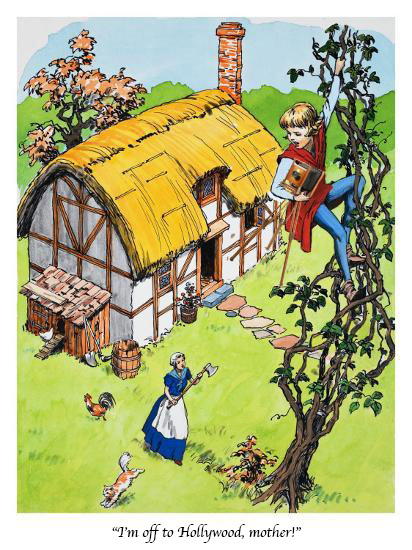
My mother leaves the choice in my hands. I am reminded of Jack and the Beanstalk, Jack’s mother entrusting him the family cow which their futures so depend on. She asks him to sell the cow, nothing more, nothing less. A simple task. And yet Jack does not come home that day with money, nor does he bring back food. He arrives home gleefully with some beans and a childish hope. 

We laugh at Jack for his foolishness, the ease with which he is swindled. Had he ever truly intended to sell the cow? Maybe, maybe not. Ambition and folly are two sides of the same coin. 

I decide to apply to film school, and it certainly feels like I’m bringing home magic beans. I had not made any films, nor ever made an attempt at writing one. It’s one thing to come home with purportedly magic beans if you’re a horticulturist, and another if you’re a poor boy named Jack who nobody wants to hire. Perhaps I had been swindled by the allure of Hollywood. Nonetheless, I’d made my choice and I would stick with it. 

I apply. My family is supportive. Unlike Jack, my mother chooses to place her hope in the dream I’ve chosen to follow. For a moment I am relieved, but I soon find that this is stressful in its own way. Jack was an underdog. His mother considered him a fool. Whether those beans grew or stayed in the soil for eternity—he had nothing more to lose. If Jack had anybody believing in him, I imagine he would have shown a bit more trepidation before beginning his climb.  

Out of Jack’s beans a great tall beanstalk grew, towering high into the sky. Meanwhile, I am admitted into a film school on the other side of the country. 

I have my worries, but I am excited to embark on my journey. A part of me has been craving an adventure, a chance to reinvent myself. And I could finally get out of Florida. So I climb up my own beanstalk, and enter a land that I had heard was full of ogres and giants: Hollywood. 

Jack is a different boy each time he climbs the beanstalk. He walks among monsters, hiding his true self with ease. He lies, he deceives, and in the end: he returns home with riches. 

In the summer before my first semester of college, I buy a new pair of glasses. A new wardrobe. I try to exercise more. Death of the old self, birth of the new. In fairy tales, a person can be torn apart limb by limb. So long as the pieces are put back together again, they’ll live. 

I start college. Attend classes. Make new friends, and fall out of touch with old ones. As I work on student film sets, I try to feign confidence. I fear that with one misstep I will be eaten alive. How did Jack do it? He tricks, thieves, and swindles as if he has been doing it all his life. 

March, 2020. I fly home for a spring break that will never end. Jack always climbed back down the beanstalk with a prize, a token of his accomplishment. As I re-enter my childhood home, I wish I had brought a hen that lays golden eggs with me. 

A few days later, a pandemic sweeps the nation. My college says we will be learning from home indefinitely. I ask what will happen to all the possessions I left behind. 

In quarantine, Jack’s story no longer feels relevant. I look at twitter. People are talking about Rapunzel. Look how easy it was for her, they say. And she was locked up all her life! Did she really want to leave that tower, I wonder? After all, she was safe there. 

I seal myself in my home, and I wait. Old friends occasionally show up outside. Perhaps one of them is my Prince. They invite me out, but I lie, say I’m in class. Or tired. Maybe tired in class. They’re aware I’m lying, trying to avoid them. They ask why I am so averse to catching up, so against rekindling old memories. I consider telling them. Telling them that I want to continue moving forward. That I do not want to slip into the past, into old habits and old selves. If I did—I fear I’d lose any progress I’ve made towards my happy ending. Why stray off the path now?

The old friends do not hear my reasoning, as I do not tell them. In jest, they call me cold or emotionless. Not always in jest. Of course, I disagree. But how we see ourselves in the mirror is bound to be different from how others view us. Unavoidable, really. 

I ask a new friend if he knows any fairy tales that resemble my situation. He recommends Oscar Wilde’s The Happy Prince. I give it a read. It’s the story of a golden statue with a heart of lead, who at night weeps for those suffering around him. With the help of a swallow, he donates pieces of himself in order to lighten their pain. I find the comparison amusing. Maybe I could try being a bit more sympathetic, I think. I’ll get around to it when this is all over. 

Days pass, then weeks, then days, then weeks again. The year draws to the close; another semester comes to an end.

I recall Sleeping Beauty. Everything in her kingdom is thrown into a hundred year slumber—servants, the flies on the wall, even the fire in the hearth. It is as if time has stopped. The story provides me some comfort in a period of great stagnation. 

Patience. Waiting. What was she dreaming about all those years? The past? The future? Or something else entirely?

The bags under my eyes get darker. I try to improve my sleeping habits. Less time awake, more time dreaming. 

I make plans for the future. I write them down, knowing they will fall through. I lay awake and dream of what my life has in store. Fairy tales often end with a wedding, but what comes next? Surely Sleeping Beauty had trouble adjusting to the new world, a century removed from her own. Surely Jack could never forget the land of giants that always looms above him. Surely their happy endings could never last. 

Day by day we climb higher and higher, stories giving our world form and direction. But what to do once the summit is reached, and the story ends? We fall into a life undefined. A terrifying world of infinite possibilities and limitless potential. 
The Giant in the Yard

By Zach Irving

I took our original project idea to heart and decided to pair a series of observations made around my yard with some related reflections on various fairy tale themes. I am not a photographer, and thus there are no photos. But, for one of the more magical moments, I did find a related and very heartwarming and hilarious video: Sandhill Cranes Flight Training. You will know from reading the appropriate point to watch it.

It was winter last week and I felt like I was summering in the Hamptons. I’ve never been there, but the sun was that perfect strength where you want to take off your shirt not for relief but for warmth, and somehow, I imagine that’s what it’s like. We don’t really get winters in Florida so much as days here and there that make you forget you’re in Florida. The only observable change of season is a sort of general loss of saturation in the trees and the grass – few feel the need to give up their leaves. As a result, I’ve never experienced a true winter setting, with the cold and the snow as background to daily life rather than vacation destination.

In “The Little Match Girl”, Hans Christian Anderson takes winter to its extreme. The cold is bitter, and the darkness is cold. It numbs and it howls, and, in the end, it kills. And this is not an unfair view of winter. For those without a hearth and home, it is deadly. A winter which spares you at first might ruin your crops and starve you in the end. We now know that lack of sunlight can literally make you depressed. The Norse, familiar with winter, thought of hell as everlasting ice, not fire. Winter is, after all, the retreat of the sun – the life giver. I sympathize with this perspective, but sometimes, when each year is the same, unbroken by the seasons, I find myself wishing my winters were wintrier.

There’s something beautiful about the real cold, the kind with ice and snow. People routinely brave the cold for a chance to see glaciers and mountains, and the more inhospitable they are the more beautiful they seem. Acres of unbroken ice make Antarctica one of the most stunning places on Earth. Snow White, fairest in all the land, is so because her skin is white as snow. Her paleness should, by association with winter, frighten and repulse us (Neil Gaiman explores this connection in “Snow, Glass, Apples”). Instead, her skin makes her special. Pure white skin is rare, like diamonds or gold. And it is also delicate, ruined by exposure to sunlight. And I think this is how I feel about the winter. It comes once a year, and in many places never. It is melted away quickly by the sun. Like Snow White’s voyeurs, we want to view the strange and fragile creature while we can – and for only so long as it remains strange and fragile. Too long of a winter, or one that makes us fragile instead of it, is feared rather than desired.

But it was not winter today and I sat in the back patio looking over the yard. The birds arrived around 12:45, with something red darting across the scene and pre-empting the arrival of three cranes who stalk our yard. I have a somewhat tense relationship with the cranes which stems from several prior encounters I had while painting our side fences. Our right fence, in the front of the house, runs through a slight ditch which fills with water regularly during the summer season. Much of the cranes’ day is spent in this area, pecking in the puddles for whatever it is they eat. My project thus took me directly into what they perceived as their territory. Indeed, these cranes appeared to lack even the most rudimentary grasp of private property, and my attempts to explain that I needed only to access our fence and did not mean to evacuate them from the premises, fell flat. As I crept closer, the cranes performed a sort of pre-fight maneuver in which they make loud noises and attempt to appear as big as they can. I did my best to offer no response. Eventually they gave up their spot, but we repeated this encounter for several days.

The cranes were now in the back yard, however, and unaware of my watching them. The three of them form a family unit, two parents and a smaller child. The largest one is carrying out a bizarre exercise wherein he jumps about two feet off the ground and flaps his wings with great force but little speed. It is distinct from the aforementioned fighting maneuver. Periodically the young crane copies him. The other one continues to eat. I am just about ready to give up on interpreting the affair when it occurs to me that I am watching the young crane learn to fly. Unlike smaller birds, cranes launch themselves from the ground instead of from a tree, and so they apparently need to actually learn how to do so. The little crane gets a couple feet off the ground but cannot sustain it. They give up eventually. Progress, perhaps, but not success.

After watching this I felt strangely like I had intruded. The scene felt like private, family business. Like watching a father and son have their first drink, or someone else’s baby take its first steps. One of those moments that makes you see the human in the animal. Fairy tales do something similar: a wolf which talks and plots in “Little Red Riding Hood”, pigs and frogs and dogs which turn into people after a kiss. But these animals are really humans in disguise; often speaking, and always with the capacity for rational thought. By portraying them as animals we associate them with the natural world, which we separate them from ourselves. This allows us, especially as children, to comprehend those parts of ourselves most animal-like: our willingness to destroy and consume, our anger and our appetites. We can more readily see a wolf as evil, a pig as dirty, a frog as grubby. What fairy tales do is to make us see the animal in the human, not the other way around.

I remember as a child being irrationally afraid of animals, thinking that if I ever laid eyes upon a snake or spider or bear my death would soon follow. I was even afraid of the crane at first, with its sharp beak and loud noises, and took extra care to always cede the playground to them. But as I aged my fear of the natural world began to mellow. For the most part, if you don’t bother animals, they won’t bother you – an oft repeated sentiment which never sunk in for young me. This tendency, to fear animals more than man, is partially refuted by tales which tell us man can be evil too. But that animals are not something to be feared is always left out. Even the animal brides are always humans in disguise, or at the least, turn into them.  It could be that I never read the animal bride tales as a child, and so never saw the animal’s redemption. I think this is an unhealthy fear, and I worry that fairy tales exacerbate it.

The most fearsome of all fairy tale villains is the man-eater. Commonly represented by ogres and giants, and almost never by humans (even Bluebeard does not eat his victims), the man-eater plays off two deep-seated fears. Most plainly, of death and dying. But why does being eaten afterwards bother us so much? It is because it demonstrates a fundamental lack of respect. Bluebeard has the decency to at least admire his collection of dead women, to recognize them as human, and thus, not as food. But a man-eater has no such qualms. It is no accident that they are generally giants. The giant is bigger and stronger than us, and he eats us because to him, we are food. We observe the same relationship with many animals, where the big (us) swallows the little (cows, pigs, etc.). And we are very afraid that we might not actually be the biggest ones around. This fear of being small and worthless is what makes the man-eater and the giant so much worse.  

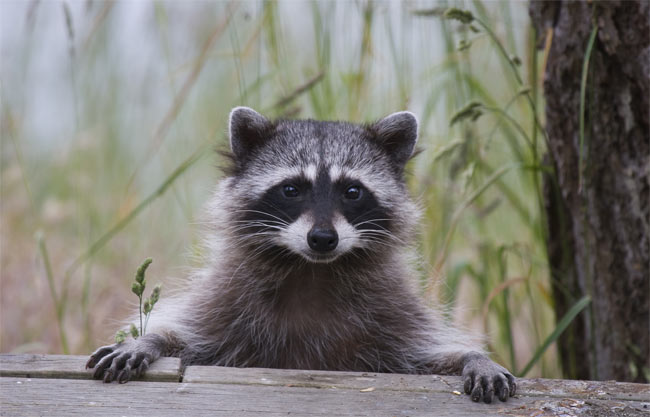
I decide to take a short walk out to the lake. As I dangle my legs over the edge of the dock, I see out of the corner of my eye some forest rustling. I turn and spot a racoon approaching the water’s edge. He does this curious thing with his hands in the water, as if he were trying to wash his hands but no one had ever shown him how. When he sees me he freezes. His racoon mother must have told him that predators can’t see without movement. Annoyed at the interruption, he leaves.

The raccoons are robbers. Specifically, they rob our cat. And they have developed a systematized approach to this robbery. At the time of approach (8 o clock, on the dot), we are either in the living or dining room. They check each room for us, leaving a lookout posted at the window in case we should check for them. Meanwhile, the other raccoons (there is always at least two, and up to four), approach the cat feeder and eat as fast as they possibly can. It’s easy enough to scare them off, with a clap or a stomp, and they scamper away like in a cartoon, looking back over their shoulder instead of at the road ahead.

It’s a hilarious routine, but I feel weirdly guilty about scaring them off. It isn’t like we don’t have food to spare, and their success rate is so low that they must be quite desperate to keep coming back. And our cat doesn’t seem to mind – she sits on the couch and watches them unbothered. But it just feels like we’re being robbed, and like the proper response to that is to chase off the robbers. Not to mention, making it easy for them to steal, or, worse, actively feeding them, will only encourage them to come back, unknown diseases and all. But running them off always makes me feel like a giant. And while I don’t ever want to meet a giant, I don’t want to be one either.

A Promise

By Ian Gray

My parents are my best friends

Or is it were?

I do not know

It is hard to say anymore

Did Snow White like her parents?

Her dad was absent

Her mother was dead

Her stepmother wished her dead

What did she feel as she ran? 

Through the woods

Far from a life she knew

Far from a life that nearly killed her

Would she have run if she knew?

The frightening woods

Her stepmother’s relentless pursuit 

A poison apple

I knew something was wrong

Why did I not ask?

A scared student

A scared son

Would Gretel have known?

Even if she did not hear

By the look of her mother

The pain of her father

Could they have talked?

Before the abandonment

Before the hunger

Before the witch

Where did they find hope?

Pebbles on a path

A scrawny bone

Her quick shove

We sat in the kitchen

Was the food supposed to be comforting?

A father no longer invincible

A son no longer a child

Does cancer have a place in fairy tales?

Only a sorcerer could concoct such a curse

A scientific reality

And a scientific mystery

Would Bluebeard’s wrath be this frightening?

A sorcerer can be outsmarted

A sorcerer can be stabbed

His house does fall

Where does one stab illness?

An invisible enemy

Arriving in silence

Leaving silence

I thought we would thrive together

Did he look forward to the future as much as I?

I wanted to be a team

Working, laughing, living

How did Jack’s father die?

I want Jack’s curiosity

His courage

His luck

Was his void ever filled?

His empty stomach

His empty soul

A boy in need of magic

Can I still kill giants?

Because I really need to

Jack did

But not everyone does

I need a promise

Is it too abstract a request?

A promise to hold

A promise kept

From where do promises come?

To where do promises go?

Are they steady and unchanging?

Or dynamic, full of life’s complexity?

I will be a promise

Standing firm for my family

Listening to life’s lyric

Holding tight, never letting go


In the summer of 2016, a week before Ian started his senior year of high school, his father was diagnosed with cancer. Treatment began shortly thereafter. His father spent Ian’s 18th birthday in the hospital fighting to survive a major surgery, which he did. The cancer, however, returned a few months later, and a couple weeks before Ian’s high school graduation, his father died. 

Ian considers his biggest blessing in life to be his parents. His admiration for his mother grows every single day as she continues to lead him and his two younger sisters. Ian strives to make his parents proud and be a son deserving of such wonderful parents. 

Ian is inspired by fairytales, magic, and the inherent promise buried within fairytales. Though there are many ways one could describe this promise, Ian’s father got to its essence in his consistent, steady reminder, “God is still on His throne.”

From the Ever After, Looking Back at the Once

by Conner Wilson

I wanted to examine memory and perspective, and the ways that certain things linger within us–some might even haunt us–long after they happen. I think there is something especially interesting about how we relate to those things that seem truly momentous, or truly magical.

In these poems, I assume the perspective of a number of fairy tale characters, ranging from the Big Bad Wolf to Bluebeard’s Wife, and try to imagine how they would reflect on a particular moment depicted in an illustration.

Propp’s Gallery Show “Encounters”

By Alexis SooHoo

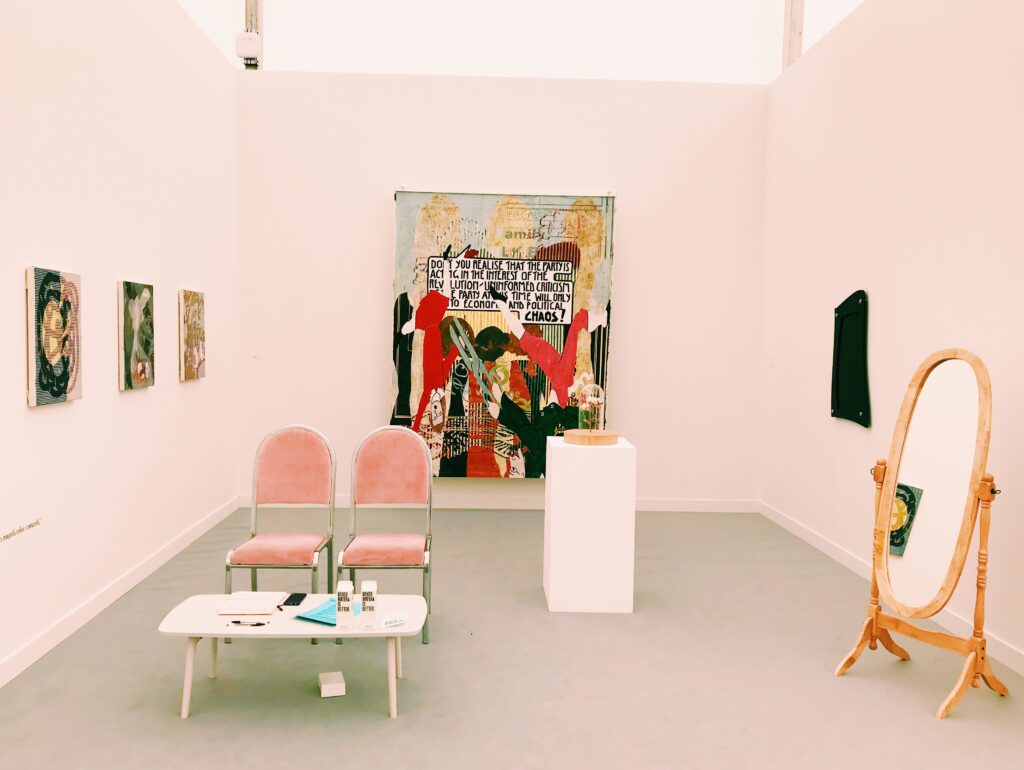
FRIEZE Los Angeles 2020

From the moment I realized that art could be my future, I felt like I had been struck by lightning. Thus, the same way every project with an ounce of creative freedom has led back to art, this one will too. This semester, I had the opportunity to work with an LA art gallery. I learned how to mount and clean oil paintings properly without damaging the texture, how to delicately navigate art world egos and how to compose art show invitations with a flair.

Most of all, I learned how to look at art as a collector, dealer or artist would. Unlike masterpieces one would learn in art history, contemporary art is about creating a connection with a piece beyond contextualization and historical analysis. Every time you revisit a piece, you should see, think and feel something new. Viewing art is an interactive, visceral and aesthetic pursuit, too often sullied by the scathing opinion of critics and professors. Unfortunately, like the academic sellout I am, today I seek to create an interdisciplinary experience between literature and art.

Propp’s Art Gallery | Encounters is an art show that features a selection of my personal favorite contemporary pieces and universally acclaimed paintings. They are presented through six different Propp Function lenses, each providing different commentary or new perspective on classic tales. Each piece speaks towards an encounter with the Propp theme, they will touch upon the content, the creation process, the contextualization in the current day, or the piece’s experience in the art world. Regardless, they seek to modernize traditional storytelling techniques and allow each viewer to become the hero of their own fairytale.

Below, I attach a PDF document that describes each section of the art show. Click here to view the virtual show.

Secret Chamber

By Alexis Chun

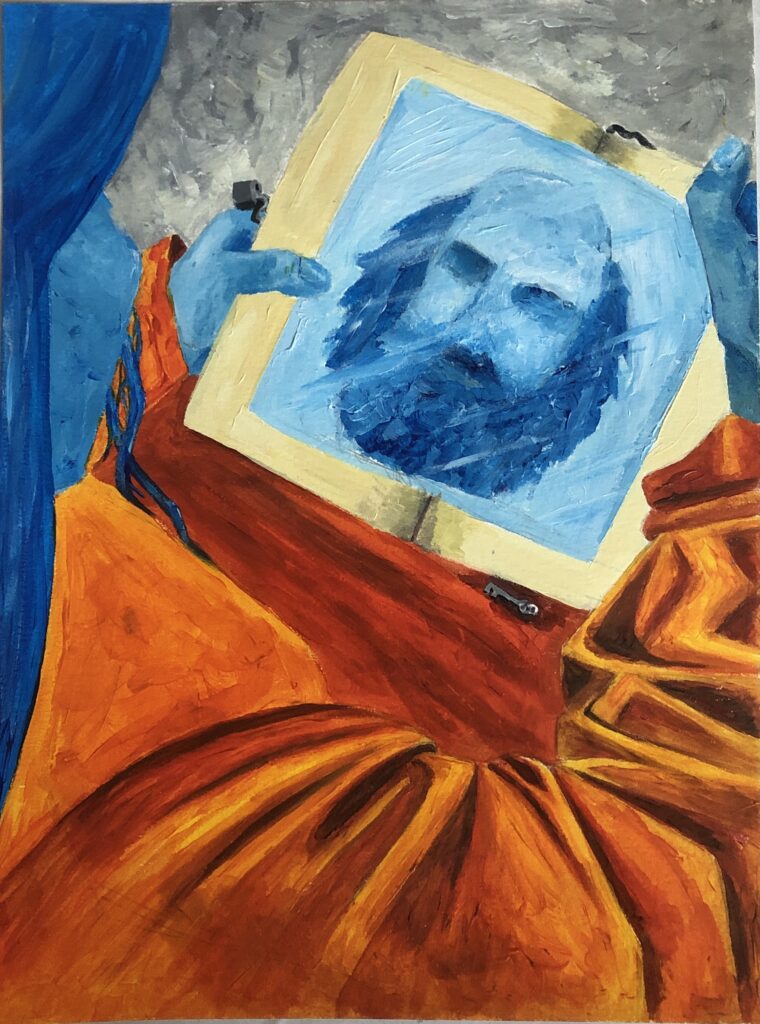
              In this painting, I wanted to portray the idea of the fairytale villain as someone or something that exists within us. When I was choosing which characters to paint, it was important to me that I choose a male villain and female protagonist. In addition to illustrating that there can be a villain within the hero, I also wanted to show the presence of an internalized male gaze. This intention led me to choose Bluebeard as my villain, and this painting became very inspired by Margaret Atwood’s short story, Bluebeard’s Egg. My painting shows a girl writing in a journal, but inside the journal is a mirror that reflects not her own image, but the image of Bluebeard. The Bluebeard and the girl’s skin and hair are painted in blue tones, while the girl’s clothes are orange. By using opposing colors, I created a direct contrast between the way the girl perceives and presents herself, and her true nature.

Medium: Acrylic paint on paper

Once Upon a Podcast

Morgan and Olivia

Director’s Note:

This project was inspired by our weekly traditions of cozying up to watch the drama of The Bachelorette unfold with our roommates. Once Upon a Podcast allowed us to critically analyze something that we already enjoy, ABC’s The Bachelorette, and to see it through a new lens with the context of our acquired knowledge about fairy tales from this course. The purpose of this project was to bring attention to the manner in which The Bachelor and The Bachelorette exploit the romantic motifs and themes that fairy tales are often reduced to in popular culture, while choosing to leave out many of the deeper analyses that we have discovered throughout this course. We discuss topics such as love vs. lust, loneliness and abandonment, the pursuit of love, and the ideal and unrealistic “reality show” expectations. We chose a video podcast format because it is a popular and convenient media form that has potential to be relatable for many young people and we thought it could reach our audience in a similar way to how the Bachelor Franchise engages us. Enjoy!

Morgan & Olivia

ATU Index Digital Companion

By Veronica Backer-Peral

For my final project, I created a digital version of Hans-Jorg-Uther’s The Types of International Folktales, more commonly known as the ATU fairytale index.

Throughout this project I learned to merge my passion for computer science, data analysis and web design with a field that I had never previously thought could be compatible with computers. Not only did I learn how to design a website and use JavaScript to supplement HTML code, I also got to familiarize myself a lot more with the ATU Index and even query the data using a Neo4J database.

Princess Timeline

By Lianlen Joy Go Distor

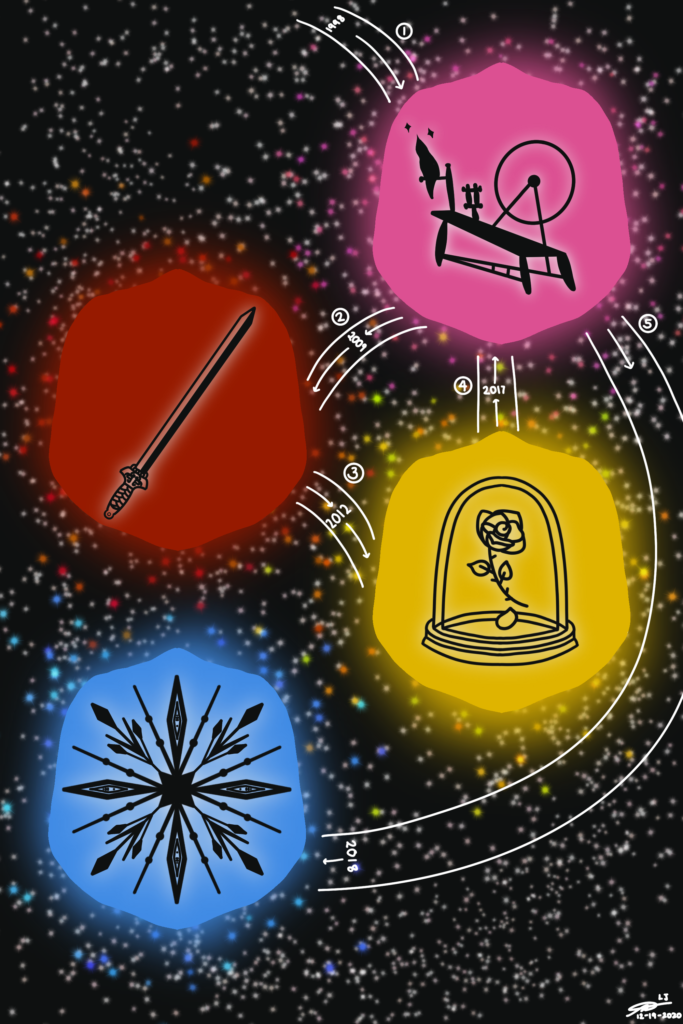
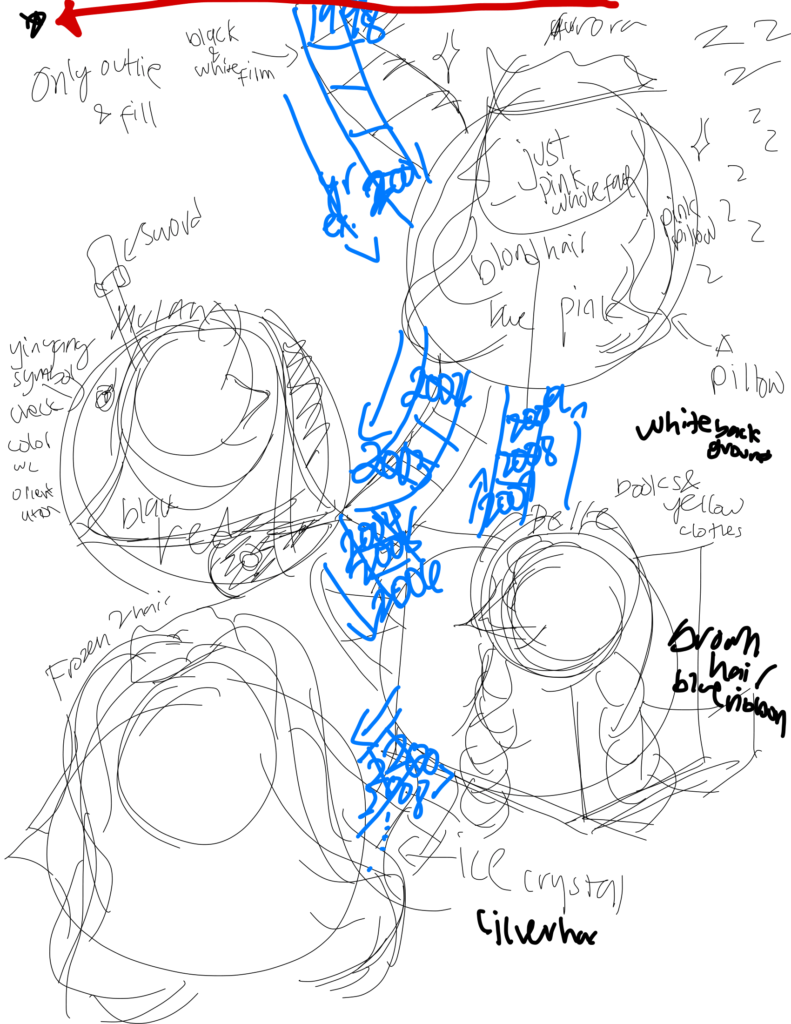
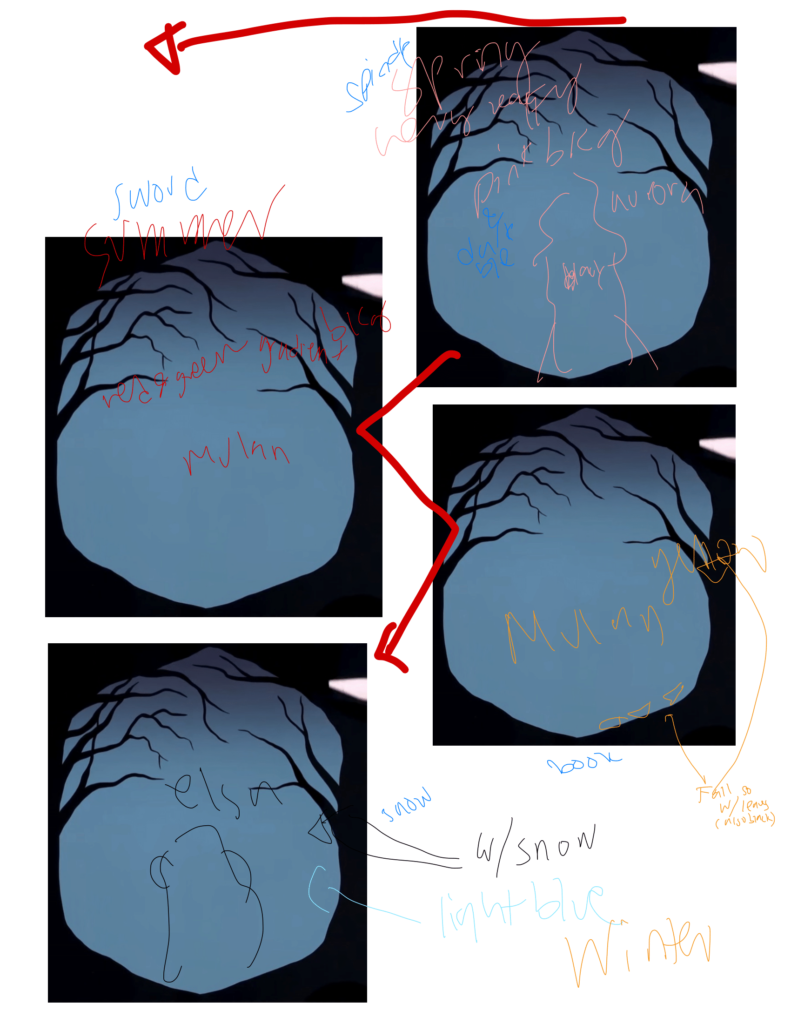
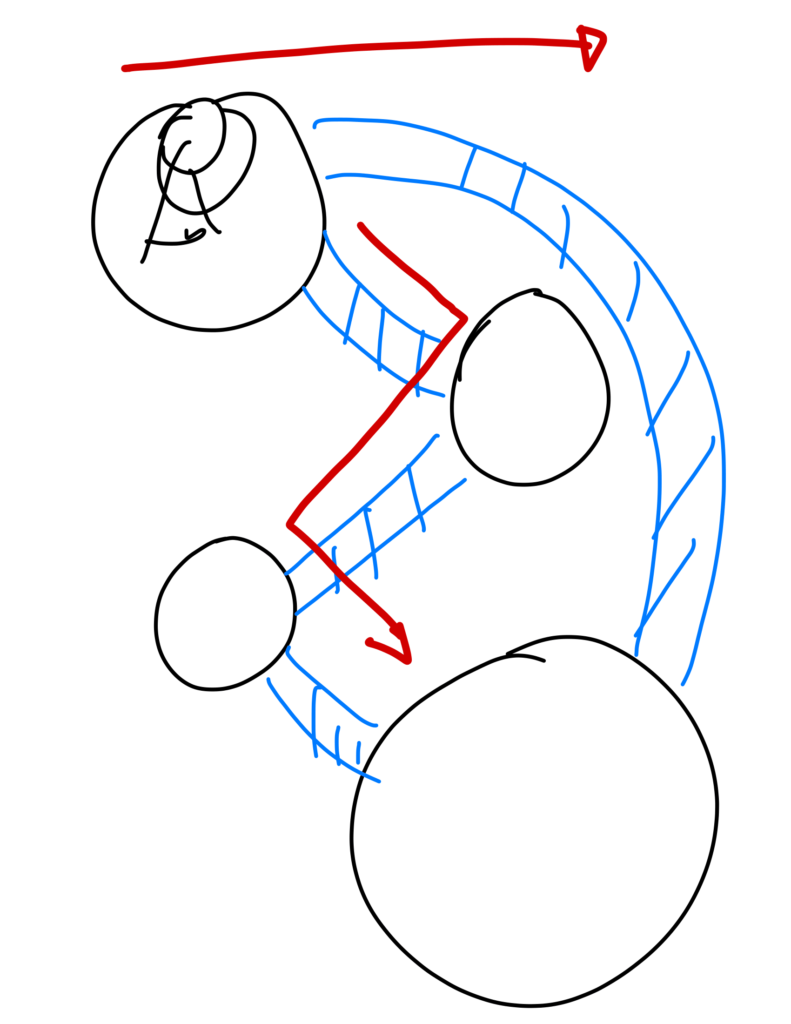
For this project, I decided to make a mini timeline of my Disney princess choices as I grew up. This project is also meaningful as I wrote about it in my first discussion board for the class. Overall, this project is a self-exploration because I wanted to visually track my choice of Disney princesses and how I switched identifying with each character as I grew up.

The Process

The Ambiguity of Villainy

By Erica Alston

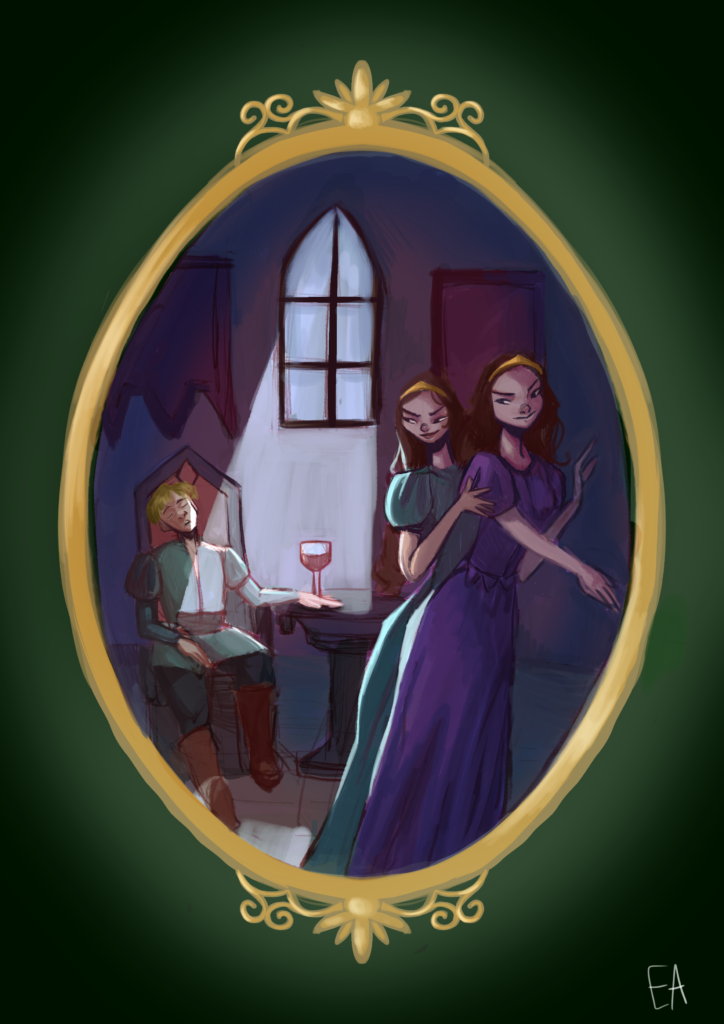
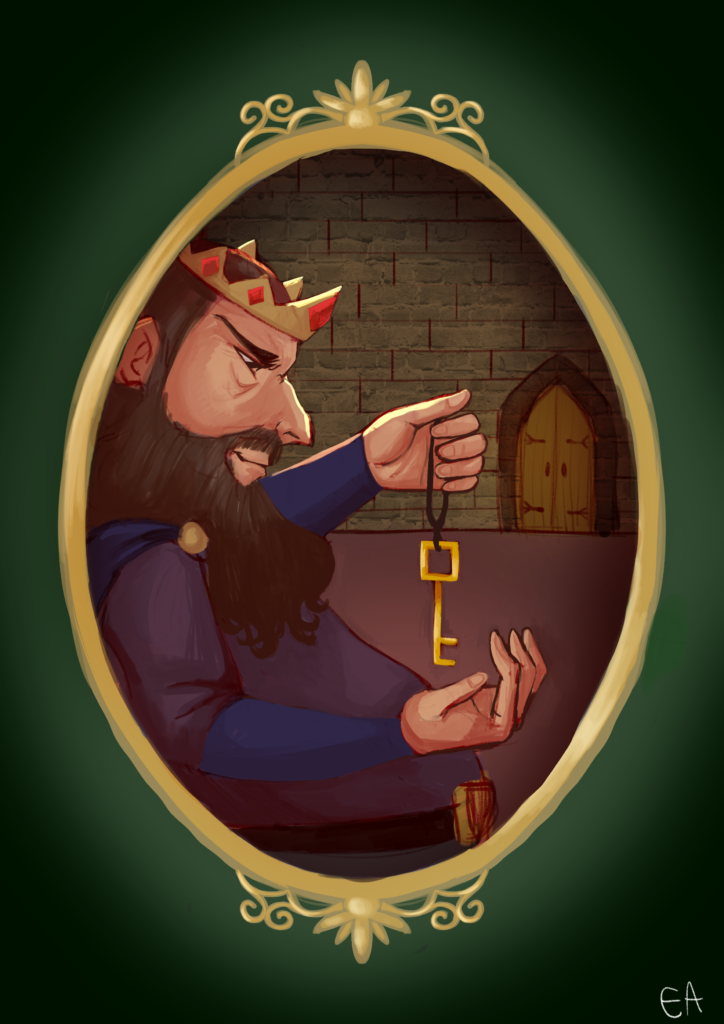
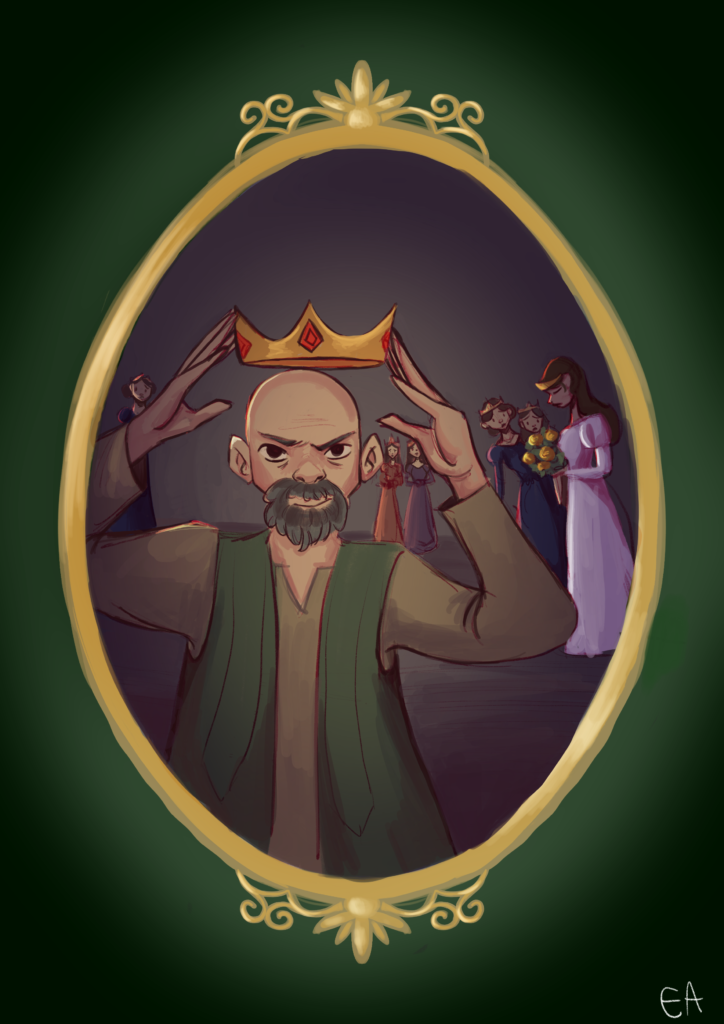
The Brothers Grimm version of “The Twelve Dancing Princesses” is a tale of villainy regarding the main characters: the king, the princesses, and the old soldier. Depending on the perspective from which one reads the story, each of the characters engages in some sort of villainy. The king locks up his daughters every night, trying to take away their freedom and the dancing that they love. There is no indication that the princesses are in danger, so the king is controlling for little reason. The princesses drug the men that take on the challenge of discovering their midnight whereabouts, leading to their deaths as they fail the challenge. Finally, the old soldier only wants to be king. He takes away the source or the princesses’ happiness for the purpose of becoming heir to the throne. The story does not have a clear indication of who is the villain because each character commits villainous acts.

The paintings are visual representations of each characters’ villainy: the princesses and the drugged wine, the king and his locks, and the old soldier and his new crown.

Medium: Digital

Read the story here: https://www.jstor.org/stable/pdf/j.ctt1c0gms9.4.pdf?refreqid=excelsior%3A08b2d464c875e7fb62c0436e1ac332ca

css.php