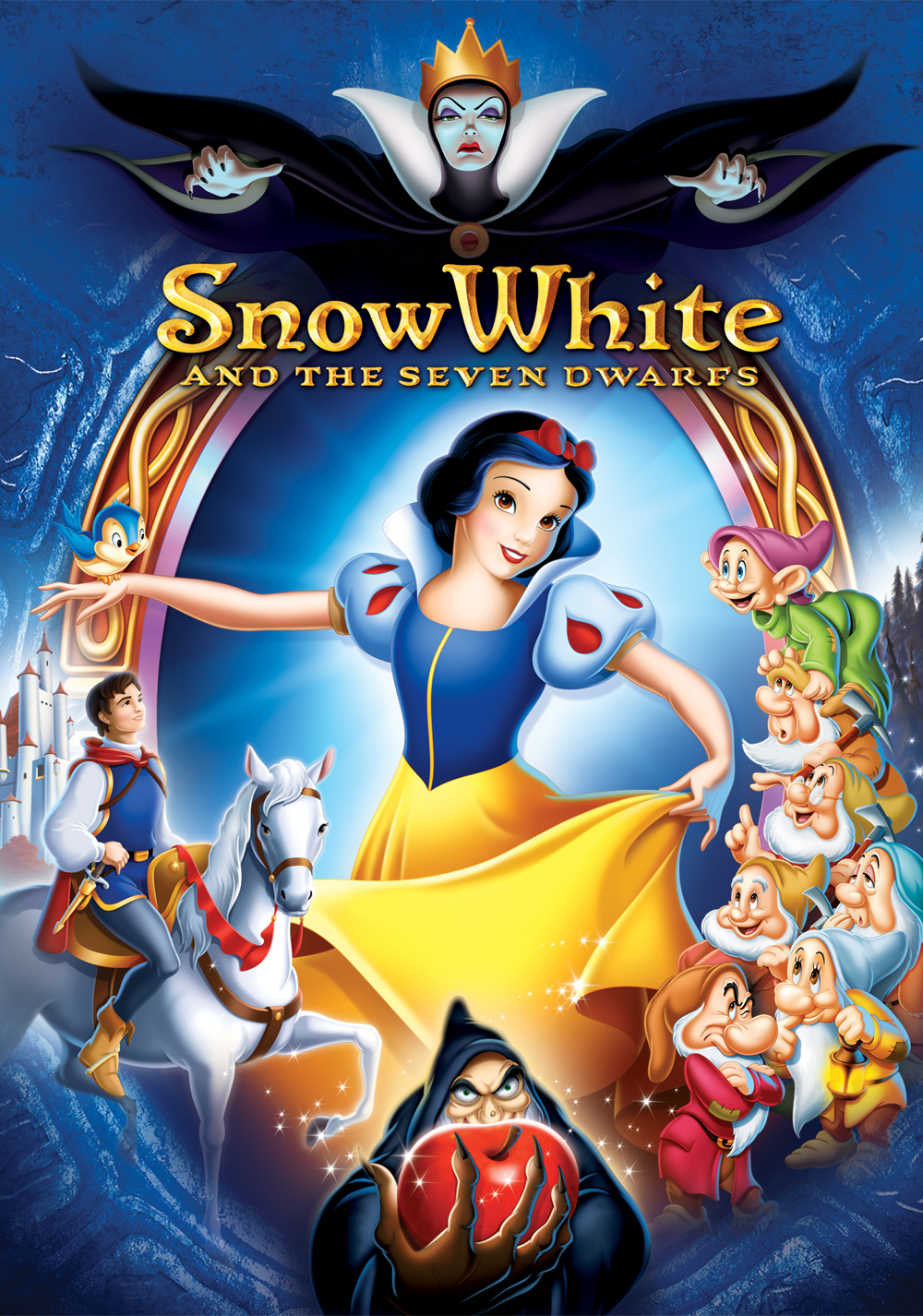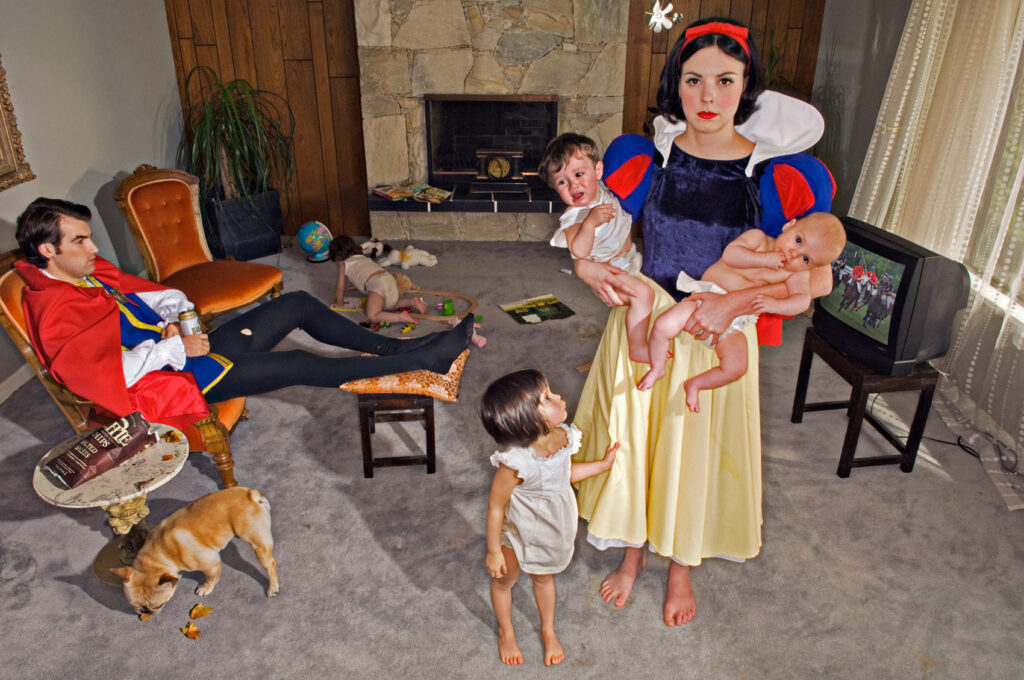
How Women are Affected by Gender Role Stereotypes in Fairy Tales

By, Liam Critchett

Virginia Woolf, A Room of One’s Own, (Penguin: London), 2000, p.37

Abstract

My project is an analysis into the breakdown of why gender roles in fairy tales are pushed on women due to the authors choices. The biggest problem in these stories I have found comes from the way women are continually represented, and the inability for change or evolution in these characters. The authors who wrote these stories had the view that women belonged in the domestic sphere and relied almost entirely on the men around them for basic life necessities. Although the original Fairy Tales provide many important life lessons, because of the ideals from time they were written in along with forcing women into the domestic sphere, the message cannot be received in the same way by children today because of progressiveness in the world today. By using the articles of highly respected authors within the field of dissecting fairy tales, and analyzing the works created by those individuals my paper will highlight the reoccurring issues fairy tales have when addressing gender roles. With this new understanding, my paper will allow the average reader to understand the problems fairy tales have when being passed to the younger generations while reviewing solutions to allow these timeless works to be better suited for the world we live in today. By shifting the focus of fairy tales to match the diversity and acceptance our world has today, it will allow the readers to better understand the people and surroundings that they will come across in the real world.  

Project 3

From the time the first fairy tale was created it was always intended to provide life lessons to the young audience to allow them to grasp the world around them without prior experience. These fairy tales represented the time of their creation, allowing them to be understood by making assumptions of the characters to fit the cultural norms of the time to provide a sense of stability to the readers. To provide the best messages to the readers in the world we live in today, the fairy tales should be re-written to promote diversity and acceptance that is represented by our ideal society today. By addressing problems that each generation will face within their lives, the authors of original fairy tales provided an extended life span to their stories which few works are lucky enough to have, but it is because of this design that it is more important to adapt the works to evolve along with the time. Although the original Fairy Tales provide many important life lessons, because of the ideals from time they were written in along with forcing women into the domestic sphere, the message cannot be received in the same way by children today because of progressiveness in the world today. 

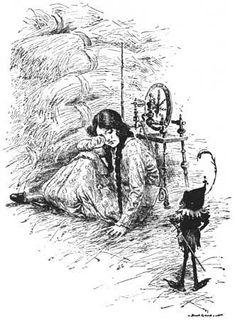
Fairy tales undervalue and push female characters to the side of the story to further the narrative that which women need to rely on men to survive. One of the most obvious times this happens comes from the early version of Rumpelstiltskin by the Brothers Grimm. Where in the story the daughter of a mill owner is locked inside a castle to spin straw into gold, throughout the story she bargains with Rumpelstiltskin to eventually be rescued by him. This not only represents the female character as being helpless but also categorizes her into a subservient job equivalent to sewing which would be a widespread activity for women in the household at the time. Also, the Millers daughter is used as a bargaining chip to the king of the land to try and appear as holding a higher class by no work of his own. By targeting these central ideas to the story, it is not intended breakdown the original storyline and messages that come with it. However, if this same story were to be read today by a young audience, the cunning and witty messages would be missed because the father daughter dynamics have changed so drastically this would seem far from normal. The issues have been covered by many scholarly articles one of which is written by Allison Craven, who discusses the blatant sexism that is present in almost all original fairy tales. ‘The book discusses the “the rise of post-feminism, and its implicit disavowal of feminism, the mythopoetic men’s movement and the crisis of masculinity’” (Craven). With her entire thesis being about the importance of the post-feminism era, while discussing the clear avoidance of Belle being the main character in the Disney production of Beauty and the Beast, Craven targets the inability for fairy tales to represent women accurately. She does not stop there, but also brings up the importance of shifting these beliefs in order to not impart them on the growing generation as it rejects the world of acceptance and diversity present today. Another important idea she brings up comes from the adaptations of these fairy tales into movies by Disney, in which they still carry on these problematic scenarios instead of working through these assumptions made hundreds of years ago by the men in power. One of the reasons Craven holds so much weight in these Disney adaptations stems from the ability of the producers and directors to alter characters and how they are represented without changing the story to better inform the viewers of the message the movie is presenting. Craven places more emphasis on the changes needing to come from Disney in the adaptations of the fairy tales because without changing these characters within the story, the movies continue to perpetuate the sex roles defined by men for women hundreds of years ago while these standards are presented to the newer generation leading to the continued struggles for women in today’s world. Why Craven’s argument within her article is so important comes from the lack of responsibility Disney takes for continuing these misogynistic ideals, as the adaptations are in some way carbon copies of the original work. Some may argue that the intended goal of Disney and the fairy tale movies are to represent the original fairy tales most accurately to preserve the messages while spreading the works to the most amount of people. However, with these ideas in mind the original fairy tales are already successful which negates the idea of them becoming more widespread through a film adaptation. With that being said, the messaging can still hold value without the story degrading groups of characters just because the original authors did as well. This is an age-old debate, but from the articles written by Seifert, they begin to discuss the missed opportunities within adaptational works to include diverse characters to show inclusion where it does not affect the story. With male authors refusing to branch out from the heterosexual characters originally in the works, fairy tales lack the evolution seen in the world today and often misrepresent the readers of the story or even hold readers and viewers back from interacting with the story because they do not see themselves within the story. All these ideas allow readers and viewers of the fairy tales to be pushed away by no fault of their own and develop the sense that they are alone in the world. 

The importance of developing characters to build around in a story is one of the main principles of fostering a strong narrative that captures the reader’s attention. One of the main concerns these fairy tales bring to light is the lack of character development, and in many cases allowing the audience to use only assumptions to describe the entire character. This can be argued that in written works it is important that the audience is able to paint their own picture, showing how descriptive the author is allowing for readers to be immersed in the story. However, this is not the case for fairy tales as the authors of the original works have chosen to not only misrepresent women but also criminally under develop all male characters to influence the readers to assume most of the important characteristics of their favorite characters. With so much time focusing on the importance of women being controlled by men in many of the stories, like Rumpelstiltskin as well as The Frog King. As women are pigeon-holed in these stories, often over analyzed, and targeted around the problem, men in these stories are an afterthought which is the topic of Attebery’s article. By targeting the men as the underdeveloped characters, it illuminates the lack of depth they have, making it important for the audience to assume what the author is saying to fill in the blanks. The assumptions however are targeting an audience hundreds of years ago with far underdeveloped cultural norms to the world we live in today, which brings the fairy tales again to the adaptations through Disney and the articles mentioned before. Craven already highlighted the lack of ownership Disney took in recreating these stories for film, and Seifert’s point comes to the forefront of this discussion as well. With all the characters being underdeveloped and assumptions made through standards that are far from acceptable, it requires the question of if Disney supported these ideas. Although this would explain the lack of character development to accompany the over sexualization of women, these patriarchal views are furthered by Disney but not perpetuated by them. To Seifert’s point many opportunities to implement different sexualities as well as diverse characters are lacking, and for fairy tales to impact the next generation with the great messages that they carry it critical to encompass all parts of human nature today. This brings me to the next article written by Monique Banks, where she discusses the importance of the timeframe original fairy tales were written in and how it impacts the narrative within the story. For the Grimm Brothers’ each story and the assumptions made about the characters were completely normal as they attempted to share the stories with the world to explain valuable life lessons. Banks’ understanding of this situation allows her to deeply analyze the situational acceptance that the authors should be awarded and the continued importance of the following adaptations to adjust the works to value the same message but reflect the people reading or watching the story and the world they live in. 

For fairy tales to continue to grow and develop as an important part of our society today it is imperative for the adaptations that follow the original works to broaden the horizons of the acceptance within the stories. This means to truly spread the life lessons learned in the story, characters need to be changed to promote diversity while also expanding the roles and development of women within the story to celebrate the positive steps our world has taken from the time the stories were written. 

Works Cited

Craven, Allison. Fairy Tale Interrupted: Feminism, Masculinity, Wonder Cinema. Peter Lang, 2017. 

Banks, Monique. “Rewards and Punishments as Developing Gendered Ideologies in Grimm Brothers’ Briar Rose.” Literator, vol. 41, no. 1, 2020, doi:10.4102/lit.v41i1.1618. 

Attebery. “Reinventing Masculinity in Fairy Tales by Men.” Marvels & Tales, vol. 32, no. 2, 2018, p. 314., doi:10.13110/marvelstales.32.2.0314. 

Seifert. “Introduction: Queer(Ing) Fairy Tales.” Marvels & Tales, vol. 29, no. 1, 2015, p. 15., doi:10.13110/marvelstales.29.1.0015. 

Jorgensen. “The Most Beautiful of All: A Quantitative Approach to Fairy-Tale Femininity.” The Journal of American Folklore, vol. 132, no. 523, 2019, p. 36., doi:10.5406/jamerfolk.132.523.0036. 

The Spoken Word: A Comparison of Fairy Tales and Online Anonymity

ABSTRACT

Online anonymity is both a blessing and a curse. On one hand, studies show that anonymity gives users a sense of security, and a way to share honest thoughts and feelings without judgement. On the other hand, this provides users to say or do things online that may be harmful to others, without fearing the consequences. There is extensive current research on both the benefits and negatives of online anonymity, in general as well as across multiple platforms, as well as whether anything posted online is even anonymous at all. To my knowledge, there is not as much research conducted on the potential individual consequences for those who carelessly post something offensive or malicious anonymously online. My paper explores the similarities between the internet and the fairy tale world in terms the weight words have, from casual promises, wishes, and curses. In fairy tales, there is most often an unseen force that responds to the careless words of characters, and holds them accountable. Similarly, the internet is a place in which any comment or post can be retraced by large companies and governments, thus there is no real anonymity. Without real anonymity, there will always remain a possibility of being held accountable. I argue that fairy tales remind us to remain vigilant in thinking before we speak and post lest we are one day held accountable for our carelessness.

INTRODUCTION

The advent of social media, though positive in many ways, has created a space like a masquerade ball. Everyone wears a mask, though some choose not to obscure their faces too much and some can be recognized despite their masks. When one wears a mask, however, a phenomenon occurs where the masked feels free to say and do things they normally would not, unconsciously believing that they will not be held accountable for their actions. It seems the world has forgotten that the clock will still strike midnight, and that is when the person underneath the mask will return to reality, to face the consequences of their carelessness the night before. The fairy tale world informs internet users on the false perception of online anonymity through wishes and woes lamented in privacy, detached promises, and incidental and intended curses with severe repercussions.

BACKGROUND

“The notion of anonymity is related to freedom from identification, secrecy, and lack of distinction”(Scott 875). It is the removal of all factors that can identify an individual. Anonymity has been involved with the internet since the mid-1990s when the internet was first opened to the public after being developed and used as a weapon during the cold war (History.com Editors). With no strict identification policies at the time, essentially all users could have been considered either anonymous or identifiable. This paved the way for deception, trolling, and cyberbullying, due to the impression of detachment and lack of accountability that anonymity provided (Sharon, John 4179). Then, around 1999, the internet started being commercialized by various companies, shifting internet communication culture from anonymous engagement to cooperative engagement (Scott 876). The debate concerning online privacy and anonymity continues to this day with little progress made. It was as recent as 2019 that Facebook went under fire for violating user privacy and in April 2021 they came under criticism again when hackers exposed the personal information of over 530 million users from 2019. Nothing shared or posted on the internet is completely private and, oddly enough, the same goes for anything spoken aloud in the world of fairy tales.

WISHES AND SUPPORT GROUPS

Wishes are granted in the fairy tale world in the same way that anonymous internet users find support from other anonymous users online. A wish is a desire for something likely unattainable and it’s presence confirms a feeling of lack or discontentment, for no one would wish for more if they feel fulfilled. Both Grimm’s fairy tales Snow White and The Juniper Tree start with a woman, sitting alone in winter, who accidentally cuts herself and bleeds and then wishes for “a child as red as blood and white as snow”(245). The lack in both cases was the lack of a child. What is notable is that both women were completely alone when they made their wishes. Meaning that there was less of a magical power granting their wishes than the wishes being the power itself. In a study done on the mobile app, Secret, used to anonymously communicate with facebook friends and phone contacts, participants reported that the anonymous platform gave them a chance to interact without the filters of social pressure used in Facebook communication (Sharon and John, 4183). In other words, where facebook highlighted the best of users lives, Secrets revealed the worst of it. Despite showing the worst instead of the best, Secrets fostered a community of genuine care. One participant reported seeing the anonymous community come together to provide emotional support to a suicidal user. Another study sought to identify the number of anonymous users on Twitter and what types of account content were more likely to come from an anonymous user and found that accounts supporting the LGBTQ community and accounts openly discussing relationship and health issues were more likely to be anonymous (Peddinti, Ross, Cappos, 87). Similarly to Secrets, these anonymous accounts were able to form communities of people with similar sexual orientations or personal dilemmas that provided users with solace. Just as a wish is a desire to fill a lack, revealing personal dilemmas is implicitly a wish for the dilemma to resolve and despite being alone or unidentifiable, there is someone or something listening and responding. In certain cases, one is met with love and support from people and powers unknown to them. Unfortunately, that is not always the case.

AVOIDING RESPONSIBILITY

Although online anonymity can often help grant wishes, there are more cases where it fosters detachedness towards other users, and users are incognizant of possible consequences of what they say, just as how many fairy tale characters make promises in the moment, without thinking of keeping them or not. The presence of anonymity by definition means avoidance of responsibility for whatever was said or done while anonymous. In an article exploring the relationship between online anonymity and personal responsibility, Tim Jordan acknowledges this by saying, “Those calling in swats, or sending multiple pizzas to a tar- get, or making threats to kill or rape via Twitter, are usually not doing so because they mean to take responsibility for their actions”(573). This is similar to the Grimm’s The Frog Prince or Iron Heinrich. For the sake of getting back her favorite golden ball, the princess promises the frog offering to retrieve it to cherish him, let him be her companion, let him sit and eat with her, and let him sleep with her. Just the same as those making threats on twitter, the princess does not agree with the frog’s request because she means to take responsibility for her promise, but to get her ball back instead. When she tries to go back on her word, the King, her father, intervenes and declares that she already gave her word and must keep it. As for those calling swats, sending pizzas, and making threats, even if there is no King to hold them accountable there is data retention and preservation, which are government protocols used to track, record, and trace online activity (Crump 193-194). An alternate form of detachment can be seen in a case study of Iraqi-American artist, Wafaa Bilal’s, staged project Domestic Tension (Unger, 202-203). Bilal spent 31 days in a room at an art gallery with a paintball gun connected to an online interface and a low resolution camera. Anyone visiting the website could click and shoot at any part of the room, and anyone visiting the gallery was given access to a computer as well and could watch him get shot in person. Online visitors fired more shots than gallery visitors and were more likely to leave abusive, degrading, and Xenophobic comments. This result is largely due to the phenomenon that someone who cannot witness consequences in person will feel impersonal or alienated from the activity. A similar scenario can be witnessed in De Beaumont’s Beauty and the Beast. The Beast gives Beauty permission to visit her sick father so long as she comes back within a week because he will die if she does not. Beauty is so distraught at the thought of his death that she not only makes the promise but bursts into tears while doing so. Despite her passion however, it only takes a little fake affection from her sisters to convince her to stay an extra four to five days. It is only on the tenth night that she decides to return and that is only because she had a dream where she saw the Beast dying. Again, it was because she saw the Beast. In both The Frog Prince and Beauty and the Beast there is conflict that arises due to feelings of detachment and impersonalness, just as there is impersonal detachment when regarding others online that is problematic in terms of loss of empathy.

ACCIDENTAL CURSES

Internet comments are often said in a fit of passion or on a whim in the same way that fairy tale curses are often accidentally spoken aloud and both carry drastic repercussions. In a study seeking to measure and compare levels of comment politeness on Youtube and Facebook for the same video of controversial Eurovision performer and drag queen Conchita Wurst, they found that facebook commenters, non anonymous, thought carefully about how their perceived audience might view the performance before commenting while Youtube commenters, anonymous, were more genuine but also more likely to attack other commenters and use profane language (Yun, 3431-3432). This conclusion reemphasizes the inhibition of social pressure on non anonymous speech versus uninhibited anonymous speech and also indicates and implies that anonymous comments were made faster, with less thought, and with more emotion. In 2019, in the UK, a discontented gamer called a swat team on another online player, however, the wrong address was given, which led to police shooting and killing an innocent young man (Jordan 573). Similarly, but less extreme than death, fake negative reviews on Trip Advisor can completely destroy a small hotel business (Scott 884). A fairy tale equivalent is Giambattista Basile’s The Young Slave, when the fairy trips on the way to bless the baby and accidentally curses the baby to die by hair comb at seven. When words are thrown about carelessly, whether in fairy tales or real life, it can cause great harm to others.

CONCLUSION

Watching the world through the screen can create a sense of alienation from everything. Especially during this time of self-quarantine. It is easy to remove oneself emotionally from another’s problems and say whatever one sees fit. However, now, more than ever, must internet users be vigilant in how they interact online. Fairy tales force characters to be held accountable for their words, and though real life does not offer the same luxury, internet users must learn from fairy tales on how to remain empathetic and attached in an increasingly online world.

WORKS CITED

Crump, Catherine. “Data Retention: Privacy, Anonymity, and Accountability Online.” Stanford Law Review, vol. 56, no. 1, 2003, pp. 191–229. JSTOR, www.jstor.org/stable/1229685. Accessed 2 May 2021.

GI WOONG YUN, et al. “Mind Your Social Media Manners: Pseudonymity, Imaginary Audience, and Incivility on Facebook vs. YouTube.” International Journal of Communication (19328036), vol. 14, Jan. 2020, pp. 3418–3438. EBSCOhost, search.ebscohost.com/login.aspx?direct=true&db=ofm&AN=149876389&site=eds-live& scope=site.

History.com Editors. “The Invention of the Internet.” History.com, A&E Television Networks, 28 Oct. 2019, www.history.com/topics/inventions/invention-of-the-internet. Accessed 3 May 2021.

Jordan, Tim. “Does Online Anonymity Undermine the Sense of Personal Responsibility?” Media, Culture & Society, vol. 41, no. 4, May 2019, pp. 572–577. EBSCOhost, search.ebscohost.com/login.aspx?direct=true&db=edb&AN=136917590&site=eds-live& scope=site.

Peddinti, Sai Teja, et al. “User Anonymity on Twitter.” IEEE Security & Privacy, Security & Privacy, IEEE, IEEE Secur. Privacy, vol. 15, no. 3, Jan. 2017, pp. 84–87. EBSCOhost, doi:10.1109/MSP.2017.74.

Scott, Susan V., and Wanda J. Orlikowski. “Entanglements in Practice: Performing Anonymity through Social Media.” MIS Quarterly, vol. 38, no. 3, Sept. 2014, pp. 873–893. EBSCOhost, search.ebscohost.com/login.aspxdirect=true&db=bth&AN=97267800&site=eds-live&scope=site.

Sharon, Tzlil, and Nicholas A. John. “Unpacking (the) Secret: Anonymous Social Media and the Impossibility of Networked Anonymity.” New Media & Society, vol. 20, no. 11, Nov. 2018, pp. 4177–4194. EBSCOhost, doi:10.1177/1461444818768547.

Unger, Clio. “‘SHOOT HIM NOW!!!’ Anonymity, Accountability and Online Spectatorship in Wafaa Bilal’s Domestic Tension.” International Journal of Performance Arts & Digital Media, vol. 11, no. 2, Oct. 2015, pp. 202–218. EBSCOhost, doi:10.1080/14794713.2015.1084808.

Fairy Tales Benefit Children Development

An analysis by Evan Leibl

This image has an empty alt attribute; its file name is FFYS-VISUAL.jpg

Abstract

In the tale “Little Red Riding Hood” by Charles Perrault, Red talks to a wolf and provides her information to a stranger which leads to her death. The main point of the tale was for the children to learn that we should never talk or share our personal information to strangers because it will cause us a lot of problems. Children have the most brain plasticity, which means they can learn easier and better. That being said, fairytales are crucial in their lives. First I am going to show that fairy tales help the children think outside the box and helps them express their feelings and problems. I will also write about how a fairy tale can help a child recover from a terrible past & become happy. Then I am going to discuss how children can relate to fairy tales and how it affects their emotions. After this, I will write about the positive effect of a tale which helps the children socialize with other people and give them a taste of reality. This selected bibliography is intended to serve and stimulate the benefits of fairy tales towards a child’s development by helping them learn at an early age so that they can use what they learned in the future.

Project 3

Growing up as children, we learned more about life in the years our parents read us fairy tales than some people fail to realize. By the time you become an adult, you suddenly have these instincts that you can’t really remember where you’ve seen something like this before. The chances are is that you read a fairy tale as a kid with the same situation. Children who are read fairy tales are more likely to start thinking out of the box when it comes to expressing their emotions and feelings. These stories also help a child become happy again if they haven’t had the best childhood. It gives them another outlook on life that just because you had a lousy childhood doesn’t mean that you won’t have a fun adulthood. Children also get to learn about social skills through the reading of fairy tales so that they can interact with other people. Since children have the most brain plasticity, they can learn easier and better, which will ultimately help them in the future, and benefits their development.

Fairy tales teach us morals and life lessons that a child or even an adult can use in their lives. Fantasy and myths can even help children think outside the box and make the sort of leaps that lead to scientific invention and discoveries. Though it sounds like a long shot, fairy tales can help children in ways that haven’t even been found yet. Children can eventually  When a child begins to read fairy tales, they start to learn about the world and how hard it can be, but they are also taught how they can survive the world by thinking outside the box. Although fairy tales have a reputation for making the supernatural natural, they benefit children in a way that they can start figuring out which stories are real and what isn’t real. These fairy tales, such as “Little Red Riding Hood,” tell young girls that they should not give their private information and stay away from strange men because there will eventually be new problems that they will have to face. When reading fairy tales children are able to find out on their own what it takes to live in this cruel world. 

Fairy tales address different socio-enthusiastic difficulties with which children are stood up over the span of their socialization. A primary hypothesis of fantasies are introduced and afterward applied to the investigation of three artistic renditions of the Cinderella cycle. Those of Basile, Charles Perrault, and the Grimm Brothers. The experiment shows that while Basile tends to the kid’s hazardous advancement from a recipient of care to a supplier, Perrault is worried about the mental establishment of haughtiness versus liberality, and Grimm with the kid’s anguish over the deficiency of the mother. Fairy tales characterize a field of potential subjects and issues and offer the kid not just plentiful space for their developments, however, make concessions to the child’s requirement for semantic construction as well.

Fairy Tales in a child’s therapy group can lead to the restoration of a containing space and a protective shield and can help to reinstate a space for illusion and fantasy. A study was conducted in a group home in which kids were abused throughout their life, the results of these studies showed that day by day the children started to change in a positive way. Fairy tales helped these children break through their personal fears. A specific example of how this worked was a girl named Cindy who came up with a game and became a leader of children to play with and concur their fears. As a child who lives in a subpar home, if your parents or guardians aren’t the best, fairy tales can give you hope that can one day become your reality. Concurring your fears isn’t the easiest thing to do, yet people do it. One might ask how you did it and people simply don’t have an answer. Ultimately fairy tales can help children who have had troubling youths to move on and almost start over in a way.

By perusing fairy tales the children discover that the detestable characters are constantly rebuffed, the great are plentifully compensated. Children need a wide range of stories if it’s frustrating eventually. Children need to know the genuine truth, fit to be instructed, and even to be changed. Fairy tales shouldn’t generally end on a glad note since then the kid will have a mentality that regardless of what occurs throughout everyday life and what they go through, they will be compensated with a cheerful closure eventually. Tragic fairy tales will instruct them to be solid and to accept that there’s consistently trust, you simply need to endeavor to roll out an improvement yourself. These types of fairy tales will help children be able to move on from whatever they have gone through and progress forward to a happier life. 

The children that read fairy tales are introduced to the realism of fantasy literature.

Fairy tales and their ethics assisted children with distinguishing their feeling of fitting retribution and give a clear comprehension of what’s good and bad. As a child enters the early adolescent year, their creative awareness is overwhelmed by their need to mingle, take a stab at freedom, and adapt in a practical world. Notwithstanding, the dream in customary writing fills in as a vehicle for the childs’ developing mindfulness and an approach to convey a portion of life’s most profound certainties. While reading fairy tales, children are susceptible to imagine anything that they want regardless of the outcome. They don’t know the difference between right and wrong because they will do it if they think that it is a good idea. Overall these stories help children learn what is right and what is wrong. As a child, fairy tales also help you in ways to find the good in the bad. Such as when you are in a bad situation as an adult, you and another person are the final two in order to receive a promotion and you lose. Fairy tales will help you understand that it is okay because you were one of two in a hundred people that could’ve been given that promotion. In other words, fairy tales give us the bright side of gloomy situations.

The genre of Fairy Tales recommends that childrens’ writing animates psyche and character advancement, giving youthful perusers. In an investigation where four hundred and seventy guardians took a section in an examination that planned to depict their suppositions and children inclinations with respect to narrating. The guardians were inquired as to why they read stories to their kids and how did it influence them. The trial showed that by far most of the guardians utilized fairy tales as an enlightening instrument, to calm their kid’s tensions or set models for them. The guardians additionally recognized the way that their youngsters were interested and emphatically influenced by narrating. The Parents said that the youthful perusers shared their energy for fantasies from multiple points of view, for the most part by discussing their number one character with the systems of adapting to their internal issues, life’s burdens, and nerves.

Fairy tales are compelling apparatuses for conferring such qualities to their crowd since journalists plan the narratives shortsightedly for kids to comprehend. They do as such by clarifying complex life issues, momentarily and distinctly. For instance, scholars once in a while blend the character characteristics of the miscreants and the legends (an individual is either positive or negative). In this manner, there is little inconsistency about how the crowd ought to see a character. Fairy tales assist kids with liking the worth of positive reasoning, which is essential in their grown-up years. Through such exercises, kids figure out how to deal with issues. Individuals consistently endeavor to discover significance throughout everyday life. Progressed intellectual abilities grown-ups assist grown-ups with effectively fathoming its significance, yet children can’t. Hence, children need to comprehend life through fantasies. Such stories feature human defects and make children mindful of them. Subsequently, they create significant fundamental abilities, through their interest and creative mind. Through the various fairy tales written the lessons that are given to the children ultimately benefit their development.


Works Cited

Dawkins, Richard. “Dawkins Debate: Should Children Listen to Fairytales?” BBC News Magazine. New York Media LLC. June 5, 2014. Web. Nov 24, 2016.

Hohr, Hansjorg. “Dynamic Aspects Of Fairy Tales: Social And Emotional Competence Through Fairy Tales.” Scandinavian Journal Of Educational Research 44.1 (2000): 89-103. Academic Search Complete. Web. 24 Nov. 2016.

Hours, Armelle. “Reading Fairy Tales and Playing: A Way Of Treating Abused Children.” Journal Of Infant, Child & Adolescent Psychotherapy 13.2 (2014): 122-132. Academic Search Complete. Web. 20 Nov. 2016.

McKeegan, Maura Roan. My Favorite Children’s Picture Books. N.d. 15 Jan. 2015. Web. 24 Nov. 2016.

Paterson, Katherine. ” CHILDREN’S BOOKS; Hope Is More Than Happiness.” New York Times.

The New York Times Company, 25 Dec. 1988. Web. 24 Nov. 2016.

Soltan, Rita. “Fairy Tale Characters Breathe New Life: A Fantasy Book Club Approach For Tweens.” Children & Libraries: The Journal Of The Association For Library Service To Children 5.2 (2007): 34-39. Academic Search Complete. Web. 20 Nov. 2016.

Tsitsani, P., et al. “Fairy Tales: A Compass For Children’s Healthy Development – A Qualitative Study In A Greek Island.” Child: Care, Health & Development 38.2 (2012): 266-272. Academic Search Complete. Web. 20 Nov. 2016.

Spellcasting 101: The Magical Quality of Names

Chinese Seal & Stamp

by Whitney Ho


Names, if you must be succinct, can be considered nothing but a series of mismatched syllables that one is conditioned to respond to. However, after some contemplation, a name becomes something that appears to hold greater significance than we often believe it to be. For example, names in Chinese culture hold a special place as they are believed to be capable of determining one’s future. The significance of names is also seen in the Brothers Grimm’s version of “Rumpelstiltskin” when the queen declares Rumpelstiltskin’s name resulting in the violent end of Rumpelstiltskin. Through the lens of the fairy tale Rumplestiltskin and Chinese traditions and superstitions, it is revealed that by “calling upon” Rumpelstiltskin’s name his death was inevitable because the queen was able to hold him accountable to his word while Rumpelstiltskin could not truly hold the queen accountable to her word and force her to offer up her child’s life after there was a change to her name.

In fairy tales, enchantment is the process by which words and sentences capture the audience into the story and names are the most basic spell or enchantment. Although enchantment is something typically associated with fantasy or the mythical, the enchantment or spellcasting of calling someone by their name is one of the most fundamental “spells” a person can cast (and one of the most varied). In Teresa White’s article,“What is a name, then?”, she argues that “If we see a written name and it happens to be the same as our own, it ‘jumps out’ at us and we find we cannot ignore it” (52). Given this fact, a name can be considered a type of spell that captures someone’s attention, especially because fairy tales typically do not give actual names to the characters, such as, “the witch”, “the wolf”, and, within “Rumpelstiltskin”, “the maiden”. These “names” carry an element of anonymity that allows the reader to relate more closely with them. An example of the name spell would be if I heard someone say “She is so mean” versus “Whitney is so mean”. Feel free to insert your pronouns and names into this scenario and see how the first allows one to dismiss it as irrelevant gossip. However, for the second statement, my attention is immediately captured. I have fallen for the spell (or perhaps curse) of my name.

Within “Rumpelstiltskin”, the guesses that the queen makes when she is attempting to figure out what Rumpelstiltskin’s name is shows how names are representative of the person they refer to. In Ann Schmiesing’s article, “Naming the Helper: Maternal Concerns and the Queen’s Incorrect Guesses in the Grimms’ ‘Rumpelstiltskin’”, she provides an analysis on the names that the queen guesses:

“Since Caspar, Melchior, and Balthasar have been the names traditionally attributed in the West to the Magi. . .The names suggest the queen’s hope—however unrealistic it may be—that the diminutive dwarf will relinquish his demand for her child and instead exercise the benevolence and wisdom associated with the Three Wise Men.” (Schmiesing 303)

With this analysis, we can see that the queen is using these names as a way of trying to change the situation that she is caught in by attempting to give Rumpelstiltskin a benevolent name and “Naming things, naming people, so the psychologists tell us, is a way of exercising power over them”(White 54). The queen’s attempts to give Rumpelstiltskin a name and change what he is seeking ultimately fails because he already has a name. Most importantly, the queen’s attempts fail because the queen believes that Rumpelstiltskin has a name other than the names that she had presented. This belief implies that the name is so significant that no one would think that Rumpelstiltskin’s “That’s not my name”(627) is a lie. 

The concept of a name being what you are connects closely with the Chinese tradition. The baby’s first name (the milk name) is originally something simple or cute and doesn’t hold much significance for the person in the public sphere(Henry 109). As the child becomes an adult they are bestowed an actual name symbolizing that they now have authority attached to their person to participate in society (hence due to the patriarchal system of ancient China some women, especially those of lower classes were left unnamed). The person’s actual name involves a communal proces and generally has an auspicious meaning (Henry 109). My grandmother once said that a name was capable of determining one’s future and used my cousins as examples. One of them had the character for literature/language while the other had the character for military/martial arts and sure enough, the second turned out to be much more sporty in comparison to the first cousin. Obviously, I had chalked it up as a mere coincidence until I had found myself writing and enjoying poetry and came to the realization that the character for “poem” was in my Chinese name. Perhaps, my grandmother was on to something.

Finally, in “Rumpelstiltskin”, the queen’s change in her name represents the most significant case of the magical quality of names because it signifies a change in authority. Oftentimes, it is easily assumed that a name and an identity are synonymous things but that is not quite right. A name is the identification for an identity. An identity is made of combinations of a person’s beliefs, experiences, appearance, and other things while the name is the word that specifically identifies that specific set of combinations. Fundamentally, the queen is still the same person because she continues to rely on someone else to complete her task. It is ultimately the messenger who comes back saying “I couldn’t find a single new name. . .I saw. . .a ridiculous little man. . .screeching. . .for Rumpelstiltskin is my name” not the queen (Grimm 627). The type of name that the queen has is of titles and descriptions. However, consider this. When the queen agreed to “promise [her] first child when she became queen”(Grimm 627) she was still a miller’s daughter, the maiden. When the name, or identifier of the “maiden” changes to “the queen”, an opportunity appears for the queen to escape the responsibility of fulfilling her promise to Rumpelstiltskin. The greatest difference between the name of the “maiden” and “the queen” is the amount of authority held by each name. The name “maiden” is anonymous and while anonymity can be a source of protection, in this story, it renders the maiden weak and susceptible to the forces beyond her (her father and the king’s demands). The name of “the queen” on the other hand implies a singularity. There is only one queen in a country and when that name (title) is used, it holds a certain amount of authority with it. In fairy tales, the spoken word means just as much as the written word. So, the agreement between the maiden and Rumpelstiltskin can be viewed as a written document with the signatures of “the maiden” and Rumpelstiltskin on it. However, when the maiden becomes the queen, the authority of the queen overrides the agreement made between the maiden and Rumpelstiltskin. But only partially, because the name of Rumpelstiltskin also has its own authority. From a strict perspective of analyzing the influence of names, when Rumpelstiltskin “appeared in [the queen’s] room and said. ‘Now give me what you promised’”(Grimm 627), he is attempting to act on the deal. However, he cannot simply take the child away (going off the promise between the maiden and Rumpelstiltskin, he has every right to) because he is now dealing with the queen, not the maiden. This new authority from the name of “the queen” had brought the maiden more time and forced Rumpelstiltskin and the queen to renegotiate the terms of their deal and placed Rumpelstiltskin and the queen on equal footing. Indeed, the argument can be made that it was Rumpelstiltskin’s empathy towards the queen because “the little man felt sorry for her”(Grimm 627), but if the queen had remained the maiden, there would be nothing stopping Rumpelstiltskin from simply taking the child.

This change in the queen’s name is similar to how “Chinese names are relational, varying according to the professional, kin, or status relationships between speaker and addressee” (Henry 110). Additionally, like signatures in European countries, China had once used seals as a means to validate an official document. Chinese seals are often written in more traditional script and typically have the owner’s name carved into the stone and serves the same functions as a signature would. Both a signature and the seal depend on the name of the signer or owner as a way to validate the claims on the documents that are being signed. Once again, the amount of trust placed into the name is seen. There is the assumption that the person is not signing someone else’s name and the owner of the seal has the name that matches the name on the seal. This assumption, this trust, especially for signing, is taken completely for granted on a daily basis. At the supermarket, when my mother goes to buy things with a credit card, she is often asked to sign her name on the payment terminal and she often simply scribbles some lines. The cashier on the other side, never asks for confirmation of her name. It is simply assumed that she is not lying. 

When it comes to names there is an irrefutable authority to them and therefore, when the queen successfully guesses Rumpelstiltskin’s name, she no longer has to give away her child’s life so the life that must be given is Rumpelstiltskin’s. Rumpelstiltskin has plans to eat the child when he says: “Today I’ll brew, tomorrow I’ll bake”(Grimm 627). The deal is, in essence, a life for a life. By looking at Rumpelstiltskin through the lens of Chinese naming traditions, specifically those that denote to a difference in authority and relationship, it is revealed that Rumpelstiltskin’s decision to allow the queen a way out of her predicament may not entirely be out of mercy, but because the spellcasting of names required this lenience to be shown. The exploration of Rumpelstiltskin with naming traditions show that utilizing the thought processes of cultures other than the Euro-centric view allows for a new understanding in the fairy tale and in other cultures. 

Works Cited

Grimm, Jacob & Grimm, Wilhem. “Rumpelstiltskin”.

Henry, Eric S. “When Dragon Met Jasmine: Domesticating English Names in Chinese Social Interaction” Anthropologica, vol. 54, no. 1, 2012, pp. 107-117.

Ho, Whitney. Image of a Chinese seal and stamp. 3 May 2021.

Schmiesing, Ann. “Naming the Helper: Maternal Concerns and the Queen’s Incorrect Guesses in the Grimms’ ‘Rumpelstiltskin’”, Marvels & Tales, vol. 25, no. 2, 2011.

White, Teresa. “WHAT IS IN A NAME, THEN”, The Way, vol. 57, no 1, pp. 51-60, 2018.

Categories
Fairy Tales

Fairy Tale Homunculi

The Incarnation of Gendered Fairy Tale Bodies

By Natalie Skaggs

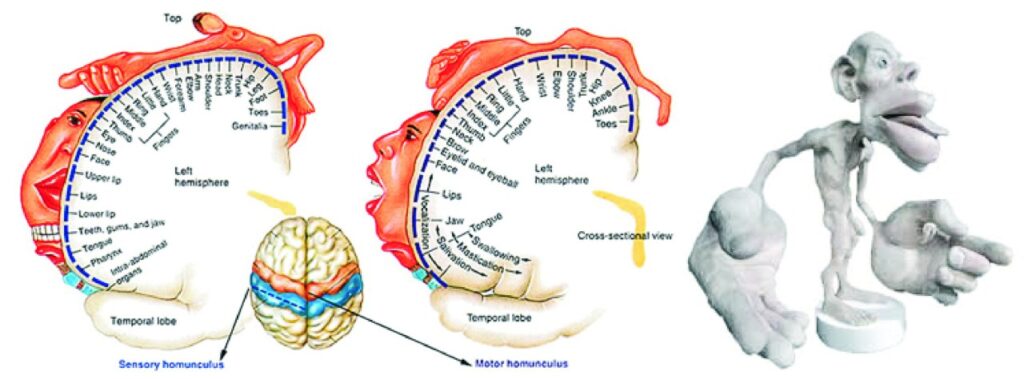
Within the scientific community the homunculus is a representation, often used in teaching and memorization, to display the space dedicated to distinct body parts within the somatosensory cortex or motor cortex of the brain. The motor and sensory homunculi are depicted as human persons having disproportionately large or small body parts according to their prominence within that system. For example, the sensory homunculus possesses a very large tongue because a large portion of the somatosensory cortex is dedicated to the tongue (Saladin 524). While these figures are designed to be nothing more than to-scale mappings, one could argue that they represent the aspects of human anatomy most significant to us as individuals. These cortexes of our minds are primarily dedicated to the homunculi’s largest limbs which we use to understand and interact with the world. In this way, the motor and sensory homunculi are creatures which more fully represent our relationship with our physical bodies than that of the human figure. However, the homunculus medium has yet to display the human body according to its existence within fairy tales. These stories reflect ideas and understanding, acting as one cortex of the global human brain. As Bordo writes, “Our bodies, no less than anything else that is human, are constituted by culture” (Bordo 142). Thus it is time to incarnate a new profound creature, one which will expound our knowledge of our physical selves within society, especially the differences between male and female.

Figure 1: Sensory and Motor Homunclui from: Saladin, Kenneth S., et al. Anatomy & Physiology: the Unity of Form and Function. Ninth Edition ed., McGraw-Hill Education, 2021.

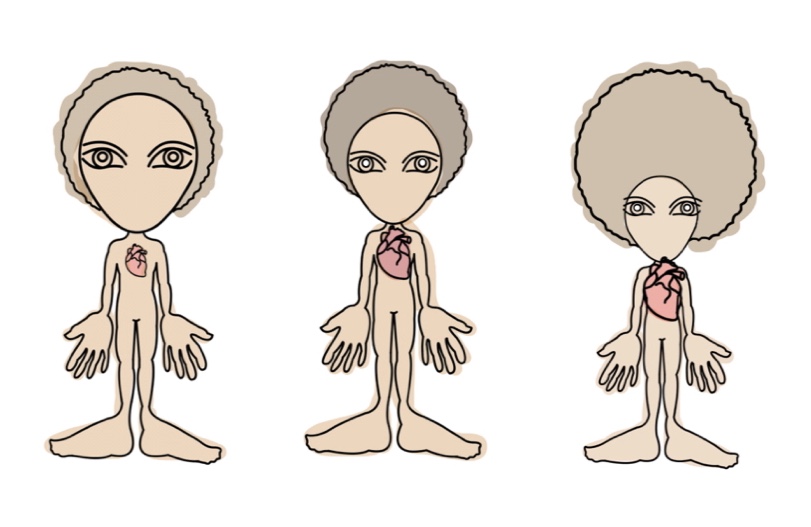
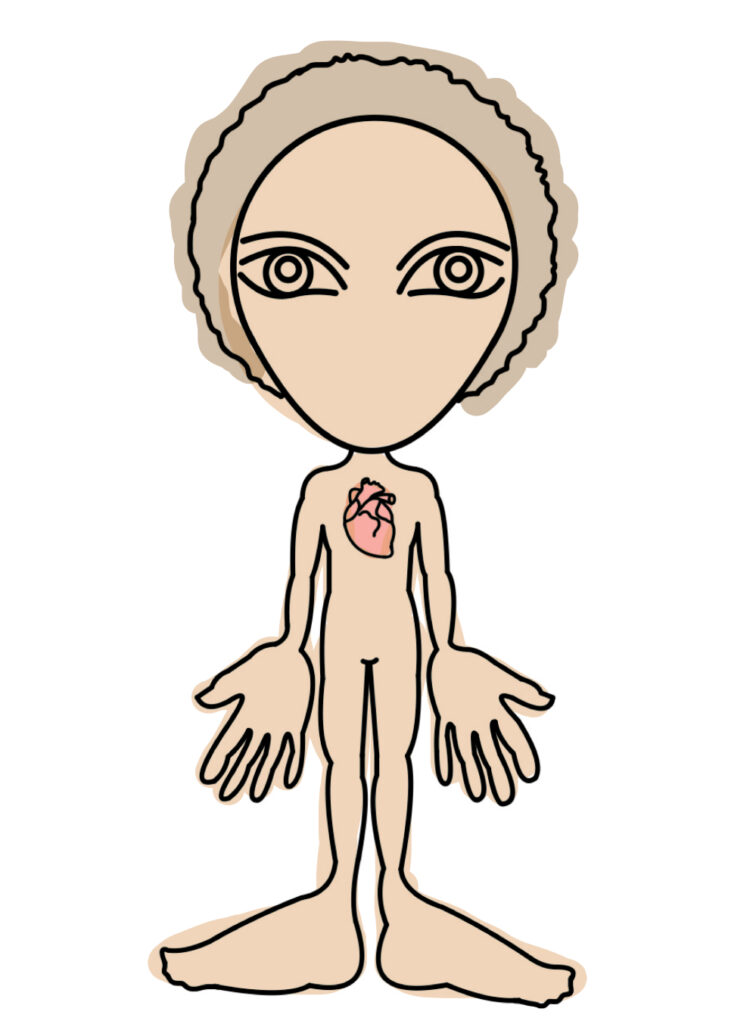
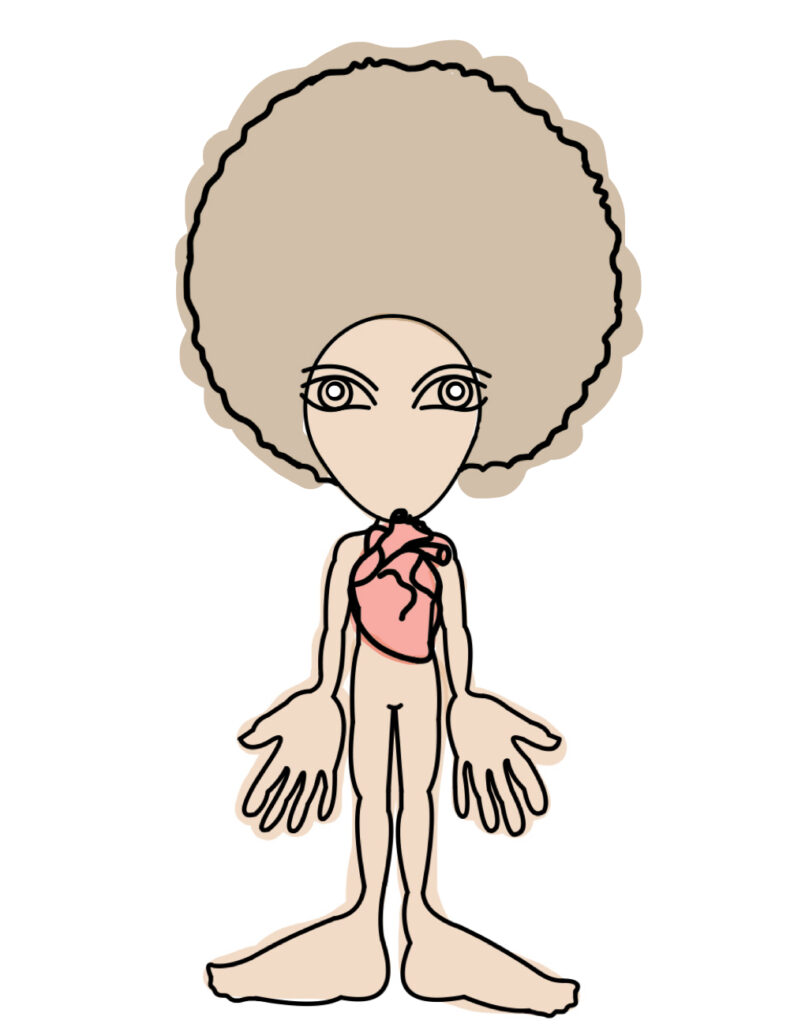
Both quantitative and qualitative methods were used to conceptualize the fairy tale corpus. Previous research, especially that of Jorgensen, quantified the presense of human anatomy within European fairy tales. Through this method the importance of individual body parts, as proven through frequency of mention, was accounted for. Then, this understanding was used to create the bodies of three fairy tale homunculi. The first homunculus depicts a universal human body, not identified by sex. This neutral homunculus is the foundation of the later two, possessing large eyes, head, heart, fingers, hands, face, hair, and feet because these are the most mentioned body parts within fairy tales. Two other homunculi stand for the gendered dimensions of human anatomy within fairy tales. Contrasting these later two figures reveals an unbalanced representation of male and female anatomy. Further analysis of the symbolic understanding of body parts within the context of fairy tales and common symbolism gives a larger meaning to each formed homunculus. Ultimately, the ununiform nature of the three homunculi is evidence of a gendered dichotomy within fairy tales which plays into a larger cultural understanding.

Figure 2: Three “fairy tale homunculi” according to fairy tale proportioned anatomy. The left creature represents a male form, the center is a gender-neutral form, and the right is a female form.

The head is the largest body part of the sex neutral and male homunculi (figure 3). The head is the most frequently mentioned body part within the Brothers Grimm tales, having 152 mentions in total for both genders combined (Jorgensen). However, the head is not equally significant for each gender. Another data base shows that the noun “head” is predominately used in reference to men within fairy tales. Specifically, male characters account for 73.08% of all usage. (Jorgensen). Additionally, the neck, that which secures the head to the body, is only used for men and never for women within these tales. But what is to be made of this hypertrophy?

Figure 3: Male fairytale homunculus.

The male association with the head encourages an elevated perspective of all men. First, the head is a symbol of power and authoritative position. The phrase, “the head of the household” or simply “head of” a group is used to define the individual with the highest rank. Due to its role within the physical body, the head is also accredited with cognitive ability and intelligence. For this reason “having a good head on one’s shoulders” is a compliment of intellect. In colloquial terms, the head is also equivalent to logic and reason. An example of this is the phrase “use your head,” which is an instruction to think logically and rationally. This cultural understanding aligns with anatomical function. The head houses the central nervous system, including the brain and spinal cord which are responsible for conscious thought as well as responsible for the autonomic life-preserving functions of the whole body. One could argue that the brain is the most vital part of human anatomy, for without it no other organ could function. Finally, the head is incased in the protective skull. Without the skull the brain would be soft and fragile, rather it is protected and sturdy. In parallel, men are shown to have strength and are free of susceptibility. In these ways, men are represented as powerful, wise, and strong figures within fairy tales.

Figure 4: Female fairytale homunculus.

In contrast, the female homunculus possesses the largest heart of all the fairy tale homunculi. Previous studies show that the heart is the third most mentioned body part of all, having 141 mentions. The majority of the mentions are accredited to female characters. The implications of such a large heart are vastly different than those of the male’s large head.

The cultural connotations of the heart are vast and primordial. Largely, the heart is accredited with affection and love. Within American culture hearts are plastered distributed on every medium on valentine’s day, a holiday which celebrates romantic effection and relationship. One fairy tale with many mentions of the heart is Jeanne-Marie Leprince de Beaumont’s version of “Beauty and the Beast.” For example, female protagonist “loved [the beast] with all her heart” (Tatar 48). So, women are displayed as loving creatures. The heart also frequently symbolizes authenticity and good character. At the heart of a person or thing is its core or true colors, and a possessing a good heart means being good in entirety. Within the same tale beauty tells the beast “I am completely pleased with your good heart” (Tatar 46). Within these tales women are depicted as creatures of love, affection, and good will.

However, equating women with the heart also means equating them with weakness. The heart is considered a fickle organ, susceptible to emotional and physical injury. In the Brothers Grimm edition of “The King Frog” a servant of the young king, Heinrich, is “so saddened by the transformation of his master into a frog that he had to have three hoops placed around his heart to keep it from bursting with pain and sorrow” (Tatar 58). Heinrich’s heart is so fickle due to sadness that without additional support it would have been his demise. The heart is also a mechanism to portray other negative emotions such as fear. Brothers Grimm also write that the “king could see that [the princess’s] heart was pounding” at the sight of the disgusting frog. (Tatar 57). Hearts are frequently damaged within fairy tales, which includes many instances of broken heartedness, a state of grief over some sort of loss. The heart has many positive connotations but is ultimately weak and becomes the downfall of many fairy tale characters.  

The feet are an example of an anatomical part which is mentioned with similar frequency for both men and women but holds vastly different significance for each. There are 38 mentions of feet within the Brothers Grimm fairy tales. However, there is a pattern of essential “pillars of the body,” such as the bones and back, having a higher association with men (Jorgensen). For example, men hold 65.91% of all leg references. Although this does not directly include feet, there is a thematic similarity of stability between the men’s feet and their legs. Within this context feet represent a strong foundation for the body, holding a positive connotation. In “Little Thumbling” by Charles Perrault the male protagonist takes boots off an ogre and places them on his own feet. Little Thumbling was very pleased because the enchanted boots “had the power to become larger or smaller according to the feet wearing them. As a result they fit his feet and his ankles as if they had been made just for him” and felt empowered to continue on his adventure (Tatar 261-262). In other instances, women lower themselves to men’s feet, demonstrating men’s position of superiority. In Charles Perrault’s “Bluebeard” the same woman does this twice when she “threw herself at her husband’s feet, weeping an begging,” and then repeats the same action when she “threw herself at his feet” just one page later (Tatar 191-192). Whenever men’s feet are mentioned, it is in a manner which favors their strength and status.

On the flip side, references of feet including women generally depict weakness. There are many instances of foot amputation or foot torture within fairy tales.  In Hans Christian Andersen’s tale “The Red Shoes” one woman, Karen, finds her feet stuck in a pair of enchanted shoes which compel her to dance without control until her feet are eventually amputated (Tatar 280). This is far from the stable pillars which men’s feet are suggested to be. Another example of unsteady standing is in “The Little Match Girl” also authored by Andersen. In this tale the protagonist is “a poor little girl, with nothing on her head and with… tiny, bare feet, which were red and blue from the cold” (Tatar 301). Here feet are used to illustrate depravity. Perhaps the most famous mention of feet within a fairy tale is in “Cinderella” by Brothers Grimm. In this tale there is one girl, Cinderella, whose feet become her greatest asset. Yet, there are twice as many girls whose feet become a source of pain, the two stepsisters. One stepsister “sliced off her toe, [and] forced her foot into the shoe” and the other “sliced off a piece of her heel, [and] forced her foot into the shoe” (Tatar 152). Both stepsisters ultimately fail at their goals when their feet, bleeding from manipulation, expose them to the prince. Although feet are significant to both genders within fairy tales, they are a resource to men and a liability to women.

In summation, the homunculi demonstrate a deeper understanding of how humanity is represented within European fairy tales. If every anatomical mention is considered a synecdoche for the whole being, then we must consider how we define those individuals. Observing the frequency of, and associations with, body parts mentioned gives light to a dichotomous perspective of gender. Specifically, masculine connections with the head and feet depict men as the more superior, wise, and strong sex. This contrasts fairy tales’ illustration of women as loving yet vulnerable and weak through the symbolism of heart and feet. Fairy tales use human anatomy to tell a story which favors male empowerment and anticipates female failure.

A scientific method of understanding the fairy tale corpus is especially valuable considering how much culture, communicated through mediums such as fairy tales, impact the health sciences.  Recent research has linked gender bias with “negative attitudes and behaviors in healthcare providers” (Rhiannon 1) The forms of bias have been found within medical education through unequal representation in anatomy textbooks,  “the visualization of stereotypical gendered emotions, roles and settings; the lack of ethnic, age, and body type diversity; and in the almost complete adherence to a sex/gender binary” (Rhiannon 5) Despite increased awareness of the impacts of gender bias within the science fields little change is yet to occur. Change may only occur within medicine when those conducting the medicine become aware of the cultural practices which breed gender bias, like fairy tale telling. If people of the sciences acknowledge that the first things they learn about our heads, our hearts, and our feet come from these stories then perhaps they will become better at treating them.

Works Cited

Bordo, Susan. The Male Body: A New Look at Men in Public and Private. Farrar, Straus & Giroux, 1999.

Jorgensen, Jeana. “Masculinity and Men’s Bodies in Fairy Tales: Youth, Violence, and Transformation.” Marvels & Tales 32.2 (2018): 338,361,494. ProQuest. Web. 7 May 2021.

Jorgensen, Jeana. “Quantifying the Grimm Corpus: Transgressive and Transformative Bodies in the Grimms’ Fairy Tales.” Marvels & Tales 28.1 (2014): 127,141,216. ProQuest. Web. 7 May 2021.

Jorgensen, Jeana. “The most Beautiful of all: A Quantitative Approach to Fairy-Tale Femininity.” Journal of American Folklore 132.523 (2019): 36,60,107. ProQuest. Web. 7 May 2021.

Parker, Rhiannon, Theresa Larkin, and Jon Cockburn. “A visual analysis of gender bias in contemporary anatomy textbooks.” Social Science & Medicine 180 (2017): 106-113.

Saladin, Kenneth S., et al. Anatomy & Physiology: the Unity of Form and Function. Ninth Edition ed., McGraw-Hill Education, 2021.

Steven, Van Wolputte. “HANG ON TO YOUR SELF: Of Bodies, Embodiment, and Selves.” Annual Review of Anthropology 33 (2004): 251-69. ProQuest. Web. 7 May 2021.

Tatar, Maria. The Classic Fairy Tales (Second Edition) (Norton Critical Editions). W. W. Norton, 2017. [Yuzu].

Fairy Tales and the Effect of Their Movie Adaptations

Jenna Nickerson

Abstract

Authors Litania Graaf and Marilyn Fleer discuss the effect of fairy tales on children and how they assist in developing social skills and create an interest for other fairytale mediums.  Whereas, Josephina Orchard and Claudia Schwabe discuss the effect of fairy tales on adults. Orchard explains how they are used in psychotherapy to allow adults to more easily talk through issues using escapism. While Schwabe dives into fairy tales’ effect on the media, stating their fluid and adaptable themes allow them to be used universally in mediums like Rated-R/PG-13 content as well as in Disney films. However, there is a lack of articles that connect these findings. Leaving the question of how fairy tales affect the transition from childhood into adulthood, specifically in regards to coping with trauma and understanding mature themes, unanswered. Therefore, my findings suggest that mature fairytale movie adaptations are part of a three-step process that begins in the early stages of childhood and continues into adult years to teach lifelong lessons and coping mechanisms that differ from tale to tale. Understanding the ways fairy tales can help adults cope with (mental/emotional) trauma is important because fairy tales are prominent in the media. These findings can express to adults how important fairytales are to childhood development and educate them in regards to fairytales being a great tool to deal with mental health struggles for not just their children, but themselves. This creates a relevant universal coping mechanism for all ages with lifelong benefits that constantly reappear for constant reassurance and security.

There Are No Happily Ever Afters and That is Okay

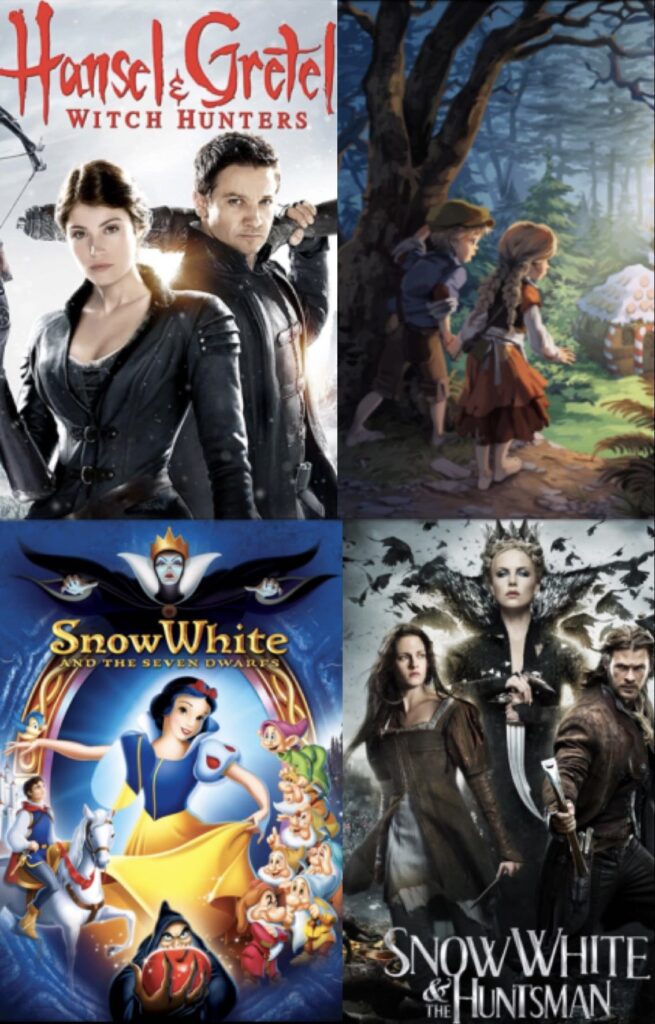
Authors Litania Graaf and Marilyn Fleer discuss the effect of fairy tales on children whereas Josephina Orchard and Claudia Schwabe discuss the effect of fairy tales on adults. Meanwhile, the question of how fairy tales affect the transition from childhood into adulthood, specifically in regards to coping with trauma and understanding mature themes, is still left unanswered. This paper examines fairytale movie adaptations targeting child audiences juxtaposed with fairy tale film adaptations for young adult/mature audiences labeled R or PG-13 to better understand this gap in research. Using Fairy Tale Films: Visions of Ambiguity (Greenhill), “The Fairy Tale and Its Uses in Contemporary New Media and Popular Culture Introduction.” (Schwabe), and “Emotions in Imaginative Situations: The Valued Place of Fairytales for Supporting Emotion Regulation.”(Fleer and Hammer) to examine the psychological narrative depictions of trauma and coping in several classic fairy tales—namely “Hansel and Gretel,” “Cinderella,” and “Snow White”—I argue that mature content in fairy tale film adaptations, specifically Hansel and Gretel: Witch Hunters (2009) and Snow White and the Huntsman (2012), allow adults to better understand and develop mature responses to trauma. The three ways this is done are: through opaque depictions of violence and sexuality in fairy tales which help prepare child audiences for comprehending the mature themes later in life, explicit and realistic depictions of violence to draw mature audiences to fantasy narratives while still implementing virtues/themes to help them cope, and the genealogy of fairy tales which allows for full circle contemplation and reflection of happily ever afters. Understanding that fairy tales can help adults cope with (mental/emotional) trauma is important because fairy tales are relevant in the media across multiple platforms. Not being aware of this coping mechanism eliminates a universal tool to deal with mental health struggles and with suicide rates and mental health awareness on the rise having access to as many coping mechanisms as possible is crucial. 

If we consider the way fairy tales help adults cope and understand trauma as a process, the first step would begin in early childhood. This is when children are first introduced to fairy tales, folktales that have been passed down and changed, and can begin reaping the psychological benefits that assist in childhood development into adolescence and eventually adulthood. In Emotions in Imaginative Situations: The Valued Place of Fairytales for Supporting Emotion Regulation, Marilyn Fleer and Marie Hammer dive into the benefits fairytales have on children with a focus on the effects of role-playing when implemented in social settings. Fleer and Hammer explain that fairy tales open up children’s creativity because they are drawn to the fantasy and mystical elements included within the stories, and because fairy tales help spark the desire to role-play

Fairytales help children collectively begin to anticipate the results of one another’s actions in their play. Fairytales also allow children to anticipate their own actions, including image-bearing dramatization, verbal descriptions, prop use, and transformation. (Fleer and Hammer, 254)

Beginning to anticipate these actions develops into a better understanding of peers’ emotions and their own, leading to “the possibilities for emotional tension, engagement, and self-awareness.”(Fleer and Hammer, 251). With all the benefits fairy tales offer children it is important to note the amount of violence that lives in the original versions of the tales (folktales). With many studies addressing the harm of children being exposed to violence in the media, it leaves the question of “how beneficial can these tales be if they are rooted with violence?”. In tales like Cinderella by the Brothers Grim, the stepsisters get their eyes plucked out as payback for how they treated Cinderella after mutilating their feet to meet the Prince’s standard of beauty. Themes that are too mature and depictions that are too graphic for young children. This is why other versions, like Disney’s Cinderella, tell the tales with an opaque description of violence while keeping the overall message. Both the Grim’s and Disney teach the lesson of always being kind and true to yourself and good things will happen to you, and if you are unkind you will be punished in some way. Some may argue that certain aspects, like the cruel treatment of Cinderella, are still too much for children. On the contrary, fairytales covering a wide array of topics like abuse, abandonment, starvation, and being outcasted have been proven to make children more comfortable talking about trauma because they have something they relate and compare to. They also feel more comfortable because they can talk about trauma in relation to fantasy which creates a safe magical world they can escape to. As Jack Zipes explains in The Changing Function of the Fairy Tale “fairy tales are now widely used in therapy, particularly with disturbed or abused children because they enable a child to gain distance from trauma and deal with it”(24). Therefore, leaving in more mature subjects but having opaque rather than graphic depictions of violence and sexuality allows for kid-friendly adaptations to be made that help children develop emotionally and socially. Furthermore, it allows mature themes to begin to be addressed and contemplated while presenting a “watered-down version” to not overwhelm and therefore better prepare child audiences for comprehending the mature themes they will eventually be faced with later in life.

Once children enter their young adult and adult years they are faced with real and explicit versions of violence in everyday life and it can be hard to comprehend and face. Going back to a familiar and safe place can be extremely beneficial for those dealing with these new stressors and past trauma. Fairy tales provide that, especially when that relationship is built in early childhood years and mature themes were introduced. I consider his to be step two of three of the ways fairytales help adults understand and cope with trauma. Josephina Orchard, with a masters in psychology, discuss more specifically the ways in which fairy tales directly help adults deal with trauma in her thesis The Use of Fairy Tales in Psychotherapy with Adults

The therapeutic process of working with a fairy tale…provides a vehicle…to consciously and voluntarily, through attending to the story in ritual, dreams, and active imagination, bring what is unconscious to consciousness. (Orchard, 59)

This is to say that fairy tales provide adults with the opportunity to reflect on mature themes and consciously access them through escapism. This is similar to how children use the elements of fantasy in fairy tales to escape reality, become more comfortable, and talk about trauma. Also in regards to adults dealing with trauma from their childhoods Orchard explains that

a child’s psyche may respond to trauma by developing a system of archetypal defenses to protect the self. By interpreting this process in fairy tale motifs…therapist and client may explore imaginally how the defenses that originally protected the person from further trauma have turned into a fortress that now isolates the person from the rest of life (63)

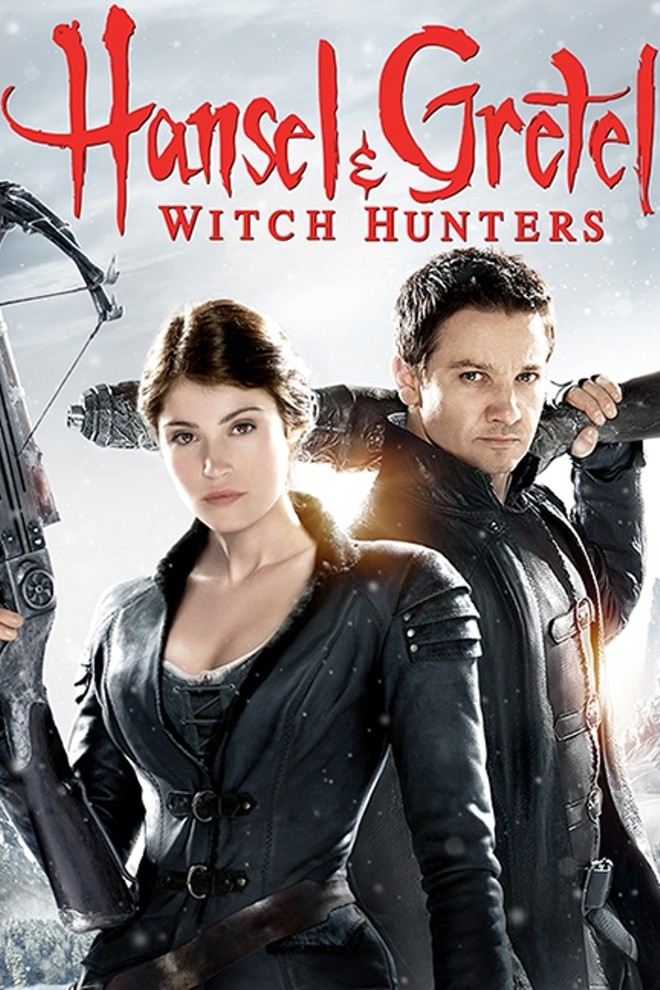
Orchard then goes on to explain the different approaches taken when using fairy tales with adults, sometimes writing their own to feel a more personal connection and better tell their story. I believe this to be one of the reasons making mature fairytale adaptations is so important. Disney movies, although enjoyed by many of all ages, have the connotation of being for children. Making it harder for adults to see or look for deeper meaning cutting them off from reaping the benefits they did as children when they watched fairytale to movie adaptations. By re-implementing the violence that was taken out of the Disney tales you create what appears to be a new genre of fairytale type movies. Except adults are still being exposed to important themes. For example, in Hansel and Gretel by the Brothers Grim, the siblings get through a series of traumatic events they wouldn’t have been able to conquer if they had not provided each other with emotional support. The same theme is prominent in the Rated-R adaptation Hansel and Gretel: Witch Hunters, the difference? The Rated-R movie has much more graphic violence and does not shy away from showing instances of sexual assault and substance abuse. In context, fairy tales to screen adaptations like Hansel and Gretel: Witch Hunters “drastically subvert viewers’ expectations of traditional fairy-tale structures and characters. To promote interest”(Schwabe, 1). This creates a medium where adults can feel that sense of comfortability, with fairy tales, they did as children, which is proven by Orchard and Zipes to be an essential part of using fairy tales for therapy. Therefore, explicit and realistic depictions of violence in mature adaptations juxtaposes fairy tales audiences grew up with to draw the mature audiences to fantasy narratives while still implementing virtues/themes to help them cope with past and current trauma. 

The last step in my proposed three-step process for how fairy tales help adults understand and cope with trauma is understanding and reflection. As briefly mentioned earlier, the genealogy of fairy tales begins with folk tales that are more violent than the Disney adaptations that have become so popular. The Disney versions being the next major point in the genealogy. Then after Disney, there is a popularization of young adult/adult fairytale movies and tv show adaptations. However, for most, the cycle in which they encounter fairytales goes Disney, folk tales, and then mature films and tv. This creates an interesting phenomenon that some call “Disneyfication”. Litania Graaf takes this concept and does a study and records her findings in the paper Disneyfication of Classic Fairy Tales. In the study she found of 40, 18-29-year-olds, 50% watched Disney films and had read non-Disney fairytale text, suggesting that although many watch the Disney films first they then, as they grow older, have an interest in the folktale versions. As stated before the themes are very similar, but Disney’s versions of happily ever after are much more black and white than those of the folktales and the mature adaptations. Pauline Greenhill’s book Fairy Tale Films : Visions of Ambiguity describes this phenomenon as well in relation to mature films. She states in her book that ”Such cautionary tales [Disney’ adaptations] follow audiences from childhood to adulthood, as is immediately evident by the works of cinematic folklore…intended for mature audiences [and] deals in shades of grey.”(Greenhill, 9) Greenhill also explains that “Fairy tale films… unnerve us because they destabilize our notion of the happy-ended and predictable fairy tale and deal with issues such as fascism, rape, and infanticide.”(Greenhill, xiii) For example, in Snow White and the Seven Dwarfs Snow White’s happily ever after comes from a prince saving her with a kiss. Whereas in Snow White and The Huntsman, Snow White leads a war against her stepmother representing the constant battle that often comes with family trauma. Snow White fights to gain her independence and save herself because in real life it is not as simple as being put to sleep and waiting for a prince and then the battle is over. The folktales and mature adaptations, like this one, show the once innocent child that they are now an adult and give a much more realistic presentation of happily ever afters. Another author touches on this concept stating 

“contemporary writers of fairy tales for adults either create tragic endings or endings that are open ended and intended to provoke the reader…overall statement against the happy end is conceived to explode the illusion that all’s well that goes well in society, that happy endings are possible in reality.”(Zipes, 25)

Both Greenhill and Zipes explain that happily ever afters are not impossible in real life but are much more complex than first shown to children in movies made for younger audiences. Graaf’s study suggests that many people grew up watching Disney films before reading the folktales and we can assume saw the Disney films before the mature movie adaptations due to the release dates and rating systems. Knowing that multiple articles discuss that fairytales promote emotional growth and reflection I draw the conclusion that the genealogy of fairy tales allows for a full circle reflection of happily ever afters. Comparing what was shown to children in early childhood years to both real-life examples and more mature fairy tale examples and reflecting on being happy not being a solidified ending but with ups and downs.

Fairytales are a huge part of the media with monopolies like Disney releasing both animated and live-action adaptations. As well as mature/young adult fairytale adaptations being released creating a genre that reaches all ages. Similarly, the genre of fairytales offers psychological benefits for all ages. This includes using them for escapism to deal with trauma, developing social skills, and emotional intelligence; because these benefits can be utilized by all ages this means different stages of utilization that can come together to form a cycle. This cycle is what I have been referring to as the three-step process fairytales help adults cope with trauma. Children start off being exposed to Disney fairy tale films which pique their interest because of fantasy and mysticism and through opaque depictions of violence and sexuality they help prepare child audiences for comprehending the mature themes later in life. Once they enter adolescence their peaked interest leads them to read folktales that have more violence than the films they grew up with while still in the realm of fairytales and fantasy. Then as they reach young adult/adulthood they begin experiencing or dealing with trauma and have a new medium of fairytales that are seen in mature adaptation films with real-world applications covering topics like assault, substance abuse, and abandonment. They then can use escapism through the safe haven they found in fairytales to deal with trauma while having their own medium that is more relatable to them. In other words, explicit and realistic depictions of violence draw mature audiences to fantasy narratives while implementing virtues/themes to help them cope. Finally, the all-encompassing factor is comparing the two previous stages together to learn that happily ever afters are not black and white but that is okay. Life is complex which is why having such a universal coping mechanism and mental health tool, like fairytales, is beneficial. 

Work Cited

Disney, Walt, et al. Snow White and the Seven Dwarfs

Fleer, Marilyn, and Marie Hammer. “Emotions in Imaginative Situations: The Valued Place of Fairytales for Supporting Emotion Regulation.” Mind, Culture & Activity, vol. 20, no. 3, July 2013, pp. 240–259. EBSCOhost, doi:10.1080/10749039.2013.781652.

Geronim, Clyde, and Hamilton Luske, directors. Cinderella. Walt Disney Productions, 1950.

Graaf, Litania. Disneyfication of Classic Fairy Tales, Utrecht , 2013, dspace.library.uu.nl/handle/1874/276472.

Greenhill, Pauline and Sidney Eve Matrix. Fairy Tale Films : Visions of Ambiguity. Utah State University Press, 2010. EBSCOhost

“Hansel and Gretel.” Fairy Tales and the Art of Subversion: the Classical Genre for Children and the Process of Civilization, by Jack Zipes, 2nd ed., Routledge, 2006, pp. 236–241. 

Orchard, Josephina. “The use of Fairy Tales in Psychotherapy with Adults.” Order No. 1487132 Pacifica Graduate Institute, 2010. Ann Arbor: ProQuest. Web. 23 Apr. 2021.

Sanders, Rupert, et al. Snow White and the Huntsman. Roth Films, 2012.

Schwabe, Claudia. “The Fairy Tale and Its Uses in Contemporary New Media and Popular Culture Introduction.” Humanities 5.4 (2016): 81. Crossref. Web. 

Tatar, Maria. The Classic Fairy Tales (Second Edition) (Norton Critical Editions). W. W. Norton, 2017. [Yuzu]. 

Wirkola, Tommy, et al. Hansel & Gretel, Witch Hunters. Paramount, 2013.Zipes, Jack. “The Changing Function of the Fairy Tale.” The Lion and the Unicorn, vol. 12 no. 2, 1988, p. 7-31. Project MUSE, doi:10.1353/uni.0.0236.

How Cinderella Helps Us Understand the Endurance of Kobe Bryant’s Legacy

By Lucas Pejovic-Nezhat

On January 26th 2020, Kobe Bryant died in a helicopter accident at the age of 41. As the world stood still and tributes poured in for the international sports icon, many described the loss similar to the death of a family member. The tragedy’s effects were felt the most in Los Angeles, where it’s residents saw a skinny 17 year old kid from Philadelphia transformed into one of basketball’s greatest players of all time. It’s easy to list all of Bryant’s never ending accomplishments to try to distinguish why he was so beloved but it fails to do him justice. Through the triumphs and defeats, celebrations and controversies, one particular aspect stood out that separated Kobe from the rest, he embodied “if you work hard-you work hard enough- your dreams come true”. Sport’s today have a following that could almost rival religion. From elementary school all the way to professional leagues, millions upon millions of people either play or watch athletes work up a sweat doing physical activity. But why? The primary reasons include building a sense of community, serves as a mental escape, and keeps people fit. So then why we constantly associate the Cinderella narrative with sports, a fairytale about a girl finding her prince charming through a long lost shoe. Every year there’s at least one team that pulls off a couple upsets and the country falls in love with during March Madness. When my basketball team won the state championship after having the worst record the year before I made an Instagram post with the caption, “Cinderella run complete”. Going beyond the simple underdog theme “Cinderella” is a rags to riches class mobility narrative arc that emphasizes compassion, perseverance, and teamwork, which is why I argue that locating her fairy tale structure in the stories we use to construct sports icons helps us actualize and fill in the blanks between fiction and realistic fairy tales.

The story of “Cinderella” is a tale that has been in circulation thousands of years. It began in ancient Greek, when a courtesan named Rhodopis had one of shoes stolen by an eagle, who flies it all the way across the Mediterranean and drops it in the lap of an Egyptian king. Since then the fairy tale has been retold countless times and has been transformed into other media such as Disney films. One of the most popular retellings is that of Brothers Grimm. In their version, “Cinderella” loses her mother to an illness at a very young age but before she passes away she tells her daughter to stay good and she will “look down on you from heaven”(Tatar 148). Soon thereafter the father remarries a cruel woman with two beautiful but equally wicked daughters. Together the new additionally family members degrade Cinderella by stealing her possessions and giving her every single arduous task possible. In light of this mistreatment, Cinderella completed the chores without complaint and visited her mother’s grave everyday. One day the king announces a grand festival and for all the beautiful women to come so that his son can find a bride. When her stepmother refuses to allow Cinderella unless she completes the impossible task of sorting peas in under an hour, two turtle doves come to her air. Despite completing her duties, she is still unfairly forbidden to go because she doesn’t have the proper attire (which was thrown out by her stepsisters). With the help of her magical tree she is thrown down a beautiful dress and slippers. Finally able to go to the ball the prince falls in love with her beauty and grace and Cinderella finds her happy ever after.

The way  “Cinderella’s rags to riches story informs the construction of sports icons by showing how crucial it is to lean on the belief and perseverance that you deserve what you want to achieve. After her mother passed and her father remarried, Cinderella’s new life should’ve been as joyous as her father’s. Having a stepmother and two beautiful stepsisters seemed like it would be an upgrade from the lonesome past year. Instead she was tormented by her new noble family members who “took away her beautiful clothes, dressed her in an old gray smock, and some wooden shoes” (148). Despite the constant degradation, Cinderella worked arduously at the tasks given to her so that she could be brought along to the King’s festival, a place she felt she deserved to be. Cinderella’s motivation to go the dance is eerily similar to the nine game stretch leading up to Kobe Bryant’s achilles tear. 2013 was “supposed to be easy” according to Bryant. “ After all, this was a team that in the offseason acquired Steve Nash, a two-time MVP, and Dwight Howard, a three-time Defensive Player of the Year. They had the league’s highest payroll, at just north of $100 million” (Holmes). Unfortunately, it was a disaster from the jump and as the season wore on, the Lakers were on track for ultimate catastrophe, not even making it to the playoffs. Despite nearly being 35 years of age, Kobe took it upon himself to lead his team to the eighth seed. Through the next nine games he averaged career best numbers, stat lines he never produced before, and took charge in calling every single play. The toll on his body was tremendous, “he would walk around like a grandma” (Holmes), ice baths, massages everything. Nonetheless, he continued to play almost every single second of each game, setting a second-best record in minutes played over a nine game stretch over the last 50 years. Even after his achilles tendon blew out, he attempted to reattach the tendon with his fingers. When that didn’t work, in grimacing agony he walked to the free throw line to drain two crucial game-tying shots. The final days of Kobe Bryant’s waning prime served as a perfect representation of why Los Angeles loved him dearly. He represented that Los Angeles was more than just  Hollywood and black tie events. “The working class and first and second generation immigrants that comprise the spinal cord of the city”(Weiss) could identify with his work ethic, dedication, and self-sacrifice. With that came the belief and inspiration, that they too could be more.

Another way “Cinderella’s” rags to riches story informs the construction of sports icons through compassion is by showing that being virtuous will bring about good fortune. Unlike her stepsisters she wasn’t a materialistic person. When her father asked what she wanted him to bring her from his trip, rather than asking for pearls and jewels she told him to “break off the first branch that brushes against your hat on the way home and bring it to me” (Tatar 149). Although her job was made more difficult by her stepsister who “ridiculed her and threw peas and lentils” (148) out in the ashes she never once spoke ill of her family. “Cinderella” was an overly generous person, sometimes to the point of being a pushover, but eventually fate rewarded her with a magical tree and birds. Early in Kobe Bryant’s career there was no such persona similarity. He was ruthless to rookies, egotistical and his head coach Phil Jackson once called him a juvenile delinquent. However, what Kobe did do was transform himself into a better man. “The Kobe Bryant of 1996 to 2004 is not the Kobe Bryant of 2005 to January 26, 2020”(Gregory). In front of the entire world’s eyes he went from a cocky teenager, to champion, to a symbol of misogyny and toxic masculinity when he was accused of rape, to a GirlDad and a fierce advocate of women’s sports. Bryant didn’t start off as a pure and loving figure like Cinderella, but he learned how to improve himself through the medium of sports.  “Everything that I’ve learned from the game of basketball, I’ve carried it over into life. Basketball has helped me be a better person, a better friend, a better father” (Bryant). After being dropped by almost every sponsor and discarded as the face of the NBA, he rehabilitated himself to being a large philanthropist and mentor to the next generation. His journey of maturation showed that no setback is permanent. As a result athletes were able to empathize with Kobe and appreciate sports because he showed that no loss is in vain because “even when you lose you learn something” (Ghildiyal) to shape your character and make you a better person.

A third way “Cinderella’s rags to riches story informs the construction of sports icons is through collaboration. Neither a fictional character or the primary human example of success through sheer will could achieve their goals alone. “Cinderella” didn’t lack resilience, each day she would work from morning until night, where she would sleep on the floor. But even she had to enlist two little turtle doves to help her put “the good ones into the little pot, the bad ones into your little pot” (Ttar 149). After they complete all sorting tasks for “Cinderella”, they even give her a dress of gold and silver and embroidered slippers. Without their aid, she would have never gotten the ending she deserved. Similarly, post Shaquille O’Neal’s departure from the Lakers, Bryant struggled to win his 4th and 5th championships, even missing the playoffs in 2006. While he did have personal success such as scoring titles and All-NBA nominations he failed to capture what he truly desired, rings. Those were the ultimate symbol of a winner and a champion, but they also represented the coherence and chemistry of a team. It wasn’t until Bryant partly shedded his mentality that his pursuit of excellence outweighed everything else “Friends hang sometimes, banners hang forever”( Bryant). Rather than continuing to be aloof from his teammates he began to open and be more vulnerable. He began to speak Spanish with his newfound co-star Pau Gasol, imparting his wisdom and pushing him to build tougher skin. That ability to “lead different people from all walks of life toward a common objective” (Ghildiyal) was learned because of basketball. By being a better leader, Kobe became someone who wanted to share success rather than playing with an individualistic mindset. Instead of demanding the best out of his teammates so that they can help him further his legacy, he pushed them to become the greatest version of themselves they can be for their sake. The necessity of teamwork would come to fruition in Game 7 of the 2010 Finals against the Celtics with Pau Gasol’s marvelous 19 point 18 rebound performance and Ron Artest’s three pointer in the waning minute. Serving as a testament that success is greater than just the will of one person.

Growing up as a basketball player I had shoes from almost every signature NBA player. Kyrie’s, Lillard’s, LeBron’s, and Harden’s were scattered and shuffled all across my garage floor. But no matter how many of their shoes my parents bought for me, they were never the players my mind would wander to for strength and inspiration, that spot was reserved for Kobe. His words “rest at the end, not in the middle” would play in my ears everytime my hands fell to my knees during the last minutes of an overtime game. Whenever I began to doubt myself or felt the pressure of failure I would whisper the words “Mamba Mentality” to put me back in the mindframe of being in control of my own success. Those were the two words I told myself when I had to shoot game-winning free throws as a freshman at my rival schools gym. With a crippling body battered by injuries those were the words I told myself when I would step to the free throw line in the fourth quarter to grind out a state championship victory, no more than 6 weeks after Kobe had passed. By looking at Kobe Bryant’s career through the lens of “Cinderella’s” narrative we can see why the fairytale still endures today and how applicable the lessons found in sports can be. He became the icon of Los Angeles not because of his grandeur celebrity status or shot-making ability. Rather the way attained success in his life through perseverance, transformation of character, and teamwork resonated with athletes. Kobe brought unified communities by being an example of growing to achieve a better life that everyone as a whole could attach their values to.

Beauty and the Beast, Small Filmmakers, and LED Walls

By Brady Amundson

Abstract

Author Julie Turnok writes that special effects, and their aesthetic, can be analyzed and interpreted. She also writes about how ILM cuts at creative freedom pushing for standardization of special effects. James Dewar explains that the printing press changed the way people intake information giving way to a different experience than what was before. Thus proving that each storytelling medium has a different structure and consequently unique outcome. A key element of fairy tales is how each story is told and the medium the story is presented provides creative choices to change the meaning of each story. So, how does the accessibility of various storytelling mediums—i.e., word of mouth, print, stage, animation, live-action feature films, and LED light stages—influence the thematic outcome of fairy tales, specifically “Beauty and the Beast?” By analyzing the thematic evolution of “Beauty and the Beast” in its various mediums, I argue that because there’s a necessary want or gain from telling a story by the teller, each medium is dependent on and thematically affected by accessibility to storytelling resources. Thus, the combination of these mediums, in terms of accessibility, structure, and thematic potential, point to greater accessibility for diverse filmmakers with communal control over the breakthrough technology of LED walls used in the filming of “The Mandalorian.” Each medium comes with its own limitations as well as various sets of prerequisites i.e., access to a stage, printing press, a camera. With the possibility of an inclusive, limitless means of production, the potential for diverse storytelling grows. New growth allows for small creators to tell their stories just as well as big Hollywood names like Disney and Warner Bros.

INTRODUCTION

Storytelling is human nature and to bar anyone from telling their story is a violation of human rights. Everyone has a story to share and spreading these diverse stories is necessary to create a more empathetic and connected society rather than a society that is divided and filled with fear. The core evolution of fairy tale storytelling mediums —i.e., word of mouth, print, stage, animation, live-action, and feature films— demonstrates through simple plot structure and changing thematic outcomes that communal access to the technological means of production increases the potential for diverse, accessible storytelling. By analyzing the thematic evolution of “Beauty and the Beast” in its various mediums, I argue that because there’s a necessary want or gain from telling a story by the teller, each medium is dependent on and thematically affected by accessibility to storytelling resources. Thus, the combination of these mediums, in terms of accessibility, structure, and thematic potential, point to greater accessibility for diverse filmmakers with communal control over the breakthrough technology of LED walls used in the filming of “The Mandalorian.” With the possibility of an inclusive, limitless means of production, the potential for diverse storytelling grows. Diverse storytelling leads to better stories and more voices and stories being heard. This essay will cover the accessibility, structure, and thematic choices involved in each medium, Oral storytelling, print, stage, animation, and live-action film through the Beauty and the Beast story. 

MEDIUMS

Fairy Tales and Oral Storytelling

Before the printing press, fairy tales were primarily told by word of mouth. Oral storytelling is quite accessible since a story can be told by anyone who has a tale to tell. As well, oral stories can be told to anyone in the immediate proximity who can listen. Because there aren’t any expenses to tell a story verbally, it’s the most accessible storytelling medium for tellers. Compared to other mediums, oral storytelling is a bit lacking. It’s solely an imaginative experience. There isn’t a visual aspect that goes along with it. Many times oral stories are fifteen minutes or less because the format doesn’t have the flexibility like a book or movie to go on for hours. Because of these limitations, oral stories only have to time quickly reach a very basic moral. This is further emphasized by the Propp Functions and ATU scale. Aarne, Thompson, and Uther were able to describe and group fairy tales by common morals and plots. Vladimir Propp does similar work by boiling down fairy tale plot points to thirty-one functions to describe a fairy tale. These authors further prove how alike and basic these tales can be.

Fairy tales started as oral stories being told in fields for entertainment during work.  The fantasy within the fairy tales helped in comforting the workers as a type of escapism. Even though the format was limited by words told, it was the perfect fit to pass the time. The tellers were able to share a quick moral during labor as well as a few jokes. As technology has evolved and new mediums have been invented, a passionate storyteller would be limited by these conditions. The format is great as a pass-time, but less creative freedom within the format can cut a big vision short.

The Printing Press and Exclusivity

The written format can expand its audience and is accessible to most storytellers, the vision of the teller however is not at its fullest form, leaving the audience to fill that gap. When the printing press was first introduced, it was more of a replacement for scribes. It took about a century to be used as a medium to spread information and stories.(Dewar) Even then, writing and books were for the rich since it was so expensive. On top of that, one needed to know English to write or read, another skill that was held for the rich. There’s also the problem of publishing. Just because an author can write doesn’t guarantee that their story will be put into a book. This middleman has the right to deny certain morals or certain people putting them in a position where they can control what information is written down. Written media changes the way a story is told on a core level. Through oral storytelling, the story is fleeting, only to exist when it’s told. The printing press completely changes this, making a written story timeless. Because of the nature of the printing press, making it easier to make more copies, a larger audience can be reached by just one rendition or telling of a story. Common fairy tales that are written down portray the authors’ interpretation. Because of the permanence and larger audience involved, the singular interpretation of the original word of mouth story is spread large, pushing the morals of the author. The flexibility of an oral retelling is consequently lost.

The written medium alters the theme of Beauty and the Beast because wealthier members of society were able to unilaterally spread a single interpretation of the theme as the medium grants access to distribution. Perrault’s theme, inner beauty vs outer beauty, is bluntly told in the end. He writes, “You showed your good sense in pre-ferring a faithful heart to a handsome face or form.” The printing press not only homogenizes the theme among diverse audiences, but it maintains the short and direct style of oral storytelling. The cost and distribution limitations of the printing press also dictate that the theme be stated to summarize vague or unanswered aspects of the story.

Stage and Theater – Bringing Fantasy to Live Performance

With live stage performances, the storyteller is now able to show off their true vision and although there are some limitations, the visual component provides a completely different experience from that of a book. With a visual component comes quite a few necessities. There needs to be a stage, a script, actors, a live audience, costumes, sets and props, lighting and tech, and other leading roles like directors and writers. What makes the medium unique however is the diversity in the way that a live production can be performed: from black box to broadway. Jeff Burke and Jared Stein explore how Artificial Intelligence and Machine Learning can be used in live performances. By fusing technology and theater, they create new experiences that push the limits of the medium. Their work proves the flexibility and storytelling diversity within this medium. Because of this diversity, the medium can be pretty accessible. Live productions add the visual element that’s been missing from the previous mediums. The props, sets, costumes, and live actors pull a viewer into the story, allowing for an immersive experience. Theater also allows for a longer story than the oral format. There are, of course, limitations. Theater misses out on world-building, there can only be so many set changes within a show. The visual aspect is limited to real-world situations, unlike a book that can describe magic or a movie that can use special effects.

Live performances alter the theme of Beauty and the Beast because the live actors personify the story bringing what used to be a written tale to life. The physicality of the props and stage build a world to escape into. Disney adds music to the story changing the mature aspects of a fairy tale into an exciting, dreamlike story for kids. Disney’s theme is a similar message to Perrault, “not to be deceived by appearances,” told by the narrator in the introduction. The music, choreography, and live actors however alter the thematic outcome from Perrault. Instead of a fifteen-minute story that gets to a moral as quickly as it can, Disney brings the story to life with characters and enchantment. There are names given and what was once imaginary is now being performed in front of an audience. Children can meet the princess Belle and the catchy songs can be played on car rides. By making the nondescript characters from Perrault’s story exciting and creating a visual world, Disney promotes their theme parks. A place where children who were once entranced by the world can go to live in it.

Disney, the Animation Giant

Disney’s animation of Beauty and the Beast can completely reinvent Perrault’s vision. Animation as a format is quite a big leap from theater or a book. This requires almost everything from a theater production as well as a team of animators. There is a significant bump in price going to a Hollywood film. This price bump makes an animated feature incredibly inaccessible to storytellers. Although exclusive, there are a lot of benefits of animation and film. Film can reach a much larger audience similar to a book. However, it differs from a book because of the visual aspect. The audience can now completely visualize the magic and fantastical elements of the story. Disney of course takes advantage of this. More magic is added to the story from Perrault’s original story with the addition of the living tea set and such. Because of animations flexibility, there is a lot more potential for immersion into the story. With a budget of $25 million the story changes. Rather than other renditions of Beauty and the Beast, Disney is investing when telling the story. This is different from an oral story which is told for the joy of storytelling. 

Disney’s animated telling alters the theme of Beauty and the Beast because their motives are different from other renditions of the story. Disney needs to make money so sellable items are added like music, fun characters, and iconic princesses. Characters like Chip, Mrs. Potts, Lumiere, and Cogsworth are the perfect toys to sell to kids, Belle is added to Disney’s arsenal of princesses so children can dress up like them. Better yet, they can go to Disneyland and meet them. The story has changed from a way to teach a quick moral to a way to entertain children for an hour and thirty-two minutes and sell merchandise.

Corporations – “Look at This Stuff, Isn’t It Neat? Wouldn’t You Think My Collection’s Complete?”

Disney’s Live-Action rendition of Beauty and the Beast pushes the boundaries of modern special effects giving a prime example of a storyteller’s vision with no constraints. With a $250 million budget, Disney’s movie proves that world-building stories are the most inaccessible format of storytelling. The VFX used in live-action movies only adds to the inaccessibility. Julie Turnok explains how the Industrial Lights & Magic look of Photorealism conquered the market. She writes that a “consequence of ILM’s photoreal aesthetic is that the dominance of special effects production eventually meant that it effectively reversed the design priority in blockbuster filmmaking.” Pointing out that ILM’s aesthetic that over-saturates the market is cutting at the creative freedom of writers. Turnok advocates for more diverse VFX aesthetics something that Disney, the owner of ILM, only incentivizes by using photorealism in their live-action film. Live-action takes the best features of every other medium and puts it into one. The film is immersive and realistic with live actors. There are beautiful landscapes so a viewer doesn’t need to imagine what the castle looks like. The magic involved in the story looks real, bringing the story to life. This format is limitless and the storyteller can tell it in a way that feels more real than ever before. 

Similar to Disney’s animation, the live-action film alters the theme of Beauty and the Beast because of their capitalist agenda. Disney once again invests in filming this movie pulling the same stunts as the animated movie. This time, however, the theme is revised to better play to the modern audience. Disney is playing on the nostalgia of the viewers to make money. Because the movie was released twenty-eight years after the original, the kids who grew up on the animated movie are adults now, many having young children. When Maurice picks a rose, the script writes “ANGLE ON MAURICE — terrified as the dark shape leaps down.”(Hoberman) The tone is much darker than the animation, dark enough to keep adults entertained but not to the point that children are scared. This is done to appeal to a wider audience. Once again, Disney takes a fairy tale and modifies it as means to their end.

CONCLUSIONS

The LED walls used in the filming of the Mandolorian are the culmination of the mediums in terms of structure and thematic potential which points to greater accessibility. Jeff Farris, a technical director at Epic Games who was part of the team that worked with LED walls used in The Mandalorian, talks about his experience. He writes that the filming process that can sometimes take months was streamlined by this technology making filming faster and easier. He explains that the LED wall allowed for quick, on-site modifications to the virtual set and gave a new, unseen, amount of creative freedom. Farris argues that the LED wall in combination with Unreal Engine achieved real-time tech in the filming world which gave new opportunities to the field and allowed for better filmmaking. This tech has the potential to let small filmmakers make Beauty and the Beast levels of immersion without the price tag. Filmmakers wouldn’t have to spend money and time to book filming locations, sets, crew labor, travel costs, limited shooting hours, and many other problems like actors immersing themselves in the landscape rather than a green screen. What makes LED walls different from other new film industry tech is that it solves many problems with one solution. On top of that, there only needs to be one LED wall for small creators to share similar to something like the YouTube creator space. The LED walls’ structure doesn’t need to be updated like a set or green screen. All that’s necessary is a change of the background. Of course with this tech being so new it’s somewhat far off from hitting the small filmmaker market but once it does, small filmmakers will have access to so much more than they ever have. The vision that they have can come to actuality without spending millions of dollars.

Each storytelling medium differs from the other on a basis of accessibility, structure, and thematic outcome. By following the different renditions of Beauty and the Beast in its different formats it was revealed that communal access to the technological means of production increases the potential for diverse storytelling. The different storytelling mediums proved that there wasn’t one perfect way to tell a story, each format had its pros and cons. Their combination, however, in terms of structure and thematic potential points to greater accessibility. The new LED wall technology used to film The Mandalorian gives a prime example of what that combination looks like. This tech opens a new door to a new era in film making where small creators can fully form their stories without limitations. Storytelling has gone through quite a lot in its evolution, from oral storytelling to multi-million blockbuster films. Each medium though comes with its limitations as well as various sets of prerequisites i.e., access to a stage, printing press, a camera. With the possibility of an inclusive, limitless means of production, the potential for diverse storytelling grows. Diverse storytelling leads to better stories and more voices and stories being heard.

Works Cited

Barter, Nick, and Helen Tregidga. “Storytelling: Beyond the Academic Article: Using Fiction, Art and Literary Techniques to Communicate.” The Journal of Corporate Citizenship, no. 54, June 2014, p. 5. EBSCOhost, search-ebscohost-com.electra.lmu.edu/login.aspx?direct=true&db=edsinc&AN=edsinc.A376683054&site=eds-live&scope=site.

Burke, Jeff, and Jared J. Stein. “Live Performance and Post-Cinematic Filmmaking.” Performance Matters, vol. 6, no. 1, Jan. 2020, pp. 28–47. EBSCOhost, search.ebscohost.com/login.aspx?direct=true&db=ibh&AN=144758933&site=eds-live&scope=site.

Choksi, Vidushi B. “CHAPTER 2: History and Cinema.” Language in India, vol. 18, no. 11, Nov. 2018, pp. 45–54. EBSCOhost, search.ebscohost.com/login.aspx?direct=true&db=ufh&AN=133295905&site=eds-live&scope=site.

Dewar, James A. The Information Age and the Printing Press: Looking Backward to See Ahead. RAND Corporation, 1 Jan. 1998, www.rand.org/pubs/papers/P8014.html. 

Farris, Jeff. “Forging New Paths for Filmmakers on ‘The Mandalorian.’” Unreal Engine, 20 Feb. 2020, www.unrealengine.com/en-US/blog/forging-new-paths-for-filmmakers-on-the-mandalorian. 

Hoberman, David, et al. Beauty and the Beast. Walt Disney Pictures, 2017. 

Perrault, Charles. “Beauty and the Beast.” Internet Archive, New York: McLoughlin Bro’s, 1891, archive.org/details/beautybeast00perr/mode/2up. 

Trousdale, Gary, and Kirk Wise. Beauty and the Beast. Buena Vista Pictures, 1991.

Turnock, Julie. “Before Industrial Light and Magic: The Independent Hollywood Special Effects Business, 1968-75.” New Review of Film & Television Studies, vol. 7, no. 2, June 2009, pp. 133–156. EBSCOhost, doi:10.1080/17400300902816895.

Turnock, Julie. “The ILM Version: Recent Digital Effects and the Aesthetics of 1970s Cinematography.” Film History, vol. 24, no. 2, Apr. 2012, p. 158. EBSCOhost, search.ebscohost.com/login.aspx?direct=true&db=edsgao&AN=edsgcl.294507910&site=eds-live&scope=site.Woolverton, Linda. Beauty and the Beast. Directed by Robert Jess Roth, performance by Susan Egan, et al., Broadway, 18 April 1994, Palace Theatre, New York City.

Love Hurts

Analysis by Amanda Hsieh

A woman looking at her own reflection not recognizing her own self from the love that she has sought

It is human nature to seek love and companionship. People who have loving relationships with others are perceived to be having fruitful lives. However, many people fail to recognize that love should be two-sided. Therefore, constantly seek the affection of others instead of a healthy, stable relationship. Ultimately, one has the ability to begin feeling as they are more important when they start getting more attention from others. Constantly seeking the affection of someone can severely affect the actions and character of a person. As depicted in the fairy tale The Little Mermaid by the Danish author Hans Christian Andersen, the urge to seek the attention of others is ingrained in human character. Modern dating apps such as Tinder and Bumble accentuated this trend. Desiring the affection of another can make someone short-sighted of their self-worth and character.

The constant desire of people to get affection from others blinds them because they fail to recognize their self-worth and end up thinking that other people are superior to them. I argue that modern dating apps such as Tinder and Bumble end up doing more harm than good to young people. I also opine that young people should understand the harmful effects of modern dating apps and try to focus on becoming successful in their lives by building social and life skills. 

Dating apps allow people to connect with others who share similar views. They are a product of modern technology and help users build conversational skills. People can check the image and personal information of their potential partners and try to connect with them. Ultimately, this gives individuals the freedom to not physically meet their partners before starting a relationship. Although convenient, these online socializing apps leave people in more harm than good. 

Love can make a person blind and lose their character. It also has the ability to impact specific actions that people normally would not do. Constant desire for attention, although looking for reassurance and affection, ironically is what is harms them in the end. 

Seeking the affection of others will make it difficult for people to understand what real love is. Love is a unique feeling that can be understood only by people who experience it. Many people get attracted to another person and try to gain their attention by whatever means. When the other person does not reciprocate, they start feeling bad about themselves. According to Eagleson, a writer for Seventeen magazine, when people are unsure what real love is, they might get a dangerous substitute (116). I agree with Eagleson that the inability to understand true love and a desire for getting the affection of others can affect their actions. In the fairytale ‘The Little Mermaid’, the mermaid glances at the handsome prince and gets enchanted. In the tale, the author describes her enchantment with the prince by saying, “It grew late, but the little mermaid was unable to take her eyes off the ship and the handsome prince” (Andersen 4). She fails to realize that her attraction towards the prince is not true love. From that time, she constantly seeks the affection of the prince without any successful results. Thus, the little mermaid’s growing affections for the Prince ultimately impacts her actions to lose part of her identity. 

Dating apps make it difficult to understand true love and nudge them to seek the attention of others. Young people crave the number of messages, likes, and contact requests they receive on dating apps end up constantly desiring the attention of others. When they do not get the desired response, they feel unhappy and think that they are not getting true love. 

The perceptions formed by people regarding their partners are not based on reality. But they are mostly positive illusions (Swami and Furnham). People think that the persons they are interested in are more attractive than themselves. As a result, they start loving others more than they love them. Such kinds of feelings are mentally and emotionally draining on the minds of people. Their self-esteem also gets hurt. When they continue seeking the affection of people they love, they ultimately start questioning, “is it me?”. The little mermaid in the fairytale thinks that the handsome prince is superior to her and starts longing for love. She sacrifices her tail and voice so that she could be together with the prince. When the prince fails to recognize her love and decides to marry another, she is heartbroken and turns into sea foam. 

The emotional unavailability of a partner whom a person loves can be frustrating (Sansui). People who use dating apps in search of casual relationships end up finding that their partners are emotionally unavailable. Even when people do not get the desired attention on dating apps, it impacts their self-esteem. Men who use dating apps experience lower self-esteem than women (“Men Have Highest Risk for Low Self-Esteem”). Many young people do not even use dating apps to look for true relationships. Rather than looking for serious long-term relationships, young people even say that they use dating apps to shop for partners. 

The desire for affection makes human beings do things that a sane and honest person would never do in a life time. In their quest for affection from others, people start cheating others. They start pretending to be somebody they are not. People who try to deceive others might ultimately end up cheating and hurting themselves. When the real identities of cheaters are ultimately revealed, their partners will start neglecting or completely abandoning them. Such consequences could prove to be devastating to the self-worth of a person. In the fairytale written by the Danish author Hans Christian Andersen, the little mermaid falls in love with a mortal prince. Her love towards the prince blindly let her sell a part of herself to become a mortal woman. She sacrifices a piece of her identity in order to in the sights of the Prince. Her deception ultimately hurts her. She could never be a mortal woman and fails to get the desired affection from the handsome prince. By the end of the story, the little mermaid ends up giving up her life as her blind love stops her from killing the prince. 

Rather than improving the self-worth of a person, dating apps merely boost their self-image. Since a better sense of one’s self-image can be gratifying, people start deceiving their contacts on dating apps. People who rely on dating apps to find partners fail to develop real social skills that will help build a long-term relationship. They start catfishing and pretend to be somebody else (Koch). People post images of others, post wrong information about their education/jobs, and even send messages copied from the internet. There are even some dangerous side-effects of catfishing when children hide their true identities and start interacting with adults. 

Poet Virgil once said“love conquers all”. However, the modern generation fails to understand what true love is. They end up seeking the affection of others and think that they are looking for love. This constant quest for the affection of others will only end up hurting a person and start behaving to be somebody else. Rather than helping the younger people build true relationships, modern dating apps only end up harming people. Simply put, they do more harm than good. People should recognize that seeking the affection of another can mold one almost where they can become completely unrecognizable. Similarly, the mermaid in Hans Christian Andersen’s tale sacrifices a part of her soul, body, and family in order to blindly follow the love she spotted with the Prince. Ultimately, she loses her life in her blind desire for love from the Prince as the Sea Witch takes her life. Twenty-First century dating, although up with the technology of today, has it’s limitations; current generations utilizing dating apps are encouraging anti-social behavior and limiting one’s learning skills. The idea that love makes one blind is a timeless message that represents love can influence identity, actions, and character. 

Works Cited

Andersen, Hans C. The Little Mermaid. C.A. Reitzel, 1837.

Eagleson, Holly. “The Truth about Love.” Seventeen, vol. 71, no. 2, Feb. 2012, pp. 116–119. EBSCO Host,

search.ebscohost.com/login.aspx?direct=true&db=f5h&AN=71840670&site=edslive&scope=site. Accessed 28 Apr. 2021.

Koch, Cory. “Opinion: Dating Apps like Tinder Cause More Harm than Good for College Students.” The Reveille, 14 Feb. 2020, www.lsureveille.com/opinion/opinion-dating-apps-like-tinder-cause-more-harm-than-good-for-college-students/article_85b9e218-4f76-11ea-bec8-a3f5674dd70a.html.

“Men Have Highest Risk for Low Self-Esteem While Using Tinder, UNT Study Finds.” University Brand Strategy and Communications News, 5 Aug. 2016, news.unt.edu/news-releases/men-have-highest-risk-low-self-esteem-while-using-tinder-unt-study-finds.

Sanusi, Tayi. “Here’s What Happens When You Love Someone Who’s Emotionally Unavailable, Experts Say.” Elite Daily, 13 Sept. 2019, www.elitedaily.com/p/heres-what-happens-when-you-love-someone-whos-emotionally-unavailable-9285838.

Swami, Viren, and Adrian Furnham. “Is Love Really so Blind?” Is Love Really so Blind?” The Psychologist, Feb. 2008, thepsychologist.bps.org.uk/volume-21/edition-2/love-really-so-blind.

The Villains of Hollywood: How parents and adults within the entertainment business continue to victimize child stars for fame and fortune

By Andrea Klishevich

Abstract

Award-winning author and historian, Jennifer Robin Terry argues that the exploitation of child actors and performers within the entertainment industry still remains a pertinent issue in today’s world although many media outlets and big Hollywood executives consistently downplay this troublesome topic. Terry uses child actor Jackie Coogan’s court case with his parents over his childhood earnings, to further illustrate how money-hungry adults consistently use and abuse their children’s talents as a means to their own profits. In a similar fashion, Jane O’Conner and attorney Neyza Guzman also go into depth about the history of child labor laws and showcase how these mandates are often accompanied with loopholes that fail to ensure the protection of child stars within the entertainment industry. Each of these authors aim to articulate their concern for child celebrities who are pressured by their parents and managers to make it big in Hollywood at the unfortunate expense of their own happiness and mental health. Ironically, it seems that these fame-hungry adults lingering in the shadows of Hollywood also mirror some of the villainous characters that are alive within the pages of our favorite childhood bedtime stories. In many classic fairy tales like “Rapunzel” and “Cinderella” it is quite customary for the authors to cast the parent of the protagonist as a vile, horrible character who outwardly condones instances of abuse, abandonment, violence, and even incest toward their child. This concept of selfish parenting can be seen in the context of popular fairy tales as well as in real world scenarios where parents continuously exploit their children’s talents for the slim chance of them “striking it rich” and becoming Hollywood’s next celebrity sweetheart. According to Dr. Lisa Rapport, “Money is a central issue in the entertainment industry and represents another disruption of the normal parent-child relationship”. This statement places a greater emphasis on the main issue at hand and deems the question: How does the maltreatment of children caught in the Hollywood spotlight coincide with the consistent portrayal of parents as villainous archetypes in fairy tales? And ultimately what does this connection illustrate about the world we live in today? Essentially, this project aims to highlight the issue of child victimization in Hollywood by illustrating how the concept of selfish parenting in many classic fairy tales can be used to expose instances of parental greed, child manipulation, and the media’s role in playing up the narrative about child stardom.

Essay

“It’s difficult being a child actor. I don’t think everything beautiful has to be exploited. Some things can be beautiful and left beautiful”.

-Ricky Schroder

     Ricky Schroder, the former child star from the popular American sitcom “Silver Spoons”, illustrates the ugly reality of growing up as a child star within the entertainment industry. He explains that many of the young and upcoming stars in this business face the constant threat of exploitation as their parents and managers vigorously aim to rebrand them as America’s next “little sweetheart” and subsequently capitalize off of their talents. However, the clear downside in pursuing this road to fame are the damaging repercussions that many of these young stars face after being thrust into the spotlight at an early age. While it seems unfathomable, many of these Hollywood parents and adults will push their children to new extremes for the chance of them catching their “first big break”. Ironically, these examples of selfish, degrading parents within the entertainment business can act as a testimony to fairy tales like “Rumpelstiltskin” and “Cinderella” where the adults jeopardize the welfare of their children for promises of wealth and riches. This bridge between wicked characters from our beloved fairy tales and the common motif of self-centered parenting that is present in our world today begs the question: how does the maltreatment of children caught in the Hollywood spotlight coincide with the consistent portrayal of parents as villainous archetypes in fairy tales? And furthermore, what does this connection illustrate about the world we live in today? 

       In many of the classic fairy tales that line the bookshelves of kindergarten classrooms and children’s libraries, it is not uncommon to find that the villain of the story is often played by the protagonist’s parents. The familiar archetypes of the evil stepmother and the selfish father-figure seen within these fairytales often embody narcissistic ideals that jeopardize the well-being of their child’s happiness for their own selfish needs. One popular fairy tale that encapsulates this phenomenon of selfish parenting is the infamous story of “Rumpelstiltskin”. In Grimm Brothers’ version of this fairytale, the story begins when an old miller lies to the king about his daughter’s magical abilities to spin straw into gold, in the hopes of impressing the king. Once the king hears of the girl’s talents, he commands the girl to join him at his castle and put these talents to the test. However, because the girl does not possess these magical powers, she must rely on a small man by the name of Rumpelstiltskin to help her complete this impossible task. Rumpelstiltskin agrees to help the young girl if she promises to give him small gifts in return for his services. The protagonist agrees to give him all her jewelry and various possessions as payment, and when she has nothing left, she naively promises her first born child to the creature. Ultimately this fairytale illustrates how children often fall victim to the selfishness of parents and adults in the real world and are forced to suffer the repercussions later in life. Fairy tales like “Rumpelstiltskin” can help us read deeper into estranged relationships many parents share with their children in the entertainment industry and showcase how adults often exploit children for their own wellbeing.

     Similar to the Rumpelstiltskin tale, when analyzing the life of a child star in the entertainment business, it is important to examine the relationship that these young actors share with their parents and how the glistening promises of fortune and fame may influence it. Dr. Rapport, a specialist in neurophysiology assessment at Wayne University argues that “Money may become central to the child’s self-evaluation. The child may perceive love as conditional on professional success and interpret the management of their earnings as reflecting parental care” (488). Here, Rapport illustrates how stressors and unique demands induced by the entertainment industry often place unwanted strain on the close bond between a child celebrity and their parent (especially when money is involved). This prevalence of greed within the entertainment industry surface in true stories such as the infamous Jackie Coogan court case, where the then 24 year old actor sued his parents over the legal entitlement to his childhood earnings. Historian Jennifer Terry recalls, “After a two-year court battle in which he tried to recoup his millions, Coogan walked away with little more than $100,000, or just 2.5% of his childhood earnings” (Terry 57-58). The Coogan case acted as an important milestone in the history of child stardom because it exposed the “darker dealings” of Hollywood fame that had previously gone unnoticed by audiences across the world. However, despite the introduction of this new bill, various loopholes within this document still left many child stars vulnerable to instances of emotional abuse and unethical work practices. Neyza L. Guzman showcases that many child labor laws fail to protect adolescent Youtube stars who are not directly labeled as “working actors” and are constantly exploited by their parents for views. Guzman cites more recent evidence of this in her evaluation of the DaddyO’Five Youtube channel, where parents used their children in “pre-planned, staged, and income-earning productions” that resulted in their videos being taken down by the Youtube community.  Ultimately, this ongoing issue of parental greed in the entertainment industry showcases how adults can act as the “true villains” behind the set scenes and by condoning instances of mistreatment that will benefit them financially. 

     In the discussion of child stars and selfish parenting, it is also important to show how life within the spotlight can have an effect on former child stars as they grow up and mature into adults. Senior lecturer Jane O’Conner showcases how child stars like Michael Jackson and Drew Barrymore act as prime examples of young celebrities who grew up in the Hollywood spotlight, but were burdened by constant stress from their parents and managers who mainly saw them as a commodity for making a profit. O’Conner illustrates how Drew Barrymore’s childhood “descended into chaos as she became heavily involved in alcohol and drugs until, at 13, she was admitted to a rehabilitation center” (293). The young actress even went onto write an autobiography at the age of 14 that detailed the “confusion she felt as a child and the disparity between the comforting experience of being part of a “family” on film sets, only to be an outsider in her own dysfunctional family” (O’Connor 293). These accounts from real stars illustrates how child actors can become victims of emotional abuse and manipulation at the hands of their parents or other adults within the entertainment industry. This in turn can have a great effect on the actor’s adult life because they will still live with this skewed sense of reality well into their future. In another paper, Leslie Margret Anderson reviews literature related to child actors’ psychological well-being in terms of the entertainment industry and illustrates how growing up in the Hollywood spotlight can have a negative effect on a young star’s childhood. She states the lack of attention to child actors’ psychological health is “noteworthy” in light of the major psychological problems many young actors experience as they get older, citing the Olsen twins and Jonathan Brandis as young stars who found ways to alcoholism and drugs. By unveiling the toxic lifestyles of many young celebrities as they transitioned from child stars to adults and highlighting instances of poor mental health, addiction to drugs and alcohol, and emotional abuse, this illustrates many child stars are used and abused by entertainment industry at a young age and subsequently suffer the repercussions later on in life.

     Although it is evident that growing up as a child star within the entertainment industry is difficult, Hollywood and the media choose to paint the lives of child stars in a “glorified light” and often gloss over the instances of social neglect and abuse that these child stars face. An article from the International Journal of Advertising discusses commercialization of young social media influencers in today’s growing world and illustrates how these advertisers and media outlets strategically use these stars for endorsements and ratings. Authors Liselot Huddersa, Steffi De Jansa and Marijke De Veirmana choose to highlight the life of young celebrity from the marketing standpoint, showing how many of these young stars are viewed as marketable “show bunnies” rather than serious artists or actors. In a similar way, Jake Halpern, a journalist and bestselling author of Fame Junkies: The Hidden Truths Behind America’s Favorite Addiction, expands on this topic by addressing society’s toxic fixation with fame and stardom within Hollywood. In “Part 1: Going to Fame School” Halpern explains the rigorous course that aspiring actors must follow to become successful stars and illustrates how society’s fascination with celebrity culture will often turn a blind eye to some of these absurd methods these actors are forced to pursue. In this way, Halpern illustrates how Hollywood promotes a taxing standard for success that can result in an individual even changing their physical appearance to fit the “ideals” of the industry. This further showcases how Hollywood can be a difficult place for a child star to feel comfortable in their own skin and not be influenced by the media’s portrayal of the “perfect beauty” standard and glamorized lifestyle. This further unveils how the real “villains” of the entertainment industry are not just selfish adults, but also society’s acceptance and promotion of the media’s portrayal of the glorified side of Hollywood.

     Ultimately, Ricky Schroder sheds light onto the bitter truth of growing up in the Hollywood spotlight and illustrates how many child actors who work in this business constantly face unfathomable menaces that accompany fame and fortune. In a world of “lights, camera, action!”  many of these child actors are expected to grow up fast and quickly adapt to new pressures that can prove difficult for young stars to grasp. Through further examination of literature, celebrity interviews, and studies, it becomes clear that many child actors are viewed as nothing more than puppets that are controlled by adults within the entertainment industry. In this way, these fame-hungry parents, managers, and reporters in the media each have a role in exploitation of the child star, and thus give a new meaning to the word villain. Fairy tales like “Rumpelstiltskin” not only act as a story before bedtime but can be used to highlight the issues of child victimization that are not uncommon and can be seen first-hand in our world today. Ultimately, these stories act a gentle reminder to beware of the real dangers that exist in our world and to subdue the fear of taking a moral stand and fight for those who cannot defend themselves.

Works Cited

Anderson, Leslie M. “Myself or someone like me: A review of the literature on the

psychological well-being of child actors.” Medical problems of performing artists 26.3 (2011): 146-149.

Halpern, Jake. Fame junkies: The hidden truths behind America’s favorite addiction. Houghton

Mifflin Harcourt, 2008.

Hudders, Liselot, Steffi De Jans, and Marijke De Veirman. “The commercialization of social

media stars: a literature review and conceptual framework on the strategic use of social media influencers.” International Journal of Advertising (2020): 1-49.

Grimm, Jacob and Wilhelm. “Rumpelstiltskin.” The Grimms’ Fairytales Start Publishing LLC,

2012, 124-126.

Guzman, J.D., Neyza (2020) “The Children of YouTube: How an Entertainment Industry Goes

Around Child Labor Laws,” Child and Family Law Journal: Vol. 8 , Article 4.

O’Connor, Jane. “From Jackie Coogan to Michael Jackson: What child stars can tell us about

ideologies of childhood.” Journal of children and media 5.3 (2011): 284-297.

Rapport, Lisa J., and Matthew Meleen. “Childhood celebrity, parental attachment, and adult

adjustment: The young performers study.” Journal of personality assessment 70.3 (1998): 484-505.

Terry, Jennifer Robin. “The Wolf at the Door: Child Actors in Liminal Legal Spaces.” The

Journal of the History of Childhood and Youth 11.1 (2018): 57-62.

Gruelle, John. Rumpelstiltskin. 1914. Grimm’s Fairy Tale. Cupples & Leon. New York.

SurLaLune.

css.php