By Jack McGarty
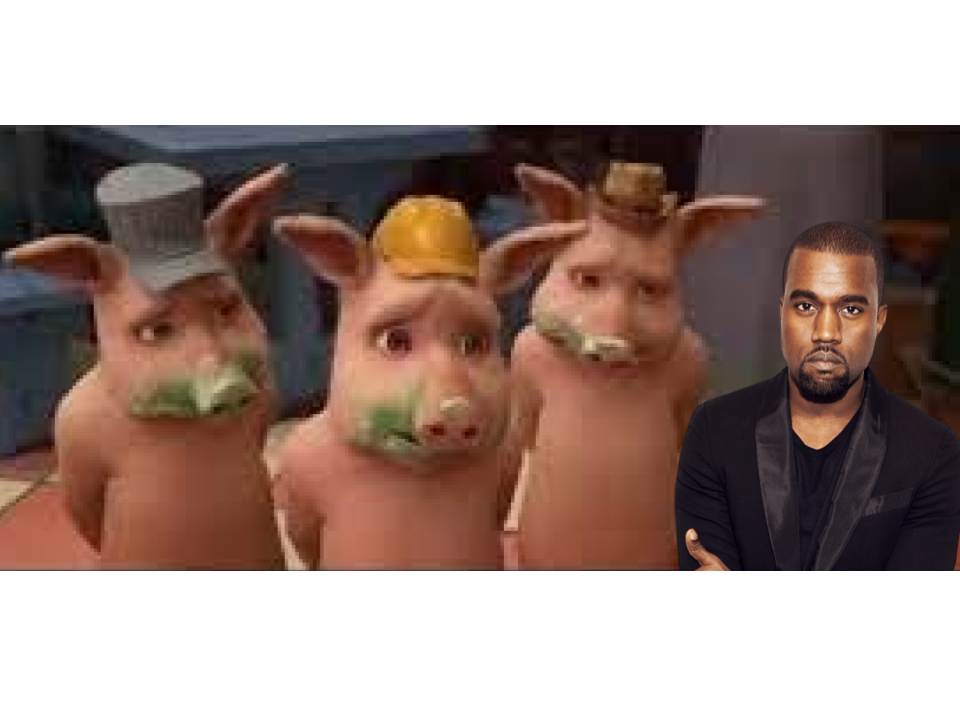
The Three Little Pigs and Kanye West
In Nazi Germany in the 1930s and 40s, citizens were not given many rights. Their media was highly repressed, most of it was just pro Nazi propaganda. In order to keep their citizens in line, The Nazis had to censor the information that was fed to their citizens. World news was hidden from them, and books were burned in order to keep the people from accessing information, and to keep them from gaining enough knowledge to overthrow them.(1)
In authoritarian regimes, censorship is used as a way to limit public knowledge and free speech; as seen in Nazi Germany, China, and North Korea to name a few. The United States luckily has a measure in place to prevent against prevention of free speech, the First Amendment to the Constitution which states: “Congress shall make no law respecting an establishment of religion, or prohibiting the free exercise thereof; or abridging the freedom of speech, or of the press; or the right of the people peaceably to assemble, and to petition the Government for a redress of grievances.”(2)
Then why is there still censorship in the United States?
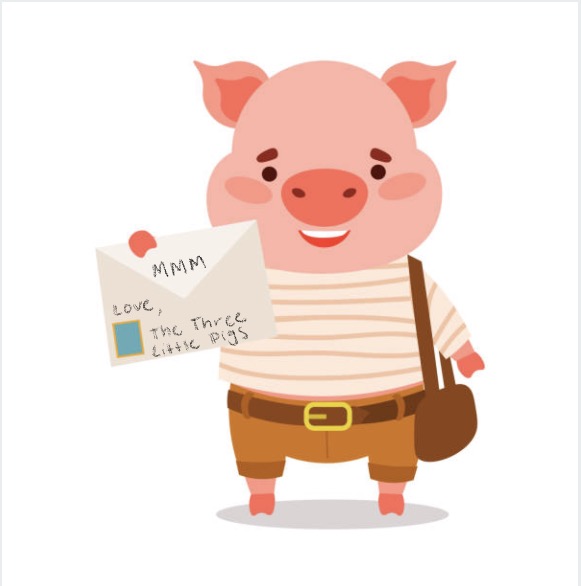
Different forms of media may be censored for a few reasons, usually regarding: use of fowl language or indecent material.(3) This is if the media is on broadcast airwaves, which are owned by the public, so they are regulated by the FCC.(3) All other media, if not on public airwaves is not regulated by the FCC. However, many social media sites like Youtube, Facebook, and Twitter censor stuff all the time. This is due to their user guidelines, that users need to abide by in order to use the app. Censorship also can be changing a story in order to try and appeal to more audiences, as seen in the case of the fairy tale “The Three Little Pigs”.
Through the disappeared murder of the wolf, the shift from focusing on raw materials to hardwork and the ways in which the pigs achieve safety, the adaptation of the survival narrative to a capitalist narrative informs us that censorship in popular media, specifically Kanye West performances, operates in three ways: depictions of violence, construction of threats/conclict/problems, and depiction of how a happy ending is achieved. This is important because censorship not only limits free speech, it limits freedom of thought too; decreasing one’s desire to be independent and have an imagination.
In “The Story of the Three Little Pigs” by James Halliwell-Phillips, there are three pigs building houses out of different materials; the first two pigs build their houses out of weak materials, while the third pig builds his out of bricks. A “big bad wolf” who blows powerful gusts of wind is the antagonist in this tale. The wolf succeeds in blowing down the first two pigs houses and eating them, while he cannot blow down the third pig’s brick house, causing the wolf to get angry and try to outsmart the pig, which backfires causing the wolf to be eaten by the third pig. The Disney version is very similar, it just has slight changes like how the first two pigs are choosing to not work and play instead causing their houses to be poorly made; they also do not get eaten by the wolves, instead escaping to the third pig’s house. The story ends with the wolf running away after getting burned by the pig’s fireplace. The Disney version changes the meaning of the fairy tale, censoring it in order to create a capitalist narrative.
The song “Power” by Kanye West is about power and what people choose to do with it. He uses this song to talk about how those with power are choosing to talk about him and what he’s doing, rather than real world issues that need attending to. One such verse, the second verse, was very critical of Saturday Night Live (SNL) and everyone who is calling him out. Kanye performed the song on SNL and chose to change and censor the second verse which added a different meaning to the song.
Censorship works through depictions of violence in transition from the Halliwell-Phillips version of “The Three Little Pigs” to the Disney version by the absence of death. In the Halliwell-Phillips version, the wolf ,“Blows the house in and eats up the little pig.”(4) While in the Disney version, the wolf still blows the house in the pig escapes to safety.(5) This censorship of death by Disney sanitizes the original theme of the story in order to promote a capitalist narrative. The pigs ran to the third pig’s house, who had put in hard work so that he would be safe from the wolf; changing the theme to hard work pays off. Censorship similarly works through depictions of violence in transition from the original second verse of “Power” by Kanye West to the SNL version of the second verse. In the original version Kanye says, “F**k SNL and the whole cast.”(6) Then when performed on Saturday Night Live he says, “The brown hero, live from ground zero.”(7) The original lyrics were very strong in calling out SNL for making fun of Kanye, but the new lyrics were just talking about himself being at the set of SNL, sanitizing the meaning of the verse just because the show made him. “Because of the seemingly innocent nature of Disney animation and its subsequent association with childhood through fairy tales and because of Disney’s prominent position within the paradigm of popular culture, scholars have identified Disney films as somehow worthy of special treatment.”(8) This quote from Tracy Mollet shows that in order to appeal to a popular audience, Disney chooses to censor violence in fairy tales to make them more “innocent” by changing the story slightly, sanitizing the original meaning. The same can be seen in Kanye West’s performance of Power on SNL, he was censored by having to change the second verse, sanitizing the original meaning of the entire song.
The construction of the threat from the Halliwell-Phillips version of “The Three Little Pigs” to the Disney version is censored by adding ignorance to the story. In the Halliwell Phillips version, the wolf shows up to the pigs house and asks to be let in, and after being told no, the wolf says, “Then I’ll huff and I’ll puff and I’ll blow your house in.”(4) In the Disney version, the pigs know about the wolf, and what he will do before hand, but keep singing, “Who’s afraid of the big, bad wolf.”(5) Inevitably, the wolf shows up and says, “Then I’ll huff and I’ll puff and I’ll blow your house in.”(5) The pigs in the Halliwell-Phillips version are given no prior knowledge of the wolf and are surprised at his attack, while the pigs in the Disney version are well aware of the wolf and what it is capable of, but choose to not “work hard” and “play all day”. Censorship by changing the story changes it from a survival narrative to a capitalist narrative to show that if you don’t work hard there are consequences. The construction of the threat in “Power” is also censored but by changing the initial meaning of the verse. In the original version, Kanye says, “Tell ’em Yeezy said they can kiss my whole a**, more specifically, they can kiss my a**hole, I’m an a**hole? You n****s got jokes.”(6) This is a funny threat, but in the SNL version, Kanye gets rid of it entirely. “Machine gun flow, made of ghetto Ross Perot, and this is disestablishmen-tarianism, with my night goggles on, yeah, military vision.”(7) The original verse takes a childish stab at SNL by telling them to kiss his a**, while in the censored version Kanye chooses to talk about Ross Perot and disestablishmentarianism. “Ross Perot was the founder of Electronic Data System, now part of Dell. He also ran for President of the U.S.A twice, and failed. Kanye also lost twice at the MTV VMA, that could be intentional.”(9) This changes the focus of the song to himself rather than calling out those who bashed him, just as the censoring “The Three Little Pigs” changes the theme of the story.
Censorship also works through the depiction of how a happy ending is perceived. Through the alteration of depictions of violence and construction of the threat, the takeaway from the Disney version of “The Three Little Pigs” is that hard work leads to success, despite the theme of the original version being about survival of the smartest and most well resourced. At the end of the Halliwell-Phillips version of the story, the third pig outsmarts the wolf, causing the wolf to try to enter the only opening in the house, the chimney. He goes down the chimney, but falls into a pot of stew, and is cooked and then eaten by the third pig.(4) In the Disney version, all three pigs are taking shelter in the third pig’s house; the wolf does go down the chimney, but then gets burned by the boiling water and jumps out and runs away.(5) The shift in these endings leaves the consumer with a different sense of meaning. The Propp Function for the ending of the Halliwell-Phillips version is “Victory”(10) because the villain, the wolf, is defeated by the pig, while the Propp Function for the ending of the Disney version is “Punishment”(10) because the wolf gets burned by the hot water for blowing down the pig’s houses. However, due to the function being “punishment” the wolf is still out there to eat the pigs if they do not work hard, adding to the capitalist narrative. At the end of the original second verse of “Power” Kanye says, “Reality is catchin’ up with me, takin’ my inner child, I’m fighting for custody, with these responsibilities that they entrusted me, as I look down at my diamond encrusted piece.”(6) Kanye is talking about how people view him as childish, but Kanye reminds us, when he “looks down at his diamond encrusted piece”, that he doesn’t care what they think because he’s wealthy and doesn’t have to listen to them. In the censored version for SNL Kanye ends the second verse with, “And your boy still fresh with the Gucci on, them Italians sure know how to make what the moulies (derogatory term for blacks used by italians) want, and they really can’t take what dude be on, but I be on the same thing ’til you prove me wrong.”(7) This ending is similar to the original version, but just as the two versions of “The Three Little Pigs” the meaning is slightly different. The Propp Function for the original ending to the second verse of “Power” is “victory”(10), as Kanye overcomes his critics by silencing them with the power and money that he has. While the adaptation of the second verse for SNL has the different Propp Function of “Recognition.”(10) As Kanye stays true to himself, having the critics recognize him for what he is, a rich, African American man in America. These subtle changes in the writing leave consumers with a different outlook on their lives.
Due to these changes from the original version of these works to the altered and censored versions, it is clear that censorship has the ability to subtly change the meaning of a story in order to fit a certain narrative that a person is trying to convey. Just as propaganda, which is censorship using subtle truths, is used to control citizens. The freedom of speech is tricky in the United States because even though people have the right to say whatever they want, they are not allowed to endanger another person or oppress them. Even in this essay about how censorship is bad, I censored some of the words in Kanye’s lyrics in order to keep this paper scholarly and politically correct; so in a way censorship can be used for good if used correctly. However, in most cases, censorship is used as a control tactic by repressing the media and instead injecting lots of propaganda into the minds of citizens. In order to create a free society, censorship cannot exist in order to control people. Best said by Kanye West: “No one man should have all that power”; no government or leader should have all the power to control its people using censorship of information because censorship not only limits free speech, it limits freedom of thought too; decreasing one’s desire to be independent and have an imagination.
Works Cited
1) Preceden. “History of Censorship Timeline.” Preceden, www.preceden.com/timelines/174747-history-of-censorship-timeline.
2) The Government of the United States of America. “U.S. Constitution – First Amendment: Resources: Constitution Annotated: Congress.gov: Library of Congress.” Constitution Annotated, Government, constitution.congress.gov/constitution/amendment-1/.
3) FCC. “The FCC and Freedom of Speech.” Federal Communications Commission, 12 Mar. 2020, www.fcc.gov/consumers/guides/fcc-and-freedom-speech
4) Halliwell-Phillips, James. “The Story of the Three Little Pigs.” English Fairy Tales, edited by Joseph Jacobs, David Nutt, 1890, pp. 68–72.
5) Disney, Walt, director. Three Little Pigs. Walt Disney Educational Media Co., 1933.
6) West, Kanye. “Power.” My Beautiful Dark Twisted Fantasy. Def Jam Recordings and Roc-A-Fella Records, 2010
7) West, Kanye. “Power (SNL Version).” My Beautiful Dark Twisted Fantasy. Def Jam Recordings and Roc-A-Fella Records, 2010
8) Mollet, Tracey. “‘With a Smile and a Song …’: Walt Disney and the Birth of the American Fairy Tale.” Marvels & Tales, vol. 27, no. 1, 2013, pp. 109–124. JSTOR
9) Genius. “Machine Gun Flow, Made of Ghetto Ross Perot.” Genius, 2 Oct. 2010, genius.com/233914. 10) Arvidson, Alf. “Vladimir Propp’s Fairy Tale Morphology and Game Studies Working Paper.” Vetenskapsrådet, 2003.