By Victoria Abansado

According to the Cambridge Dictionary, worldbuilding is “the act of creating an imaginary world in a book, movie, computer game, etc., so that it appears to be real” (Cambridge University Press & Assessment n.pag). For something to “appear to be real,” the creator of said book, movie, or videogame must be extremely intentional when crafting their fictional world. Some of the greatest examples of worldbuilding that immediately come to mind are the worlds of Harry Potter, Avatar, and Star Wars, all in which incorporate elements of fantasy, adventure, and science fiction. “Snow White” by the Brothers Grimm is another great example of worldbuilding by its authors, one that embraces the traditional structure of classic fairy tales through magical settings and intense character dynamics. Worldbuilding can look different across all forms of media, but what happens when this storytelling method is applied to a real-life interactive space? In 1955, Walt Disney did just that with the opening of Disneyland Park in Anaheim, California. The original park opened with four themed lands: Adventureland, Fantasyland, Frontierland, and Tomorrowland – all in which you can still visit at the park today (Rhodes n.pag). Guests enter Disneyland through Main Street U.S.A. with a sign reading “Here you leave today and enter the world of yesterday, tomorrow, and fantasy,” signaling that you are about to embark on a journey that provides an escape from the real world. Although all areas of the park have their own special features and attractions, I believe that Fantasyland especially feeds into that magical escapism that Disneyland aspires to achieve in their park. The creation of Snow White’s Enchanted Wish in Fantasyland highlights how fairytales like the Grimms’ “Snow White” can be transformed into interactive experiences because they utilize strong methods of worldbuilding, such as environment and setting, character identities, and power dynamics. This transformation of “Snow White” into an animated motion picture and then finally into a real-life amusement park attraction reveals how fairytales offer timeless expressions of guidance and escapism that are comforting and relevant to both children and adults.
In the original tale of “Snow White,” the Brothers Grimm build their fictional fairy tale world by implementing physical descriptions of the environment and setting. This literary foundation therefore allows Disneyland Park Imagineers to create an experience that is both authentic and engaging for their audiences. Following the Grimms’ version of “Snow White” readers are taken through a world characterized by beauty, danger, and magic. Snow White escapes from the Queen and her Huntsman by frantically running through the dark forest, comes across the Dwarfs’ miniature home with peculiar furniture, then finally almost spends the rest of her life trapped in a glass coffin. But perhaps the most chilling environment that readers are faced with throughout the story is the Queen’s foreboding chamber, described as “remote” and “hidden…where no one ever set foot” (Grimms 100). The Grimms make it a point to mention that the Queen’s chamber is a place where no one other than herself can enter because here she uses her witchcraft with cruel intentions – to kill the fairest of them all. This sense of danger and secrecy materializes in Snow White’s Enchanted Wish when riders exit the Dwarfs’ mines and are met with two vultures keeping watch from a tree branch up above. The scene that plays out immediately after perfectly captures the essence of Propp function #6, Trickery, because we physically witness the Queen transform herself into a frail old peddler woman and the conjure the infamous poison apple. With the use of dark ambiance, accompanying sound effects of birds cawing and potions hissing, and neon-like lighting during this sequence, Imagineers are able to achieve the terrifying yet mystical environment that is presented in the Grimms’ original tale. These methods of the ‘dark ride’ that allows Imagineers to bring the “Snow White” tale to life is what Gary Dehrer argues is an essential part of achieving the virtual reality of Disneyland in his article titled “Imagineers in Search of the Future:” “Dark rides formed the backbone of Fantasyland’s entertainment experience, as special effects could be used to further create illusion and magic…The power of dark rides pulled guests deeper into the Park experience, whether it was riding with Mr. Toad or flying with Peter Pan” (Dehrer n.pag). In this sense, riders get to experience Snow White’s story from a first-person point of view. Specifically in this chamber sequence, the audience knows of Snow White’s misfortune before she does herself, simply because of how Imagineers decided to tell her story. Throughout the entirety of Snow White’s Enchanted Wish, Imagineers engage in physical storytelling and carefully build the world of Snow White just as the Grimms do literarily in their original tale.
In addition to using intentional descriptions of environment and setting, the Grimms utilize specific character identities to build the fictional world of “Snow White,” which is then physically transformed into the ride as well. In the original tale, the Seven Dwarfs play a large role in Snow White’s story and happy ending. They are characterized as being hospitable, helpful, and wise, and are often seen as playing the role of the Helper, one of seven Propp’s dramatis personae. In the story, the Dwarfs are the ones who invite Snow White to be a guest in their home, warn her of the dangers of the Queen, and even provide her with a glass coffin as her final resting place: “They said: ‘We can’t possibly lower her into the dark ground.’ And so they had a transparent glass coffin made that allowed Snow White to be seen from all sides…They brought the coffin up to the top of a mountain, and one of them was always there to keep vigil” (Grimms 101). This scene perfectly captures the sincere nature of the Dwarfs because it reveals their kindness towards her even in death. Previously, their relationship to Snow White felt slightly transactional because they allowed her to stay in their cottage in exchange for her keeping house. However, now that she is dead, there is nothing that the Dwarfs receive by taking care of her – they simply are doing so to honor her and her beauty.
I think the ride at Disneyland does an excellent job of bringing their characters life by opening the ride with their miniature cottage and playful dance sequence. The physical embodiment of the Dwarfs in Snow White’s Enchanted Wish gives riders hope when things go array with the Evil Queen at the climax of the attraction. Because they are introduced as friendly and helpful companions to Snow White from the get-go, it makes sense for the ride to end with the Dwarfs killing the Evil Queen themselves. This sense of security that the Dwarfs provide throughout the ride is what H. P. Steeves argues is an important part of constructing the chasm between perception and reality in his article titled “Becoming Disney: Perception and being at the happiest place on Earth:” “We must believe we are relatively safe, yet perceive that we are in danger. Both are necessary for the experience of thrill. If we do not believe we are safe then we do not get on the ride. If we do not perceive any danger then the ride is not exhilarating” (Steeves n.pag). In this excerpt, Steeves is talking about the rollercoaster rides in Disneyland, but I think the same principle can applied to the dark rides featured in Fantasyland, especially in Snow White’s Enchanted Wish. Before the ride was known under this name, it was titled “Snow White’s Scary Adventures,” implying that the ride featured some aspects of danger and unsettlement. However, even with the name change and ride updates made within the past few years, I still think the ride can be considered scary, especially for younger audiences. With the reoccurring danger of the Evil Queen, the Dwarfs provide a sense of safety, innocence, and lightheartedness that remind riders of the happy ending that is to come. Even when riders are seated into their buggy at the beginning of the ride, the backdrop features the Dwarfs’ miniature cottage, with their silhouettes dancing with Snow White in the window. Overall, the Dwarfs embodiment in Snow White’s Enchanted Wish directly reflects their character identities from the original tale because of how they are introduced from the very beginning and their reoccurring presence throughout the remainder of the ride.
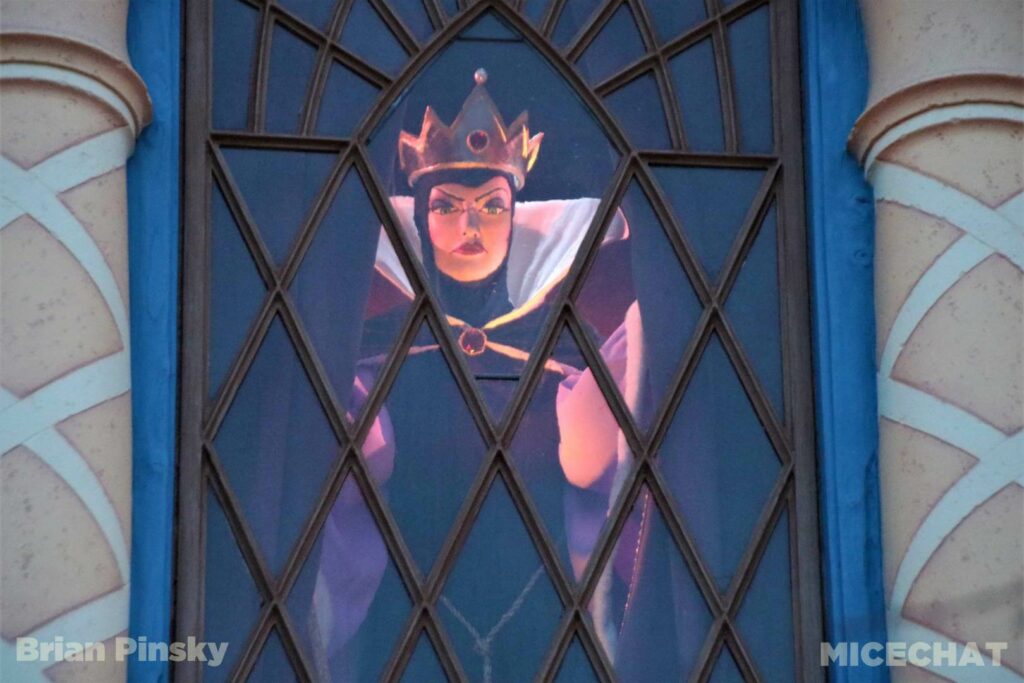
Finally, the Grimms introduce a strong power dynamic between the Queen and Snow White in their original tale that is translated both through the interior and exterior of the ride in Fantasyland. In the story, the Queen holds power over her stepdaughter in multiple ways. For one, she, herself, is the Queen, which already gives her hierarchical status over Snow White. Two, the Queen is now playing the role of a mother, a parental figure who usually acts a source of knowledge and wisdom for their children. But perhaps most importantly, the Queens holds power over Snow White in her hatred and jealousy towards her, especially after hearing she is not the fairest of the land: “When the Queen heard these words, she trembled and turned green with envy. From that moment on, she hated Snow White, and whenever she set eyes on her, her heart turned as cold as stone. Envy and pride grew like weeds in her heart” (Grimms 96). I would argue that these feelings of hatred and jealousy from the Queen hold the most power over Snow White because they are the driving forces of action in this story. It is not only what prompts Snow White to run away in the first place, but it is also what prompts the Queen’s motives for deceit and trickery. Without this power dynamic present throughout the tale, there would be no sense of danger for Snow White, and no need for the Huntsman or Dwarfs’ help in the first place.

As Sandra M. Gilbert and Susan Gubar write in their essay titled “[Snow White and Her Wicked Stepmother],” the Queen “is a plotter, plot-maker, a schemer, a witch, an artist, an impersonator, a woman of almost infinite creative energy, witty, wily, and self-absorbed as all artists traditionally are” (Gilbert and Gubar 389). The Queen carries all of these personas throughout the entire story, which is what makes her character so great. She imposes power over her stepdaughter through her own means, and it is merely up to the Dwarfs and the Prince to save Snow White in the end. The Queen is the embodiment of a strong, independent woman – qualities that Snow White unfortunately lacks in both the original story and ride adaptation. In Snow White’s Enchanted Wish, the Queen can be seen in both the interior and exterior of the ride, always watching over and plotting her next move. She can be spotted occasionally opening the curtain and peering through the castle window on the ride’s exterior tower, signaling the danger she imposes even before the ride begins. Simply her placement above park-goers in the castle tower physically symbolizes the power she not only holds over Snow White, but over us as well. When riders are finally seated, the Queen is a reoccurring character throughout and is always casted in a sinister light – her loud cackles can be heard echoing through the ride’s tunnels and her presence irks younger (and truthfully older) audiences as she horrifically turns to reveal her transformation into an old hag. Even in her death, she can be seen towering over the Dwarfs and the riders at the top of a rocky cliff. The Queen’s character dominates the ride entirely, and it is the danger that she imposes that makes us feel accomplished when we finally reach the end.
The creation of Snow White’s Enchanted Wish in Disneyland Park is the embodiment of the Grimms’ worldbuilding in the original tale of “Snow White.” Their fictional world comes to life through implementing methods of environment and setting, character identities, and power dynamics, all in which can be seen throughout the ride adaptation in Fantasyland. The ability to bring a fairy tale to life with an interactive amusement park experience reveals how storytelling can transform across all mediums and become a physical space for people of all ages to enjoy. This transformation from written to interactive storytelling is important because it highlights how fairy tales remain prevalent throughout centuries of literature and timeless across generations of people. Thousands of adults and children alike visit Disneyland yearly to escape from the pressures of everyday life. Rides like Snow White’s Enchanted Wish offer its guests a glimpse into another life, one that isn’t their own but can still be experienced firsthand.
Works Cited
Cambridge University Press & Assessment. “World-building.” Cambridge Dictionary,
Cambridge University Press & Assessment, 2024, https://dictionary.cambridge.org/us/dictionary/english/world-building. Accessed 05 December 2024.
Dehrer, Gary. “Imagineers in Search of the Future.” The Futurist, vol. 45, no. 2, March 2011, pp.
36-42. ProQuest, https://lmu.idm.oclc.org/login?url=https://www.proquest.com/magazines/imagineers-search-future/docview/850509175/se-2.
Fox, Alison. “See How Disneyland’s Snow White Ride Went from Scary to Enchanting.” Travel + Leisure, Travel + Leisure, 22 July 2022, www.travelandleisure.com/trip-ideas/disney-vacations/disneyland-new-snow-white-ride-revamp.
Gilbert, Sandra M., and Susan Gubar. “[Snow White and her Wicked Stepmother].” The Classic
Fairy Tales, edited by Maria Tartar, W. W. Norton & Company, 2017, pp. 387-393.
Grimm, Jacob, and Wilhelm Grimm. “Snow White.” The Classic Fairy Tales, edited by Maria
Tartar, W.W. Norton & Company, 2017, pp. 95-102.
Rhodes, Elizabeth. “Looking Back at Disneyland’s Opening Day, Almost 70 Years Later.” Travel + Leisure, Travel + Leisure, 16 July 2024, www.travelandleisure.com/trip-ideas/disney-vacations/disneyland-anniversary-65-years.
Steeves, H. P. “Becoming Disney: Perception and being at the happiest place on Earth.” The
Midwest Quarterly, vol. 44, no. 2, 2003, pp. 176-194. ProQuest, https://lmu.idm.oclc.org/login?url=https://www.proquest.com/scholarly-journals/becoming-disney-perception-being-at-happiest/docview/195713736/se-2.
